

Analyst
Analyst
Credit Beat Led By Corporate Demand, While Money Supply Growth Slows
- Sep 26’s M1 growth slowed to 3.2% yoy (-0.9ppt mom), well below Bloomberg’s consensus of 4.0% yoy, partly on a high base from Sep 25’s stock market rally. M2 growth eased to 7.2% yoy (-0.3ppt mom), also below consensus of 7.4% yoy.
- New bank loans rose to Rmb1.08t from Aug 26’s Rmb0.06t, marginally beating consensus of Rmb1.03t but below Sep 25’s Rmb1.29t, as flat household loans outweighed stronger corporate & government loans of Rmb1.14t. New TSF of Rmb3.55t beat the Rmb3.34t consensus, supported by government bond issuance of Rmb1.54t (+Rmb0.53t mom).
- Outstanding bank loans growth slipped to 4.8% yoy (-0.1ppt mom), a fresh low, while outstanding TSF growth eased to 7.1% yoy (-0.1ppt mom). The FAI push is lifting corporate lending, but with household demand still absent, further fiscal stimulus is needed to stabilise credit growth.
Our View
- M2 growth eased by 0.3ppt to 7.2% yoy in Sep 26, below Bloomberg’s consensus forecast of 7.4% yoy. This extends the deceleration to a fourth consecutive month and marks the slowest pace since Mar 25. M1 money supply growth fell more sharply to 3.2% yoy from 4.1% yoy in August, well short of market expectations of 4.0% yoy, and broke out of its 4.0-4.1% range of the past three months. A high base from Sep 25, when funds shifted into demand deposits during the stock market rally, explains part of the decline. However, the miss against consensus points to softer transactional demand for money. M0 growth also moderated to 10.6% yoy (-0.6ppt mom).
- Banks added Rmb1.08t in new loans in Sep 26, recovering from Aug 26’s Rmb0.06t on quarter end seasonality and marginally beating Bloomberg’s consensus estimate of Rmb1.03t, though still below the Rmb1.29t recorded in Sep 25. New corporate & government loans rose to Rmb1.14t (+Rmb0.92t mom), above Sep 25’s Rmb0.99t, led by short-term (+Rmb0.62t mom) and medium-to-long-term (+Rmb0.57t mom) loans. New household loans were flat (+Rmb0.20t mom), well below Sep 25’s Rmb0.39t, with long-term borrowing only marginally positive at Rmb0.09t.
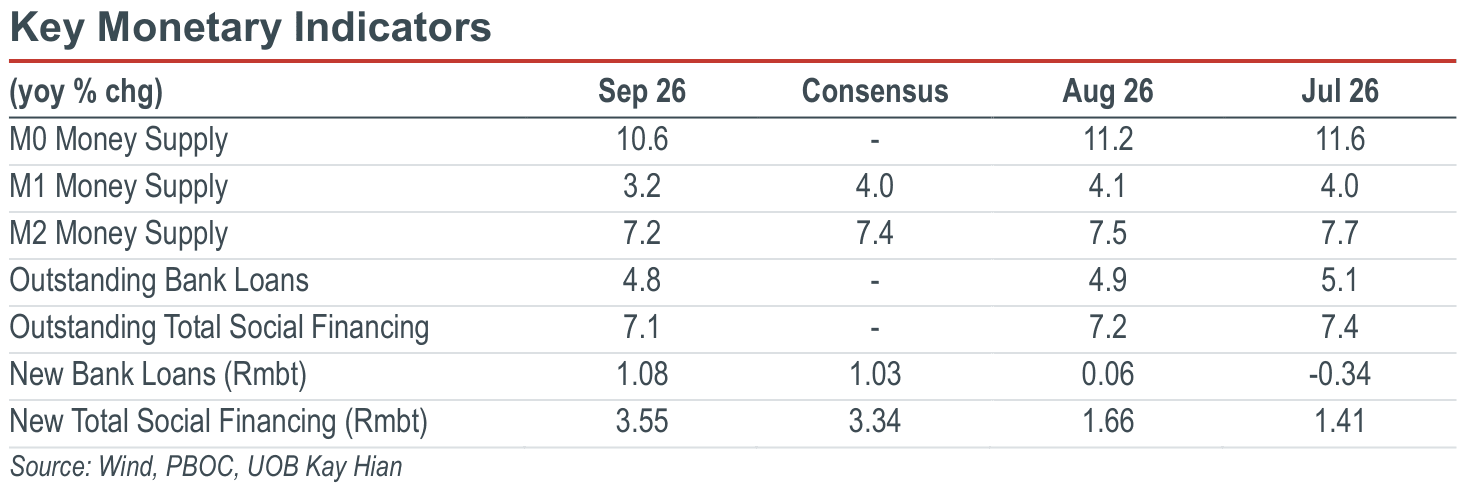
- Sep 26’s new TSF grew to Rmb3.55t from Aug 26’s Rmb1.66t, beating Bloomberg’s consensus of Rmb3.34t and broadly in line with Sep 25’s Rmb3.53t. New government bond issuance rose to Rmb1.54t (+Rmb0.53t mom), lifting its growth to 13.7% yoy (+0.2ppt mom), the first rise this year. This offset weaker renminbi loans within TSF of Rmb1.27t, compared with Rmb1.61t in Sep 25. In contrast, corporate bonds issuance saw slower growth at 9.3% yoy (-0.4ppt mom). Growth in bank acceptances (-8.8% yoy, -3.7ppt mom) and trust loans (0.7% yoy, -1.2ppt mom) also weakened further.
Credit Beat Led By Corporate Demand, While Money Supply Growth Slows
- Sep 26’s M1 growth slowed to 3.2% yoy (-0.9ppt mom), well below Bloomberg’s consensus of 4.0% yoy, partly on a high base from Sep 25’s stock market rally. M2 growth eased to 7.2% yoy (-0.3ppt mom), also below consensus of 7.4% yoy.
- New bank loans rose to Rmb1.08t from Aug 26’s Rmb0.06t, marginally beating consensus of Rmb1.03t but below Sep 25’s Rmb1.29t, as flat household loans outweighed stronger corporate & government loans of Rmb1.14t. New TSF of Rmb3.55t beat the Rmb3.34t consensus, supported by government bond issuance of Rmb1.54t (+Rmb0.53t mom).
- Outstanding bank loans growth slipped to 4.8% yoy (-0.1ppt mom), a fresh low, while outstanding TSF growth eased to 7.1% yoy (-0.1ppt mom). The FAI push is lifting corporate lending, but with household demand still absent, further fiscal stimulus is needed to stabilise credit growth.
Our View
- M2 growth eased by 0.3ppt to 7.2% yoy in Sep 26, below Bloomberg’s consensus forecast of 7.4% yoy. This extends the deceleration to a fourth consecutive month and marks the slowest pace since Mar 25. M1 money supply growth fell more sharply to 3.2% yoy from 4.1% yoy in August, well short of market expectations of 4.0% yoy, and broke out of its 4.0-4.1% range of the past three months. A high base from Sep 25, when funds shifted into demand deposits during the stock market rally, explains part of the decline. However, the miss against consensus points to softer transactional demand for money. M0 growth also moderated to 10.6% yoy (-0.6ppt mom).
- Banks added Rmb1.08t in new loans in Sep 26, recovering from Aug 26’s Rmb0.06t on quarter end seasonality and marginally beating Bloomberg’s consensus estimate of Rmb1.03t, though still below the Rmb1.29t recorded in Sep 25. New corporate & government loans rose to Rmb1.14t (+Rmb0.92t mom), above Sep 25’s Rmb0.99t, led by short-term (+Rmb0.62t mom) and medium-to-long-term (+Rmb0.57t mom) loans. New household loans were flat (+Rmb0.20t mom), well below Sep 25’s Rmb0.39t, with long-term borrowing only marginally positive at Rmb0.09t.
- Sep 26’s new TSF grew to Rmb3.55t from Aug 26’s Rmb1.66t, beating Bloomberg’s consensus of Rmb3.34t and broadly in line with Sep 25’s Rmb3.53t. New government bond issuance rose to Rmb1.54t (+Rmb0.53t mom), lifting its growth to 13.7% yoy (+0.2ppt mom), the first rise this year. This offset weaker renminbi loans within TSF of Rmb1.27t, compared with Rmb1.61t in Sep 25. In contrast, corporate bonds issuance saw slower growth at 9.3% yoy (-0.4ppt mom). Growth in bank acceptances (-8.8% yoy, -3.7ppt mom) and trust loans (0.7% yoy, -1.2ppt mom) also weakened further.
Analyst
Analyst
IMPORTANT NOTICE - DISCLOSURES AND DISCLAIMERS
This report is provided subject to, and must be read together with, the full Disclosures / Disclaimers available at this link, which are incorporated by reference into this report. In particular, this report is intended for general circulation and informational purposes only and does not constitute personal investment advice or a recommendation to buy or sell any investment product or security. You should independently evaluate the information and, where necessary, seek advice from a qualified financial adviser regarding the suitability of any investment. Analyst certifications required under applicable regulations, including SEC Regulation AC (where relevant), are included in this report. By accessing, receiving or using this report, you acknowledge that you have read, understood and agreed to be bound by the Disclosures / Disclaimers, as may be amended, supplemented or updated from time to time.