

Wealth Daily
Election Rotation Divides Cloud Leaders and Power Suppliers
Today’s Must-Know News
Overnight Markets
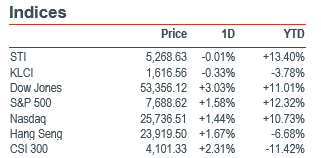
Market Movers: Major markets completed the 4 November session with the S&P 500 up 1.58% and Dow up 3.03%. A Democratic sweep of Congress prompted a sharp reassessment of AI infrastructure economics. Amazon (AMZN US) gained about 6.1% as investors weighed whether constraints on new data centres could protect existing cloud capacity and temper spending. GE Vernova (GEV US) fell about 9.3% on concern about slower power-equipment demand. These are expectations, not enacted restrictions. ChangXin Memory (688825 CH) rose about 13.6% on the day its chairman proposed increasing the repurchase range from RMB1–2bn to RMB2.5–5bn. The larger programme still requires company approval; the proposal does not establish completed purchases. (AP / Reuters / Reuters / Filing) Amazon (AMZN US) and GE Vernova (GEV US) are our Core Recommendations.
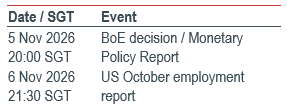
Macro: China cut its targeted share-buyback relending rate by 25bps to 1.0%, lowering funding costs for eligible purchases rather than changing the broad policy rate. The forthcoming BoE decision is due at 20:00 SGT today. Economists expect a 25bp increase to 4.00%; updated inflation forecasts and guidance will test expectations of further tightening. A less hawkish path would challenge market pricing. (Xinhua / Reuters / BoE)
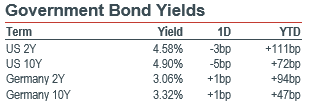
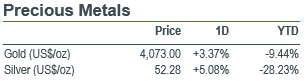
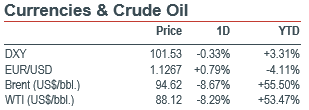
FICC: December gold settled at US$4,073/oz, up 3.37%, and silver at US$52.282/oz, up 5.08%. January Brent fell 8.67% to US$94.62/bbl and December WTI fell 8.29% to US$88.12/bbl. The US 10-year Treasury yield declined 5bps to 4.90%. (Market data / US Treasury)
AI
• Amazon gains as election repricing favours incumbent cloud platforms. Amazon(AMZN US) rose about 6.1% at the U.S. close as investors reassessed the winners from possible limits on new data centres. Reuters reported that tighter construction constraints could protect established cloud operators' existing capacity and temper their capital-spending burden. This is a valuation and policy-expectations shift: legislation remains uncertain, while a slower capacity build could also limit future growth. (Reuters) Amazon (AMZN US) is our Core Recommendation.
• Tencent brings vision and computer use to Hy4. Tencent (0700.HK) launched Hy4 with image understanding and computer-use capabilities for longer agent tasks. Model weights and system cards are planned for release in coming days. WorkBuddy and CodeBuddy users can try it free through 15 November, while TokenHub pricing is halved through 31 December. The rollout broadens competition in agent software, although product adoption and commercial returns remain the decisive tests. (Company/Anadolu) Tencent (0700.HK) is our Core Recommendation.
• GE Vernova and power suppliers face a political reset. GE Vernova (GEV US) fell about 9.3% as the Democratic election sweep raised concern about tighter constraints on data-centre construction. CoreWeave (CRWV US) also declined about 9.9%. Investors are reassessing electricity-demand assumptions and project approvals after campaigning focused on household power costs. Restrictions have not been enacted; the risk is slower conversion of AI infrastructure spending into equipment orders. (Reuters / Dow Jones) GE Vernova (GEV US) is our Core Recommendation.
• Arm licensing surge masks a royalty miss. Arm (ARM US) reported 2Q revenue of US$1.44bn, up 27% YoY, as licensing revenue rose 50% to US$773m. Royalties increased 8% to US$670m, below the US$720.8m consensus despite doubling data-centre royalties. Its US$1.54bn midpoint revenue outlook broadly matched expectations. The divergence highlights uneven conversion of AI design wins into recurring chip-shipment royalties, despite strong demand for new licences. (Company / Reuters)
Americas
• Meta adds coding-agent infrastructure. Meta Platforms (META US) agreed to acquire Conductor, whose founder confirmed the move. The coding-tool developer will close its cloud service on 20 November and support its local product into early 2027 while building a new interface. Financial terms were undisclosed. The acquisition strengthens Meta's developer-tool position as AI competition expands from model capabilities into everyday software workflows. (Company / Axios) Meta Platforms (META US) is our Core Recommendation.
• CVS proposes a healthcare and pharmacy split. CVS Health (CVS US) fell about 12.5% after announcing plans to separate its healthcare and pharmacy operations into two listed companies in the first half of 2028. It also projected at least US$8.65 in 2027 adjusted EPS, above US$8.53 consensus. The planned tax-free separation could clarify valuation, but investors still lack a detailed allocation of earnings, debt and standalone costs. (Company / Reuters)
• OpenAI moves deeper into coding infrastructure. OpenAI agreed to acquire Pierre Computer Company, whose Code Storage technology and open-source Trees and Diffs tools already support Codex. The transaction remains subject to customary closing conditions, including regulatory approvals, with the businesses separate until completion. OpenAI plans to integrate the team and technology while continuing open-source support. Undisclosed financial terms leave the commercial return uncertain, but the deal extends its coding platform. (Company / Axios)
• Datadog strong quarter meets a tougher comparison. Datadog (DDOG US) fell about 14.4% despite 3Q revenue rising 35% YoY to US$1.20bn and non-GAAP EPS reaching US$0.81, above US$0.64 consensus. It guided 4Q revenue to US$1.19–1.20bn, implying little sequential growth. Customers generating at least US$100,000 in annual recurring revenue increased to 4,860 from 4,060. The contrast puts attention on durable expansion rather than one quarter's earnings beat. (Company / Investing.com)
• AppLovin lifts its advertising revenue outlook. AppLovin (APP US) reported 3Q revenue of US$2.185bn, up 55% YoY, and adjusted EBITDA of US$1.842bn, representing an 84% margin. Its 4Q revenue guidance of US$2.365–2.395bn points to further sequential expansion. The board added US$3.2bn to its repurchase authorisation. Strong cash generation supports capital returns, although the authorisation represents potential future buying rather than shares already repurchased. (Company)
• Hospitals rally on hopes for policy relief. HCA Healthcare (HCA US) gained about 10.3% as the Democratic sweep revived hopes for relief from Medicaid funding cuts and a possible extension of enhanced insurance subsidies. Reuters reported that analysts see scope to delay some implementation, while President Trump's veto power constrains broader reversals. The rally reflects improved policy expectations rather than an enacted change to hospital reimbursement or patient coverage. (Reuters)
• Uber bookings growth outpaces its profit outlook. Uber Technologies (UBER US) reported 3Q gross bookings of US$59.8bn, up 20% YoY, and adjusted EBITDA of US$3.0bn, up 31%. However, its 4Q adjusted EPS forecast of US$0.95–0.99 missed US$1.06 consensus. Higher driver incentives and Middle East disruption weighed on the outlook. Sustained demand is encouraging, but the gap shows that volume growth does not automatically translate into stronger near-term margins. (Company / Reuters)
Greater China
• CXMT chairman proposes a larger repurchase programme. CXMT (688825.SH) rose approximately +13.6% on the day its chairman proposed raising the share-repurchase range to RMB2.5bn–5bn, from RMB1bn–2bn. The proposal still requires corporate approval. The announcement coincided with a broad semiconductor rebound and renewed state support for equities. A larger buyback would signal confidence and absorb supply, but it does not by itself resolve memory-industry pricing or capital-spending risks. (Company / Bloomberg)
• Memory shares rebound with policy support. Montage Technology (688008.SH) climbed approximately +11.9% and GigaDevice (3986.HK) gained approximately +8.6% as Chinese semiconductor shares rebounded alongside cheaper central-bank funding for share repurchases. These were completed-session reactions within a broad sector rally. Improved market liquidity can support valuations, while lasting upside still depends on orders, margins and delivery of AI-related demand. (Gelonghui/Eastmoney) Montage Technology (688008.SH) and GigaDevice (3986.HK) are our Investment Opportunities.
• Weichai joins the mainland equity rebound. Weichai Power (000338.SZ) rose approximately +8.5% in the completed mainland session, with turnover of about RMB3.6bn. The move came as new central-bank support for buybacks helped lift Chinese equities. That stronger liquidity backdrop may sustain investor interest in industrial suppliers, but the share-price rebound alone does not establish a corresponding improvement in engine demand, margins or order conversion. (Sina / Xinhua) Weichai Power (000338.SZ) is our Investment Opportunity.
• Sino Biopharm signs an oncology options deal. Sino Biopharmaceutical (1177.HK) agreed to develop six preclinical cancer programmes with Boehringer Ingelheim. It will receive US$358m upfront and in near-term payments, with eligibility for a further US$7bn in option and milestone payments plus royalties. Sino will lead development through global Phase I. The agreement brings external validation and funding, although most consideration depends on successful clinical development and commercial execution. (Company / Reuters)
Asia ex. China
• Mitsubishi lifts profit guidance and announces a buyback. Mitsubishi Corp (8058 JP) raised its forecast for the year ending March 2027 to JPY1.2tn from JPY1.1tn and announced a share buyback of up to JPY1tn. First-half attributable profit rose 74.2% to JPY619.7bn as stronger energy and metals prices helped earnings. Capital returns strengthen shareholder support, although the forecast remains exposed to commodity prices and the timing of gains from asset transactions. (Company / Reuters)
• UOB lowers its margin outlook despite fee growth. United Overseas Bank (UOB SP) reported 3Q net profit of S$1.25bn, against S$443m a year earlier and below the S$1.35bn analyst forecast. Net fees rose 19% to S$733m, but net interest margin fell to 1.68%. Full-year margin guidance is now below 1.75%, versus 1.75%–1.80% previously. Wealth-related fees provide support, while deposit competition continues to constrain lending profitability. (Company / Reuters)
• Mitsui raises earnings guidance as resources strengthen. Mitsui & Co (8031 JP) increased its profit forecast for the year ending March 2027 to JPY1.05tn from JPY920bn, a 14% upgrade supported by stronger energy and metals prices. It also aims to increase annual LNG handling volume by 3m tonnes by 2030 from its current 12m tonnes. The expansion supports longer-term supply growth, while commodity cyclicality remains an important influence on cash generation. (Company / Reuters)
• Chunghwa earnings rise with ICT and asset gains. Chunghwa Telecom (2412 TT) reported 3Q revenue of NT$67.59bn, up 16.7%, and net profit of NT$12.22bn, up 29.5%. An asset-revitalisation gain contributed to the result, alongside operating growth. ICT revenue increased 19%, with order intake up 84%. The enterprise pipeline supports future activity, but investors should distinguish recurring service performance from the one-off contribution when assessing the earnings trajectory. (Company)
EMEA and Others
• AI infrastructure valuations face a regulatory test. Siemens Energy (ENR GR) fell about 8.0% and Schneider Electric (SU FP) about 3.4% as investors assessed possible tighter Democratic oversight of AI investment. European technology shares slipped 0.2% against a 1.82% STOXX 600 gain. Power-equipment valuations remain sensitive to data-centre spending expectations; the reaction does not establish that customer orders have changed. (Reuters)
• Novo raises its outlook as obesity volumes recover. Novo Nordisk (NOVO B DC) raised FY26 adjusted sales and operating-profit growth guidance to -2% to +2% at constant exchange rates, from -6% to 0%. On that basis, quarterly adjusted operating profit rose 27% to DKK31.72bn and sales grew 4%. Reported operating profit fell 9% at CER after DKK8.7bn of impairments. Recovering GLP-1 volumes support the upgrade, but write-downs temper the result. (Company / Reuters)
• European banks lead the post-election rotation. Euro STOXX Banks rose about 4.60%, versus the STOXX 600's 1.82% advance to 657.40. Reuters linked the rally to rotation into lenders and expectations of less unilateral US pressure after the election. Lower oil prices eased the inflation backdrop; sustained gains still depend on lending demand, credit costs and actual policy changes. (Reuters)
• BMW separates operating resilience from restructuring costs. BMW (BMW GR) reported quarterly pretax profit of EUR2.083bn, down 10.6%, with automotive EBIT margin at 3.4%. Full-year reported automotive margin guidance fell to -0.5% to +0.5% from 1%-3%, reflecting fourth-quarter restructuring charges. Automotive free cash flow is still expected above EUR2.5bn, making cash delivery a key test of the turnaround. (Company / Reuters)
• Construction recovery and savings lift Heidelberg. Heidelberg Materials (HEI GR) gained about 9.5% as quarterly revenue rose to EUR6.413bn from EUR5.807bn and operating profit reached EUR1.281bn from EUR1.179bn. Another EUR300m of savings is planned across 2027-28; FY26 operating-profit guidance remains EUR3.40bn-3.65bn. European and North American recovery supports earnings, while additional savings buffer energy-cost volatility. (Company / Reuters)
• Fresenius upgrades earnings expectations as margins widen. Fresenius (FRE GR) posted quarterly revenue of EUR5.803bn and EBIT of EUR638m, up 10% at constant currency. Margin rose 50bps to 11.0%; core EPS grew 14% to EUR0.72 at constant currency. FY26 EPS growth is now expected in the upper half of 10%-15%, with EBIT margin above 11.5%. Improving profitability supports debt reduction and investment. (Company / Reuters)
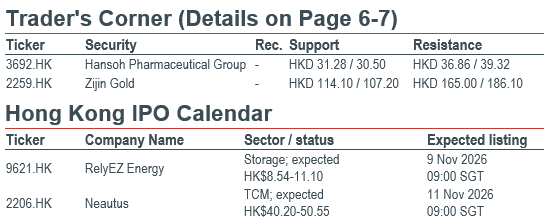
Traders' Corner
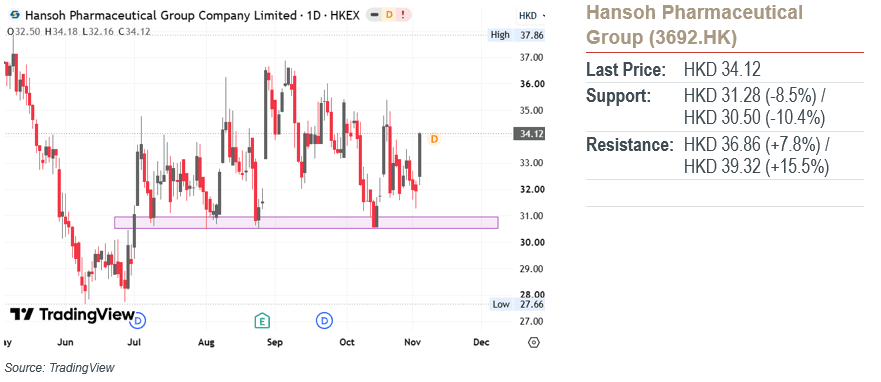
Our Technical View
Price successfully defended its previous support, absorbing downside pressure and establishing a higher low within the price structural hierarchy.
Technical momentum strongly corroborates this structural defense: after consolidating around the 50 neutral baseline, the RSI has turned upward with positive velocity into bullish territory.
As long as price remains defended above this newly support, we see continued upward expansion toward overhead resistance.
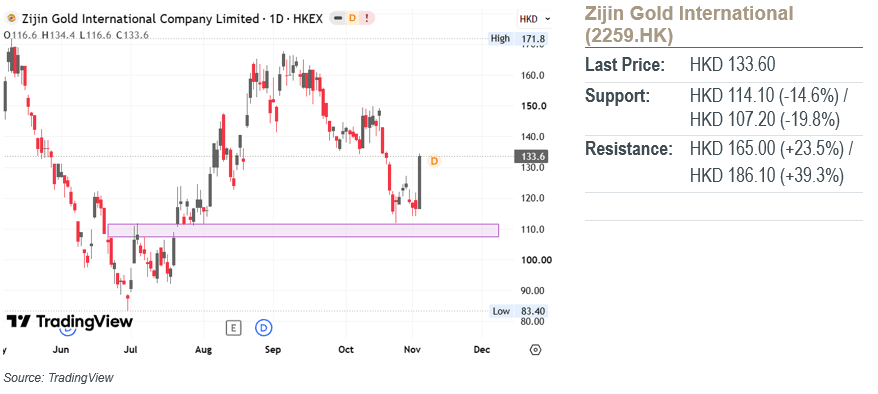
Our Technical View
Price rebounded from its previous gap-support baseline, validated by a strong bullish daily rebound candle.
The RSI has turned bullish after turning upward near the oversold threshold.
As long as price remains defended above the gap-support floor, we see continued upward expansion toward higher resistance targets.
Market Movers: Major markets completed the 4 November session with the S&P 500 up 1.58% and Dow up 3.03%. A Democratic sweep of Congress prompted a sharp reassessment of AI infrastructure economics. Amazon (AMZN US) gained about 6.1% as investors weighed whether constraints on new data centres could protect existing cloud capacity and temper spending. GE Vernova (GEV US) fell about 9.3% on concern about slower power-equipment demand. These are expectations, not enacted restrictions. ChangXin Memory (688825 CH) rose about 13.6% on the day its chairman proposed increasing the repurchase range from RMB1–2bn to RMB2.5–5bn. The larger programme still requires company approval; the proposal does not establish completed purchases. (AP / Reuters / Reuters / Filing) Amazon (AMZN US) and GE Vernova (GEV US) are our Core Recommendations.
Macro: China cut its targeted share-buyback relending rate by 25bps to 1.0%, lowering funding costs for eligible purchases rather than changing the broad policy rate. The forthcoming BoE decision is due at 20:00 SGT today. Economists expect a 25bp increase to 4.00%; updated inflation forecasts and guidance will test expectations of further tightening. A less hawkish path would challenge market pricing. (Xinhua / Reuters / BoE)
FICC: December gold settled at US$4,073/oz, up 3.37%, and silver at US$52.282/oz, up 5.08%. January Brent fell 8.67% to US$94.62/bbl and December WTI fell 8.29% to US$88.12/bbl. The US 10-year Treasury yield declined 5bps to 4.90%. (Market data / US Treasury)
AI
• Amazon gains as election repricing favours incumbent cloud platforms. Amazon(AMZN US) rose about 6.1% at the U.S. close as investors reassessed the winners from possible limits on new data centres. Reuters reported that tighter construction constraints could protect established cloud operators' existing capacity and temper their capital-spending burden. This is a valuation and policy-expectations shift: legislation remains uncertain, while a slower capacity build could also limit future growth. (Reuters) Amazon (AMZN US) is our Core Recommendation.
• Tencent brings vision and computer use to Hy4. Tencent (0700.HK) launched Hy4 with image understanding and computer-use capabilities for longer agent tasks. Model weights and system cards are planned for release in coming days. WorkBuddy and CodeBuddy users can try it free through 15 November, while TokenHub pricing is halved through 31 December. The rollout broadens competition in agent software, although product adoption and commercial returns remain the decisive tests. (Company/Anadolu) Tencent (0700.HK) is our Core Recommendation.
• GE Vernova and power suppliers face a political reset. GE Vernova (GEV US) fell about 9.3% as the Democratic election sweep raised concern about tighter constraints on data-centre construction. CoreWeave (CRWV US) also declined about 9.9%. Investors are reassessing electricity-demand assumptions and project approvals after campaigning focused on household power costs. Restrictions have not been enacted; the risk is slower conversion of AI infrastructure spending into equipment orders. (Reuters / Dow Jones) GE Vernova (GEV US) is our Core Recommendation.
• Arm licensing surge masks a royalty miss. Arm (ARM US) reported 2Q revenue of US$1.44bn, up 27% YoY, as licensing revenue rose 50% to US$773m. Royalties increased 8% to US$670m, below the US$720.8m consensus despite doubling data-centre royalties. Its US$1.54bn midpoint revenue outlook broadly matched expectations. The divergence highlights uneven conversion of AI design wins into recurring chip-shipment royalties, despite strong demand for new licences. (Company / Reuters)
Americas
• Meta adds coding-agent infrastructure. Meta Platforms (META US) agreed to acquire Conductor, whose founder confirmed the move. The coding-tool developer will close its cloud service on 20 November and support its local product into early 2027 while building a new interface. Financial terms were undisclosed. The acquisition strengthens Meta's developer-tool position as AI competition expands from model capabilities into everyday software workflows. (Company / Axios) Meta Platforms (META US) is our Core Recommendation.
• CVS proposes a healthcare and pharmacy split. CVS Health (CVS US) fell about 12.5% after announcing plans to separate its healthcare and pharmacy operations into two listed companies in the first half of 2028. It also projected at least US$8.65 in 2027 adjusted EPS, above US$8.53 consensus. The planned tax-free separation could clarify valuation, but investors still lack a detailed allocation of earnings, debt and standalone costs. (Company / Reuters)
• OpenAI moves deeper into coding infrastructure. OpenAI agreed to acquire Pierre Computer Company, whose Code Storage technology and open-source Trees and Diffs tools already support Codex. The transaction remains subject to customary closing conditions, including regulatory approvals, with the businesses separate until completion. OpenAI plans to integrate the team and technology while continuing open-source support. Undisclosed financial terms leave the commercial return uncertain, but the deal extends its coding platform. (Company / Axios)
• Datadog strong quarter meets a tougher comparison. Datadog (DDOG US) fell about 14.4% despite 3Q revenue rising 35% YoY to US$1.20bn and non-GAAP EPS reaching US$0.81, above US$0.64 consensus. It guided 4Q revenue to US$1.19–1.20bn, implying little sequential growth. Customers generating at least US$100,000 in annual recurring revenue increased to 4,860 from 4,060. The contrast puts attention on durable expansion rather than one quarter's earnings beat. (Company / Investing.com)
• AppLovin lifts its advertising revenue outlook. AppLovin (APP US) reported 3Q revenue of US$2.185bn, up 55% YoY, and adjusted EBITDA of US$1.842bn, representing an 84% margin. Its 4Q revenue guidance of US$2.365–2.395bn points to further sequential expansion. The board added US$3.2bn to its repurchase authorisation. Strong cash generation supports capital returns, although the authorisation represents potential future buying rather than shares already repurchased. (Company)
• Hospitals rally on hopes for policy relief. HCA Healthcare (HCA US) gained about 10.3% as the Democratic sweep revived hopes for relief from Medicaid funding cuts and a possible extension of enhanced insurance subsidies. Reuters reported that analysts see scope to delay some implementation, while President Trump's veto power constrains broader reversals. The rally reflects improved policy expectations rather than an enacted change to hospital reimbursement or patient coverage. (Reuters)
• Uber bookings growth outpaces its profit outlook. Uber Technologies (UBER US) reported 3Q gross bookings of US$59.8bn, up 20% YoY, and adjusted EBITDA of US$3.0bn, up 31%. However, its 4Q adjusted EPS forecast of US$0.95–0.99 missed US$1.06 consensus. Higher driver incentives and Middle East disruption weighed on the outlook. Sustained demand is encouraging, but the gap shows that volume growth does not automatically translate into stronger near-term margins. (Company / Reuters)
Greater China
• CXMT chairman proposes a larger repurchase programme. CXMT (688825.SH) rose approximately +13.6% on the day its chairman proposed raising the share-repurchase range to RMB2.5bn–5bn, from RMB1bn–2bn. The proposal still requires corporate approval. The announcement coincided with a broad semiconductor rebound and renewed state support for equities. A larger buyback would signal confidence and absorb supply, but it does not by itself resolve memory-industry pricing or capital-spending risks. (Company / Bloomberg)
• Memory shares rebound with policy support. Montage Technology (688008.SH) climbed approximately +11.9% and GigaDevice (3986.HK) gained approximately +8.6% as Chinese semiconductor shares rebounded alongside cheaper central-bank funding for share repurchases. These were completed-session reactions within a broad sector rally. Improved market liquidity can support valuations, while lasting upside still depends on orders, margins and delivery of AI-related demand. (Gelonghui/Eastmoney) Montage Technology (688008.SH) and GigaDevice (3986.HK) are our Investment Opportunities.
• Weichai joins the mainland equity rebound. Weichai Power (000338.SZ) rose approximately +8.5% in the completed mainland session, with turnover of about RMB3.6bn. The move came as new central-bank support for buybacks helped lift Chinese equities. That stronger liquidity backdrop may sustain investor interest in industrial suppliers, but the share-price rebound alone does not establish a corresponding improvement in engine demand, margins or order conversion. (Sina / Xinhua) Weichai Power (000338.SZ) is our Investment Opportunity.
• Sino Biopharm signs an oncology options deal. Sino Biopharmaceutical (1177.HK) agreed to develop six preclinical cancer programmes with Boehringer Ingelheim. It will receive US$358m upfront and in near-term payments, with eligibility for a further US$7bn in option and milestone payments plus royalties. Sino will lead development through global Phase I. The agreement brings external validation and funding, although most consideration depends on successful clinical development and commercial execution. (Company / Reuters)
Asia ex. China
• Mitsubishi lifts profit guidance and announces a buyback. Mitsubishi Corp (8058 JP) raised its forecast for the year ending March 2027 to JPY1.2tn from JPY1.1tn and announced a share buyback of up to JPY1tn. First-half attributable profit rose 74.2% to JPY619.7bn as stronger energy and metals prices helped earnings. Capital returns strengthen shareholder support, although the forecast remains exposed to commodity prices and the timing of gains from asset transactions. (Company / Reuters)
• UOB lowers its margin outlook despite fee growth. United Overseas Bank (UOB SP) reported 3Q net profit of S$1.25bn, against S$443m a year earlier and below the S$1.35bn analyst forecast. Net fees rose 19% to S$733m, but net interest margin fell to 1.68%. Full-year margin guidance is now below 1.75%, versus 1.75%–1.80% previously. Wealth-related fees provide support, while deposit competition continues to constrain lending profitability. (Company / Reuters)
• Mitsui raises earnings guidance as resources strengthen. Mitsui & Co (8031 JP) increased its profit forecast for the year ending March 2027 to JPY1.05tn from JPY920bn, a 14% upgrade supported by stronger energy and metals prices. It also aims to increase annual LNG handling volume by 3m tonnes by 2030 from its current 12m tonnes. The expansion supports longer-term supply growth, while commodity cyclicality remains an important influence on cash generation. (Company / Reuters)
• Chunghwa earnings rise with ICT and asset gains. Chunghwa Telecom (2412 TT) reported 3Q revenue of NT$67.59bn, up 16.7%, and net profit of NT$12.22bn, up 29.5%. An asset-revitalisation gain contributed to the result, alongside operating growth. ICT revenue increased 19%, with order intake up 84%. The enterprise pipeline supports future activity, but investors should distinguish recurring service performance from the one-off contribution when assessing the earnings trajectory. (Company)
EMEA and Others
• AI infrastructure valuations face a regulatory test. Siemens Energy (ENR GR) fell about 8.0% and Schneider Electric (SU FP) about 3.4% as investors assessed possible tighter Democratic oversight of AI investment. European technology shares slipped 0.2% against a 1.82% STOXX 600 gain. Power-equipment valuations remain sensitive to data-centre spending expectations; the reaction does not establish that customer orders have changed. (Reuters)
• Novo raises its outlook as obesity volumes recover. Novo Nordisk (NOVO B DC) raised FY26 adjusted sales and operating-profit growth guidance to -2% to +2% at constant exchange rates, from -6% to 0%. On that basis, quarterly adjusted operating profit rose 27% to DKK31.72bn and sales grew 4%. Reported operating profit fell 9% at CER after DKK8.7bn of impairments. Recovering GLP-1 volumes support the upgrade, but write-downs temper the result. (Company / Reuters)
• European banks lead the post-election rotation. Euro STOXX Banks rose about 4.60%, versus the STOXX 600's 1.82% advance to 657.40. Reuters linked the rally to rotation into lenders and expectations of less unilateral US pressure after the election. Lower oil prices eased the inflation backdrop; sustained gains still depend on lending demand, credit costs and actual policy changes. (Reuters)
• BMW separates operating resilience from restructuring costs. BMW (BMW GR) reported quarterly pretax profit of EUR2.083bn, down 10.6%, with automotive EBIT margin at 3.4%. Full-year reported automotive margin guidance fell to -0.5% to +0.5% from 1%-3%, reflecting fourth-quarter restructuring charges. Automotive free cash flow is still expected above EUR2.5bn, making cash delivery a key test of the turnaround. (Company / Reuters)
• Construction recovery and savings lift Heidelberg. Heidelberg Materials (HEI GR) gained about 9.5% as quarterly revenue rose to EUR6.413bn from EUR5.807bn and operating profit reached EUR1.281bn from EUR1.179bn. Another EUR300m of savings is planned across 2027-28; FY26 operating-profit guidance remains EUR3.40bn-3.65bn. European and North American recovery supports earnings, while additional savings buffer energy-cost volatility. (Company / Reuters)
• Fresenius upgrades earnings expectations as margins widen. Fresenius (FRE GR) posted quarterly revenue of EUR5.803bn and EBIT of EUR638m, up 10% at constant currency. Margin rose 50bps to 11.0%; core EPS grew 14% to EUR0.72 at constant currency. FY26 EPS growth is now expected in the upper half of 10%-15%, with EBIT margin above 11.5%. Improving profitability supports debt reduction and investment. (Company / Reuters)
Traders' Corner
Our Technical View
Price successfully defended its previous support, absorbing downside pressure and establishing a higher low within the price structural hierarchy.
Technical momentum strongly corroborates this structural defense: after consolidating around the 50 neutral baseline, the RSI has turned upward with positive velocity into bullish territory.
As long as price remains defended above this newly support, we see continued upward expansion toward overhead resistance.
Our Technical View
Price rebounded from its previous gap-support baseline, validated by a strong bullish daily rebound candle.
The RSI has turned bullish after turning upward near the oversold threshold.
As long as price remains defended above the gap-support floor, we see continued upward expansion toward higher resistance targets.
Disclosures and disclaimers
This report is provided subject to, and must be read together with, the full Disclosures / Disclaimers available at this link, which are incorporated by reference into this report. In particular, this report is intended for general circulation and informational purposes only and does not constitute personal investment advice or a recommendation to buy or sell any investment product or security. You should independently evaluate the information and, where necessary, seek advice from a qualified financial adviser regarding the suitability of any investment. Analyst certifications required under applicable regulations, including SEC Regulation AC (where relevant), are included in this report. By accessing, receiving or using this report, you acknowledge that you have read, understood and agreed to be bound by the Disclosures / Disclaimers, as may be amended, supplemented or updated from time to time.


