

Wealth Daily
AI Shares Recover as Funding Visibility Lifts Confidence
Today’s Must-Know News
Overnight Markets
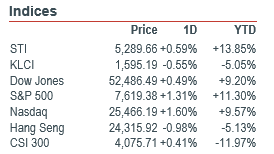
Market Movers: U.S. equities rebounded on 11 November, with the S&P 500 rising approximately 1.3% and the Nasdaq gaining approximately 1.6%, as AI-infrastructure shares recovered. Nvidia (NVDA US) gained approximately 2.9% despite a Baird downgrade, while Micron (MU US) jumped approximately 11.9% as CoreWeave’s customer-funding outlook improved confidence in memory and server spending. Earlier in Asia, SK Hynix’s Korean shares (000660.KS) rose approximately 5.4% on the same earnings read-through. CoreWeave expects US$9bn in customer prepayments and deposits over the next three months. Upfront cash helps financing visibility, but continued orders and investment discipline remain necessary for the wider sector’s recovery. (AP / Aju / Reuters) Nvidia (NVDA US) is our Core Recommendation; Micron (MU US) and SK Hynix (SKHY US) are our Investment Opportunities.
Macro: The People’s Bank of China reaffirmed moderately loose policy in its third-quarter report and pledged stronger countercyclical support for domestic demand. It proposed diversifying loan-pricing benchmarks beyond the LPR. September new corporate lending rates were below 3.0%, while M2 grew 7.2%. The emphasis is transmission and financing access; the report does not announce a new benchmark-rate cut. (PBOC)
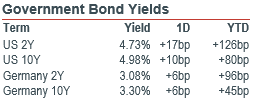
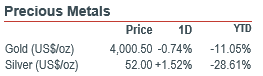
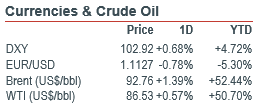
FICC: Brent settled 1.39% higher at US$92.76/bbl, while silver gained approximately 1.5% and gold fell 0.74%. EUR/USD declined 0.78%; Germany’s 10-year yield increased 6bp to 3.3%. The mixed commodity and rate moves leave inflation and financing costs relevant to equity valuations. US Treasury markets were closed for Veterans Day, so the sidebar retains 10 November yields and changes. WTI rose 0.57% to US$86.53/bbl. (eOption / ECB / Bundesbank / US Treasury)
AI
• Google extends AI genomics into individual cell types. Alphabet’s (GOOGL US) DeepMind introduced AlphaGenome 2, trained on more than 100m cell profiles across 68 tissues. Its reported variant-identification rate reached 30%, versus 16% for the earlier comparator, on a specified immune-cell dataset. Non-commercial research access is available, with commercial research in private preview. The advance could improve target discovery, but the model is not validated for clinical diagnosis and disclosed revenue is absent. (DeepMind) Alphabet (GOOGL US) is our Investment Opportunity.
• OpenAI’s growth still leaves a heavy financing burden. OpenAI’s third-quarter revenue rose roughly 50% quarter on quarter to US$10bn, while adjusted operating losses widened to US$10.9bn from US$10.1bn, according to investor documents reported by the Wall Street Journal. The adjusted operating margin improved to negative 109% from negative 150%. Stronger sales therefore reduced losses relative to revenue without eliminating substantial funding needs; the company did not immediately comment to Reuters. (Reuters / WSJ)
• Tencent launches consumer AI search. Tencent (700 HK) launched Yuanbao Search through a standalone website and QQ Browser. It combines AI summaries with original-source links and access to WeChat public accounts and video channels. The consumer launch extends technology previously offered to businesses. Advertising remains possible, with labelled and collapsible placements. Distribution offers an advantage, but monetisation depends on building repeat search habits. (Smart Things) Tencent (700 HK) is our Core Recommendation.
• Anthropic’s reported order book tests capital-market appetite. Anthropic’s proposed IPO attracted indications of interest several times the shares available, Bloomberg reported, citing people familiar with the matter. Large potential allocations drove demand for a transaction targeting up to US$90.4bn across the IPO and a private placement. These are preliminary orders rather than completed financing. Conversion into firm allocations and final pricing will test investors’ willingness to fund frontier-model expansion. (Bloomberg)
Americas
• Nvidia rebounds despite a more cautious broker stance. Nvidia (NVDA US) gained approximately 2.9% during the broader AI recovery, even as Baird downgraded it to Neutral and Morgan Stanley removed its Top Pick designation while retaining Overweight. Reuters linked the reassessment to data-centre spending visibility and leadership uncertainty. With 59 of 64 brokerages still rating the shares Buy or Strong Buy, the split highlights sensitivity to execution and confidence rather than uniform analyst capitulation. (Reuters / AP) Nvidia (NVDA US) is our Core Recommendation.
• Memory and storage shares participate in the AI rebound. Micron (MU US) rallied approximately 11.90% as CoreWeave’s demand and funding update improved sentiment toward AI infrastructure. SanDisk advanced about 13.7%, Seagate 10.0% and Dell 11.8% in the same completed session. The synchronized recovery indicates renewed confidence in spending across memory, storage and servers. It is a market reassessment rather than a new Micron earnings release; sustained orders and cash conversion remain the next tests. (AP / Reuters / Market data) Micron (MU US) is our Investment Opportunity.
• Meta prepares an infrastructure leadership handover. Meta Platforms (META US) confirmed that infrastructure chief Santosh Janardhan will leave in early 2027, with former Amazon Web Services executive Dave Brown succeeding him. Bloomberg reported that Janardhan would remain through the first quarter to support the transition. The handover places responsibility for complex data-centre execution with a new leader as AI capacity remains strategically important; the announcement itself disclosed no change to investment guidance. (Reuters) Meta (META US) is our Core Recommendation.
• Amazon accepts changes to Japanese marketplace pricing. Amazon (AMZN US) obtained approval for a Japanese competition commitment plan requiring alternative offers to remain visible when sellers do not match rival sites’ prices. The changes are due within six months, with monitoring over five years. The regulator made no finding of an antitrust violation. Greater seller pricing freedom could weaken cross-platform price discipline while resolving this investigation without a formal infringement decision. (JFTC / Jiji) Amazon (AMZN US) is our Core Recommendation.
• CoreWeave’s cash outlook sparks a sharp recovery. CoreWeave (CRWV US) rose approximately 24.7% in the first full session after results. It expects US$9bn of customer prepayments and deposits over the next three months and lifted annual revenue guidance to US$13–13.3bn. Third-quarter revenue reached US$3.66bn, but net losses widened to US$709m. Upfront customer cash eases immediate financing concerns, while heavy spending and interest costs still constrain profitability. (Company / Reuters / AP)
• McCormick’s food combination faces a UK remedies deadline. Britain’s competition regulator identified concerns over McCormick’s (MKC US) proposed US$65bn combination with Unilever’s foods business, focusing on dry recipe mixes and sauces. The companies have until 18 November to offer remedies or face a deeper investigation. Mustard competition was not identified as a concern. The ruling raises execution risk and potential divestment requirements, but does not constitute a final block on the transaction. (CMA / Reuters)
Greater China
• Bank recapitalisations clear exchange review. ICBC (1398 HK) and Agricultural Bank of China (1288 HK) received Shanghai exchange approval for previously announced A-share placements of up to RMB100bn and RMB160bn, respectively. CSRC registration is still required. This advances capital replenishment rather than announcing new funding plans. Stronger core capital would support lending, although completion timing and returns on the expanded equity base remain uncertain. (ICBC / The Paper) Industrial and Commercial Bank of China (1398 HK) and Agricultural Bank of China (1288 HK) are our Investment Opportunities.
• Shipbuilding orders extend the backlog. China CSSC Holdings (600150.SH) disclosed contracts for 20 very large crude carriers, including 16 vessels costing RMB13.43bn before tax. Delivery extends from 2029 into 2030, and relevant approvals remain outstanding. The new disclosure strengthens long-term workload visibility rather than current earnings. Execution costs, construction milestones and delayed cash conversion will determine how effectively the order book translates into profit. (COSCO / CLS)
Asia ex. China
• SK Hynix rebounds with AI sentiment. SK Hynix (000660.KS) gained 5.36% to KRW1,277,000 as Korean chip shares recovered following CoreWeave’s reassuring US after-hours results. Foreign investors bought a net KRW655.3bn of KOSPI shares. The move reflects renewed confidence in AI infrastructure demand; it does not remove customer-concentration, valuation or investment-cycle risks. Memory suppliers still need sustained orders to convert stronger sentiment into earnings. (Aju) SK Hynix (SKHY US) is our Investment Opportunity.
• TSMC gains on dividend and sales confidence. Taiwan Semiconductor Manufacturing (2330 TT) rose 4.81% to TWD2,395 after the preceding day’s dividend and sales disclosures. Its third-quarter dividend increases to TWD9 from TWD7 for the second quarter, while October sales grew almost 60%. The fresh market reaction reinforces confidence in AI demand. Sustaining that confidence requires capacity investment to translate into profitable growth rather than simply larger commitments. (CNA) Taiwan Semiconductor Manufacturing (TSM US) is our Core Recommendation.
• Blackstone raises IDP takeover proposal. IDP Education (IEL AU) rose approximately 16.3% after disclosing Blackstone’s revised A$3-per-share cash proposal, less subsequent dividends or distributions. The board is considering the unsolicited, non-binding approach and has made no decision. Earlier proposals were rejected. The increased offer highlights the value of IDP’s international education platform, but transaction completion and the eventual terms remain uncertain. (Company / Reuters)
• Fuel costs weigh on Singapore Airlines. Singapore Airlines (SIA SP) reported first-half net profit of S$134m, down 43.9%, despite revenue rising 16.8% to S$11.30bn. Fuel costs before hedging increased 90.3%. The group declared a seven-Singapore-cent interim dividend, including a five-cent special component. Strong passenger demand supports revenue, but fuel exposure continues to constrain the conversion of record sales into shareholder earnings. (Company / AsiaOne)
EMEA and Others
• Siemens Energy turns strong demand into larger shareholder returns. Siemens Energy (ENR DE) rose approximately 10.8% as fiscal-year revenue reached €44.2bn, up 15.5% on a comparable basis, and pretax free cash flow reached €8.8bn. Management targets a 14–16% profit margin before special items in 2027, proposes a €2.30 dividend and plans additional buybacks of up to €9bn through 2030. Delivery execution remains critical as its record backlog converts into earnings. (Siemens Energy)
• RWE’s earnings momentum supports a stronger full-year finish. RWE (RWE DE) increased nine-month adjusted EBITDA 35% to €4.6bn and adjusted EPS 42% to €2.52. New assets, better European wind conditions and stronger trading contributed. Management retained its €5.75–6.35bn annual EBITDA range but now expects results towards the upper end. Net investment of €10.7bn underlines the growth commitment, while trading variability and substantial funding needs remain relevant to cash generation. (RWE)
• Vestas improves margins while orders and cash conversion weaken. Vestas (VWS DC) reported quarterly revenue of €5.68bn, up 6%, and an 8.5% EBIT margin before special items, versus 7.8% a year earlier. Turbine order intake fell 27% to 3,377MW and adjusted free cash flow fell to €99m from €508m. The narrowed 7.5–8.5% annual margin outlook leaves execution and working-capital recovery central to converting a €77.9bn backlog into returns. (Vestas)
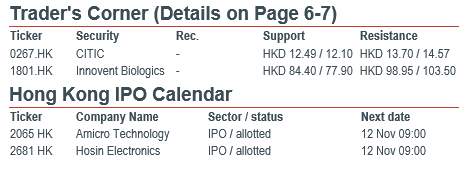
Traders' Corner
Our Technical View
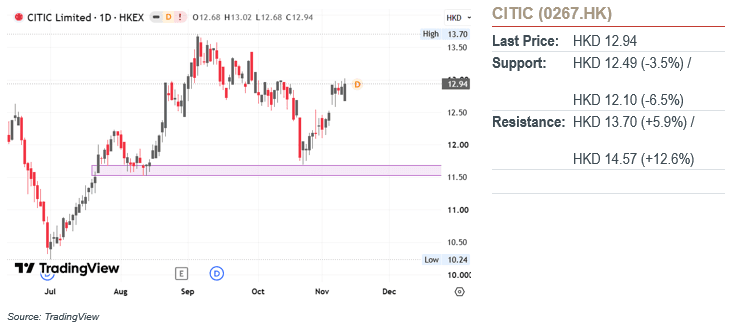
Price successfully defended its position above the gap-support baseline and formed a flag continuation pattern.
The RSI is in bullish territory and continues to slope upward with positive velocity.
An upward breakout wave targeting upper swing high resistance boundaries can be expected once price breakout the flag pattern.
Our Technical View
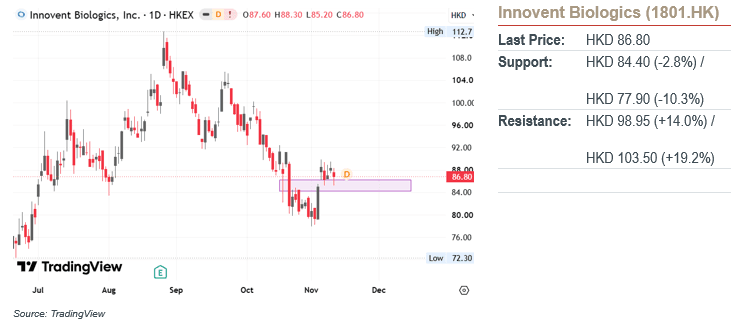
Price successfully preserved its position above the gap-support baseline on intraday retests.
It is compressing within a tight range.
The RSI is hovering around the 50 neutral baseline.
As long as price remains defended above the gap-support baseline, we see an upward expansion wave targeting upper swing high resistance.
Market Movers: U.S. equities rebounded on 11 November, with the S&P 500 rising approximately 1.3% and the Nasdaq gaining approximately 1.6%, as AI-infrastructure shares recovered. Nvidia (NVDA US) gained approximately 2.9% despite a Baird downgrade, while Micron (MU US) jumped approximately 11.9% as CoreWeave’s customer-funding outlook improved confidence in memory and server spending. Earlier in Asia, SK Hynix’s Korean shares (000660.KS) rose approximately 5.4% on the same earnings read-through. CoreWeave expects US$9bn in customer prepayments and deposits over the next three months. Upfront cash helps financing visibility, but continued orders and investment discipline remain necessary for the wider sector’s recovery. (AP / Aju / Reuters) Nvidia (NVDA US) is our Core Recommendation; Micron (MU US) and SK Hynix (SKHY US) are our Investment Opportunities.
Macro: The People’s Bank of China reaffirmed moderately loose policy in its third-quarter report and pledged stronger countercyclical support for domestic demand. It proposed diversifying loan-pricing benchmarks beyond the LPR. September new corporate lending rates were below 3.0%, while M2 grew 7.2%. The emphasis is transmission and financing access; the report does not announce a new benchmark-rate cut. (PBOC)
FICC: Brent settled 1.39% higher at US$92.76/bbl, while silver gained approximately 1.5% and gold fell 0.74%. EUR/USD declined 0.78%; Germany’s 10-year yield increased 6bp to 3.3%. The mixed commodity and rate moves leave inflation and financing costs relevant to equity valuations. US Treasury markets were closed for Veterans Day, so the sidebar retains 10 November yields and changes. WTI rose 0.57% to US$86.53/bbl. (eOption / ECB / Bundesbank / US Treasury)
AI
• Google extends AI genomics into individual cell types. Alphabet’s (GOOGL US) DeepMind introduced AlphaGenome 2, trained on more than 100m cell profiles across 68 tissues. Its reported variant-identification rate reached 30%, versus 16% for the earlier comparator, on a specified immune-cell dataset. Non-commercial research access is available, with commercial research in private preview. The advance could improve target discovery, but the model is not validated for clinical diagnosis and disclosed revenue is absent. (DeepMind) Alphabet (GOOGL US) is our Investment Opportunity.
• OpenAI’s growth still leaves a heavy financing burden. OpenAI’s third-quarter revenue rose roughly 50% quarter on quarter to US$10bn, while adjusted operating losses widened to US$10.9bn from US$10.1bn, according to investor documents reported by the Wall Street Journal. The adjusted operating margin improved to negative 109% from negative 150%. Stronger sales therefore reduced losses relative to revenue without eliminating substantial funding needs; the company did not immediately comment to Reuters. (Reuters / WSJ)
• Tencent launches consumer AI search. Tencent (700 HK) launched Yuanbao Search through a standalone website and QQ Browser. It combines AI summaries with original-source links and access to WeChat public accounts and video channels. The consumer launch extends technology previously offered to businesses. Advertising remains possible, with labelled and collapsible placements. Distribution offers an advantage, but monetisation depends on building repeat search habits. (Smart Things) Tencent (700 HK) is our Core Recommendation.
• Anthropic’s reported order book tests capital-market appetite. Anthropic’s proposed IPO attracted indications of interest several times the shares available, Bloomberg reported, citing people familiar with the matter. Large potential allocations drove demand for a transaction targeting up to US$90.4bn across the IPO and a private placement. These are preliminary orders rather than completed financing. Conversion into firm allocations and final pricing will test investors’ willingness to fund frontier-model expansion. (Bloomberg)
Americas
• Nvidia rebounds despite a more cautious broker stance. Nvidia (NVDA US) gained approximately 2.9% during the broader AI recovery, even as Baird downgraded it to Neutral and Morgan Stanley removed its Top Pick designation while retaining Overweight. Reuters linked the reassessment to data-centre spending visibility and leadership uncertainty. With 59 of 64 brokerages still rating the shares Buy or Strong Buy, the split highlights sensitivity to execution and confidence rather than uniform analyst capitulation. (Reuters / AP) Nvidia (NVDA US) is our Core Recommendation.
• Memory and storage shares participate in the AI rebound. Micron (MU US) rallied approximately 11.90% as CoreWeave’s demand and funding update improved sentiment toward AI infrastructure. SanDisk advanced about 13.7%, Seagate 10.0% and Dell 11.8% in the same completed session. The synchronized recovery indicates renewed confidence in spending across memory, storage and servers. It is a market reassessment rather than a new Micron earnings release; sustained orders and cash conversion remain the next tests. (AP / Reuters / Market data) Micron (MU US) is our Investment Opportunity.
• Meta prepares an infrastructure leadership handover. Meta Platforms (META US) confirmed that infrastructure chief Santosh Janardhan will leave in early 2027, with former Amazon Web Services executive Dave Brown succeeding him. Bloomberg reported that Janardhan would remain through the first quarter to support the transition. The handover places responsibility for complex data-centre execution with a new leader as AI capacity remains strategically important; the announcement itself disclosed no change to investment guidance. (Reuters) Meta (META US) is our Core Recommendation.
• Amazon accepts changes to Japanese marketplace pricing. Amazon (AMZN US) obtained approval for a Japanese competition commitment plan requiring alternative offers to remain visible when sellers do not match rival sites’ prices. The changes are due within six months, with monitoring over five years. The regulator made no finding of an antitrust violation. Greater seller pricing freedom could weaken cross-platform price discipline while resolving this investigation without a formal infringement decision. (JFTC / Jiji) Amazon (AMZN US) is our Core Recommendation.
• CoreWeave’s cash outlook sparks a sharp recovery. CoreWeave (CRWV US) rose approximately 24.7% in the first full session after results. It expects US$9bn of customer prepayments and deposits over the next three months and lifted annual revenue guidance to US$13–13.3bn. Third-quarter revenue reached US$3.66bn, but net losses widened to US$709m. Upfront customer cash eases immediate financing concerns, while heavy spending and interest costs still constrain profitability. (Company / Reuters / AP)
• McCormick’s food combination faces a UK remedies deadline. Britain’s competition regulator identified concerns over McCormick’s (MKC US) proposed US$65bn combination with Unilever’s foods business, focusing on dry recipe mixes and sauces. The companies have until 18 November to offer remedies or face a deeper investigation. Mustard competition was not identified as a concern. The ruling raises execution risk and potential divestment requirements, but does not constitute a final block on the transaction. (CMA / Reuters)
Greater China
• Bank recapitalisations clear exchange review. ICBC (1398 HK) and Agricultural Bank of China (1288 HK) received Shanghai exchange approval for previously announced A-share placements of up to RMB100bn and RMB160bn, respectively. CSRC registration is still required. This advances capital replenishment rather than announcing new funding plans. Stronger core capital would support lending, although completion timing and returns on the expanded equity base remain uncertain. (ICBC / The Paper) Industrial and Commercial Bank of China (1398 HK) and Agricultural Bank of China (1288 HK) are our Investment Opportunities.
• Shipbuilding orders extend the backlog. China CSSC Holdings (600150.SH) disclosed contracts for 20 very large crude carriers, including 16 vessels costing RMB13.43bn before tax. Delivery extends from 2029 into 2030, and relevant approvals remain outstanding. The new disclosure strengthens long-term workload visibility rather than current earnings. Execution costs, construction milestones and delayed cash conversion will determine how effectively the order book translates into profit. (COSCO / CLS)
Asia ex. China
• SK Hynix rebounds with AI sentiment. SK Hynix (000660.KS) gained 5.36% to KRW1,277,000 as Korean chip shares recovered following CoreWeave’s reassuring US after-hours results. Foreign investors bought a net KRW655.3bn of KOSPI shares. The move reflects renewed confidence in AI infrastructure demand; it does not remove customer-concentration, valuation or investment-cycle risks. Memory suppliers still need sustained orders to convert stronger sentiment into earnings. (Aju) SK Hynix (SKHY US) is our Investment Opportunity.
• TSMC gains on dividend and sales confidence. Taiwan Semiconductor Manufacturing (2330 TT) rose 4.81% to TWD2,395 after the preceding day’s dividend and sales disclosures. Its third-quarter dividend increases to TWD9 from TWD7 for the second quarter, while October sales grew almost 60%. The fresh market reaction reinforces confidence in AI demand. Sustaining that confidence requires capacity investment to translate into profitable growth rather than simply larger commitments. (CNA) Taiwan Semiconductor Manufacturing (TSM US) is our Core Recommendation.
• Blackstone raises IDP takeover proposal. IDP Education (IEL AU) rose approximately 16.3% after disclosing Blackstone’s revised A$3-per-share cash proposal, less subsequent dividends or distributions. The board is considering the unsolicited, non-binding approach and has made no decision. Earlier proposals were rejected. The increased offer highlights the value of IDP’s international education platform, but transaction completion and the eventual terms remain uncertain. (Company / Reuters)
• Fuel costs weigh on Singapore Airlines. Singapore Airlines (SIA SP) reported first-half net profit of S$134m, down 43.9%, despite revenue rising 16.8% to S$11.30bn. Fuel costs before hedging increased 90.3%. The group declared a seven-Singapore-cent interim dividend, including a five-cent special component. Strong passenger demand supports revenue, but fuel exposure continues to constrain the conversion of record sales into shareholder earnings. (Company / AsiaOne)
EMEA and Others
• Siemens Energy turns strong demand into larger shareholder returns. Siemens Energy (ENR DE) rose approximately 10.8% as fiscal-year revenue reached €44.2bn, up 15.5% on a comparable basis, and pretax free cash flow reached €8.8bn. Management targets a 14–16% profit margin before special items in 2027, proposes a €2.30 dividend and plans additional buybacks of up to €9bn through 2030. Delivery execution remains critical as its record backlog converts into earnings. (Siemens Energy)
• RWE’s earnings momentum supports a stronger full-year finish. RWE (RWE DE) increased nine-month adjusted EBITDA 35% to €4.6bn and adjusted EPS 42% to €2.52. New assets, better European wind conditions and stronger trading contributed. Management retained its €5.75–6.35bn annual EBITDA range but now expects results towards the upper end. Net investment of €10.7bn underlines the growth commitment, while trading variability and substantial funding needs remain relevant to cash generation. (RWE)
• Vestas improves margins while orders and cash conversion weaken. Vestas (VWS DC) reported quarterly revenue of €5.68bn, up 6%, and an 8.5% EBIT margin before special items, versus 7.8% a year earlier. Turbine order intake fell 27% to 3,377MW and adjusted free cash flow fell to €99m from €508m. The narrowed 7.5–8.5% annual margin outlook leaves execution and working-capital recovery central to converting a €77.9bn backlog into returns. (Vestas)
Traders' Corner
Our Technical View
Price successfully defended its position above the gap-support baseline and formed a flag continuation pattern.
The RSI is in bullish territory and continues to slope upward with positive velocity.
An upward breakout wave targeting upper swing high resistance boundaries can be expected once price breakout the flag pattern.
Our Technical View
Price successfully preserved its position above the gap-support baseline on intraday retests.
It is compressing within a tight range.
The RSI is hovering around the 50 neutral baseline.
As long as price remains defended above the gap-support baseline, we see an upward expansion wave targeting upper swing high resistance.
Disclosures and disclaimers
This report is provided subject to, and must be read together with, the full Disclosures / Disclaimers available at this link, which are incorporated by reference into this report. In particular, this report is intended for general circulation and informational purposes only and does not constitute personal investment advice or a recommendation to buy or sell any investment product or security. You should independently evaluate the information and, where necessary, seek advice from a qualified financial adviser regarding the suitability of any investment. Analyst certifications required under applicable regulations, including SEC Regulation AC (where relevant), are included in this report. By accessing, receiving or using this report, you acknowledge that you have read, understood and agreed to be bound by the Disclosures / Disclaimers, as may be amended, supplemented or updated from time to time.


