

CIO Summary
- We are pleased to present the October issue of our CIO Quarterly Review, covering our annual outlook, core views and recommendations in 3Q2026. Read on to discover what worked, what didn’t, and the latest on our high-conviction ideas.
- Four of our top five predictions were validated through 3Q. China’s Growing Pains, the US-China AI Race, Breaking the Dollar’s Grip (de dollarization), and the Fed Wildcard were all reinforced by data and evidence in 3Q. The one miss was the Great AI Cooldown, as AI capex remained surprisingly strong in 2026.
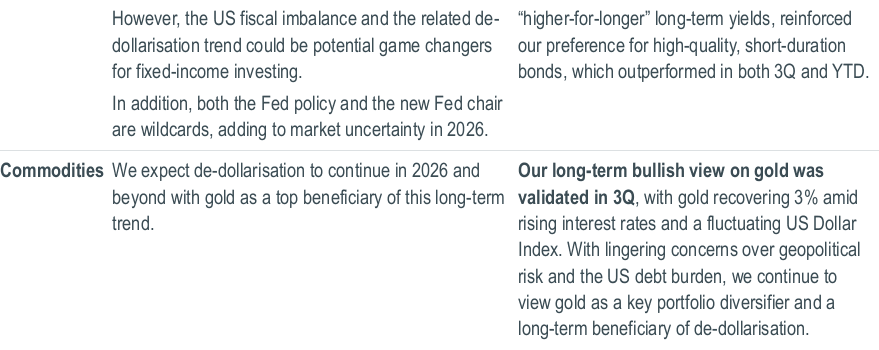
- Macro shocks vs. AI tailwinds. Our Core Views were broadly well placed in 3Q, although we underestimated the resilience of global and US equities as robust earnings and continued AI optimism outweighed macro headwinds. Our fixed-income view proved correct, with the Fed Wildcard and higher-for-longer long-term Treasury yields supporting our Core Recommendation for high-quality, short-duration bonds. Meanwhile, gold’s resilience further validated our long-term bullish view, underpinned by its role as a top de-dollarization beneficiary and a key portfolio diversifier.
- Key Call on oversold AI “casualties” continued to pay off, outperforming the Nasdaq 100 in 3Q and since our Feb 24 initiation. Microsoft, Broadcom and Snowflake remain our top picks here, backed by strong AI growth and adoption. AppLovin was removed after its August results raised company-specific concerns, but it remained on our watch list
- US Core Recommendations delivered broadly positive results in 3Q. Our AI stock picks outperformed both the S&P 500 and Nasdaq 100, while energy-related picks continued to beat the index by a wide margin. Defensives lagged during the market upturn, as expected, but remain essential portfolio stabilisers.
- China Core Recommendations delivered mixed yet solid performance in 3Q. Our Greater China AI picks significantly outperformed the Hang Seng Tech Index, while energy-related stocks also maintained their YTD lead over the Hang Seng Index despite a weaker 3Q. Defensives lagged during the market rebound but remained ahead YTD. Almost everywhere, China’s Growing Pains continued to weigh on company fundamentals and investor sentiment.
- We continue to recommend a balanced approach based on our barbell strategy, investing across AI, defensives and energy.
Top Predictions for 2026
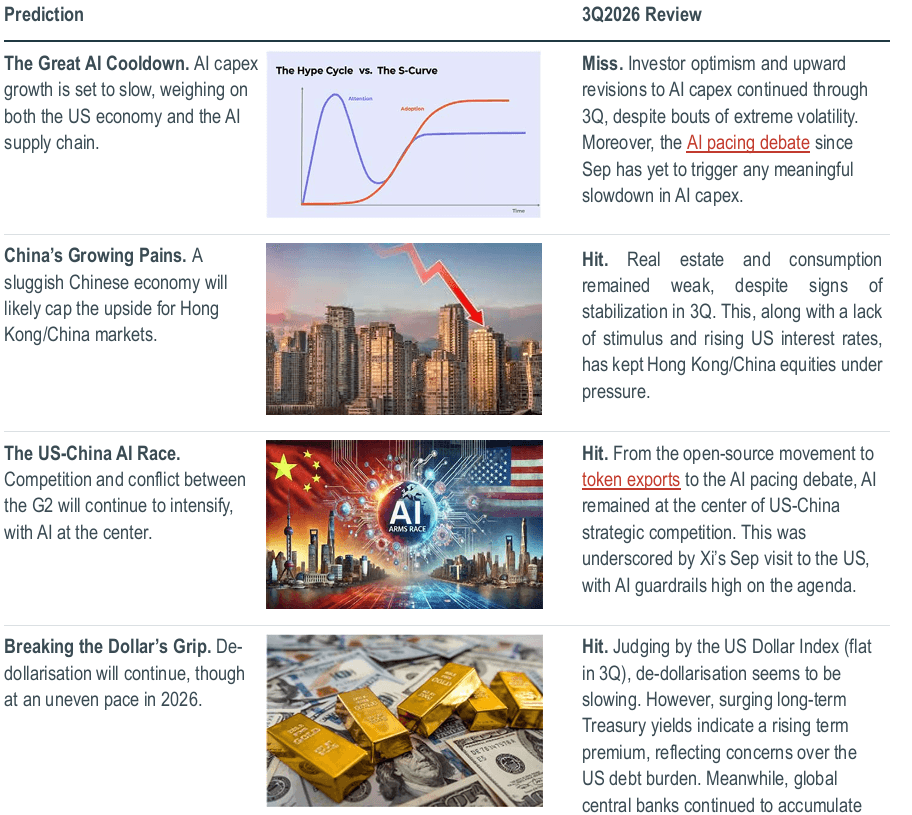
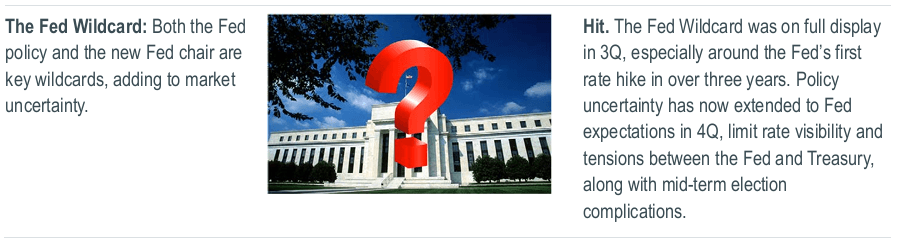
Core Views in 3Q2026
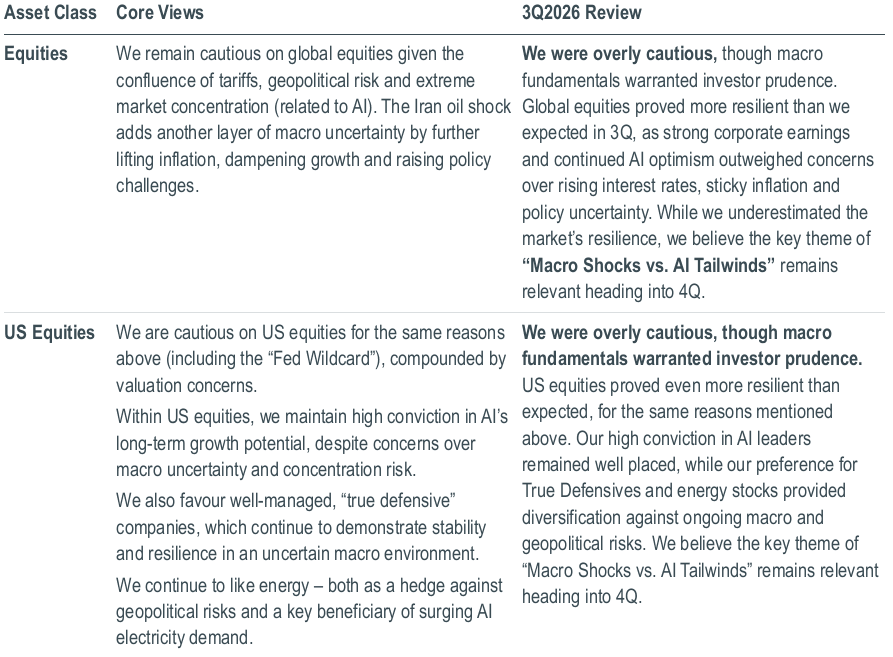
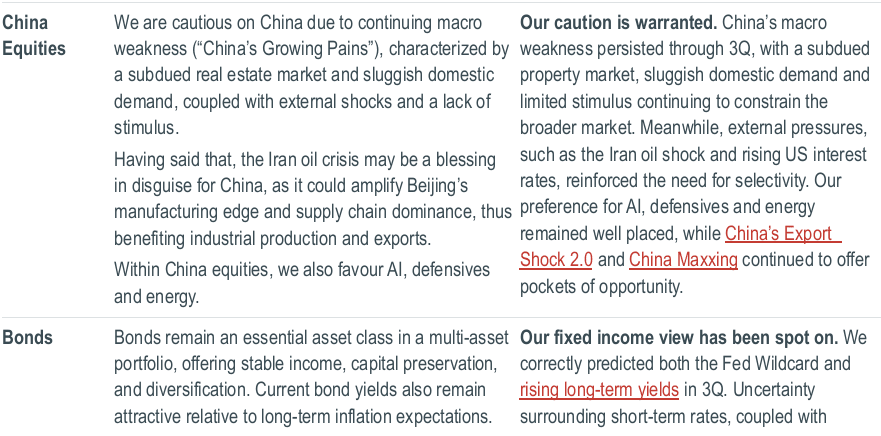
Key Call
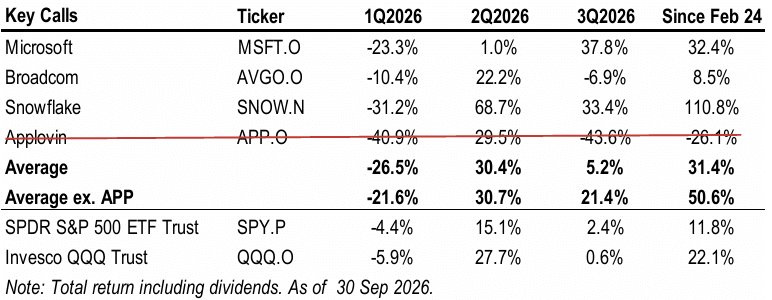
- Our Key Call remains on oversold software stocks perceived as AI casualties, i.e. Microsoft (MSFT), Broadcom (AVGO) and Snowflake (SNOW). The former two remain our Core Recommendations, while SNOW is rated Investment Opportunity (previously known as Trading Buy). AppLovin (APP) was removed from the list as of mid-August due to company-specific issues (details below).
- Even including APP, the Key Call has done well, outperforming the Nasdaq 100 (QQQ) in both 3Q and since our Feb 24 initiation. These four stocks have returned 31.4% on average, vs. 11.8% for the Nasdaq 100.
- Microsoft (MSFT) reported a 2Q earnings beat. June quarter revenue reached USD 90bn, beating the USD 87.6bn consensus. EPS of USD 4.74 also surpassed the USD 4.24 expectation. Azure grew 43% yoy, beating the 40% estimate, with management guiding to further acceleration. Copilot stood out as a bright spot, with users reaching 30mn versus the 25mn expectation, while low penetration suggests ample room for upside. Microsoft also announced a major update to the Microsoft Copilot app in Sep, introducing three core capabilities: Home, Code, and Autopilot, directly integrating key functionalities from Word, Excel, and PowerPoint. Our recent checks indicate that Copilot adoption has increased 5x recently, further validating MSFT as an AI enterprise application winner.
- Broadcom (AVGO) announced strong quarterly results, with AI revenue (49% of total) up 221% yoy, ahead of market expectations. During the earnings call, management guided AI revenue to double to USD 115bn in 2027 and double again to USD 230bn by 2028, while projecting 2028 EPS of over USD 30. However, AVGO shares remained under pressure for mainly two concerns: potential TPU market-share loss and circular-financing risk. We remain optimistic. Recent channel checks suggest that Broadcom remains deeply engaged with Google beyond TPU v8i and will likely capture the majority of Google’s TPU volumes in 2028-2029. Customer concentration risk should decline as Anthropic emerges as Broadcom's largest AI customer in 2027–2028. As the clear leader in AI ASICs and networking chips, the stock is attractive at the current valuation, in our view.
- Snowflake (SNOW) shares gained another 33% in 3Q and more than doubled since our Feb 24 call. The company reported strong 2Q revenue and guidance that both beat elevated buyside expectations. Revenue was up 37% as enterprise customers increasingly migrate data to Snowflake’s platform for AI applications. In addition, Snowflake’s new Cortex Code, a database focused AI coding agent, continues to see rapid adoption this quarter, bringing new workload to its core platform. We believe SNOW is one of the best-positioned software names to benefit from AI innovation, yet we are also cautious about elevated expectations in the short term.
- AppLovin (APP) reported a 2Q earnings miss, with both revenue and earnings up 53%+ yoy but 5% below consensus. Management attributed the weakness to product timing, as the updated recommendation engine was only launched at the quarter-end, implying the issue was one-off. Worth noting also is that its advertisement targeting performance was slowing for some reason. Without ad tech advancement and significant wallet share gains, our APP investment thesis is in question. We therefore removed APP from the Key Call following its August earnings, but have kept it on our watch list given its growth potential from e-commerce ramp-up.
US Stock Core Recommendations
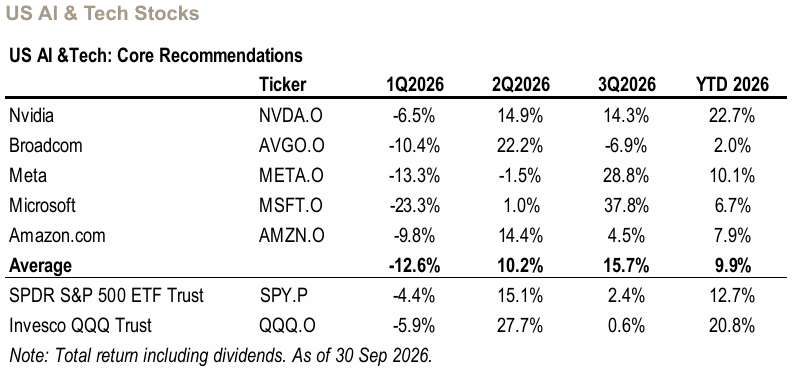
- Our US AI Core Recommendations outperformed the S&P 500 and Nasdaq 100 in 3Q, though YTD returns still lagged both benchmarks. AVGO and AMZN were the biggest detractors, each facing company-specific issues rather than industry-wide weakness. We maintain high conviction in our AI stock picks, as their long-term investment theses remain firmly intact.
- Nvidia (NVDA) reported another blowout quarter, with revenue up 106% yoy to USD 96.2bn – exceeding already elevated buy-side expectations. The company guided for 70% revenue growth next fiscal year (Jan 2028), well above the 45% consensus. And the number would be much higher if not for supply constraints. During the earnings call, CEO Jensen Huang highlighted the rising adoption of open-source models as another tailwind for Nvidia, as its GPU architecture is flexible and applicable across nearly all AI models and workloads. Nvidia continues to offer strong visibility and robust growth, supported by its secured share of the supply capacity. Still a must-own AI name.
- Meta’s (META) 2Q revenue rose 28% yoy to USD 60.8bn, slightly beating the USD 60.2bn consensus. Operating income also exceeded expectations slightly if excluding one-time expenses. However, Meta traded down 7% post earnings as the market increasingly demanded clarity on how its massive AI capex would translate into tangible monetization. The company shares rallied shortly after with the launch of its first personal AI agent in September. Muse claimed the No. 1 free app on Apple's US App Store, overtaking OpenAI’s ChatGPT. Meta’s unprecedented social network advantage across Instagram, Facebook, and WhatsApp allows Muse to develop a deep understanding of user profiles and deliver highly personalized services. We remain optimistic on Meta for the long term, but there is limited near-term financial impact from Muse. As a nascent technology, Muse also faces several technological challenges such as the risk of being blocked by ecosystem partners.
- Amazon (AMZN) reported another strong quarter, with revenue up 20% yoy to USD 201bn (slightly ahead of expectations), and EBIT reaching USD 27.5bn (comfortably beating the USD 26bn consensus). AWS revenue grew 37% and exceeded the 35% buy-side expectation, while operating margin expanded to 39% and backlog increased 36% qoq to USD 496bn – all pointing to strong AI demand. On the call, Amazon articulated its AI data center economics, noting that servers typically have a 5-to-6-year useful life, most of its AI capacity is secured by 5-year contracts, and capital investments reach breakeven in under 3 years on average. This signals its heavy AI investment may be reaching a financial inflection point, effectively addressing ongoing concerns about the return-on investment (ROI) of hyperscalers’ relentless AI capex.
- For Microsoft (MSFT) and Broadcom (AVGO), see the Key Call section above.
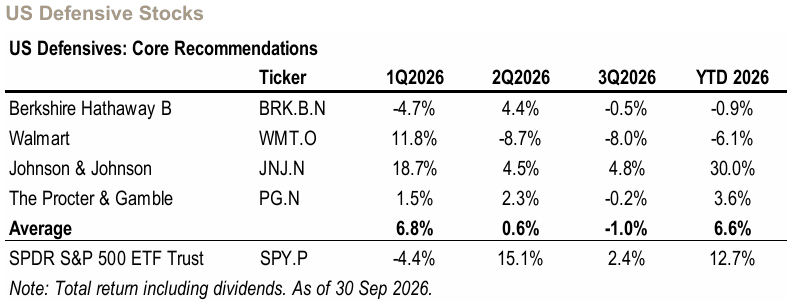
- Our US defensives underperformed the S&P 500 in 3Q, which is expected in a market upturn.
- Berkshire (BRK.B) delivered solid 2Q results. While its insurance segment (GEICO and BH Primary) missed underwriting estimates due to higher losses and expense ratios, this was more than offset by strong operational beats across BNSF (+4% to estimates), Berkshire Hathaway Energy (+20%), and Manufacturing, Services & Retailing (+18%). Notably, new CEO Greg Abel has begun to meaningfully deploy the group’s excess cash (declining from USD 397.4bn in 1Q to ~USD 365.5bn in 2Q), driven by USD 19.8bn in net equity purchase. These included: (1) July’s closing of the Taylor Morrison acquisition, (2) ~USD 4.5bn in BRK share repurchases, and (3) ~USD 17bn addition to its Alphabet stake. Berkshire is currently trading at a ~3% discount to its intrinsic value, making it an attractive, resilient defensive compounder in today’s uncertain macro environment.
- Walmart (WMT) shares plunged ~9% post 2Q earnings, as investors focused on the deceleration in US comp sales (+2.6% vs. +3.5% consensus) and pricing noise in health & wellness. However, Walmart’s operating margin still came above expectation (5.0% vs. 4.6%) amid improving eCommerce profitability. Management is strategically reinvesting tariff refunds into customer experience and price investments – a move that will drive market share gains across grocery, general merchandise, and higher-income households in 2H2026. We maintain our Core Recommendation on Walmart as an exceptionally well-managed, defensive retailer – expected to deliver solid earnings growth from its high-margin membership and retail media businesses.
- Procter & Gamble (PG) reported mixed 4QFY2026 results, with flat organic sales. Gross margin was better than expected while operating margins came in slightly behind (19.5% vs. 20.0% consensus). While the Beauty segment outperformed due to strength in SK-II and other brands, broader weakness in North America sales reflected subdued category demand and unfavorable inventory timing. Looking ahead, management provided a muted FY2027 outlook, guiding 1-3% organic sales growth and 0-3% EPS growth. These include a ~5% EPS decline in 1H2027, driven by a ~USD 1bn headwind in commodity, energy, and supply chain costs before a 2H2027 recovery.
- Johnson & Johnson (JNJ) announced largely in-line 3Q results, yet shares fell 5.7% post earnings, as the Medicine beat was offset by a MedTech miss. The Medicine unit was blessed with strong immunology momentum, while MedTech sales were dragged by international weakness in Cardiovascular and Surgery (including China VBP headwinds and Middle East disruptions). Nevertheless, 3Q EPS of USD 2.59 was USD 0.09 ahead of consensus, and JNJ slightly raised full year 2026 guidance on revenue and adjusted EPS. We view the results as reinforcing JNJ’s strong growth profile from its robust medicine pipeline, though the share pullback reflects market’s high bar for high-multiple names. Looking ahead, we still like JNJ as a Core Recommendation, as its Medicine segment is poised for high-single-digit growth through 2030 and its MedTech portfolio pivoting toward higher-growth verticals.
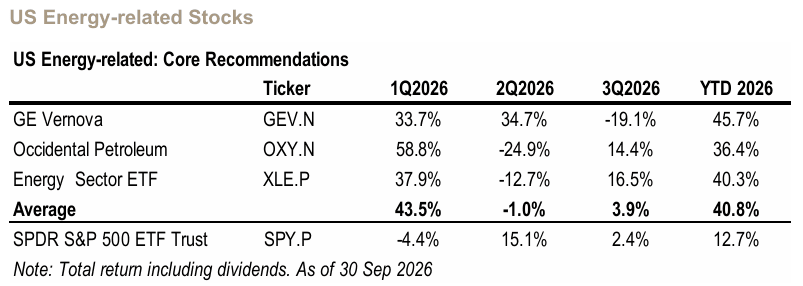
- Our energy-related stocks continue to outperform amid the Middle East tensions, beating the S&P 500 by a wide margin in 3Q and YTD.
- GE Vernova’s (GEV) 2Q revenue grew 22% to USD 11.1bn, slightly beating the consensus. Backlog reached a record USD 176bn, up USD 13.0bn sequentially, implying continuing strong orders that exceeded available supply. Demand is not an issue, but limited supply capacity is. At September’s Morgan Stanley conference, CEO said the company already sold multiple slots for 2032 deliveries, again underscoring strong demand visibility. Capacity is expected to ramp up from 5GW per quarter in 2H2026 to 6 in 2H2027 and eventually 7 in 2028. Successful capacity expansion and good execution position GEV to benefit from surging AI-driven power demand.
- Occidental Petroleum (OXY) delivered a robust 2Q beat, with adjusted EPS of USD 2.40 (vs. consensus USD 1.7–1.8) and free cash flow of USD 3.02bn (vs. consensus USD 2.2–2.5bn). This was driven by solid production execution, a big midstream pre-tax income upside and disciplined capex of USD 1.59bn. Looking ahead, management maintained its full-year 2026 capex guidance, while raising midstream pre-tax income outlook to USD 1.30–1.50bn (from USD 1.0–1.2bn). Notably, OXY has also outlined an ambitious long-term target to deliver USD 4.0bn in annual sustainable cash flow improvement from 2025 to 2030, anchored by USD 1.7bn in corporate savings, USD 800mn in oil & gas efficiencies, USD 100mn in midstream savings, and USD 1.4bn in combined LCV and sustaining capital reductions. This exceptional cash generation plan reinforces our investment thesis on OXY as a top-tier, capex-disciplined E&P player in the US.
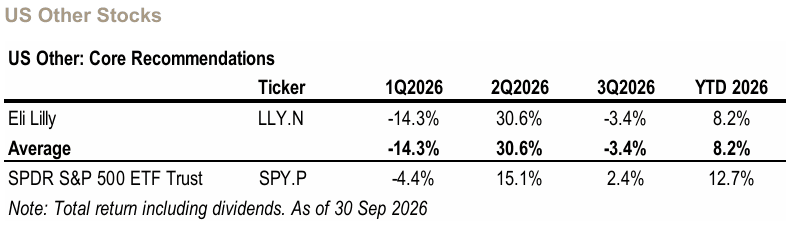
Eli Lilly (LLY) delivered an impressive 2Q beat, with shares up 4.5% post results. Total revenue surged to USD 23bn (vs. USD 20-21bn expected) on broad-based strength across its flagship incretin franchise, with Mounjaro and Zepbound beating estimates by 4-14%. Management raised 2026 topline guidance by USD 2.5bn at the midpoint to USD 85bn, ahead of market expectations. Its positive outlook is further supported by oral GLP-1 Foundayo channel checks – showing strong prescriber uptake and encouraging early international launch metrics. Beyond the metabolic franchise, LLY’s non-incretin portfolio is also picking up significant commercial and pipeline momentum, with the Oncology, Immunology, and Neuroscience segment growing 121% yoy. This is mainly driven by outperformance in Ebglyss, Kisunla, and the oral SERD Inluriyo. Meanwhile, management also signaled an acceleration in business development, emphasizing increasingly bolt on acquisitions and the potential for larger, transformative deals – thanks to the company’s strong balance sheet. We maintain our Core Recommendatio on LLY as it continues to demonstrate unparalleled commercial execution and pipeline diversification.
China Stock Core Recommendations
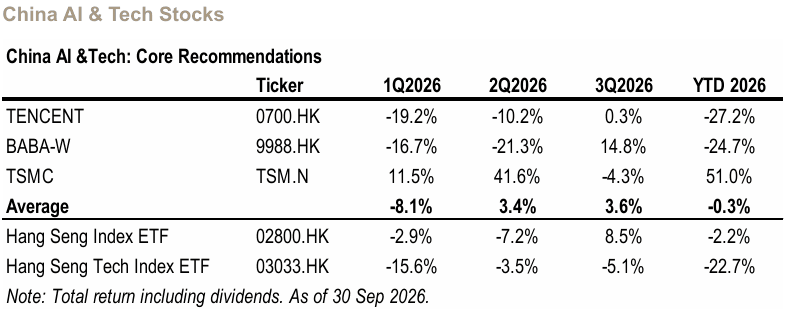
- Our Greater China AI Core Recommendations significantly outperformed the Hang Seng Tech Index in 3Q, though still lagged the broader Hang Seng Index. We continue to view Alibaba and Tencent as China’s Full-Stack AI Leaders, supported by their comprehensive AI ecosystems, massive scale and strong distribution advantage.
- Tencent (0700.HK) announced resilient 2Q earnings, with revenue +11% yoy to RMB 204.8bn and non-IFRS operating profit +9% yoy to RMB 75.6bn. Strong gaming and advertising franchises provide a solid earnings base for Tencent’s AI investment, while WorkBuddy and Weixin’s Xiaowei AI agents offer new monetisation opportunities through WeChat’s “Weapon of Mass Distribution”. Granted, rising AI spending weighs on near-term cash flow, but Tencent’s position as a leading AI practitioner (similar to Meta) should drive long-term profit growth and valuation re-rating. At around 12x forward P/E, the stock offers an attractive long-term entry point. Tencent remains our Core Recommendation, combining strong cash-generating franchises, WeChat’s distribution reach and long-term AI monetisation potential.
- Alibaba (9988.HK) reported mixed June-quarter earnings, with revenue up 9% yoy to RMB 269.0bn, but adjusted EBITA down 30% and free cash flow remaining negative due to aggressive AI investment. AI cloud and compute revenue surged 45%, but domestic customer-management revenue weakened amid China’s Growing Pains. Shares returned 14.8% in 3Q, supported by stronger investor confidence in its AI cloud business as the “crown jewel”. Funding requirements following the August share placement remain a concern, though investor sentiment is also improving. Alibaba remains our Core Recommendation, with its integrated technology capabilities and established enterprise customer base providing a strong platform for long-term AI monetisation.
- TSMC (TSM) is scheduled to report 3Q earnings on October 15th. Consensus calls for revenue of TWD 1,494bn, up 17.6% qoq, and around 2% above the high end of guidance. Due to overwhelming AI-driven demand, TSMC is expected to implement a ~10% advanced-node price increase in early 2027, while mature-node pricing could rise by ~5%. We expect TSMC to continue its aggressive capacity expansion to meet surging demand for GPUs, ASICs, CPUs and advanced packaging. TSMC remains one of the highest-certainty growth stories in global tech, despite recurring concerns over the sustainability of rapid AI capex expansion.
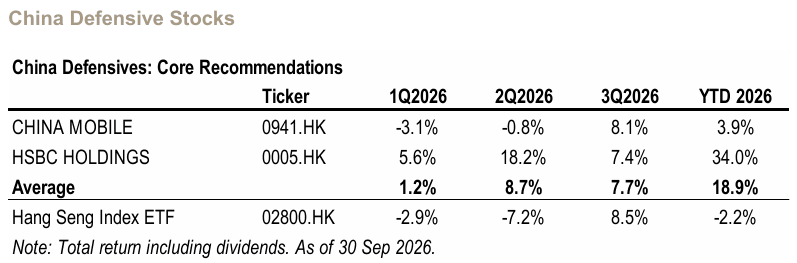
- Our defensive stock picks slightly underperformed the Hang Seng Index during the 3Q rebound, which is expected in an up market. However, they continued to outperform the index YTD, with China Mobile and HSBC as best ideas for the defensive end of our Barbell Strategy.
- China Mobile (0941.HK) announced mixed 2Q results, with revenue down 3.0% yoy but attributable profit down 7.5% to RMB 49.6bn, affected by weak traditional communications and higher VATs. Nevertheless, shares gained 8.1% in 3Q, likely supported by its attractive dividend yield (circa. 6.5%) and defensive nature (stable growth). Its interim dividend also rose 0.3% to RMB 2.51 per share. Improved cash generation supports dividends, but AI-related computing investment could constrain future dividend growth. China Mobile remains our Core Recommendation as a True Defensive, high-dividend yield stock with a potential AI re-rating story.
HSBC (0005.HK) reported solid 2Q earnings, with profit before tax excluding notable items up 13% yoy to USD 10.3bn (on a constant-currency basis). Banking NII grew 9% and wealth income rose 21%, prompting higher FY2026 NII guidance. The bank declared a second interim dividend of USD 0.10 per share and announced a share buyback of up to USD 1bn – although the latter was smaller than expected. HSBC remains a Core Recommendation for steady growth and solid shareholder returns, underpinned by its international franchise and Asian wealth business. However, its strong stock return YTD, Hong Kong commercial-property exposures, rising US interest rates, limited buyback headroom and geopolitical uncertainty have all made the risk-reward less attractive.

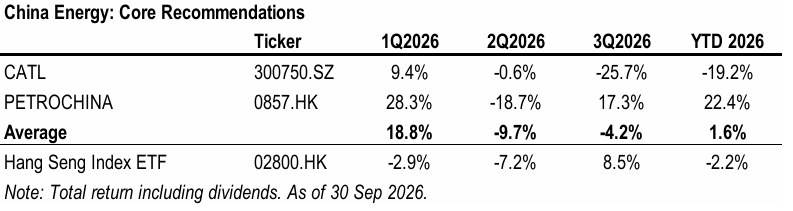
- Our Chinese energy-related stock picks underperformed the market in 3Q, yet remained ahead YTD – mainly driven by higher oil prices.
- CATL (300750.SZ) delivered strong 2Q growth, with revenue up 56.9% yoy to RMB 147.8bn and attributable profit up 36.5% to RMB 22.5bn – although margins narrowed. Its A-shares were down 25.7% in 3Q amid slower domestic storage installations, a weakening domestic EV market and supplier-diversification concerns. We view supplier-switching fears as overdone, given CATL’s unmatched advantages in technology, scale and reliability. Meanwhile, grid storage demand could offset any EV share loss as countries increasingly focus on energy security and expand their renewable capacities amid the Iran oil crisis. CATL remains a Core Recommendation, supported by its leadership in EV power batteries, growing energy-storage market and overseas expansion opportunities.
- PetroChina (0857.HK) reported strong 2Q earnings growth, with attributable profit up 49.5% yoy to RMB 55.6bn. Robust free cash flow and a 46% interim payout ratio underpin solid shareholder returns and attractive dividend yields (circa. 5.1%). Refining, fuel sales and trading helped offset overseas production disruptions and higher lifting costs in the upstream segment. PetroChina remains a Core Recommendation, combining exposure to China’s energy-security agenda, with upstream oil-price leverage and consistent dividends.
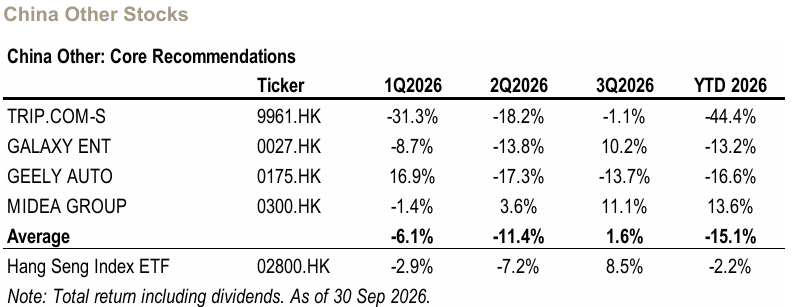
- Performance across our other China picks remained lacklustre, as China’s Growing Pains (weak macro) continued to weigh on both company fundamentals and investor sentiment.
- Trip.com (9961.HK) announced mixed 2Q results, with revenue up 6% yoy to RMB 15.7bn and non-GAAP net profit down 4.3% to RMB 4.8bn. International-platform revenue grew more than 50% – a bright spot against soft domestic demand. The OTA was hit with a RMB 5.2bn antitrust penalty, resulting in a one-time, attributable net loss. The fine is significant, but it removes a key overhang on the stock. Trip.com remains a Core Recommendation as a key beneficiary of China’s tourism boom, supported by its leading travel platform and extensive supplier network, with international expansion and cross-border travel further broadening its growth potential.
- Galaxy Entertainment (0027.HK) reported mixed 2Q results, with revenue down 2% yoy to HKD 11.8bn and adjusted EBITDA down 5% to HKD 3.38bn. However, normalised EBITDA rose 8%, and interim dividend increased to HKD 0.90 per share. Gaming revenue fell 5% qoq versus Macau’s 7% decline, implying market-share gains. Competition and higher operating costs remain sources of margin risk. Galaxy is a Core Recommendation and our top pick in Macau gaming, benefiting from China’s tourism boom through its premium-mass positioning and integrated resorts. Phase 4 expansion and a strong net-cash balance sheet support long-term growth and shareholder returns.
- Geely Auto (0175.HK) delivered stronger underlying 2Q earnings, with core net profit up 12% qoq to RMB 5.1bn and gross margin expanding to 18.4% – driven by premiumisation and an improving product mix. First-half exports surged 158% yoy, prompting a higher full-year export target. China’s reduction in the NEV export VAT rebate from 13% to 9%, effective April 2027, adds industry wide pressure to export profitability. However, Geely’s higher overseas selling prices and expanding local production footprint provide scope to mitigate this impact, reinforcing the merits of its globalisation strategy. Geely remains a Core Recommendation as a “quality growth” story, supported by its premium brands, profitable overseas expansion and the “One Geely” integration strategy.
- Midea (000333.SZ / 0300.HK) reported modest 2Q results, with revenue up 4.6% yoy to RMB 128.9bn and attributable profit up 1.3% to RMB 13.8bn. Overseas own-brand expansion and building technology growth supported earnings despite weak domestic demand, while raw-materials and foreign exchange presented cost headwinds. Midea replaced Haier as a new Core Recommendation in July, supported by more balanced global exposures, structurally higher margins and diversified growth engines. Overseas brand upgrade and expanding commercial and industrial businesses reinforce Midea as a top pick for our China Export Shock 2.0 and China Maxxing themes.
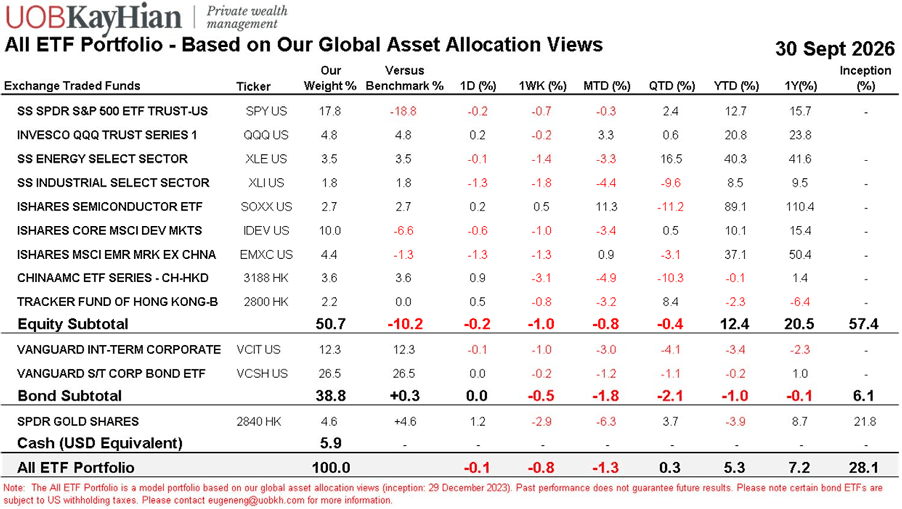
Appendix A: All ETF Portfolio (for Global Asset Allocation)
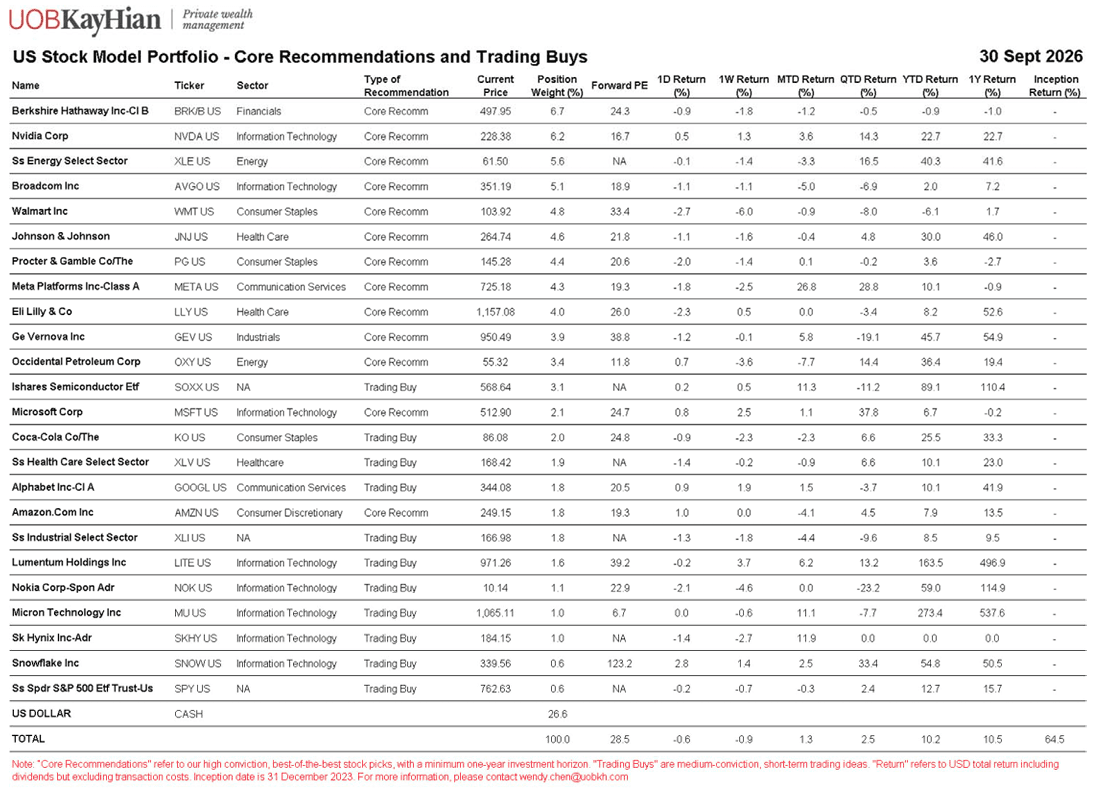
Appendix B: US Stock Model Portfolio
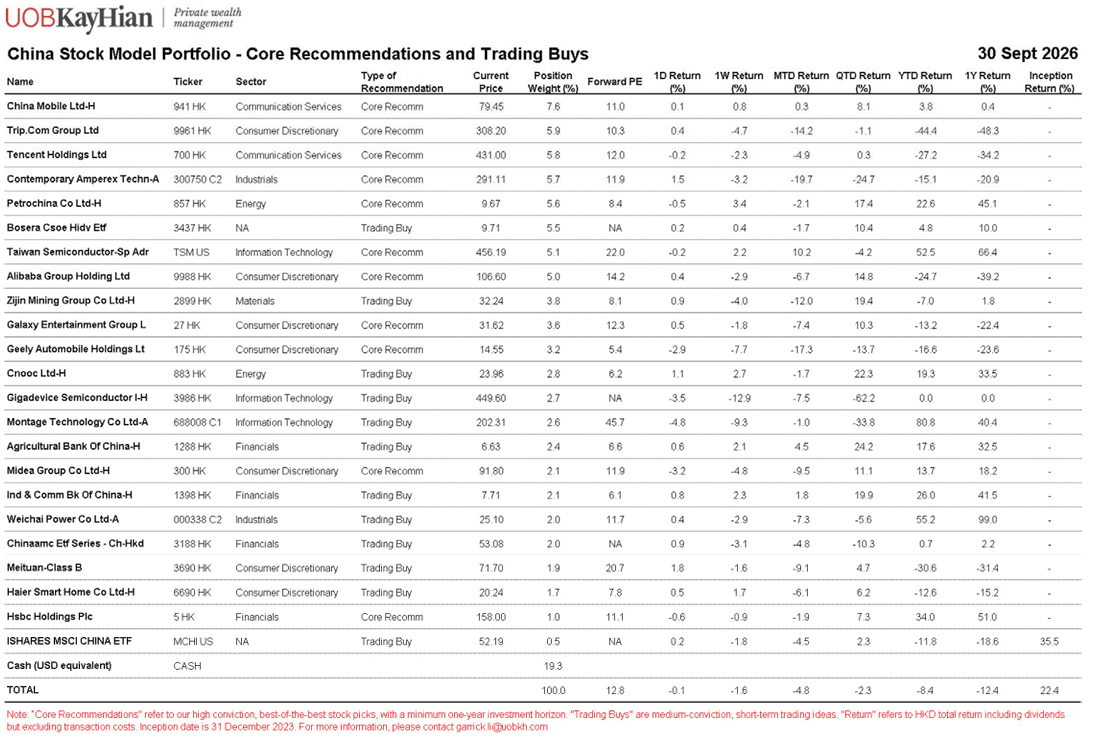
Appendix C: China Stock Model Portfolio
CIO Summary
- We are pleased to present the October issue of our CIO Quarterly Review, covering our annual outlook, core views and recommendations in 3Q2026. Read on to discover what worked, what didn’t, and the latest on our high-conviction ideas.
- Four of our top five predictions were validated through 3Q. China’s Growing Pains, the US-China AI Race, Breaking the Dollar’s Grip (de dollarization), and the Fed Wildcard were all reinforced by data and evidence in 3Q. The one miss was the Great AI Cooldown, as AI capex remained surprisingly strong in 2026.
- Macro shocks vs. AI tailwinds. Our Core Views were broadly well placed in 3Q, although we underestimated the resilience of global and US equities as robust earnings and continued AI optimism outweighed macro headwinds. Our fixed-income view proved correct, with the Fed Wildcard and higher-for-longer long-term Treasury yields supporting our Core Recommendation for high-quality, short-duration bonds. Meanwhile, gold’s resilience further validated our long-term bullish view, underpinned by its role as a top de-dollarization beneficiary and a key portfolio diversifier.
- Key Call on oversold AI “casualties” continued to pay off, outperforming the Nasdaq 100 in 3Q and since our Feb 24 initiation. Microsoft, Broadcom and Snowflake remain our top picks here, backed by strong AI growth and adoption. AppLovin was removed after its August results raised company-specific concerns, but it remained on our watch list
- US Core Recommendations delivered broadly positive results in 3Q. Our AI stock picks outperformed both the S&P 500 and Nasdaq 100, while energy-related picks continued to beat the index by a wide margin. Defensives lagged during the market upturn, as expected, but remain essential portfolio stabilisers.
- China Core Recommendations delivered mixed yet solid performance in 3Q. Our Greater China AI picks significantly outperformed the Hang Seng Tech Index, while energy-related stocks also maintained their YTD lead over the Hang Seng Index despite a weaker 3Q. Defensives lagged during the market rebound but remained ahead YTD. Almost everywhere, China’s Growing Pains continued to weigh on company fundamentals and investor sentiment.
- We continue to recommend a balanced approach based on our barbell strategy, investing across AI, defensives and energy.
Top Predictions for 2026
Core Views in 3Q2026
Key Call
- Our Key Call remains on oversold software stocks perceived as AI casualties, i.e. Microsoft (MSFT), Broadcom (AVGO) and Snowflake (SNOW). The former two remain our Core Recommendations, while SNOW is rated Investment Opportunity (previously known as Trading Buy). AppLovin (APP) was removed from the list as of mid-August due to company-specific issues (details below).
- Even including APP, the Key Call has done well, outperforming the Nasdaq 100 (QQQ) in both 3Q and since our Feb 24 initiation. These four stocks have returned 31.4% on average, vs. 11.8% for the Nasdaq 100.
- Microsoft (MSFT) reported a 2Q earnings beat. June quarter revenue reached USD 90bn, beating the USD 87.6bn consensus. EPS of USD 4.74 also surpassed the USD 4.24 expectation. Azure grew 43% yoy, beating the 40% estimate, with management guiding to further acceleration. Copilot stood out as a bright spot, with users reaching 30mn versus the 25mn expectation, while low penetration suggests ample room for upside. Microsoft also announced a major update to the Microsoft Copilot app in Sep, introducing three core capabilities: Home, Code, and Autopilot, directly integrating key functionalities from Word, Excel, and PowerPoint. Our recent checks indicate that Copilot adoption has increased 5x recently, further validating MSFT as an AI enterprise application winner.
- Broadcom (AVGO) announced strong quarterly results, with AI revenue (49% of total) up 221% yoy, ahead of market expectations. During the earnings call, management guided AI revenue to double to USD 115bn in 2027 and double again to USD 230bn by 2028, while projecting 2028 EPS of over USD 30. However, AVGO shares remained under pressure for mainly two concerns: potential TPU market-share loss and circular-financing risk. We remain optimistic. Recent channel checks suggest that Broadcom remains deeply engaged with Google beyond TPU v8i and will likely capture the majority of Google’s TPU volumes in 2028-2029. Customer concentration risk should decline as Anthropic emerges as Broadcom's largest AI customer in 2027–2028. As the clear leader in AI ASICs and networking chips, the stock is attractive at the current valuation, in our view.
- Snowflake (SNOW) shares gained another 33% in 3Q and more than doubled since our Feb 24 call. The company reported strong 2Q revenue and guidance that both beat elevated buyside expectations. Revenue was up 37% as enterprise customers increasingly migrate data to Snowflake’s platform for AI applications. In addition, Snowflake’s new Cortex Code, a database focused AI coding agent, continues to see rapid adoption this quarter, bringing new workload to its core platform. We believe SNOW is one of the best-positioned software names to benefit from AI innovation, yet we are also cautious about elevated expectations in the short term.
- AppLovin (APP) reported a 2Q earnings miss, with both revenue and earnings up 53%+ yoy but 5% below consensus. Management attributed the weakness to product timing, as the updated recommendation engine was only launched at the quarter-end, implying the issue was one-off. Worth noting also is that its advertisement targeting performance was slowing for some reason. Without ad tech advancement and significant wallet share gains, our APP investment thesis is in question. We therefore removed APP from the Key Call following its August earnings, but have kept it on our watch list given its growth potential from e-commerce ramp-up.
US Stock Core Recommendations
- Our US AI Core Recommendations outperformed the S&P 500 and Nasdaq 100 in 3Q, though YTD returns still lagged both benchmarks. AVGO and AMZN were the biggest detractors, each facing company-specific issues rather than industry-wide weakness. We maintain high conviction in our AI stock picks, as their long-term investment theses remain firmly intact.
- Nvidia (NVDA) reported another blowout quarter, with revenue up 106% yoy to USD 96.2bn – exceeding already elevated buy-side expectations. The company guided for 70% revenue growth next fiscal year (Jan 2028), well above the 45% consensus. And the number would be much higher if not for supply constraints. During the earnings call, CEO Jensen Huang highlighted the rising adoption of open-source models as another tailwind for Nvidia, as its GPU architecture is flexible and applicable across nearly all AI models and workloads. Nvidia continues to offer strong visibility and robust growth, supported by its secured share of the supply capacity. Still a must-own AI name.
- Meta’s (META) 2Q revenue rose 28% yoy to USD 60.8bn, slightly beating the USD 60.2bn consensus. Operating income also exceeded expectations slightly if excluding one-time expenses. However, Meta traded down 7% post earnings as the market increasingly demanded clarity on how its massive AI capex would translate into tangible monetization. The company shares rallied shortly after with the launch of its first personal AI agent in September. Muse claimed the No. 1 free app on Apple's US App Store, overtaking OpenAI’s ChatGPT. Meta’s unprecedented social network advantage across Instagram, Facebook, and WhatsApp allows Muse to develop a deep understanding of user profiles and deliver highly personalized services. We remain optimistic on Meta for the long term, but there is limited near-term financial impact from Muse. As a nascent technology, Muse also faces several technological challenges such as the risk of being blocked by ecosystem partners.
- Amazon (AMZN) reported another strong quarter, with revenue up 20% yoy to USD 201bn (slightly ahead of expectations), and EBIT reaching USD 27.5bn (comfortably beating the USD 26bn consensus). AWS revenue grew 37% and exceeded the 35% buy-side expectation, while operating margin expanded to 39% and backlog increased 36% qoq to USD 496bn – all pointing to strong AI demand. On the call, Amazon articulated its AI data center economics, noting that servers typically have a 5-to-6-year useful life, most of its AI capacity is secured by 5-year contracts, and capital investments reach breakeven in under 3 years on average. This signals its heavy AI investment may be reaching a financial inflection point, effectively addressing ongoing concerns about the return-on investment (ROI) of hyperscalers’ relentless AI capex.
- For Microsoft (MSFT) and Broadcom (AVGO), see the Key Call section above.
- Our US defensives underperformed the S&P 500 in 3Q, which is expected in a market upturn.
- Berkshire (BRK.B) delivered solid 2Q results. While its insurance segment (GEICO and BH Primary) missed underwriting estimates due to higher losses and expense ratios, this was more than offset by strong operational beats across BNSF (+4% to estimates), Berkshire Hathaway Energy (+20%), and Manufacturing, Services & Retailing (+18%). Notably, new CEO Greg Abel has begun to meaningfully deploy the group’s excess cash (declining from USD 397.4bn in 1Q to ~USD 365.5bn in 2Q), driven by USD 19.8bn in net equity purchase. These included: (1) July’s closing of the Taylor Morrison acquisition, (2) ~USD 4.5bn in BRK share repurchases, and (3) ~USD 17bn addition to its Alphabet stake. Berkshire is currently trading at a ~3% discount to its intrinsic value, making it an attractive, resilient defensive compounder in today’s uncertain macro environment.
- Walmart (WMT) shares plunged ~9% post 2Q earnings, as investors focused on the deceleration in US comp sales (+2.6% vs. +3.5% consensus) and pricing noise in health & wellness. However, Walmart’s operating margin still came above expectation (5.0% vs. 4.6%) amid improving eCommerce profitability. Management is strategically reinvesting tariff refunds into customer experience and price investments – a move that will drive market share gains across grocery, general merchandise, and higher-income households in 2H2026. We maintain our Core Recommendation on Walmart as an exceptionally well-managed, defensive retailer – expected to deliver solid earnings growth from its high-margin membership and retail media businesses.
- Procter & Gamble (PG) reported mixed 4QFY2026 results, with flat organic sales. Gross margin was better than expected while operating margins came in slightly behind (19.5% vs. 20.0% consensus). While the Beauty segment outperformed due to strength in SK-II and other brands, broader weakness in North America sales reflected subdued category demand and unfavorable inventory timing. Looking ahead, management provided a muted FY2027 outlook, guiding 1-3% organic sales growth and 0-3% EPS growth. These include a ~5% EPS decline in 1H2027, driven by a ~USD 1bn headwind in commodity, energy, and supply chain costs before a 2H2027 recovery.
- Johnson & Johnson (JNJ) announced largely in-line 3Q results, yet shares fell 5.7% post earnings, as the Medicine beat was offset by a MedTech miss. The Medicine unit was blessed with strong immunology momentum, while MedTech sales were dragged by international weakness in Cardiovascular and Surgery (including China VBP headwinds and Middle East disruptions). Nevertheless, 3Q EPS of USD 2.59 was USD 0.09 ahead of consensus, and JNJ slightly raised full year 2026 guidance on revenue and adjusted EPS. We view the results as reinforcing JNJ’s strong growth profile from its robust medicine pipeline, though the share pullback reflects market’s high bar for high-multiple names. Looking ahead, we still like JNJ as a Core Recommendation, as its Medicine segment is poised for high-single-digit growth through 2030 and its MedTech portfolio pivoting toward higher-growth verticals.
- Our energy-related stocks continue to outperform amid the Middle East tensions, beating the S&P 500 by a wide margin in 3Q and YTD.
- GE Vernova’s (GEV) 2Q revenue grew 22% to USD 11.1bn, slightly beating the consensus. Backlog reached a record USD 176bn, up USD 13.0bn sequentially, implying continuing strong orders that exceeded available supply. Demand is not an issue, but limited supply capacity is. At September’s Morgan Stanley conference, CEO said the company already sold multiple slots for 2032 deliveries, again underscoring strong demand visibility. Capacity is expected to ramp up from 5GW per quarter in 2H2026 to 6 in 2H2027 and eventually 7 in 2028. Successful capacity expansion and good execution position GEV to benefit from surging AI-driven power demand.
- Occidental Petroleum (OXY) delivered a robust 2Q beat, with adjusted EPS of USD 2.40 (vs. consensus USD 1.7–1.8) and free cash flow of USD 3.02bn (vs. consensus USD 2.2–2.5bn). This was driven by solid production execution, a big midstream pre-tax income upside and disciplined capex of USD 1.59bn. Looking ahead, management maintained its full-year 2026 capex guidance, while raising midstream pre-tax income outlook to USD 1.30–1.50bn (from USD 1.0–1.2bn). Notably, OXY has also outlined an ambitious long-term target to deliver USD 4.0bn in annual sustainable cash flow improvement from 2025 to 2030, anchored by USD 1.7bn in corporate savings, USD 800mn in oil & gas efficiencies, USD 100mn in midstream savings, and USD 1.4bn in combined LCV and sustaining capital reductions. This exceptional cash generation plan reinforces our investment thesis on OXY as a top-tier, capex-disciplined E&P player in the US.
Eli Lilly (LLY) delivered an impressive 2Q beat, with shares up 4.5% post results. Total revenue surged to USD 23bn (vs. USD 20-21bn expected) on broad-based strength across its flagship incretin franchise, with Mounjaro and Zepbound beating estimates by 4-14%. Management raised 2026 topline guidance by USD 2.5bn at the midpoint to USD 85bn, ahead of market expectations. Its positive outlook is further supported by oral GLP-1 Foundayo channel checks – showing strong prescriber uptake and encouraging early international launch metrics. Beyond the metabolic franchise, LLY’s non-incretin portfolio is also picking up significant commercial and pipeline momentum, with the Oncology, Immunology, and Neuroscience segment growing 121% yoy. This is mainly driven by outperformance in Ebglyss, Kisunla, and the oral SERD Inluriyo. Meanwhile, management also signaled an acceleration in business development, emphasizing increasingly bolt on acquisitions and the potential for larger, transformative deals – thanks to the company’s strong balance sheet. We maintain our Core Recommendatio on LLY as it continues to demonstrate unparalleled commercial execution and pipeline diversification.
China Stock Core Recommendations
- Our Greater China AI Core Recommendations significantly outperformed the Hang Seng Tech Index in 3Q, though still lagged the broader Hang Seng Index. We continue to view Alibaba and Tencent as China’s Full-Stack AI Leaders, supported by their comprehensive AI ecosystems, massive scale and strong distribution advantage.
- Tencent (0700.HK) announced resilient 2Q earnings, with revenue +11% yoy to RMB 204.8bn and non-IFRS operating profit +9% yoy to RMB 75.6bn. Strong gaming and advertising franchises provide a solid earnings base for Tencent’s AI investment, while WorkBuddy and Weixin’s Xiaowei AI agents offer new monetisation opportunities through WeChat’s “Weapon of Mass Distribution”. Granted, rising AI spending weighs on near-term cash flow, but Tencent’s position as a leading AI practitioner (similar to Meta) should drive long-term profit growth and valuation re-rating. At around 12x forward P/E, the stock offers an attractive long-term entry point. Tencent remains our Core Recommendation, combining strong cash-generating franchises, WeChat’s distribution reach and long-term AI monetisation potential.
- Alibaba (9988.HK) reported mixed June-quarter earnings, with revenue up 9% yoy to RMB 269.0bn, but adjusted EBITA down 30% and free cash flow remaining negative due to aggressive AI investment. AI cloud and compute revenue surged 45%, but domestic customer-management revenue weakened amid China’s Growing Pains. Shares returned 14.8% in 3Q, supported by stronger investor confidence in its AI cloud business as the “crown jewel”. Funding requirements following the August share placement remain a concern, though investor sentiment is also improving. Alibaba remains our Core Recommendation, with its integrated technology capabilities and established enterprise customer base providing a strong platform for long-term AI monetisation.
- TSMC (TSM) is scheduled to report 3Q earnings on October 15th. Consensus calls for revenue of TWD 1,494bn, up 17.6% qoq, and around 2% above the high end of guidance. Due to overwhelming AI-driven demand, TSMC is expected to implement a ~10% advanced-node price increase in early 2027, while mature-node pricing could rise by ~5%. We expect TSMC to continue its aggressive capacity expansion to meet surging demand for GPUs, ASICs, CPUs and advanced packaging. TSMC remains one of the highest-certainty growth stories in global tech, despite recurring concerns over the sustainability of rapid AI capex expansion.
- Our defensive stock picks slightly underperformed the Hang Seng Index during the 3Q rebound, which is expected in an up market. However, they continued to outperform the index YTD, with China Mobile and HSBC as best ideas for the defensive end of our Barbell Strategy.
- China Mobile (0941.HK) announced mixed 2Q results, with revenue down 3.0% yoy but attributable profit down 7.5% to RMB 49.6bn, affected by weak traditional communications and higher VATs. Nevertheless, shares gained 8.1% in 3Q, likely supported by its attractive dividend yield (circa. 6.5%) and defensive nature (stable growth). Its interim dividend also rose 0.3% to RMB 2.51 per share. Improved cash generation supports dividends, but AI-related computing investment could constrain future dividend growth. China Mobile remains our Core Recommendation as a True Defensive, high-dividend yield stock with a potential AI re-rating story.
HSBC (0005.HK) reported solid 2Q earnings, with profit before tax excluding notable items up 13% yoy to USD 10.3bn (on a constant-currency basis). Banking NII grew 9% and wealth income rose 21%, prompting higher FY2026 NII guidance. The bank declared a second interim dividend of USD 0.10 per share and announced a share buyback of up to USD 1bn – although the latter was smaller than expected. HSBC remains a Core Recommendation for steady growth and solid shareholder returns, underpinned by its international franchise and Asian wealth business. However, its strong stock return YTD, Hong Kong commercial-property exposures, rising US interest rates, limited buyback headroom and geopolitical uncertainty have all made the risk-reward less attractive.
- Our Chinese energy-related stock picks underperformed the market in 3Q, yet remained ahead YTD – mainly driven by higher oil prices.
- CATL (300750.SZ) delivered strong 2Q growth, with revenue up 56.9% yoy to RMB 147.8bn and attributable profit up 36.5% to RMB 22.5bn – although margins narrowed. Its A-shares were down 25.7% in 3Q amid slower domestic storage installations, a weakening domestic EV market and supplier-diversification concerns. We view supplier-switching fears as overdone, given CATL’s unmatched advantages in technology, scale and reliability. Meanwhile, grid storage demand could offset any EV share loss as countries increasingly focus on energy security and expand their renewable capacities amid the Iran oil crisis. CATL remains a Core Recommendation, supported by its leadership in EV power batteries, growing energy-storage market and overseas expansion opportunities.
- PetroChina (0857.HK) reported strong 2Q earnings growth, with attributable profit up 49.5% yoy to RMB 55.6bn. Robust free cash flow and a 46% interim payout ratio underpin solid shareholder returns and attractive dividend yields (circa. 5.1%). Refining, fuel sales and trading helped offset overseas production disruptions and higher lifting costs in the upstream segment. PetroChina remains a Core Recommendation, combining exposure to China’s energy-security agenda, with upstream oil-price leverage and consistent dividends.
- Performance across our other China picks remained lacklustre, as China’s Growing Pains (weak macro) continued to weigh on both company fundamentals and investor sentiment.
- Trip.com (9961.HK) announced mixed 2Q results, with revenue up 6% yoy to RMB 15.7bn and non-GAAP net profit down 4.3% to RMB 4.8bn. International-platform revenue grew more than 50% – a bright spot against soft domestic demand. The OTA was hit with a RMB 5.2bn antitrust penalty, resulting in a one-time, attributable net loss. The fine is significant, but it removes a key overhang on the stock. Trip.com remains a Core Recommendation as a key beneficiary of China’s tourism boom, supported by its leading travel platform and extensive supplier network, with international expansion and cross-border travel further broadening its growth potential.
- Galaxy Entertainment (0027.HK) reported mixed 2Q results, with revenue down 2% yoy to HKD 11.8bn and adjusted EBITDA down 5% to HKD 3.38bn. However, normalised EBITDA rose 8%, and interim dividend increased to HKD 0.90 per share. Gaming revenue fell 5% qoq versus Macau’s 7% decline, implying market-share gains. Competition and higher operating costs remain sources of margin risk. Galaxy is a Core Recommendation and our top pick in Macau gaming, benefiting from China’s tourism boom through its premium-mass positioning and integrated resorts. Phase 4 expansion and a strong net-cash balance sheet support long-term growth and shareholder returns.
- Geely Auto (0175.HK) delivered stronger underlying 2Q earnings, with core net profit up 12% qoq to RMB 5.1bn and gross margin expanding to 18.4% – driven by premiumisation and an improving product mix. First-half exports surged 158% yoy, prompting a higher full-year export target. China’s reduction in the NEV export VAT rebate from 13% to 9%, effective April 2027, adds industry wide pressure to export profitability. However, Geely’s higher overseas selling prices and expanding local production footprint provide scope to mitigate this impact, reinforcing the merits of its globalisation strategy. Geely remains a Core Recommendation as a “quality growth” story, supported by its premium brands, profitable overseas expansion and the “One Geely” integration strategy.
- Midea (000333.SZ / 0300.HK) reported modest 2Q results, with revenue up 4.6% yoy to RMB 128.9bn and attributable profit up 1.3% to RMB 13.8bn. Overseas own-brand expansion and building technology growth supported earnings despite weak domestic demand, while raw-materials and foreign exchange presented cost headwinds. Midea replaced Haier as a new Core Recommendation in July, supported by more balanced global exposures, structurally higher margins and diversified growth engines. Overseas brand upgrade and expanding commercial and industrial businesses reinforce Midea as a top pick for our China Export Shock 2.0 and China Maxxing themes.
Appendix A: All ETF Portfolio (for Global Asset Allocation)
Appendix B: US Stock Model Portfolio
Appendix C: China Stock Model Portfolio
Disclosures and disclaimers
This report is provided subject to, and must be read together with, the full Disclosures / Disclaimers available at this link, which are incorporated by reference into this report. In particular, this report is intended for general circulation and informational purposes only and does not constitute personal investment advice or a recommendation to buy or sell any investment product or security. You should independently evaluate the information and, where necessary, seek advice from a qualified financial adviser regarding the suitability of any investment. Analyst certifications required under applicable regulations, including SEC Regulation AC (where relevant), are included in this report. By accessing, receiving or using this report, you acknowledge that you have read, understood and agreed to be bound by the Disclosures / Disclaimers, as may be amended, supplemented or updated from time to time.


