

Analyst
Qi Wang, CFA
qi.wang@uobkh.comAnalyst
Wendy Chen
wendy.chen@uobkh.comAnalyst
In connection with UOBKH institutional research
Key US Market Indices

- US macro data: a synchronized cooling. July’s macro data delivered a synchronized cooling across key metrics: (1) Core CPI rose a benign 0.22% mom (in-line), providing a brief respite amid resurging oil prices in July; (2) Nonfarm payrolls unexpectedly contracted by 23K, well below the consensus forecast of an 80k gain; and (3) Retail sales declined 0.6% mom, missed expectations for an increase. Collectively, the softer prints drove FedWatch’s September hike odds down sharply from 55% to 30%, validating our view of the market’s “false hawkishness” in the near-term.
- US stock market: a synchronized rally. US equities posted a synchronized rally over the past two weeks, signaling a healthy reset in market dynamics. The tech-heavy Nasdaq Composite led the charge with a +3.1% gain, outpacing the S&P 500 (+2.4%) and the Dow Jones Industrial Average (+1.0%). YTD returns across all three indexes have surged to an impressive 15.0%/13.7%/11.8% respectively, signaling broad-based participation.
- Robust 2Q2026 earnings reaffirm underlying strength. The majority of S&P 500 companies have reported 2Q results – with revenue growth accelerating to the fastest pace since 2021, and earnings on track to surge nearly 50% yoy, vastly outpacing the +22% consensus. Even excluding outsized private investment gains, underlying earnings growth remained a robust +31% yoy in 2Q, according to Goldman Sachs.
- Near-term setup remains constructive. Our early-August call for a favorable technical setup has played out as expected, with a notable MTD rebound as the liquidation of Situation Awareness fund and aggressive momentum de-grossing ran their course. Looking ahead, the news flow will be lighter until Nvidia earnings (Aug 26) amd the Jackson Hole symposium (Aug 27-29). Amid resilient corporate fundamentals and the impending August share buyback window, the market backdrop looks favorable in the near term, with a potential market awakening likely in September-October.
- Must-read: our Leading Investor Signals including latest holding data from quarterly 13F filings.
- Best performing sectors: Info Tech (XLK), Energy (XLE), and Health Care (XLV).
- Potential movers and shakers:

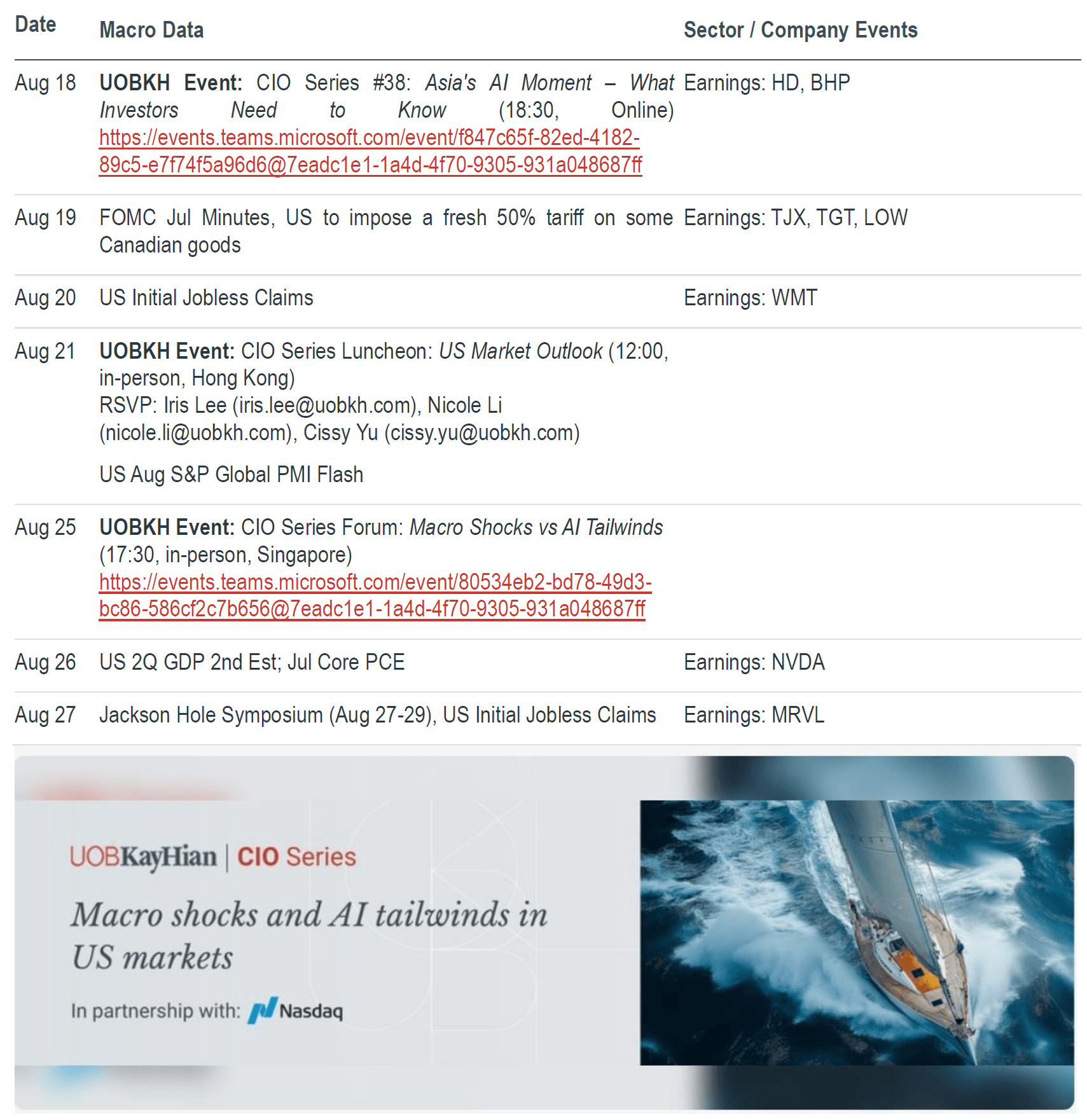
- Must Watch Events: FOMC Jul Minutes (Aug 19), US 2Q GDP 2nd Est; Jul Core PCE (Aug 26), Jackson Hole Symposium (Aug 27-29), US Aug Labor data (Sep 4). Earnings: WMT (Aug 20), NVDA (Aug 26), MRVL (Aug 27). Details below.
Leading Investor Signals
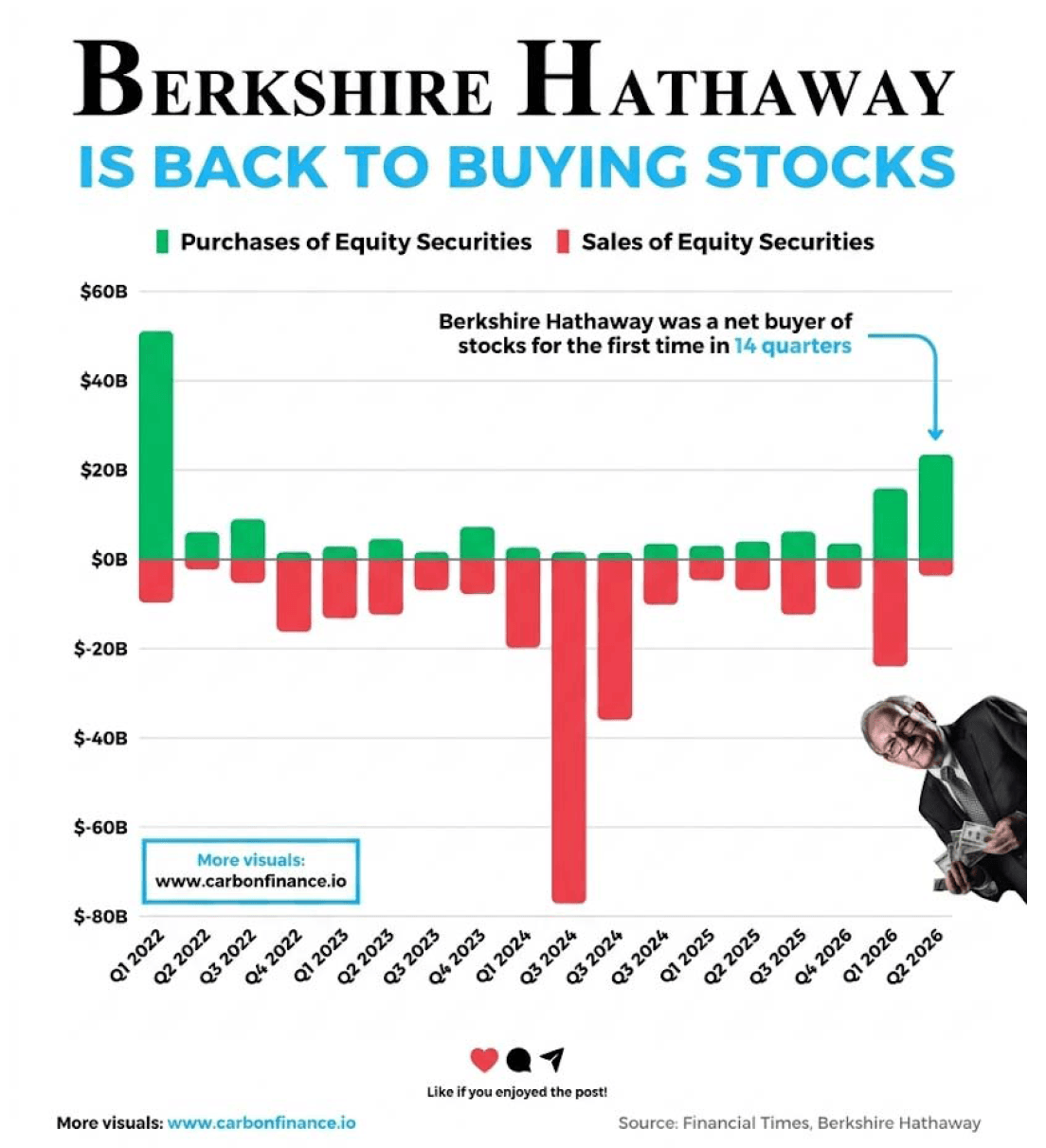
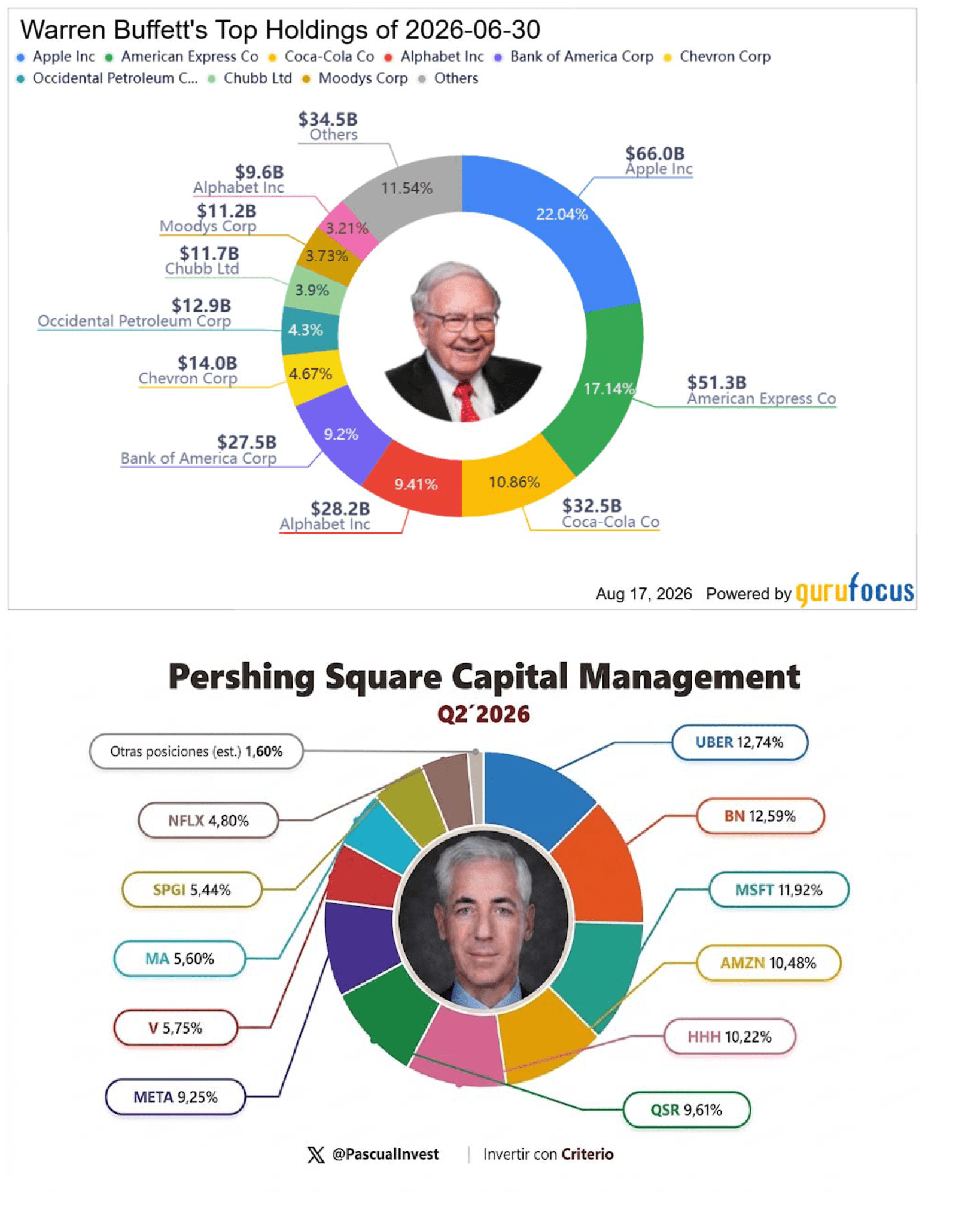
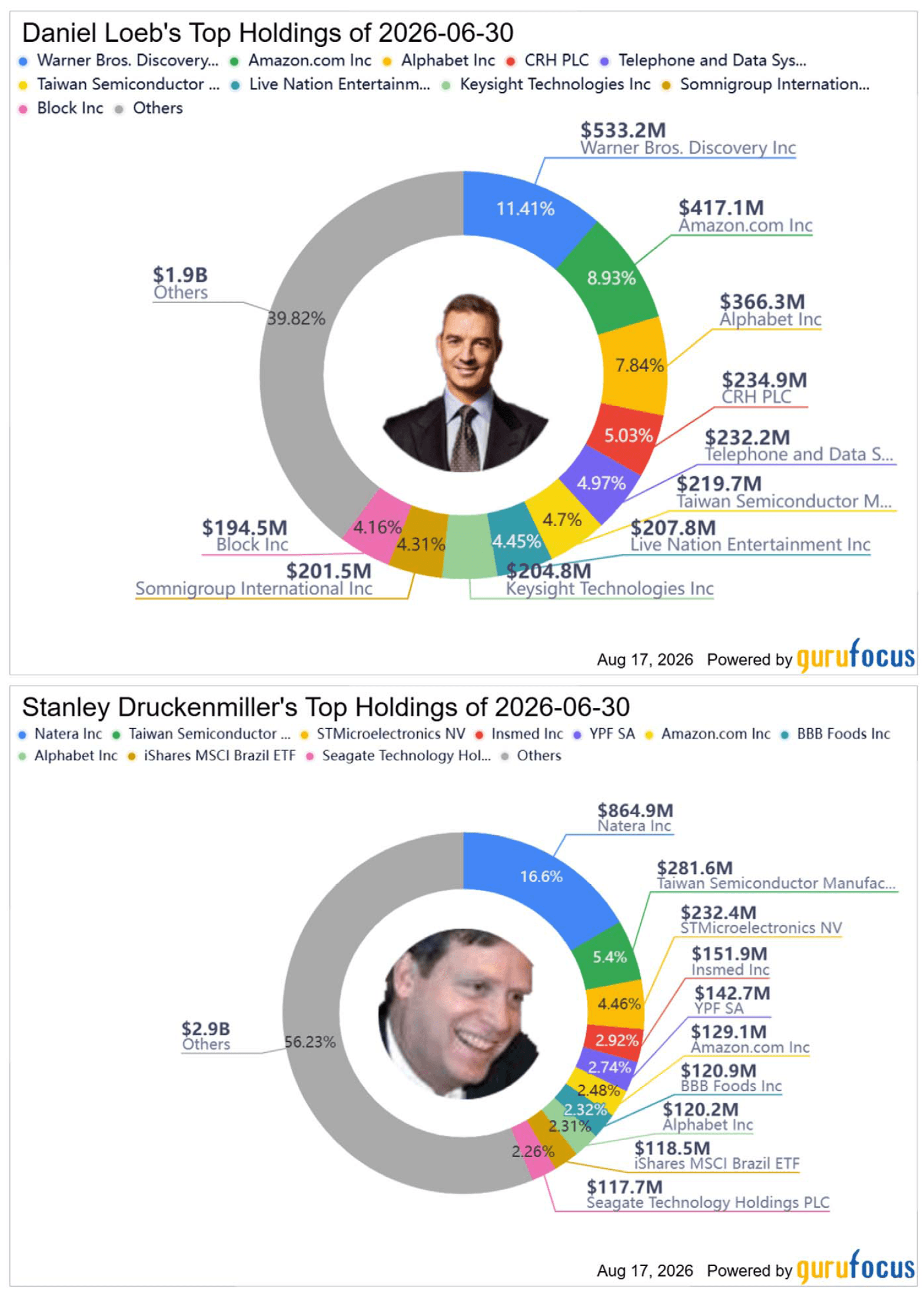
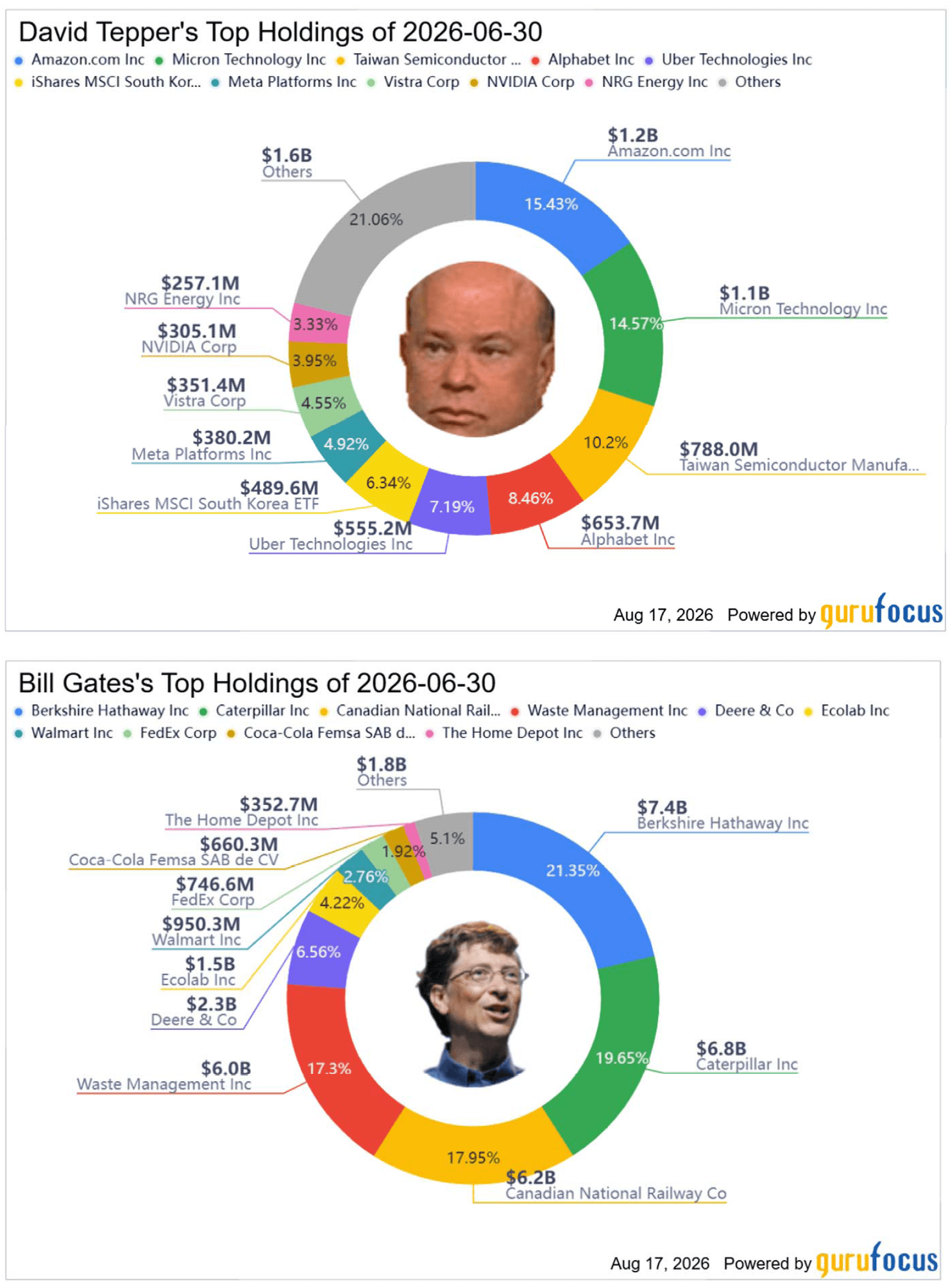
This edition’s Leading Investor Signals features President Trump latest developments (see below), as well as holding data from the quarterly 13F filings (see below and Appendix B). The most notable change is Berkshire Hathaway has finally resumed stock purchases – a constructive signal for the US market.
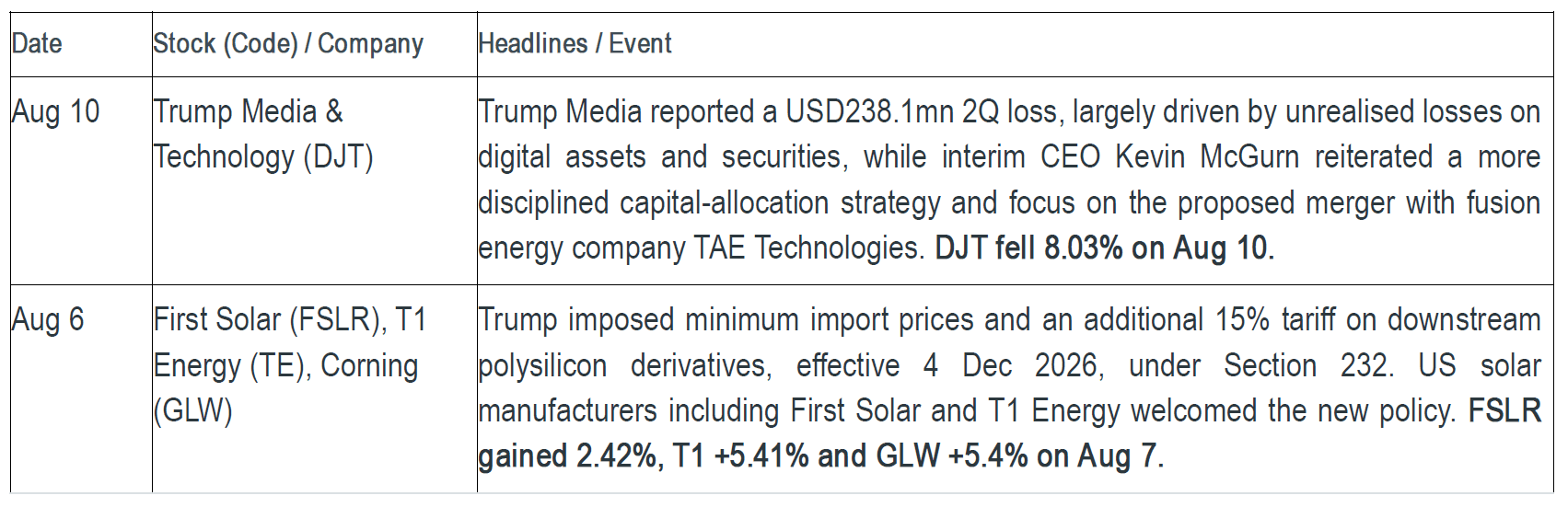
President Trump’s Investment-related News and Comments
For more quarterly holdings of leading investors, please refer to Appendix B.
Best 3 S&P Sectors (Past 2 Weeks)
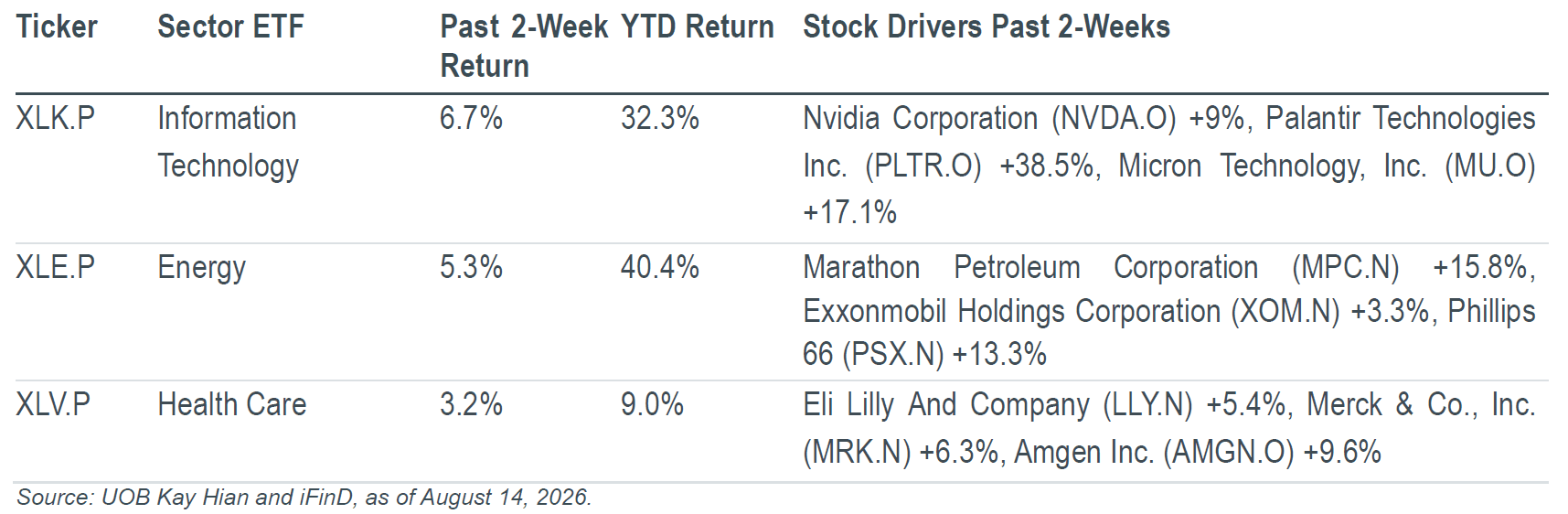
- Information Technology (XLK) staged a powerful 6.7% rally over the past two weeks, pushing its YTD return to a robust 32.3% and reclaiming the market champion. The surge validates our thesis on AI infrastructure growth and monetization opportunities. Nvidia (NVDA) climbed a steady 9.0% post its half-a-trillion-dollar MOUs (memorandums of understanding) with Wall Street, reinforcing its unassailable grip on the AI compute ecosystem. Palantir (PLTR) delivered an impressive 38.5% surge post its earnings beat and guidance raise. Micron Technology (MU) rallied 17.1%, buoyed by the robust long-term guidance raise from Sandisk that boosted sentiment across the memory industry. Robust 2Q results, along with hyperscaler capex increases, have restored investor confidence in the AI hardware sector. We maintain NVDA as a Core Recommendation and MU as Trading Buy.
- Energy (XLE) advanced 5.3%, extending its stellar YTD performance to an outstanding 40.4%. The sector continues to serve as a portfolio hedge against persistent geopolitical risks. However, the past two weeks saw rotation into downstream refining complex, with Marathon Petroleum (MPC) +15.8% and Phillips 66 (PSX) +13.3%, – both driven by favourable crack spreads. Integrated major ExxonMobil (XOM) added a steady 3.3%, being rewarded for its disciplined capital allocation and reliable shareholder returns. As long as geopolitical tail risks persist, energy remains an indispensable pillar in our barbell strategy. XLE remains our Core Recommendation.
- Health Care (XLV) posted a steady 3.2% gain, lifting its YTD return to 9.0% and reinstating its position as a defensive compounder, as investors re-balance their portfolios towards cash-flow-rich, non-cyclical businesses. Amgen (AMGN) led the pack with a 9.6% gain, supported by renewed optimism for its drug pipeline. Merck (MRK) advanced 6.3%, demonstrating the resilience of its diversified pharmaceutical franchise. Eli Lilly (LLY) added 5.4%, continuing its relentless advancement in scaling GLP-1 prescription market share. LLY remain our Core Recommendations and XLV is a Trading Buy.
Worst 3 S&P Sectors (Past 2 Weeks)
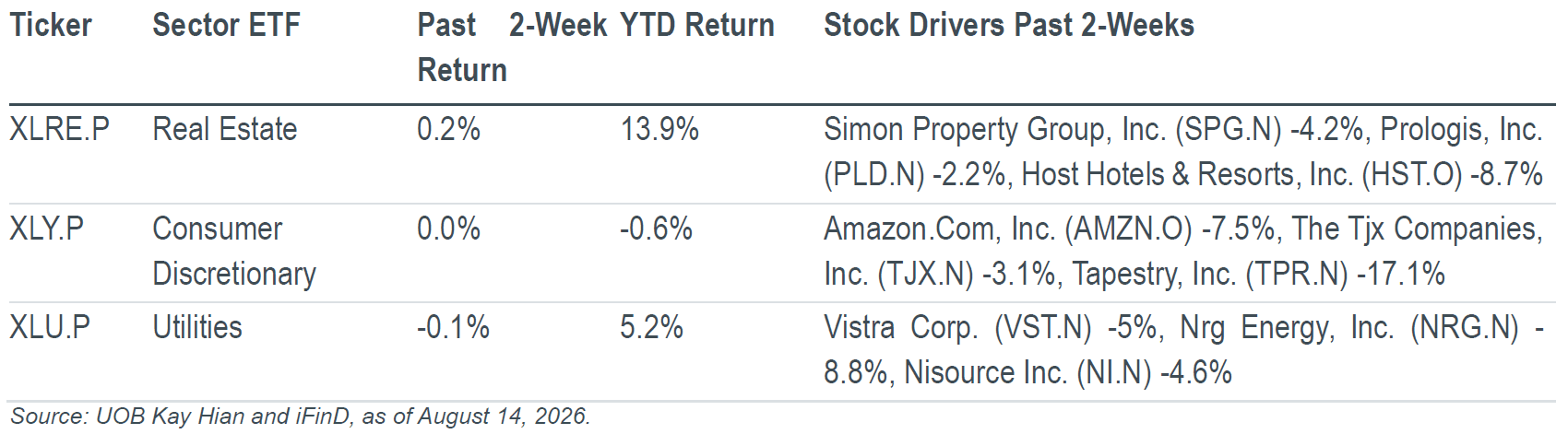
- Real Estate (XLRE) managed a marginal 0.2% gain, underperforming the broader market, though its YTD return remained a respectable 13.9%. Within the sector, REITs are highly sensitive to the interest rate trajectory, making them most vulnerable to the Fed rate hikes. Other sub-sectors also faced near-term headwinds: Host Hotels & Resorts (HST) dropped 8.7% on concerns over softening corporate travel demand, while Simon Property Group (SPG) and industrial logistics leader Prologis (PLD) retreated 4.2% and 2.2% respectively, amid broader profit-taking. Despite the consolidation, structural demand for modern logistics facilities and experiential retail support the logistics subsector’s fundamentals.
- Consumer Discretionary (XLY) stalled over the past two weeks, leaving the sector in negative YTD territory at -0.6%. The sector’s stagnation was directly catalyzed by disappointing US retail sales in July, which triggered a broad reassessment of cyclical consumption. Tapestry (TPR) suffered a severe 17.1% decline, as its conservative guidance and normalization of Coach sales validated mounting concerns over luxury spending power. Amazon (AMZN) pulled back 7.5%, as soft retail data fueled near-term concerns over e-commerce growth. TJX (TJX) dipped 3.1%, reflecting headwinds for the broader off-price retail narrative.
- Utilities (XLU) edged lower by 0.1%, moderating its YTD gain to 5.2%. The sector continues to face headwinds as a classic "bond proxy" amid lingering "Fed Wildcard" that push long-term yield to elevated levels. Independent power producers and traditional utilities face notable selling pressures: NRG Energy (NRG) fell 8.8%, Vistra Corp. (VST) declined 5.0%, and Nisource (NI) slipped 4.6%. While long-term structural narratives of AI-driven power demand and grid modernization remain intact, near-term flow rotation is playing against the sector.
Stocks: Potential Movers and Shakers

- Strong 2Q2026 operating performance. Operating earnings rose 16% yoy to USD 13.0bn, supported by broad-based strength across non-insurance businesses. Manufacturing, service and retailing earnings increased 24% to USD 4.5bn, Berkshire Hathaway Energy profit rose 27% to USD 891 mn andbnSF Railway earnings increased 6% to USD 1.6bn; insurance underwriting earnings declined 13% and insurance investment income fell 9%.
- Investment gains lifted reported net income. Net earnings more than doubled to USD 25.7bn from USD 12.4bn a year earlier, including USD 12.7bn of investment gains from the equity portfolio. Management continues to caution that quarterly net income can be volatile because unrealised market gains and losses are recognised through earnings.
- Capital deployment has turned more active. Cash and Treasury holdings declined to USD 360bn from a record USD 369bn in 1Q2026, reflecting USD 20.0bn of net equity purchases and USD 4.5bn of share buybacks. As noted, Berkshire was a net buyer of equities for the first time in 14 quarters, completed the Taylor Morrison acquisition and materially increased its Alphabet stake, indicating more proactive deployment of balance-sheet liquidity under Greg Abel. BRK remains our Core Recommendation amid ongoing macro uncertainties. (Jonathan Koh)

- UK approval expands oral GLP-1 access. Eli Lilly's Foundayo (orforglipron) received UK approval on 10 Aug 2026, expanding oral GLP-1 treatment options alongside Novo Nordisk's Wegovy pill. Access remains private while NICE conducts its cost-effectiveness review for NHS coverage.
- Competitive positioning remains important. Novo Nordisk has a roughly two-month head start and about 300,000 UK patients already on Wegovy pill. Lilly is positioning Foundayo's lack of food and water restrictions as a key differentiator.
- Early sales provide initial validation. The market reacted positively to the approval, while Foundayo generated USD 98mn of US sales in 2Q2026 following its April launch.
- Constructive long-term outlook. We remain positive on Lilly. UK entry opens another major market for Foundayo and supports the broader oral GLP-1 strategy alongside Mounjaro and Zepbound; slower US uptake to date appears more consistent with prescriber familiarity lag than a demand issue. LLY remains our Core Recommendation. (Tang Kai Jie)

- China retail deliveries weakened sharply. Tesla's July China deliveries fell 32.9% yoy and 48.5% mom to 27,249 units, marking a second consecutive yoy decline and pushing the brand out of China's top 10 NEV rankings. Shanghai exports moved in the opposite direction, reaching a record 66,330 units, up 143.2% yoy, with January-July exports of 295,324 units already exceeding the full-year 2025 total.
- Shanghai is increasingly serving as an export base. Tesla now ranks third in China's NEV exports with a 12.3% share. Elsewhere, the company ended the 1,021-day IF Metall strike in Sweden after buying out the remaining striking members, filed for a USD 10.1bn solar-cell factory in Texas alongside the SpaceX-led USD 16.8bn Terafab chip plant, and recalled 20,000 Model 3/Y vehicles over headlight brightness.
- Neutral as export strength offsets domestic pressure. Record exports cushion the China retail slowdown, but domestic deliveries have now declined yoy for two consecutive months and China revenue is becoming more dependent on overseas demand. Near-term catalysts are August China retail trends, the EU review of FSD and funding for the two Texas plants, both of which sit outside the core auto business. (Ken Lee)

- 2Q2026 EPS beat while revenue was broadly in line. McDonald's reported 2Q2 global comparable sales growth of 1% yoy. Revenue rose 2% yoy in constant currency to USD 7.1bn, 0.4% below consensus, while non-GAAP net income increased 4% yoy to USD 2.4bn. EPS of USD 3.38 rose 5% yoy and beat consensus by 2%.
- China same-store sales remained under pressure. International Developmental Licensed Markets comparable sales rose 2% yoy, led by Japan, but China same-store sales declined amid a challenging macro and consumer backdrop. Management maintained its plan to open more than 1,000 restaurants in China in 2026 and target 10,000 stores by 2028.
- 2026 guidance was trimmed on FX and the unit-opening timeline. The expected 2026 adjusted EPS tailwind from foreign exchange was reduced to USD 0.15 from USD 0.20-0.30 previously. McDonald's now expects to reach 50,000 restaurants globally in 2028 rather than by end-2027, while still targeting about 2,600 gross openings this year.
- International comps are expected to accelerate in 3Q2026. Management expects comparable sales growth in both International Operated Markets and International Developmental Licensed Markets to improve sequentially in 3Q2026. US comparable sales were slightly negative in July, with management focused on rebuilding guest traffic and maintaining its value positioning.
- Valuation supports long-term accumulation. The consensus target price was lowered 2% to USD 315.47 after the results, while the shares were little changed. McDonald's trades at about 20.0x NTM PE, around 15% below its 10-year average of 23.5x and roughly in line with the S&P 500, supporting our Neutral near-term view but a constructive long-term stance. (Ejann Hiew)

- 2Q2026 revenue missed expectations despite a strong EPS beat. Revenue reached CHF 850 mn, up 22% yoy on a constant-currency basis but 4% below Visible Alpha consensus. Gross margin improved 3.9ppt yoy to 65.4%, while adjusted net profit rose 497% yoy to CHF 118 mn and EPS of CHF 0.31 beat consensus by 9%.
- APAC remained the key growth engine, led by China. Asia-Pacific sales rose 55% yoy at constant currency, although growth slowed from 61% in 1Q2026. Management said China exceeded expectations across channels, including Tmall, while the first Macau store delivered above-average conversion.
- 2026 revenue guidance was reduced while margin guidance improved. Full-year net sales growth guidance was cut to the low-20s% from at least 23% previously, while gross margin guidance was raised to at least 65% on a higher direct-to-consumer mix.
- Inventory held back to protect premiumisation, not cleared through discounts. Inventory rose 13% yoy in 2Q2026 to CHF 473 mn, primarily volume-led, with FX also lifting the reported value. Management is deliberately restraining wholesale sell-in to avoid in-channel buildup that could undermine full-price integrity, while describing Americas softness as transitory. The company is widening its pricing architecture across three tiers: a USD 160 entry point, a USD 210-250 tier where management is seeing strong demand and moving significant volume, and a premium LightSpray tier of up to USD 290, where demand currently exceeds supply. Rather than discounting to clear inventory, management is holding firm on price, stating that lowering prices has never been part of its playbook.
- Difficult market environment for premiumisation. In our view, management's commentary sends a conflicting message: it remains confident in premium pricing power and refuses to discount despite higher inventory, yet simultaneously cut 2026 revenue growth guidance to the low-20s%. If the brand's pricing power were fully intact, we would expect this to be reflected more clearly in top-line growth rather than a guidance cut. The combination instead suggests that global inflationary pressure amid the Middle East conflict remains a headwind to premiumisation.
- Market remains sceptical; stay cautious on the stock for now. Following the results, the shares have fallen around 15% to date and the consensus target price has been cut 16% to USD 45.40, reflecting market scepticism over management retaining its no-discount stance amid the ongoing macro environment. This adds to broader institutional caution toward consumer discretionary stocks, which remain the worst-performing S&P sector YTD amid weak consumer confidence, inflation pressure and tariff risk. The stock has broken its one-year support level of USD 31.58, and we see potential for further downside toward USD 27.02. We suggest staying cautious on the stock for now. (Ejann Hiew)
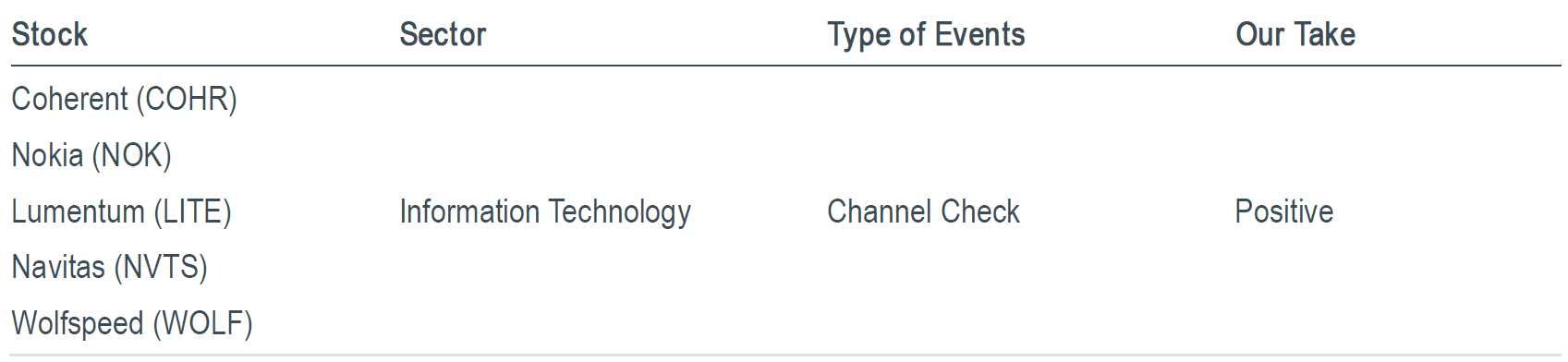
- Memory constraints are reshaping next-generation AI system design. Consensus expectations are shifting toward lower memory usage per rack for next-generation AI chips, alongside faster development of scale-up and scale-out interconnects to offset potential performance trade-offs. The shift reflects severe memory supply constraints and elevated memory costs.
- Optical interconnect suppliers should benefit from faster specification upgrades. A greater emphasis on scale-up and scale-out connectivity should accelerate demand for higher-performance optical components and networking solutions. We see Coherent (COHR), Lumentum (LITE) and Nokia (NOK) as key beneficiaries of this architecture shift.
- HVDC adoption is becoming increasingly important for next-generation racks. As scale-up architectures become a key development focus, adoption of 800V DC power distribution is moving closer to a necessity rather than an option. This should support high-voltage power semiconductor suppliers including Navitas Semiconductor (NVTS) and Wolfspeed (WOLF).
- Strong execution remains rewarded, but relative laggards offer catch-up potential. Lumentum's strong results and guidance should keep it among market favourites. However, we see more attractive relative value in recent underperformers including Coherent, Nokia, Navitas and Wolfspeed if AI infrastructure spending continues to broaden beyond memory and compute.
- Positive on beneficiaries of the architecture transition. We view the combination of memory scarcity, higher memory costs and faster interconnect and power-architecture upgrades as supportive for optical networking and HVDC-related suppliers. The key risk is a slower-than-expected transition in next-generation rack specifications. (Johnny Yum)
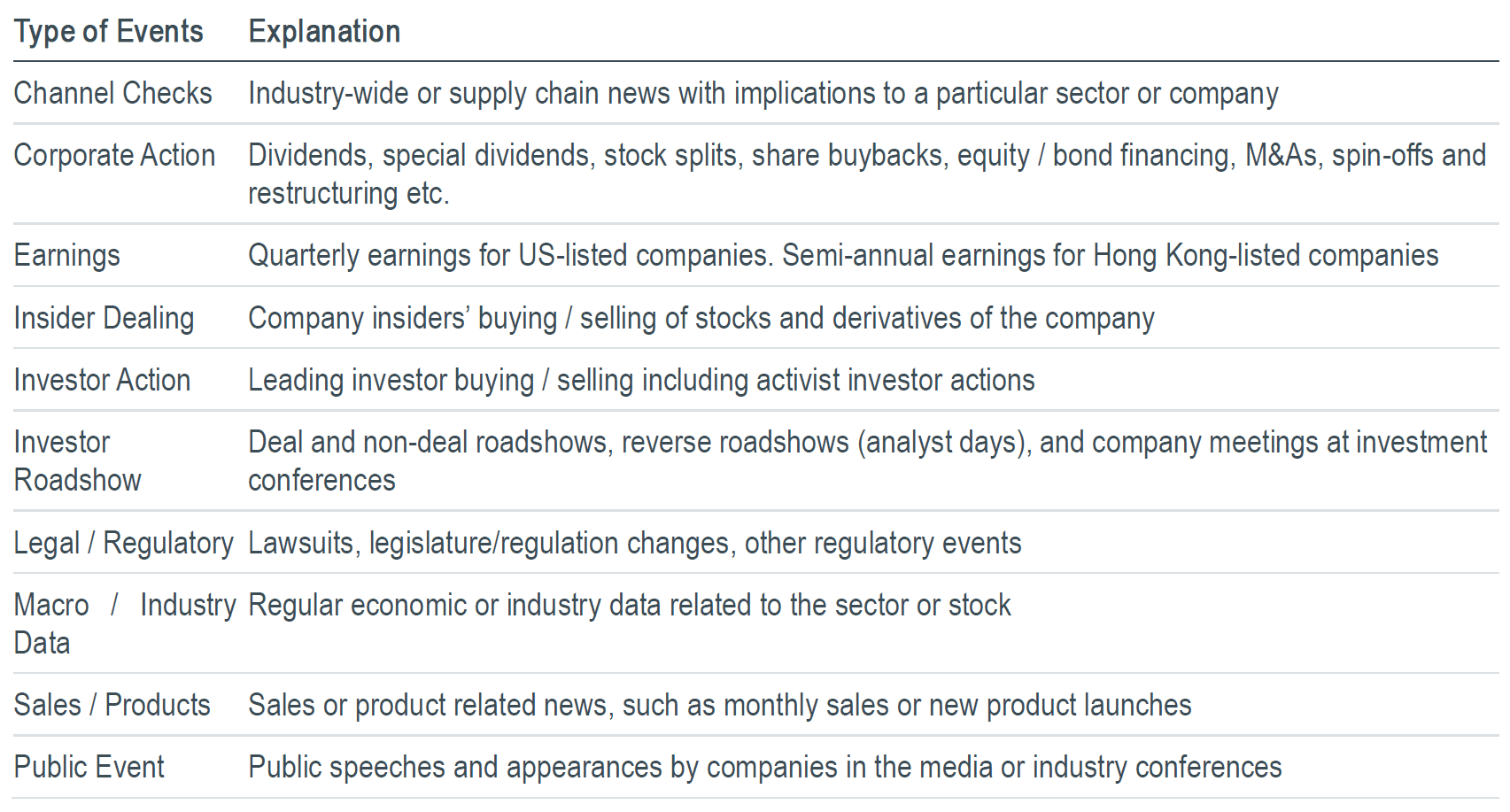
Appendix A – US Stock Model Portfolio
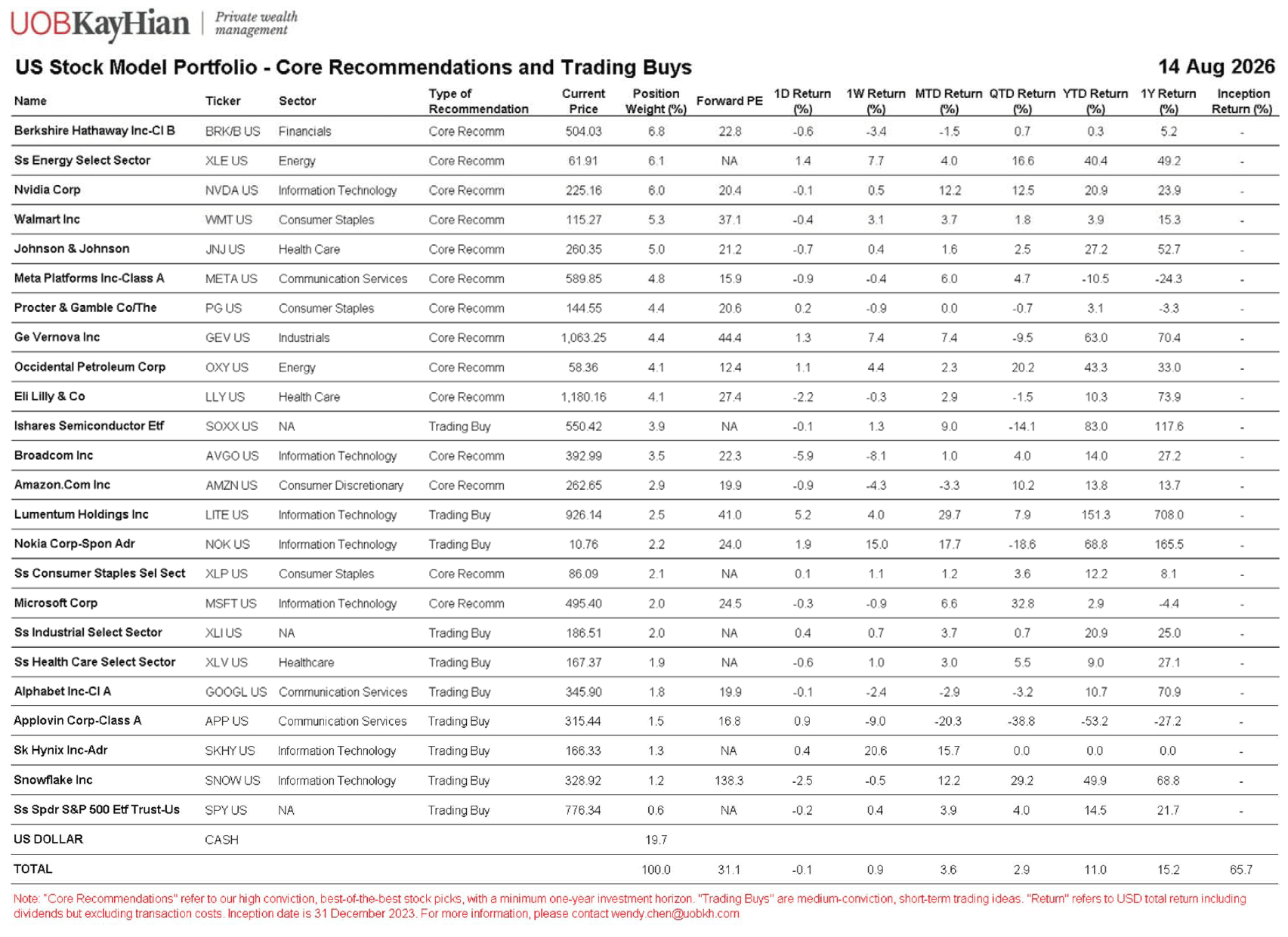
Appendix B – Leading Investor Signals
Below are quarterly holdings as of 30 June 2026, per the latest 13F filings.
Key US Market Indices
- US macro data: a synchronized cooling. July’s macro data delivered a synchronized cooling across key metrics: (1) Core CPI rose a benign 0.22% mom (in-line), providing a brief respite amid resurging oil prices in July; (2) Nonfarm payrolls unexpectedly contracted by 23K, well below the consensus forecast of an 80k gain; and (3) Retail sales declined 0.6% mom, missed expectations for an increase. Collectively, the softer prints drove FedWatch’s September hike odds down sharply from 55% to 30%, validating our view of the market’s “false hawkishness” in the near-term.
- US stock market: a synchronized rally. US equities posted a synchronized rally over the past two weeks, signaling a healthy reset in market dynamics. The tech-heavy Nasdaq Composite led the charge with a +3.1% gain, outpacing the S&P 500 (+2.4%) and the Dow Jones Industrial Average (+1.0%). YTD returns across all three indexes have surged to an impressive 15.0%/13.7%/11.8% respectively, signaling broad-based participation.
- Robust 2Q2026 earnings reaffirm underlying strength. The majority of S&P 500 companies have reported 2Q results – with revenue growth accelerating to the fastest pace since 2021, and earnings on track to surge nearly 50% yoy, vastly outpacing the +22% consensus. Even excluding outsized private investment gains, underlying earnings growth remained a robust +31% yoy in 2Q, according to Goldman Sachs.
- Near-term setup remains constructive. Our early-August call for a favorable technical setup has played out as expected, with a notable MTD rebound as the liquidation of Situation Awareness fund and aggressive momentum de-grossing ran their course. Looking ahead, the news flow will be lighter until Nvidia earnings (Aug 26) amd the Jackson Hole symposium (Aug 27-29). Amid resilient corporate fundamentals and the impending August share buyback window, the market backdrop looks favorable in the near term, with a potential market awakening likely in September-October.
- Must-read: our Leading Investor Signals including latest holding data from quarterly 13F filings.
- Best performing sectors: Info Tech (XLK), Energy (XLE), and Health Care (XLV).
- Potential movers and shakers:
- Must Watch Events: FOMC Jul Minutes (Aug 19), US 2Q GDP 2nd Est; Jul Core PCE (Aug 26), Jackson Hole Symposium (Aug 27-29), US Aug Labor data (Sep 4). Earnings: WMT (Aug 20), NVDA (Aug 26), MRVL (Aug 27). Details below.
Leading Investor Signals
This edition’s Leading Investor Signals features President Trump latest developments (see below), as well as holding data from the quarterly 13F filings (see below and Appendix B). The most notable change is Berkshire Hathaway has finally resumed stock purchases – a constructive signal for the US market.
President Trump’s Investment-related News and Comments
For more quarterly holdings of leading investors, please refer to Appendix B.
Best 3 S&P Sectors (Past 2 Weeks)
- Information Technology (XLK) staged a powerful 6.7% rally over the past two weeks, pushing its YTD return to a robust 32.3% and reclaiming the market champion. The surge validates our thesis on AI infrastructure growth and monetization opportunities. Nvidia (NVDA) climbed a steady 9.0% post its half-a-trillion-dollar MOUs (memorandums of understanding) with Wall Street, reinforcing its unassailable grip on the AI compute ecosystem. Palantir (PLTR) delivered an impressive 38.5% surge post its earnings beat and guidance raise. Micron Technology (MU) rallied 17.1%, buoyed by the robust long-term guidance raise from Sandisk that boosted sentiment across the memory industry. Robust 2Q results, along with hyperscaler capex increases, have restored investor confidence in the AI hardware sector. We maintain NVDA as a Core Recommendation and MU as Trading Buy.
- Energy (XLE) advanced 5.3%, extending its stellar YTD performance to an outstanding 40.4%. The sector continues to serve as a portfolio hedge against persistent geopolitical risks. However, the past two weeks saw rotation into downstream refining complex, with Marathon Petroleum (MPC) +15.8% and Phillips 66 (PSX) +13.3%, – both driven by favourable crack spreads. Integrated major ExxonMobil (XOM) added a steady 3.3%, being rewarded for its disciplined capital allocation and reliable shareholder returns. As long as geopolitical tail risks persist, energy remains an indispensable pillar in our barbell strategy. XLE remains our Core Recommendation.
- Health Care (XLV) posted a steady 3.2% gain, lifting its YTD return to 9.0% and reinstating its position as a defensive compounder, as investors re-balance their portfolios towards cash-flow-rich, non-cyclical businesses. Amgen (AMGN) led the pack with a 9.6% gain, supported by renewed optimism for its drug pipeline. Merck (MRK) advanced 6.3%, demonstrating the resilience of its diversified pharmaceutical franchise. Eli Lilly (LLY) added 5.4%, continuing its relentless advancement in scaling GLP-1 prescription market share. LLY remain our Core Recommendations and XLV is a Trading Buy.
Worst 3 S&P Sectors (Past 2 Weeks)
- Real Estate (XLRE) managed a marginal 0.2% gain, underperforming the broader market, though its YTD return remained a respectable 13.9%. Within the sector, REITs are highly sensitive to the interest rate trajectory, making them most vulnerable to the Fed rate hikes. Other sub-sectors also faced near-term headwinds: Host Hotels & Resorts (HST) dropped 8.7% on concerns over softening corporate travel demand, while Simon Property Group (SPG) and industrial logistics leader Prologis (PLD) retreated 4.2% and 2.2% respectively, amid broader profit-taking. Despite the consolidation, structural demand for modern logistics facilities and experiential retail support the logistics subsector’s fundamentals.
- Consumer Discretionary (XLY) stalled over the past two weeks, leaving the sector in negative YTD territory at -0.6%. The sector’s stagnation was directly catalyzed by disappointing US retail sales in July, which triggered a broad reassessment of cyclical consumption. Tapestry (TPR) suffered a severe 17.1% decline, as its conservative guidance and normalization of Coach sales validated mounting concerns over luxury spending power. Amazon (AMZN) pulled back 7.5%, as soft retail data fueled near-term concerns over e-commerce growth. TJX (TJX) dipped 3.1%, reflecting headwinds for the broader off-price retail narrative.
- Utilities (XLU) edged lower by 0.1%, moderating its YTD gain to 5.2%. The sector continues to face headwinds as a classic "bond proxy" amid lingering "Fed Wildcard" that push long-term yield to elevated levels. Independent power producers and traditional utilities face notable selling pressures: NRG Energy (NRG) fell 8.8%, Vistra Corp. (VST) declined 5.0%, and Nisource (NI) slipped 4.6%. While long-term structural narratives of AI-driven power demand and grid modernization remain intact, near-term flow rotation is playing against the sector.
Stocks: Potential Movers and Shakers
- Strong 2Q2026 operating performance. Operating earnings rose 16% yoy to USD 13.0bn, supported by broad-based strength across non-insurance businesses. Manufacturing, service and retailing earnings increased 24% to USD 4.5bn, Berkshire Hathaway Energy profit rose 27% to USD 891 mn andbnSF Railway earnings increased 6% to USD 1.6bn; insurance underwriting earnings declined 13% and insurance investment income fell 9%.
- Investment gains lifted reported net income. Net earnings more than doubled to USD 25.7bn from USD 12.4bn a year earlier, including USD 12.7bn of investment gains from the equity portfolio. Management continues to caution that quarterly net income can be volatile because unrealised market gains and losses are recognised through earnings.
- Capital deployment has turned more active. Cash and Treasury holdings declined to USD 360bn from a record USD 369bn in 1Q2026, reflecting USD 20.0bn of net equity purchases and USD 4.5bn of share buybacks. As noted, Berkshire was a net buyer of equities for the first time in 14 quarters, completed the Taylor Morrison acquisition and materially increased its Alphabet stake, indicating more proactive deployment of balance-sheet liquidity under Greg Abel. BRK remains our Core Recommendation amid ongoing macro uncertainties. (Jonathan Koh)
- UK approval expands oral GLP-1 access. Eli Lilly's Foundayo (orforglipron) received UK approval on 10 Aug 2026, expanding oral GLP-1 treatment options alongside Novo Nordisk's Wegovy pill. Access remains private while NICE conducts its cost-effectiveness review for NHS coverage.
- Competitive positioning remains important. Novo Nordisk has a roughly two-month head start and about 300,000 UK patients already on Wegovy pill. Lilly is positioning Foundayo's lack of food and water restrictions as a key differentiator.
- Early sales provide initial validation. The market reacted positively to the approval, while Foundayo generated USD 98mn of US sales in 2Q2026 following its April launch.
- Constructive long-term outlook. We remain positive on Lilly. UK entry opens another major market for Foundayo and supports the broader oral GLP-1 strategy alongside Mounjaro and Zepbound; slower US uptake to date appears more consistent with prescriber familiarity lag than a demand issue. LLY remains our Core Recommendation. (Tang Kai Jie)
- China retail deliveries weakened sharply. Tesla's July China deliveries fell 32.9% yoy and 48.5% mom to 27,249 units, marking a second consecutive yoy decline and pushing the brand out of China's top 10 NEV rankings. Shanghai exports moved in the opposite direction, reaching a record 66,330 units, up 143.2% yoy, with January-July exports of 295,324 units already exceeding the full-year 2025 total.
- Shanghai is increasingly serving as an export base. Tesla now ranks third in China's NEV exports with a 12.3% share. Elsewhere, the company ended the 1,021-day IF Metall strike in Sweden after buying out the remaining striking members, filed for a USD 10.1bn solar-cell factory in Texas alongside the SpaceX-led USD 16.8bn Terafab chip plant, and recalled 20,000 Model 3/Y vehicles over headlight brightness.
- Neutral as export strength offsets domestic pressure. Record exports cushion the China retail slowdown, but domestic deliveries have now declined yoy for two consecutive months and China revenue is becoming more dependent on overseas demand. Near-term catalysts are August China retail trends, the EU review of FSD and funding for the two Texas plants, both of which sit outside the core auto business. (Ken Lee)
- 2Q2026 EPS beat while revenue was broadly in line. McDonald's reported 2Q2 global comparable sales growth of 1% yoy. Revenue rose 2% yoy in constant currency to USD 7.1bn, 0.4% below consensus, while non-GAAP net income increased 4% yoy to USD 2.4bn. EPS of USD 3.38 rose 5% yoy and beat consensus by 2%.
- China same-store sales remained under pressure. International Developmental Licensed Markets comparable sales rose 2% yoy, led by Japan, but China same-store sales declined amid a challenging macro and consumer backdrop. Management maintained its plan to open more than 1,000 restaurants in China in 2026 and target 10,000 stores by 2028.
- 2026 guidance was trimmed on FX and the unit-opening timeline. The expected 2026 adjusted EPS tailwind from foreign exchange was reduced to USD 0.15 from USD 0.20-0.30 previously. McDonald's now expects to reach 50,000 restaurants globally in 2028 rather than by end-2027, while still targeting about 2,600 gross openings this year.
- International comps are expected to accelerate in 3Q2026. Management expects comparable sales growth in both International Operated Markets and International Developmental Licensed Markets to improve sequentially in 3Q2026. US comparable sales were slightly negative in July, with management focused on rebuilding guest traffic and maintaining its value positioning.
- Valuation supports long-term accumulation. The consensus target price was lowered 2% to USD 315.47 after the results, while the shares were little changed. McDonald's trades at about 20.0x NTM PE, around 15% below its 10-year average of 23.5x and roughly in line with the S&P 500, supporting our Neutral near-term view but a constructive long-term stance. (Ejann Hiew)
- 2Q2026 revenue missed expectations despite a strong EPS beat. Revenue reached CHF 850 mn, up 22% yoy on a constant-currency basis but 4% below Visible Alpha consensus. Gross margin improved 3.9ppt yoy to 65.4%, while adjusted net profit rose 497% yoy to CHF 118 mn and EPS of CHF 0.31 beat consensus by 9%.
- APAC remained the key growth engine, led by China. Asia-Pacific sales rose 55% yoy at constant currency, although growth slowed from 61% in 1Q2026. Management said China exceeded expectations across channels, including Tmall, while the first Macau store delivered above-average conversion.
- 2026 revenue guidance was reduced while margin guidance improved. Full-year net sales growth guidance was cut to the low-20s% from at least 23% previously, while gross margin guidance was raised to at least 65% on a higher direct-to-consumer mix.
- Inventory held back to protect premiumisation, not cleared through discounts. Inventory rose 13% yoy in 2Q2026 to CHF 473 mn, primarily volume-led, with FX also lifting the reported value. Management is deliberately restraining wholesale sell-in to avoid in-channel buildup that could undermine full-price integrity, while describing Americas softness as transitory. The company is widening its pricing architecture across three tiers: a USD 160 entry point, a USD 210-250 tier where management is seeing strong demand and moving significant volume, and a premium LightSpray tier of up to USD 290, where demand currently exceeds supply. Rather than discounting to clear inventory, management is holding firm on price, stating that lowering prices has never been part of its playbook.
- Difficult market environment for premiumisation. In our view, management's commentary sends a conflicting message: it remains confident in premium pricing power and refuses to discount despite higher inventory, yet simultaneously cut 2026 revenue growth guidance to the low-20s%. If the brand's pricing power were fully intact, we would expect this to be reflected more clearly in top-line growth rather than a guidance cut. The combination instead suggests that global inflationary pressure amid the Middle East conflict remains a headwind to premiumisation.
- Market remains sceptical; stay cautious on the stock for now. Following the results, the shares have fallen around 15% to date and the consensus target price has been cut 16% to USD 45.40, reflecting market scepticism over management retaining its no-discount stance amid the ongoing macro environment. This adds to broader institutional caution toward consumer discretionary stocks, which remain the worst-performing S&P sector YTD amid weak consumer confidence, inflation pressure and tariff risk. The stock has broken its one-year support level of USD 31.58, and we see potential for further downside toward USD 27.02. We suggest staying cautious on the stock for now. (Ejann Hiew)
- Memory constraints are reshaping next-generation AI system design. Consensus expectations are shifting toward lower memory usage per rack for next-generation AI chips, alongside faster development of scale-up and scale-out interconnects to offset potential performance trade-offs. The shift reflects severe memory supply constraints and elevated memory costs.
- Optical interconnect suppliers should benefit from faster specification upgrades. A greater emphasis on scale-up and scale-out connectivity should accelerate demand for higher-performance optical components and networking solutions. We see Coherent (COHR), Lumentum (LITE) and Nokia (NOK) as key beneficiaries of this architecture shift.
- HVDC adoption is becoming increasingly important for next-generation racks. As scale-up architectures become a key development focus, adoption of 800V DC power distribution is moving closer to a necessity rather than an option. This should support high-voltage power semiconductor suppliers including Navitas Semiconductor (NVTS) and Wolfspeed (WOLF).
- Strong execution remains rewarded, but relative laggards offer catch-up potential. Lumentum's strong results and guidance should keep it among market favourites. However, we see more attractive relative value in recent underperformers including Coherent, Nokia, Navitas and Wolfspeed if AI infrastructure spending continues to broaden beyond memory and compute.
- Positive on beneficiaries of the architecture transition. We view the combination of memory scarcity, higher memory costs and faster interconnect and power-architecture upgrades as supportive for optical networking and HVDC-related suppliers. The key risk is a slower-than-expected transition in next-generation rack specifications. (Johnny Yum)
Appendix A – US Stock Model Portfolio
Appendix B – Leading Investor Signals
Below are quarterly holdings as of 30 June 2026, per the latest 13F filings.
Analyst
Qi Wang, CFA
qi.wang@uobkh.comAnalyst
Wendy Chen
wendy.chen@uobkh.comAnalyst
In connection with UOBKH institutional research
Disclosures and disclaimers
This report is provided subject to, and must be read together with, the full Disclosures / Disclaimers available at this link, which are incorporated by reference into this report. In particular, this report is intended for general circulation and informational purposes only and does not constitute personal investment advice or a recommendation to buy or sell any investment product or security. You should independently evaluate the information and, where necessary, seek advice from a qualified financial adviser regarding the suitability of any investment. Analyst certifications required under applicable regulations, including SEC Regulation AC (where relevant), are included in this report. By accessing, receiving or using this report, you acknowledge that you have read, understood and agreed to be bound by the Disclosures / Disclaimers, as may be amended, supplemented or updated from time to time.


