

Wealth Daily
Cooling US Payrolls Ease Fed Hike Concerns
Today’s Must-Know News
Overnight Markets
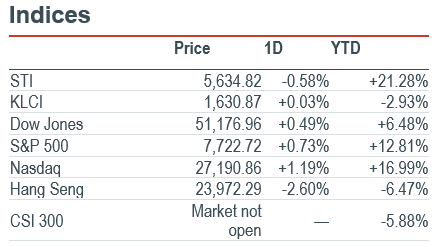
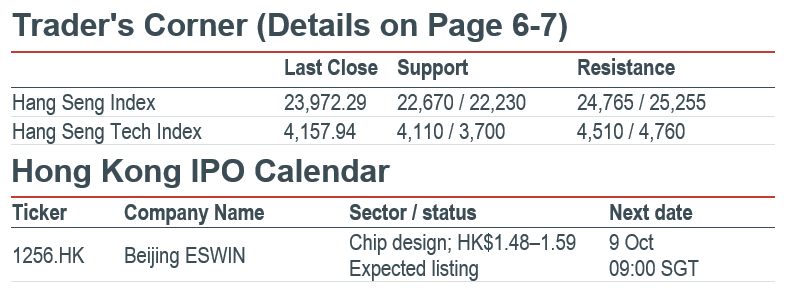
Market Movers: HSBC (0005.HK) fell about 5.4% to HK$149.50 in the 2 October Hong Kong session as rising bond yields pressured banks. The S&P 500 gained 0.73% in the later US session. Tesla (TSLA US) rose about 4.7% to US$370.59 after reporting third-quarter deliveries of 486,532; Seagate (STX US) fell about 10.2% to US$848.99 on reported Toshiba capacity-expansion plans. Separately, Amazon (AMZN US) reportedly sought investors for US$8bn of Nvidia chips through a proposed leaseback structure, highlighting AI funding demands. (Reuters / Reuters / Reuters) HSBC (0005.HK) and Amazon (AMZN US) are our Core Recommendations.
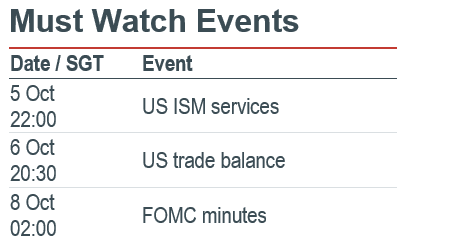
Macro: September US payrolls rose 29,000, unemployment reached 4.2%, and earlier job gains were revised down by 60,000. Wages increased 0.1% month on month and 3.0% year on year. The softer hiring mix eased immediate overheating concerns. ISM services is due at 22:00 SGT on 5 October, testing demand and price pressures. (BLS / ISM)
Geopolitical: Houthi claims of strikes on Saudi Aramco sites added weekend supply uncertainty. The claims concerned Riyadh and Khurais facilities. Confirmed damage or lost output was not established in the Reuters report, leaving energy-sensitive assets exposed to further supply headlines. Friday's oil settlements predate these developments. (Reuters)
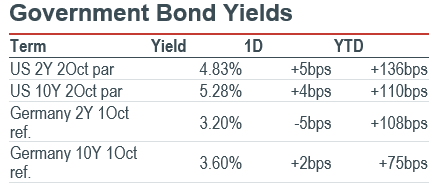
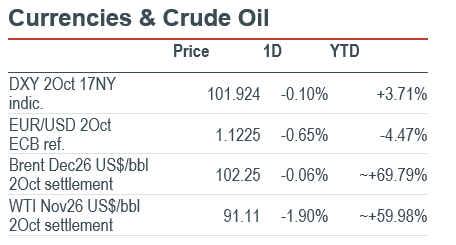
FICC: OPEC+ retained September production targets for November at Sunday's meeting. The G7's 100m-barrel release over four months includes earlier commitments, and a substantial diesel release within 20 days; it is not wholly additional supply. The US 10-year par yield reached 5.28%, up 4bps at Friday's official reference. (OPEC / G7 / US Treasury)
AI
Amazon explores outside funding for AI chips. Amazon (AMZN US) reportedly seeks investors for US$8bn of Nvidia chips. Reuters, citing the Financial Times on 2 October, said a proposed vehicle would own Grace Blackwell chips across more than a dozen US data centres and lease them to Amazon. Talks remain ongoing. The proposal offers financing flexibility, while lease costs and equipment-risk allocation remain unresolved. (Reuters) Amazon (AMZN US) is our Core Recommendation.
Storage stocks reprice prospective competition. Seagate (STX US) and Western Digital (WDC US) each fell about 10.2% in the 2 October US regular session, to US$848.99 and US$415.29 respectively. Reuters cited a Nikkei report that Toshiba plans to double hard-drive capacity by fiscal 2027. Prospective supply competition could pressure storage pricing; the report establishes neither completed additional output nor weaker demand. (Reuters)
Cash merger terms lift Synaptics and onsemi. Synaptics (SYNA US) rose about 14.1% to US$121.10 in the 2 October US session after the prior day's merger revision; onsemi (ON US) gained about 6.0% to US$84.89. The amended US$123-per-share cash offer values Synaptics equity at US$5.7bn. The edge-AI combination targets mid-2027 completion and immediate non-GAAP earnings accretion, subject to shareholder and remaining regulatory approvals. (onsemi / Reuters)
White House names federal AI coordination team. President Trump named intelligence director Jay Clayton to lead a federal AI task force on Sunday. Members include FTC chair Andrew Ferguson, Pentagon technology chief Emil Michael and personnel director Scott Kupor. Its remit covers engagement with AI companies, consumers and critical-infrastructure providers. The appointments create an oversight coordination channel; the reports identified no new binding operating rules or funding commitment. (AP / DW)
Americas
Tesla deliveries support Friday rebound. Tesla (TSLA US) rose about 4.7% to US$370.59 in the 2 October US regular session after its delivery update. 3Q deliveries were 486,532 vehicles, against production of 464,391; energy-storage deployments reached 13.7GWh. Volumes support the operating-demand picture, but do not establish financial performance. Pricing, product mix and costs remain central to assessing the earnings contribution. (Tesla / Reuters)
US hiring slows as earlier gains are revised. September US payrolls rose 29,000 and unemployment reached 4.2%, the 2 October release showed. July and August gains were revised down by 60,000. Average hourly earnings increased 0.1% month on month and 3.0% year on year. Softer hiring and wages reduce immediate tightening pressure, but also raise demand concerns; inflation evidence remains necessary to establish the rate outlook. (BLS)
Nike falls as outlook outweighs margin improvement. Nike (NKE US) fell about 3.6% to US$33.87 on 2 October after the prior evening's fiscal first-quarter results. Revenue declined 4% to US$11.21bn, while gross margin improved 60 basis points to 42.8%. The company forecast a high-single-digit revenue decline for fiscal 2027 and adjusted earnings of US$1.15–1.35 per share. Its cost programme provides a potential profit buffer, but the weak sales outlook leaves the pace of demand recovery central to the turnaround. (Nike / Reuters)
Disney opens selected titles to Netflix. Disney (DIS US) and Netflix (NFLX US) confirmed a new licensing agreement on 2 October covering films and television series. The first two seasons of Percy Jackson and the Olympians are available globally on Netflix from 4 October for three months; the five Ice Age films also receive a three-month window. Selected Disney and Pixar films follow from early 2027, with launch dates and territories varying. The arrangement provides another route to monetise the library, although financial terms were not disclosed. (Reuters)
Rivian retains full-year delivery range. Rivian (RIVN US) reported 19,248 third-quarter deliveries on 2 October and maintained its annual outlook. Production reached 19,751 vehicles, and the company retained its full-year delivery range of 65,000–70,000, describing the quarter as consistent with expectations. The shares nonetheless closed about 3.1% lower at US$14.30. The unchanged guidance leaves execution over the remaining quarter as the immediate test; the volume release does not by itself establish progress on margins, cash use or sustainable profitability. (Rivian)
Greater China
HSBC's selloff exposed Hong Kong banks' sensitivity to global rates. HSBC (0005.HK) fell about 5.4% to HK$149.50 in Friday's Hong Kong session as banks led a broader retreat. Reuters linked the weakness to the preceding rise in US yields, while mainland holidays removed Southbound buying support. Higher rates can lift asset income, but also raise funding costs and pressure credit demand; the sharp repricing shows why the net interest margin benefit should not be treated as a one-way earnings catalyst. (Reuters) HSBC (0005.HK) is our Core Recommendation.
Galaxy's Friday decline kept attention on Macau gaming demand. Galaxy Entertainment (0027.HK) lost about 4.2% to HK$30.30 in Friday's Hong Kong session, with Reuters reporting casino weakness after September gaming revenue continued to fall. The decline kept the focus on the quality of spending during the holiday travel period. For casino operators, stronger holiday visitation will matter only if it converts into gaming spend and operating profit, making demand quality more useful than visitor volumes alone. (Reuters) Galaxy Entertainment (0027.HK) is our Core Recommendation.
New World's lease exit offers cash savings but leaves a costly reset. New World Development (0017.HK) fell about 3.8% to HK$5.82 in Friday's Hong Kong session. In a fresh Friday assessment, Citi said the previously announced 11 SKIES sublease termination removed minimum annual rent of HK$1.8bn through September 2066. Dow Jones reported HK$18.3bn of associated impairment, including HK$2.3bn of early termination costs. The cash-flow relief is material, but the charge illustrates how expensive it can be to unwind underperforming property commitments. (Dow Jones)
Hong Kong's retail rebound remained uneven beneath the headline. August retail sales, released Friday, rose 5.6% year on year to HK$32.1bn, while sales volume grew 2.9%. Jewellery, watches and valuable gifts increased 11.9%, but motor vehicles fell 22.0% and clothing declined 0.5%. The value-volume gap and divergent categories suggest retailers cannot rely on a broad consumer recovery. Product mix and exposure to discretionary big-ticket purchases remain important in assessing revenue growth and earnings conversion. (Hong Kong Government)
Asia ex. China
DFI's Starbucks reshaping brings a near-term earnings trade-off. DFI Retail (D01 SP) fell about 8.8% to US$3.10 in Friday's Singapore session as analysts assessed its previously announced Starbucks transaction. DBS estimated a US$43m FY2027 net earnings shortfall, despite US$340m of cash proceeds, according to Business Times. The Friday assessment shifted attention from disposal cash to recurring profit. A steadier operating structure may help over time, but reinvestment returns and the pace of replacing the foregone contribution will determine whether value is created. (Business Times / Business Times)
UNIQLO's September growth relied on higher spending per shopper. Fast Retailing (9983 JP) reported in its Friday update that UNIQLO Japan same-store sales, including online, rose 10.8% year on year in September. Customer numbers fell 0.5%, while average spending increased 11.3%; total directly operated store and online sales gained 9.9%. The company cited cooler weather and demand for autumn and winter products. The stronger basket size supports sales, but weak traffic leaves the durability of demand dependent on product mix and seasonal purchasing. (Fast Retailing)
Singapore electronics strength sharpened the gap with supply constraints. September's manufacturing PMI, released at 9.00pm SGT on Friday, rose to 51.7 from 51.5, while electronics climbed to 52.9 from 52.6. Business Times reported stronger AI-related demand alongside growing order backlogs and pressure from input costs and delivery times. The survey supports continued activity growth, but improving orders do not automatically translate into higher margins. Electronics suppliers with capacity and pricing power appear better placed than manufacturers facing energy and feedstock constraints. (SIPMM / Business Times)
Tohoku bank integration talks put scale and costs in focus. Procrea Holdings (7384 JP), Akita Bank (8343 JP) and Iwate Bank (8345 JP) agreed on Friday to begin discussions on a holding-company integration, targeting April 2028. Their combined assets were about JPY13.3tn at end-March. The banks cited population decline and rising technology and cybersecurity requirements. A shared platform could spread investment costs across a larger balance sheet, but the target remains subject to negotiations and approvals, with integration terms still to be settled. (Procrea Holdings / Strike)
RTS Link's revised target shifts attention to certification. Singapore and Malaysia said on Friday that passenger services on the Johor Bahru-Singapore RTS Link are now targeted for February 2027, subject to independent safety certification and final approvals. The operator expects testing and trial runs to finish by end-2026. The four-kilometre link is designed to carry up to 10,000 passengers an hour in each direction. The delay defers the cross-border commuting benefit and leaves certification, rather than completed infrastructure, as the key execution risk. (LTA / CNA)
EMEA and Others
Infineon's rebound showed renewed appetite for chip exposure. Infineon (IFX GY) gained about 8.8% to EUR64.64 in Friday's completed Xetra session as European technology shares rebounded on renewed AI-related buying, according to Reuters and Dow Jones. Its strength shows how quickly semiconductor expectations can dominate daily performance, but investors still need company-level order and margin evidence to distinguish durable earnings improvement from a recovery in risk appetite. (Reuters / Dow Jones)
Bayer's US$2.2bn Ohio investment extends its US growth commitment. Bayer (BAYN GY) announced on Friday a US$2.2bn pharmaceutical manufacturing site in New Albany, Ohio, expected to create around 600 jobs. Drug-substance production is planned for 2031 and finished products for 2034. Reuters reported that the US now supplies 35% of pharma revenue, versus 20% in 2018. The project strengthens local supply capacity, but its long construction timetable makes execution and cash returns more relevant than any immediate earnings contribution. (Bayer / Reuters)
IG's revenue warning exposed weak conversion of customer growth. IG Group (IGG LN) fell about 22.6% to 990p in Friday's London session after reporting approximately GBP240m of third-quarter revenue, down 14% year on year, and guiding to mid-single-digit full-year revenue growth. Its OTC revenue retention was around 70%, against about 80% since the second half of 2025. Although first trades rose more than 25%, weaker retention shows why customer acquisition alone cannot offset a poorer trading mix and lower revenue capture. (IG Group / Reuters)
Julius Baer's buyback clarifies the route for surplus capital. Julius Baer (BAER SW) gained about 2.0% to CHF72.64 in Friday's Swiss session after announcing regulatory approval for a share buyback of up to CHF600m. The programme is expected to start in coming weeks and run for up to a year, subject to market conditions. A revised distribution policy targets a 40-60% payout of IFRS net profit and a 15% CET1 ratio. The framework supports capital returns while preserving a defined buffer for the wealth-management business. (Julius Baer / Reuters)
Yemen's escalation added a fresh uncertainty for Saudi oil supply. Reuters reported before Monday's Asian open that the Houthis said they had launched missiles and drones at Saudi Aramco sites in Riyadh and Khurais. AFP had observed a fire at the Riyadh refinery on Saturday and reported renewed strikes by Yemen's government forces on Sunday. Saudi authorities had not commented when that AFP report was published. The reviewed reports did not establish a production-loss figure, leaving the supply consequence uncertain despite the escalation. (Reuters / AFP)
Emergency stock releases meet a pause in OPEC+ supply increases. The G7 agreed on Friday to implement a coordinated 100m-barrel release over four months, including a substantial diesel release within the first 20 days. The commitment implements March measures and takes account of quantities already released. On Sunday, seven OPEC+ members kept September production requirements unchanged for November. Stock draws can relieve near-term shortages, but unchanged producer targets and infrastructure risks limit certainty over how quickly physical supply conditions will improve. (G7 / OPEC)
Traders’ corner
Our Technical View
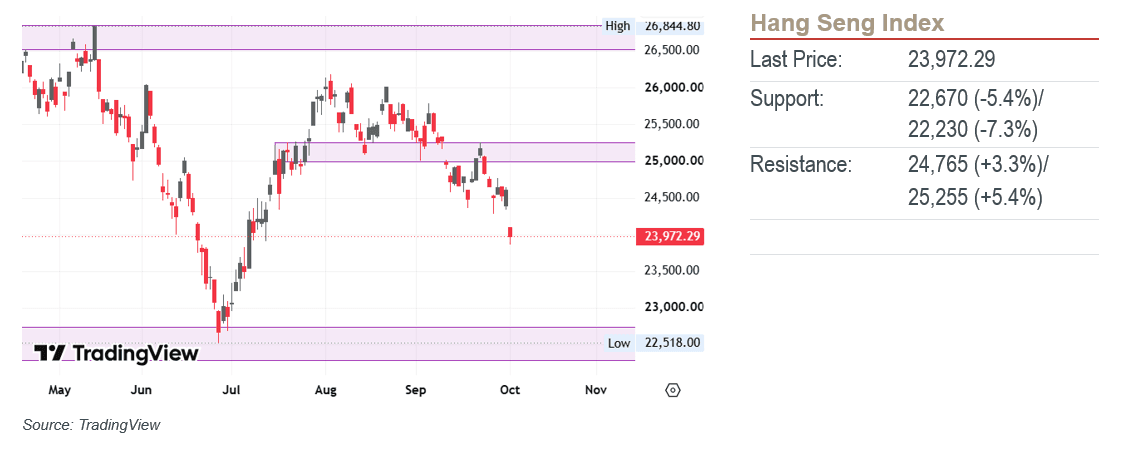
Weekly Chart: Price executed a high-velocity downward expansion and is currently traversing halfway through its structural liquidity void The weekly RSI remains established in bearish territory and continues to slope downward, signaling persistent trend velocity and multi-week structural weakness. As long as price remains below its upper resistance anchors, we see continued downward expansion until its lower support.
Daily Chart: Price executed a decisive downside expansion validated by last Friday’s falling window, establishing a formidable horizontal supply ceiling. The subsequent price progression continues to print a clean sequence of lower highs and lower lows. The RSI remains in deeply bearish territory and is approaching the oversold threshold, signaling high-velocity trend momentum rather. As long as price remains capped underneath this gap resistance ceiling, we could expect continued downward expansion toward lower demand targets.
Our Technical View
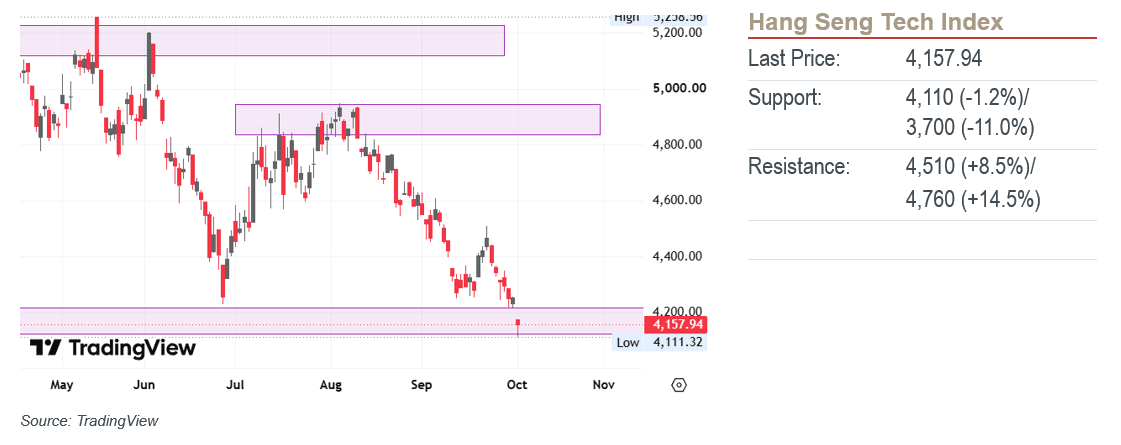
Weekly Chart: Price is currently executing a critical retest along its previous low support zone. The higher-timeframe backdrop remains heavily skewed to the downside, with the weekly timeframe printing an aggressive bearish continuation candlestick pattern that reinforces a lower-high and lower-low structural hierarchy. A decisive breach and weekly close below this previous low demand boundary will confirm a complete structural breakdown, hinting for an accelerated downward expansion toward lower demand targets.
Daily Chart: Price executed a retest along its previous low support zone, printing a hammer candlestick pattern. However, the macro structural hierarchy remains constrained by the falling window created last Friday, which establishes a formidable overhead supply anchor. This falling window acts as an immediate resistance ceiling, threatening to truncate the hammer's bullish reaction into a lower-high trap. A failure to fill this gap, followed by a decisive breach and daily close below the hammer's low, will confirm a complete structural breakdown, opening path-of-least-resistance dynamics for an accelerated downward expansion toward lower demand targets.
Market Movers: HSBC (0005.HK) fell about 5.4% to HK$149.50 in the 2 October Hong Kong session as rising bond yields pressured banks. The S&P 500 gained 0.73% in the later US session. Tesla (TSLA US) rose about 4.7% to US$370.59 after reporting third-quarter deliveries of 486,532; Seagate (STX US) fell about 10.2% to US$848.99 on reported Toshiba capacity-expansion plans. Separately, Amazon (AMZN US) reportedly sought investors for US$8bn of Nvidia chips through a proposed leaseback structure, highlighting AI funding demands. (Reuters / Reuters / Reuters) HSBC (0005.HK) and Amazon (AMZN US) are our Core Recommendations.
Macro: September US payrolls rose 29,000, unemployment reached 4.2%, and earlier job gains were revised down by 60,000. Wages increased 0.1% month on month and 3.0% year on year. The softer hiring mix eased immediate overheating concerns. ISM services is due at 22:00 SGT on 5 October, testing demand and price pressures. (BLS / ISM)
Geopolitical: Houthi claims of strikes on Saudi Aramco sites added weekend supply uncertainty. The claims concerned Riyadh and Khurais facilities. Confirmed damage or lost output was not established in the Reuters report, leaving energy-sensitive assets exposed to further supply headlines. Friday's oil settlements predate these developments. (Reuters)
FICC: OPEC+ retained September production targets for November at Sunday's meeting. The G7's 100m-barrel release over four months includes earlier commitments, and a substantial diesel release within 20 days; it is not wholly additional supply. The US 10-year par yield reached 5.28%, up 4bps at Friday's official reference. (OPEC / G7 / US Treasury)
AI
Amazon explores outside funding for AI chips. Amazon (AMZN US) reportedly seeks investors for US$8bn of Nvidia chips. Reuters, citing the Financial Times on 2 October, said a proposed vehicle would own Grace Blackwell chips across more than a dozen US data centres and lease them to Amazon. Talks remain ongoing. The proposal offers financing flexibility, while lease costs and equipment-risk allocation remain unresolved. (Reuters) Amazon (AMZN US) is our Core Recommendation.
Storage stocks reprice prospective competition. Seagate (STX US) and Western Digital (WDC US) each fell about 10.2% in the 2 October US regular session, to US$848.99 and US$415.29 respectively. Reuters cited a Nikkei report that Toshiba plans to double hard-drive capacity by fiscal 2027. Prospective supply competition could pressure storage pricing; the report establishes neither completed additional output nor weaker demand. (Reuters)
Cash merger terms lift Synaptics and onsemi. Synaptics (SYNA US) rose about 14.1% to US$121.10 in the 2 October US session after the prior day's merger revision; onsemi (ON US) gained about 6.0% to US$84.89. The amended US$123-per-share cash offer values Synaptics equity at US$5.7bn. The edge-AI combination targets mid-2027 completion and immediate non-GAAP earnings accretion, subject to shareholder and remaining regulatory approvals. (onsemi / Reuters)
White House names federal AI coordination team. President Trump named intelligence director Jay Clayton to lead a federal AI task force on Sunday. Members include FTC chair Andrew Ferguson, Pentagon technology chief Emil Michael and personnel director Scott Kupor. Its remit covers engagement with AI companies, consumers and critical-infrastructure providers. The appointments create an oversight coordination channel; the reports identified no new binding operating rules or funding commitment. (AP / DW)
Americas
Tesla deliveries support Friday rebound. Tesla (TSLA US) rose about 4.7% to US$370.59 in the 2 October US regular session after its delivery update. 3Q deliveries were 486,532 vehicles, against production of 464,391; energy-storage deployments reached 13.7GWh. Volumes support the operating-demand picture, but do not establish financial performance. Pricing, product mix and costs remain central to assessing the earnings contribution. (Tesla / Reuters)
US hiring slows as earlier gains are revised. September US payrolls rose 29,000 and unemployment reached 4.2%, the 2 October release showed. July and August gains were revised down by 60,000. Average hourly earnings increased 0.1% month on month and 3.0% year on year. Softer hiring and wages reduce immediate tightening pressure, but also raise demand concerns; inflation evidence remains necessary to establish the rate outlook. (BLS)
Nike falls as outlook outweighs margin improvement. Nike (NKE US) fell about 3.6% to US$33.87 on 2 October after the prior evening's fiscal first-quarter results. Revenue declined 4% to US$11.21bn, while gross margin improved 60 basis points to 42.8%. The company forecast a high-single-digit revenue decline for fiscal 2027 and adjusted earnings of US$1.15–1.35 per share. Its cost programme provides a potential profit buffer, but the weak sales outlook leaves the pace of demand recovery central to the turnaround. (Nike / Reuters)
Disney opens selected titles to Netflix. Disney (DIS US) and Netflix (NFLX US) confirmed a new licensing agreement on 2 October covering films and television series. The first two seasons of Percy Jackson and the Olympians are available globally on Netflix from 4 October for three months; the five Ice Age films also receive a three-month window. Selected Disney and Pixar films follow from early 2027, with launch dates and territories varying. The arrangement provides another route to monetise the library, although financial terms were not disclosed. (Reuters)
Rivian retains full-year delivery range. Rivian (RIVN US) reported 19,248 third-quarter deliveries on 2 October and maintained its annual outlook. Production reached 19,751 vehicles, and the company retained its full-year delivery range of 65,000–70,000, describing the quarter as consistent with expectations. The shares nonetheless closed about 3.1% lower at US$14.30. The unchanged guidance leaves execution over the remaining quarter as the immediate test; the volume release does not by itself establish progress on margins, cash use or sustainable profitability. (Rivian)
Greater China
HSBC's selloff exposed Hong Kong banks' sensitivity to global rates. HSBC (0005.HK) fell about 5.4% to HK$149.50 in Friday's Hong Kong session as banks led a broader retreat. Reuters linked the weakness to the preceding rise in US yields, while mainland holidays removed Southbound buying support. Higher rates can lift asset income, but also raise funding costs and pressure credit demand; the sharp repricing shows why the net interest margin benefit should not be treated as a one-way earnings catalyst. (Reuters) HSBC (0005.HK) is our Core Recommendation.
Galaxy's Friday decline kept attention on Macau gaming demand. Galaxy Entertainment (0027.HK) lost about 4.2% to HK$30.30 in Friday's Hong Kong session, with Reuters reporting casino weakness after September gaming revenue continued to fall. The decline kept the focus on the quality of spending during the holiday travel period. For casino operators, stronger holiday visitation will matter only if it converts into gaming spend and operating profit, making demand quality more useful than visitor volumes alone. (Reuters) Galaxy Entertainment (0027.HK) is our Core Recommendation.
New World's lease exit offers cash savings but leaves a costly reset. New World Development (0017.HK) fell about 3.8% to HK$5.82 in Friday's Hong Kong session. In a fresh Friday assessment, Citi said the previously announced 11 SKIES sublease termination removed minimum annual rent of HK$1.8bn through September 2066. Dow Jones reported HK$18.3bn of associated impairment, including HK$2.3bn of early termination costs. The cash-flow relief is material, but the charge illustrates how expensive it can be to unwind underperforming property commitments. (Dow Jones)
Hong Kong's retail rebound remained uneven beneath the headline. August retail sales, released Friday, rose 5.6% year on year to HK$32.1bn, while sales volume grew 2.9%. Jewellery, watches and valuable gifts increased 11.9%, but motor vehicles fell 22.0% and clothing declined 0.5%. The value-volume gap and divergent categories suggest retailers cannot rely on a broad consumer recovery. Product mix and exposure to discretionary big-ticket purchases remain important in assessing revenue growth and earnings conversion. (Hong Kong Government)
Asia ex. China
DFI's Starbucks reshaping brings a near-term earnings trade-off. DFI Retail (D01 SP) fell about 8.8% to US$3.10 in Friday's Singapore session as analysts assessed its previously announced Starbucks transaction. DBS estimated a US$43m FY2027 net earnings shortfall, despite US$340m of cash proceeds, according to Business Times. The Friday assessment shifted attention from disposal cash to recurring profit. A steadier operating structure may help over time, but reinvestment returns and the pace of replacing the foregone contribution will determine whether value is created. (Business Times / Business Times)
UNIQLO's September growth relied on higher spending per shopper. Fast Retailing (9983 JP) reported in its Friday update that UNIQLO Japan same-store sales, including online, rose 10.8% year on year in September. Customer numbers fell 0.5%, while average spending increased 11.3%; total directly operated store and online sales gained 9.9%. The company cited cooler weather and demand for autumn and winter products. The stronger basket size supports sales, but weak traffic leaves the durability of demand dependent on product mix and seasonal purchasing. (Fast Retailing)
Singapore electronics strength sharpened the gap with supply constraints. September's manufacturing PMI, released at 9.00pm SGT on Friday, rose to 51.7 from 51.5, while electronics climbed to 52.9 from 52.6. Business Times reported stronger AI-related demand alongside growing order backlogs and pressure from input costs and delivery times. The survey supports continued activity growth, but improving orders do not automatically translate into higher margins. Electronics suppliers with capacity and pricing power appear better placed than manufacturers facing energy and feedstock constraints. (SIPMM / Business Times)
Tohoku bank integration talks put scale and costs in focus. Procrea Holdings (7384 JP), Akita Bank (8343 JP) and Iwate Bank (8345 JP) agreed on Friday to begin discussions on a holding-company integration, targeting April 2028. Their combined assets were about JPY13.3tn at end-March. The banks cited population decline and rising technology and cybersecurity requirements. A shared platform could spread investment costs across a larger balance sheet, but the target remains subject to negotiations and approvals, with integration terms still to be settled. (Procrea Holdings / Strike)
RTS Link's revised target shifts attention to certification. Singapore and Malaysia said on Friday that passenger services on the Johor Bahru-Singapore RTS Link are now targeted for February 2027, subject to independent safety certification and final approvals. The operator expects testing and trial runs to finish by end-2026. The four-kilometre link is designed to carry up to 10,000 passengers an hour in each direction. The delay defers the cross-border commuting benefit and leaves certification, rather than completed infrastructure, as the key execution risk. (LTA / CNA)
EMEA and Others
Infineon's rebound showed renewed appetite for chip exposure. Infineon (IFX GY) gained about 8.8% to EUR64.64 in Friday's completed Xetra session as European technology shares rebounded on renewed AI-related buying, according to Reuters and Dow Jones. Its strength shows how quickly semiconductor expectations can dominate daily performance, but investors still need company-level order and margin evidence to distinguish durable earnings improvement from a recovery in risk appetite. (Reuters / Dow Jones)
Bayer's US$2.2bn Ohio investment extends its US growth commitment. Bayer (BAYN GY) announced on Friday a US$2.2bn pharmaceutical manufacturing site in New Albany, Ohio, expected to create around 600 jobs. Drug-substance production is planned for 2031 and finished products for 2034. Reuters reported that the US now supplies 35% of pharma revenue, versus 20% in 2018. The project strengthens local supply capacity, but its long construction timetable makes execution and cash returns more relevant than any immediate earnings contribution. (Bayer / Reuters)
IG's revenue warning exposed weak conversion of customer growth. IG Group (IGG LN) fell about 22.6% to 990p in Friday's London session after reporting approximately GBP240m of third-quarter revenue, down 14% year on year, and guiding to mid-single-digit full-year revenue growth. Its OTC revenue retention was around 70%, against about 80% since the second half of 2025. Although first trades rose more than 25%, weaker retention shows why customer acquisition alone cannot offset a poorer trading mix and lower revenue capture. (IG Group / Reuters)
Julius Baer's buyback clarifies the route for surplus capital. Julius Baer (BAER SW) gained about 2.0% to CHF72.64 in Friday's Swiss session after announcing regulatory approval for a share buyback of up to CHF600m. The programme is expected to start in coming weeks and run for up to a year, subject to market conditions. A revised distribution policy targets a 40-60% payout of IFRS net profit and a 15% CET1 ratio. The framework supports capital returns while preserving a defined buffer for the wealth-management business. (Julius Baer / Reuters)
Yemen's escalation added a fresh uncertainty for Saudi oil supply. Reuters reported before Monday's Asian open that the Houthis said they had launched missiles and drones at Saudi Aramco sites in Riyadh and Khurais. AFP had observed a fire at the Riyadh refinery on Saturday and reported renewed strikes by Yemen's government forces on Sunday. Saudi authorities had not commented when that AFP report was published. The reviewed reports did not establish a production-loss figure, leaving the supply consequence uncertain despite the escalation. (Reuters / AFP)
Emergency stock releases meet a pause in OPEC+ supply increases. The G7 agreed on Friday to implement a coordinated 100m-barrel release over four months, including a substantial diesel release within the first 20 days. The commitment implements March measures and takes account of quantities already released. On Sunday, seven OPEC+ members kept September production requirements unchanged for November. Stock draws can relieve near-term shortages, but unchanged producer targets and infrastructure risks limit certainty over how quickly physical supply conditions will improve. (G7 / OPEC)
Traders’ corner
Our Technical View
Weekly Chart: Price executed a high-velocity downward expansion and is currently traversing halfway through its structural liquidity void The weekly RSI remains established in bearish territory and continues to slope downward, signaling persistent trend velocity and multi-week structural weakness. As long as price remains below its upper resistance anchors, we see continued downward expansion until its lower support.
Daily Chart: Price executed a decisive downside expansion validated by last Friday’s falling window, establishing a formidable horizontal supply ceiling. The subsequent price progression continues to print a clean sequence of lower highs and lower lows. The RSI remains in deeply bearish territory and is approaching the oversold threshold, signaling high-velocity trend momentum rather. As long as price remains capped underneath this gap resistance ceiling, we could expect continued downward expansion toward lower demand targets.
Our Technical View
Weekly Chart: Price is currently executing a critical retest along its previous low support zone. The higher-timeframe backdrop remains heavily skewed to the downside, with the weekly timeframe printing an aggressive bearish continuation candlestick pattern that reinforces a lower-high and lower-low structural hierarchy. A decisive breach and weekly close below this previous low demand boundary will confirm a complete structural breakdown, hinting for an accelerated downward expansion toward lower demand targets.
Daily Chart: Price executed a retest along its previous low support zone, printing a hammer candlestick pattern. However, the macro structural hierarchy remains constrained by the falling window created last Friday, which establishes a formidable overhead supply anchor. This falling window acts as an immediate resistance ceiling, threatening to truncate the hammer's bullish reaction into a lower-high trap. A failure to fill this gap, followed by a decisive breach and daily close below the hammer's low, will confirm a complete structural breakdown, opening path-of-least-resistance dynamics for an accelerated downward expansion toward lower demand targets.
Disclosures and disclaimers
This report is provided subject to, and must be read together with, the full Disclosures / Disclaimers available at this link, which are incorporated by reference into this report. In particular, this report is intended for general circulation and informational purposes only and does not constitute personal investment advice or a recommendation to buy or sell any investment product or security. You should independently evaluate the information and, where necessary, seek advice from a qualified financial adviser regarding the suitability of any investment. Analyst certifications required under applicable regulations, including SEC Regulation AC (where relevant), are included in this report. By accessing, receiving or using this report, you acknowledge that you have read, understood and agreed to be bound by the Disclosures / Disclaimers, as may be amended, supplemented or updated from time to time.


