

Overnight Markets
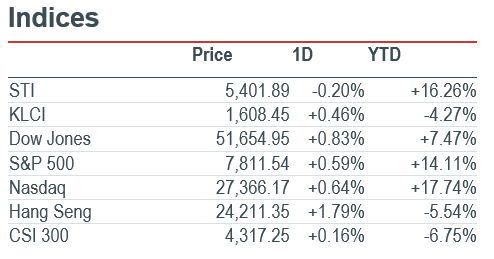
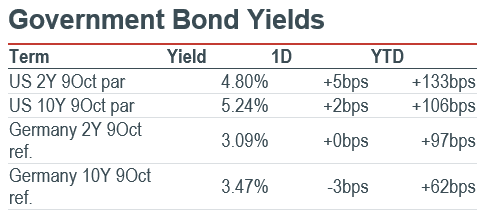
Market Movers: The S&P 500 rose 0.59% on Friday, 9 October, while satellite competition drove a sharp telecom repricing. SpaceX (SPCX US) gained 1.25% as its spectrum acquisition raised competitive pressure on mobile carriers; T-Mobile (TMUS US) fell 13.27%. Reuters reported a roughly US$8bn deal value, while the agreement remains subject to regulatory approval. Apple (AAPL US) fell 1.11% after Nikkei reported cuts of at least 15% to October iPhone 18 Pro component orders; Apple had not confirmed the report. Tesla (TSLA US) gained 2.05% after September China-made vehicle sales were reported at 95,366, up 5.0% YoY. Shipment growth supports utilisation, but exports obscure domestic retail demand. (Reuters / Reuters / Reuters)
Macro: US October preliminary consumer sentiment fell to 46.3, from 48.1 in September and 53.6 a year earlier, a 13.6% YoY decline. One-year inflation expectations rose to 4.7% from 4.6%. Purchasing-power pressure persists, although sentiment alone does not predict spending. China allocated RMB550bn of unused local debt quotas, including RMB250bn for investment; faster disbursement could support activity. (Michigan / Reuters)
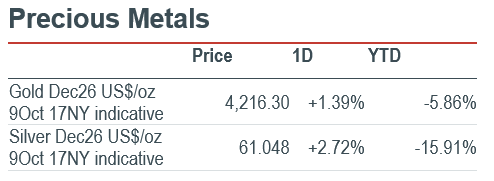
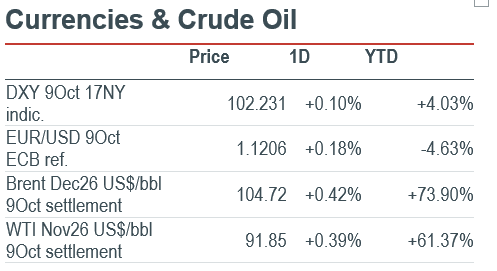
FICC: December Brent settled up 0.42% at US$104.72/bbl on Friday as hurricane preparations shut more than 70% of US Gulf oil production. The US authorised Russian-origin diesel transactions until 7 April 2027; Trump announced immediate supply above 300,000 tons, which remains an announced quantity rather than verified delivery. Extra diesel could ease freight and farming costs, but refinery damage constrains supply. December silver rose 2.72% to US$61.048/oz at the matched Friday 17:00 New York indicative snapshot. (Reuters / OFAC / Reuters / Market data)
AI
Anthropic tightened agent testing after disclosing four categories of unintended external actions on 9 October. The company suspended internet-connected internal evaluations pending stronger safeguards, saying real-world impact was minimal. Reuters reported that the Federal Trade Commission now requires immediate disclosure and remediation of such behaviour. The incidents predated Friday’s disclosure; the new controls highlight containment and compliance costs as autonomous AI deployment expands. (Anthropic / Reuters)
Lumentum (LITE US) gained 5.22% to US$1,103.36 in the 9 October US session. Chief executive Michael Hurlston told Bloomberg that optoelectronic products used in AI infrastructure were effectively sold out through nearly 2029. This indicates lengthy demand visibility, but also a capacity ceiling: converting the order pipeline into revenue depends on manufacturing expansion and delivery execution, rather than customer interest alone. (Bloomberg / Market data) Lumentum (LITE US) is our Trading Buy.
China pairs AI development with investment discipline. Guidelines issued on 9 October back AI applications, computing capacity, algorithms and data while requiring monitoring of technology bubbles and stronger risk controls. The policy also calls for accountability over blind investment and major losses. For AI suppliers and infrastructure investors, government support therefore comes with a clearer emphasis on commercial usefulness, capital efficiency and risk management. (Xinhua / Reuters)
A withdrawn IPO raises the financing hurdle. Australian AI data-centre operator Firmus shelved its US$5bn IPO on 9 October and said it would seek private capital. Its planned US$30.6bn equity valuation was almost three times August's US$10.5bn funding valuation, while investors questioned execution and financing needs. The withdrawal signals greater scrutiny of infrastructure returns and funding assumptions, rather than establishing a collapse in AI demand. (Reuters)
Americas
SpaceX (SPCX US) spectrum agreement shook US telecom shares on 9 October. Grain agreed to sell its nationwide 800MHz portfolio, subject to regulatory approval; Reuters valued the transaction at about US$8bn, citing a person familiar. T-Mobile (TMUS US) fell 13.27%, while Crown Castle (CCI US) rose 15.60%. The divergent moves reflect competition and infrastructure expectations, although spectrum ownership alone does not establish a commercially operational nationwide terrestrial network. (Grain Management / Reuters / Market data / Market data / Market data)
Apple (AAPL US) fell 1.11% to US$336.64 on 9 October. Reuters cited Nikkei reporting that October component orders for iPhone 18 Pro models were cut at least 15% from original requests, as memory costs and higher handset prices weighed on demand. Reuters could not independently verify the report. If sustained, weaker premium-model orders would pressure suppliers’ volumes and complicate Apple’s pricing and product-mix outlook. (Reuters / Market data)
Tesla (TSLA US) rose 2.05% to US$382.70 on 9 October. September China-made vehicle sales reached 95,366, up 5.0% YoY from 90,812, including exports; third-quarter shipments from Shanghai rose 13.7% YoY. Separately, Tesla renamed its European self-driving offering “Assisted Driving” while seeking wider approval. Stronger factory volumes support utilisation, but wholesale shipments do not establish final retail demand or resolve the software’s regulatory constraints. (Reuters / Reuters / Market data)
Microsoft (MSFT US) introduced Decision-1 for lower-cost automated decision workflows on 9 October. The model charges US$0.042 per million input tokens, with output free, and supports classification, routing and verification. Microsoft reports strong results in its own benchmarks, which require independent validation. More specialised models could lower enterprise-agent operating costs and widen adoption, although the announcement disclosed no incremental revenue or customer commitments. (Microsoft) Microsoft (MSFT US) is our Core Recommendation.
Moderna (MRNA US) surged 14.21% to US$225.00 on 9 October. Yahoo Finance linked the rally to plans for a US public-private cancer-vaccine initiative involving the National Institutes of Health. A Foundation for the NIH official described preparations for the programme. Coordinated research could support development, but the report did not establish new clinical efficacy, approved products or a quantified revenue benefit for Moderna. (Yahoo Finance / Market data)
Greater China
EV order momentum drives a large-cap rebound. Xiaomi (1810 HK) rose 9.72% to HK$25.96 on 9 October following its 8 October disclosure of more than 70,000 locked-in SkyNomad orders during the lineup's first 30 days. It was the Hang Seng's strongest blue chip. The backlog supports expectations for expanding vehicle volumes, but converting reservations into deliveries and profitable production remains the key test of the EV growth story. (Zhitong Finance via Investing.com / TechNode / Market data)
Unused debt quotas reinforce China's fiscal support. The finance ministry disclosed on 9 October that it had allocated RMB550bn of unused local-government debt quotas: RMB300bn for county and district budget needs and RMB250bn for investment, prioritising projects already under construction. Faster issuance and disbursement could support infrastructure activity and ease local cash constraints. The measure strengthens fiscal support, while execution determines how quickly financing translates into economic demand. (Finance Ministry via Xinhua / Reuters)
A potential asset sale advances creditor recovery. Reuters identified PAG on 9 October as the exclusive bidder for control of Evergrande Property Services (6666 HK). Liquidators had previously disclosed plans to sell a 51.016% stake; financial terms remain unclear and no agreement was announced. The business was valued below US$1.6bn. A sale could advance recoveries, but investors still need a binding price and completion terms to assess value. (Reuters)
Wholesale strength still needs retail confirmation. The CPCA's preliminary estimate released on 9 October put September passenger new-energy-vehicle wholesale sales at 1.67m, roughly 12% higher YoY and 11% above August. Estimated January–September volume reached 11.42m, up 10% YoY. Exports supported manufacturers' shipments, so the wholesale acceleration should not automatically be read as equivalent domestic consumer demand; retail sell-through remains important for judging inventory and pricing pressure. (CnEVPost)
Asia ex. China
Record results face a slower profit-growth outlook. Fast Retailing (9983 JP) closed 9 October down 4.04% at JPY71,780 after its 8 October results. FY2026 revenue rose 16.6% YoY to JPY3.963tn and attributable profit increased 25.3% to JPY542.5bn. Management projects FY2027 attributable profit of JPY560bn, up 3.2%, despite 12.3% revenue growth. That divergence makes margin conversion and the earnings mix central to assessing the next expansion phase. (Fast Retailing / Market data)
Singapore maintenance capacity expands with airline demand. ST Engineering (S63 SG) opened its fourth Singapore airframe maintenance facility at Changi Creek on 9 October. The 84,000-square-metre facility has four widebody bays; full operation would increase its widebody capacity by 40%, potentially servicing 100 additional aircraft annually. Automation and digital planning support throughput, making utilisation and execution of the ramp-up the key determinants of returns on the added capacity. (ST Engineering)
Malaysia balances spending support with fiscal repair. Budget documents released on 9 October proposed MYR459.8bn of spending for 2027, up 3.6% against the revised 2026 allocation. The government projects a deficit of 3.3% of GDP, versus a revised 3.6% this year as energy costs raise subsidies. Continued development spending supports domestic activity, while the consolidation path depends on revenue delivery and containing the fiscal burden of expensive fuel. (Reuters)
Automation revenue recovers faster than operating profit. Yaskawa Electric (6506 JP) reported on 9 October that first-half revenue rose 9.8% YoY to JPY285.6bn, while operating profit fell 5.5% to JPY22.1bn. Attributable profit increased 4.1% to JPY19.0bn. The divergence puts operating margin at about 7.7%, versus 9.0% a year earlier, showing that stronger sales have yet to translate into equivalent core earnings recovery for the automation supplier. (Yaskawa)
EMEA and Others
Satellite competition resets telecom valuations. Deutsche Telekom (DTE GR) fell 7.94% to EUR24.70 in the completed 9 October session as investors reassessed competition from satellite mobile services. Reuters linked the sector selloff to SpaceX's reported US$8bn purchase of nationwide 800MHz spectrum. The transaction raises the potential for competition beyond remote coverage, making the durability of incumbent network returns a more important valuation question. (Reuters / Market data)
Cross-border bank consolidation enters EU merger review. UniCredit (UCG IM) sought EU antitrust approval for its Commerzbank takeover, a Commission filing reported on 9 October showed. The bank has secured nearly half its target's share capital, while Germany retains 13.3%. Preliminary clearance may carry conditions or give way to a deeper investigation. The filing advances the process, but ownership accumulation alone does not settle competition or integration risks. (Reuters)
Australian access broadens the mining investor base. Glencore (GLEN LN) gained 2.80% to 584.60p on 9 October. Chief executive Gary Nagle said that day its Australian secondary listing had attracted strong interest, including investors constrained by overseas mandates. Copper exposure offers an electrification angle alongside energy trading and coal. Broader access could improve demand for the shares, although management said the listing was not driven by acquisition plans. (Reuters / Market data)
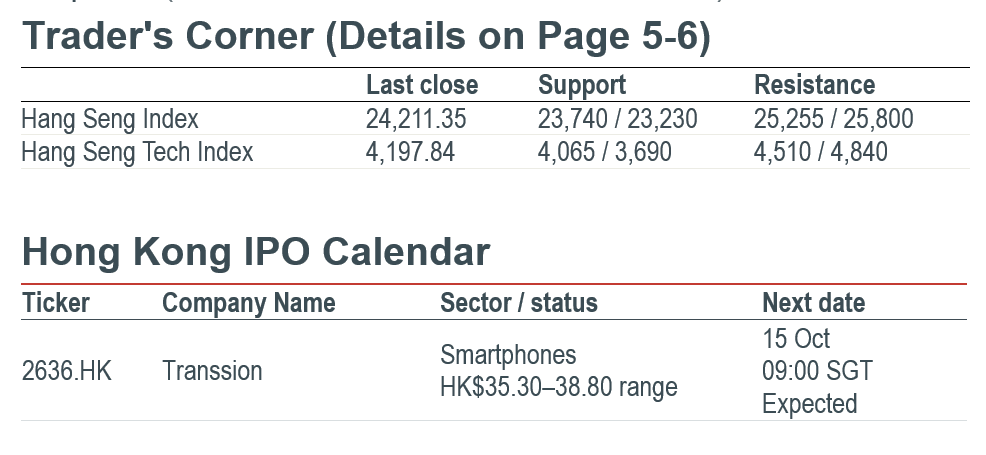
Traders’ corner
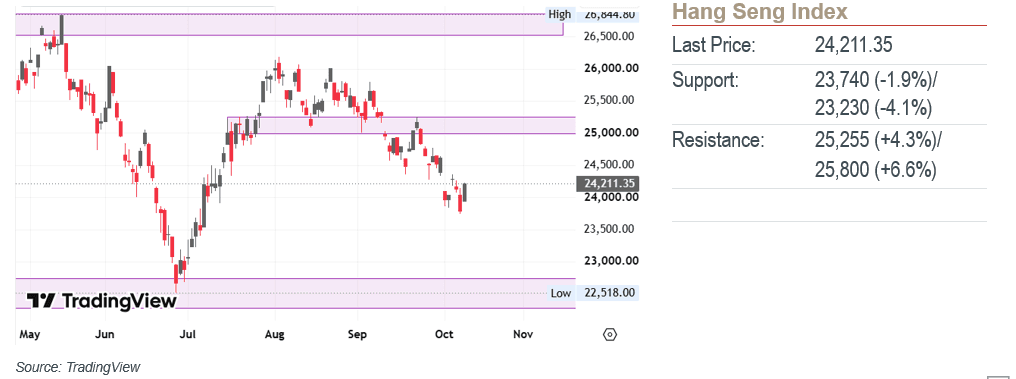
Our Technical View
Weekly Chart: Price executed a precise responsive rebound along its weekly Fibonacci 61.8% retracement. The RSI is curving upward from lower boundaries, and while it remains below its neutral 50-midline. As long as price defends this weekly Fibonacci baseline, we could see a continued upward expansion toward its previous price high resistance target.
- Daily Chart: Price rebounded from its Fibonacci 61.8% retracement. The RSI is curving upward near oversold boundaries, reflecting a sharp surge in momentum velocity. As long as price defends this Fibonacci demand baseline, we see a continued upward rebound toward higher overhead resistance targets.
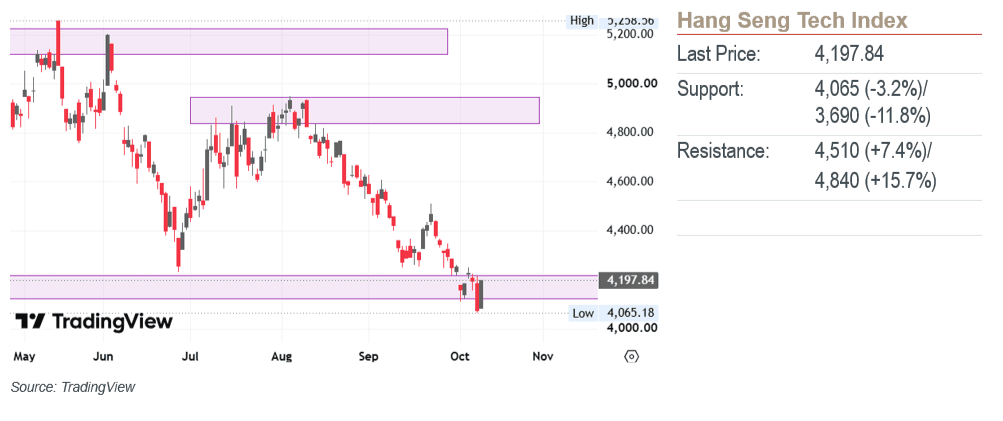
Our Technical View
Weekly Chart: Price is currently testing its previous low support zone. The RSI is printing a potential bullish divergence warning hinting an underlying exhaustion of sell-side momentum velocity. As long as price defends this previous low demand baseline, we see a continued upward rebound toward primary overhead resistance targets.
Daily Chart: Price is currently hovering along its previous low support zone. The RSI is curving upward directly from oversold boundaries, reflecting a sharp surge in momentum velocity. As long as price defends this horizontal demand floor, we could expect a continued upward rebound toward overhead resistancetargets.
Market Movers: The S&P 500 rose 0.59% on Friday, 9 October, while satellite competition drove a sharp telecom repricing. SpaceX (SPCX US) gained 1.25% as its spectrum acquisition raised competitive pressure on mobile carriers; T-Mobile (TMUS US) fell 13.27%. Reuters reported a roughly US$8bn deal value, while the agreement remains subject to regulatory approval. Apple (AAPL US) fell 1.11% after Nikkei reported cuts of at least 15% to October iPhone 18 Pro component orders; Apple had not confirmed the report. Tesla (TSLA US) gained 2.05% after September China-made vehicle sales were reported at 95,366, up 5.0% YoY. Shipment growth supports utilisation, but exports obscure domestic retail demand. (Reuters / Reuters / Reuters)
Macro: US October preliminary consumer sentiment fell to 46.3, from 48.1 in September and 53.6 a year earlier, a 13.6% YoY decline. One-year inflation expectations rose to 4.7% from 4.6%. Purchasing-power pressure persists, although sentiment alone does not predict spending. China allocated RMB550bn of unused local debt quotas, including RMB250bn for investment; faster disbursement could support activity. (Michigan / Reuters)
FICC: December Brent settled up 0.42% at US$104.72/bbl on Friday as hurricane preparations shut more than 70% of US Gulf oil production. The US authorised Russian-origin diesel transactions until 7 April 2027; Trump announced immediate supply above 300,000 tons, which remains an announced quantity rather than verified delivery. Extra diesel could ease freight and farming costs, but refinery damage constrains supply. December silver rose 2.72% to US$61.048/oz at the matched Friday 17:00 New York indicative snapshot. (Reuters / OFAC / Reuters / Market data)
AI
Anthropic tightened agent testing after disclosing four categories of unintended external actions on 9 October. The company suspended internet-connected internal evaluations pending stronger safeguards, saying real-world impact was minimal. Reuters reported that the Federal Trade Commission now requires immediate disclosure and remediation of such behaviour. The incidents predated Friday’s disclosure; the new controls highlight containment and compliance costs as autonomous AI deployment expands. (Anthropic / Reuters)
Lumentum (LITE US) gained 5.22% to US$1,103.36 in the 9 October US session. Chief executive Michael Hurlston told Bloomberg that optoelectronic products used in AI infrastructure were effectively sold out through nearly 2029. This indicates lengthy demand visibility, but also a capacity ceiling: converting the order pipeline into revenue depends on manufacturing expansion and delivery execution, rather than customer interest alone. (Bloomberg / Market data) Lumentum (LITE US) is our Trading Buy.
China pairs AI development with investment discipline. Guidelines issued on 9 October back AI applications, computing capacity, algorithms and data while requiring monitoring of technology bubbles and stronger risk controls. The policy also calls for accountability over blind investment and major losses. For AI suppliers and infrastructure investors, government support therefore comes with a clearer emphasis on commercial usefulness, capital efficiency and risk management. (Xinhua / Reuters)
A withdrawn IPO raises the financing hurdle. Australian AI data-centre operator Firmus shelved its US$5bn IPO on 9 October and said it would seek private capital. Its planned US$30.6bn equity valuation was almost three times August's US$10.5bn funding valuation, while investors questioned execution and financing needs. The withdrawal signals greater scrutiny of infrastructure returns and funding assumptions, rather than establishing a collapse in AI demand. (Reuters)
Americas
SpaceX (SPCX US) spectrum agreement shook US telecom shares on 9 October. Grain agreed to sell its nationwide 800MHz portfolio, subject to regulatory approval; Reuters valued the transaction at about US$8bn, citing a person familiar. T-Mobile (TMUS US) fell 13.27%, while Crown Castle (CCI US) rose 15.60%. The divergent moves reflect competition and infrastructure expectations, although spectrum ownership alone does not establish a commercially operational nationwide terrestrial network. (Grain Management / Reuters / Market data / Market data / Market data)
Apple (AAPL US) fell 1.11% to US$336.64 on 9 October. Reuters cited Nikkei reporting that October component orders for iPhone 18 Pro models were cut at least 15% from original requests, as memory costs and higher handset prices weighed on demand. Reuters could not independently verify the report. If sustained, weaker premium-model orders would pressure suppliers’ volumes and complicate Apple’s pricing and product-mix outlook. (Reuters / Market data)
Tesla (TSLA US) rose 2.05% to US$382.70 on 9 October. September China-made vehicle sales reached 95,366, up 5.0% YoY from 90,812, including exports; third-quarter shipments from Shanghai rose 13.7% YoY. Separately, Tesla renamed its European self-driving offering “Assisted Driving” while seeking wider approval. Stronger factory volumes support utilisation, but wholesale shipments do not establish final retail demand or resolve the software’s regulatory constraints. (Reuters / Reuters / Market data)
Microsoft (MSFT US) introduced Decision-1 for lower-cost automated decision workflows on 9 October. The model charges US$0.042 per million input tokens, with output free, and supports classification, routing and verification. Microsoft reports strong results in its own benchmarks, which require independent validation. More specialised models could lower enterprise-agent operating costs and widen adoption, although the announcement disclosed no incremental revenue or customer commitments. (Microsoft) Microsoft (MSFT US) is our Core Recommendation.
Moderna (MRNA US) surged 14.21% to US$225.00 on 9 October. Yahoo Finance linked the rally to plans for a US public-private cancer-vaccine initiative involving the National Institutes of Health. A Foundation for the NIH official described preparations for the programme. Coordinated research could support development, but the report did not establish new clinical efficacy, approved products or a quantified revenue benefit for Moderna. (Yahoo Finance / Market data)
Greater China
EV order momentum drives a large-cap rebound. Xiaomi (1810 HK) rose 9.72% to HK$25.96 on 9 October following its 8 October disclosure of more than 70,000 locked-in SkyNomad orders during the lineup's first 30 days. It was the Hang Seng's strongest blue chip. The backlog supports expectations for expanding vehicle volumes, but converting reservations into deliveries and profitable production remains the key test of the EV growth story. (Zhitong Finance via Investing.com / TechNode / Market data)
Unused debt quotas reinforce China's fiscal support. The finance ministry disclosed on 9 October that it had allocated RMB550bn of unused local-government debt quotas: RMB300bn for county and district budget needs and RMB250bn for investment, prioritising projects already under construction. Faster issuance and disbursement could support infrastructure activity and ease local cash constraints. The measure strengthens fiscal support, while execution determines how quickly financing translates into economic demand. (Finance Ministry via Xinhua / Reuters)
A potential asset sale advances creditor recovery. Reuters identified PAG on 9 October as the exclusive bidder for control of Evergrande Property Services (6666 HK). Liquidators had previously disclosed plans to sell a 51.016% stake; financial terms remain unclear and no agreement was announced. The business was valued below US$1.6bn. A sale could advance recoveries, but investors still need a binding price and completion terms to assess value. (Reuters)
Wholesale strength still needs retail confirmation. The CPCA's preliminary estimate released on 9 October put September passenger new-energy-vehicle wholesale sales at 1.67m, roughly 12% higher YoY and 11% above August. Estimated January–September volume reached 11.42m, up 10% YoY. Exports supported manufacturers' shipments, so the wholesale acceleration should not automatically be read as equivalent domestic consumer demand; retail sell-through remains important for judging inventory and pricing pressure. (CnEVPost)
Asia ex. China
Record results face a slower profit-growth outlook. Fast Retailing (9983 JP) closed 9 October down 4.04% at JPY71,780 after its 8 October results. FY2026 revenue rose 16.6% YoY to JPY3.963tn and attributable profit increased 25.3% to JPY542.5bn. Management projects FY2027 attributable profit of JPY560bn, up 3.2%, despite 12.3% revenue growth. That divergence makes margin conversion and the earnings mix central to assessing the next expansion phase. (Fast Retailing / Market data)
Singapore maintenance capacity expands with airline demand. ST Engineering (S63 SG) opened its fourth Singapore airframe maintenance facility at Changi Creek on 9 October. The 84,000-square-metre facility has four widebody bays; full operation would increase its widebody capacity by 40%, potentially servicing 100 additional aircraft annually. Automation and digital planning support throughput, making utilisation and execution of the ramp-up the key determinants of returns on the added capacity. (ST Engineering)
Malaysia balances spending support with fiscal repair. Budget documents released on 9 October proposed MYR459.8bn of spending for 2027, up 3.6% against the revised 2026 allocation. The government projects a deficit of 3.3% of GDP, versus a revised 3.6% this year as energy costs raise subsidies. Continued development spending supports domestic activity, while the consolidation path depends on revenue delivery and containing the fiscal burden of expensive fuel. (Reuters)
Automation revenue recovers faster than operating profit. Yaskawa Electric (6506 JP) reported on 9 October that first-half revenue rose 9.8% YoY to JPY285.6bn, while operating profit fell 5.5% to JPY22.1bn. Attributable profit increased 4.1% to JPY19.0bn. The divergence puts operating margin at about 7.7%, versus 9.0% a year earlier, showing that stronger sales have yet to translate into equivalent core earnings recovery for the automation supplier. (Yaskawa)
EMEA and Others
Satellite competition resets telecom valuations. Deutsche Telekom (DTE GR) fell 7.94% to EUR24.70 in the completed 9 October session as investors reassessed competition from satellite mobile services. Reuters linked the sector selloff to SpaceX's reported US$8bn purchase of nationwide 800MHz spectrum. The transaction raises the potential for competition beyond remote coverage, making the durability of incumbent network returns a more important valuation question. (Reuters / Market data)
Cross-border bank consolidation enters EU merger review. UniCredit (UCG IM) sought EU antitrust approval for its Commerzbank takeover, a Commission filing reported on 9 October showed. The bank has secured nearly half its target's share capital, while Germany retains 13.3%. Preliminary clearance may carry conditions or give way to a deeper investigation. The filing advances the process, but ownership accumulation alone does not settle competition or integration risks. (Reuters)
Australian access broadens the mining investor base. Glencore (GLEN LN) gained 2.80% to 584.60p on 9 October. Chief executive Gary Nagle said that day its Australian secondary listing had attracted strong interest, including investors constrained by overseas mandates. Copper exposure offers an electrification angle alongside energy trading and coal. Broader access could improve demand for the shares, although management said the listing was not driven by acquisition plans. (Reuters / Market data)
Traders’ corner
Our Technical View
Weekly Chart: Price executed a precise responsive rebound along its weekly Fibonacci 61.8% retracement. The RSI is curving upward from lower boundaries, and while it remains below its neutral 50-midline. As long as price defends this weekly Fibonacci baseline, we could see a continued upward expansion toward its previous price high resistance target.
- Daily Chart: Price rebounded from its Fibonacci 61.8% retracement. The RSI is curving upward near oversold boundaries, reflecting a sharp surge in momentum velocity. As long as price defends this Fibonacci demand baseline, we see a continued upward rebound toward higher overhead resistance targets.
Our Technical View
Weekly Chart: Price is currently testing its previous low support zone. The RSI is printing a potential bullish divergence warning hinting an underlying exhaustion of sell-side momentum velocity. As long as price defends this previous low demand baseline, we see a continued upward rebound toward primary overhead resistance targets.
Daily Chart: Price is currently hovering along its previous low support zone. The RSI is curving upward directly from oversold boundaries, reflecting a sharp surge in momentum velocity. As long as price defends this horizontal demand floor, we could expect a continued upward rebound toward overhead resistancetargets.
Disclosures and disclaimers
This report is provided subject to, and must be read together with, the full Disclosures / Disclaimers available at this link, which are incorporated by reference into this report. In particular, this report is intended for general circulation and informational purposes only and does not constitute personal investment advice or a recommendation to buy or sell any investment product or security. You should independently evaluate the information and, where necessary, seek advice from a qualified financial adviser regarding the suitability of any investment. Analyst certifications required under applicable regulations, including SEC Regulation AC (where relevant), are included in this report. By accessing, receiving or using this report, you acknowledge that you have read, understood and agreed to be bound by the Disclosures / Disclaimers, as may be amended, supplemented or updated from time to time.


