

Overnight Markets
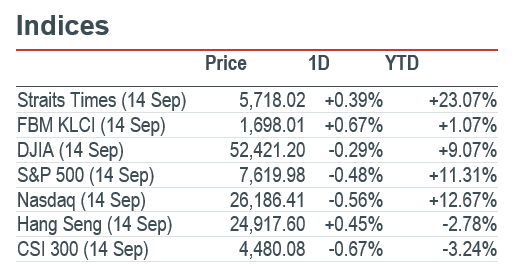
Market Movers: At Monday’s 14 September US close, Nvidia (NVDA US) fell 3.36% as weekend AI-safety warnings weighed on chipmakers. CrowdStrike (CRWD US) rose 13.85% as the same debate lifted cybersecurity demand expectations. Earlier at the Tokyo close, SoftBank Group (9984 JP) lost 10.72% as investors reassessed its AI exposure. The contrasting reactions reveal how a slower development cycle could affect hardware orders, funding needs and security spending differently. The repricing spans suppliers and investors, but it reflects changed expectations rather than newly announced cuts to committed capital expenditure. (Reuters / Dow Jones / AP)
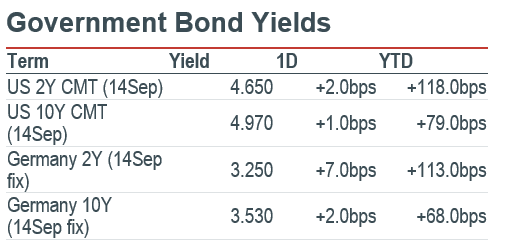
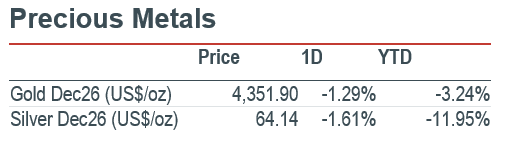
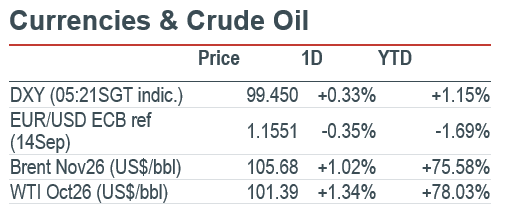
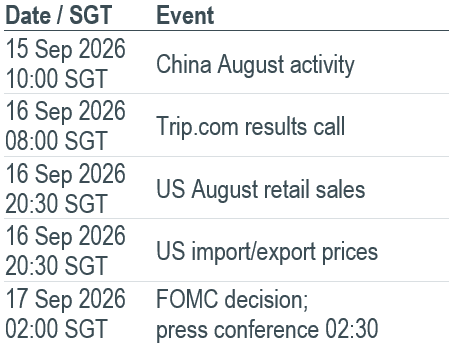
FICC: Brent November futures settled at US$105.68 a barrel on Monday as fresh regional attacks kept supply concerns elevated. The US 10-year Treasury yield briefly reached 5% intraday; the official daily constant-maturity reading was 4.97%. Higher energy costs and borrowing rates leave equity valuations exposed even where earnings remain firm. The S&P 500 closed down 0.48%, while the Nasdaq Composite lost 0.56%. WTI October settled at US$101.39, while December gold finished at US$4,351.90 an ounce, down 1.29%. Bullion’s decline shows the session did not produce a uniform shift into defensive assets. The next policy test is the FOMC decision at 02:00 SGT on 17 September, followed by the press conference at 02:30. (AP / US Treasury / Federal Reserve / eOption / Reuters) Nvidia (NVDA US) is our Core Recommendation.
AI
Nvidia falls as investors reassess AI spending. Nvidia (NVDA US) lost 3.36% to US$210.96 in Monday's regular session, from US$218.29 on Friday, as investors reacted to weekend calls for slower frontier-model development. The Philadelphia semiconductor index fell about 5.9%. The fresh market reaction highlights hardware suppliers' sensitivity to deployment schedules: a voluntary slowdown could defer orders, even before customers announce any reduction in committed capital spending. (Reuters) Nvidia (NVDA US) is our Core Recommendation.
Cybersecurity suppliers gain from the AI safety debate. CrowdStrike (CRWD US) rose 13.85% to US$235.38 on Monday, from US$206.74, while Palo Alto Networks (PANW US) gained 13.09% to US$373.94, from US$330.65. Dow Jones linked the rally to expectations of greater protection against increasingly capable AI systems, following weekend warnings from leading labs. The divergence from chips suggests security budgets may benefit even if frontier-development spending slows. (Dow Jones)
Microsoft opens its AI conduct rules to public scrutiny. Microsoft (MSFT US) began a six-week consultation on Monday on draft rules for its MAI models. The proposed standards require human control, acceptance of shutdown and limits on autonomous goals, while permitting enterprise configuration. A revised version is planned later this year. Customers gain a clearer basis for evaluating safeguards, although the consultation does not establish that future models will reliably meet every constraint. (Microsoft) Microsoft (MSFT US) is our Core Recommendation.
Americas
Bank of America warns that fee momentum is weakening. Bank of America (BAC US) expects third-quarter investment-banking fees of US$1.6bn–US$1.8bn, versus US$2bn a year earlier, and broadly flat trading revenue, Brian Moynihan said at Monday's Barclays conference. The implied 10%–20% fee decline suggests a softer contribution from dealmaking despite volatile markets. Slower capital-markets income would reduce the bank's earnings cushion as investors assess how higher interest rates affect borrowers and transaction activity. (Bloomberg / Investing.com)
Elmet secures government backing for a domestic tungsten network. Elmet (ELMT US) announced a US$450m committed US government investment on Monday, including a US$200m initial draw and warrants for up to 19.9% of post-transaction shares. A separate stockpile contract has a US$2bn ceiling but only US$150m guaranteed. The package can finance processing expansion and diversified supply; investors must weigh that support against dilution and the production ramp required before stockpile deliveries begin. (Elmet)
Enterprise-software shares recover as AI disruption fears ease. ServiceNow (NOW US) gained 7.41% to US$142.35 on Monday, from US$132.53 on Friday; Adobe (ADBE US) and Workday (WDAY US) also advanced. Reuters described a rebound after recent concerns that AI competition could squeeze margins. The divergence from falling chip shares suggests investors are reassessing software's competitive outlook if frontier development slows, rather than responding to new revenue or earnings upgrades. (Reuters)
Baldwin agrees to a US$7.7bn take-private transaction. Baldwin (BWIN US) signed a definitive agreement on Monday with Sequence Holdings and Michael Dell's family office. Shareholders would receive US$32.50 in cash; the approximately US$7.7bn enterprise value includes US$4.6bn of equity and US$3.1bn of net debt. Completion is expected in the first quarter of 2027, subject to approvals. The deal provides an insurance-broker valuation benchmark, with shareholder and regulatory clearance still required. (Baldwin)
Vista explores strategic options for Finastra. Vista Equity is considering a sale, stake disposal or other combination involving Finastra, Reuters reported on Monday, citing four people familiar with the discussions. One source suggested a valuation as high as US$12bn and expected annual EBITDA of US$650m. The process is preliminary, and the companies declined comment. The potential transaction tests appetite for established banking software while AI disruption complicates valuation and private-equity exit decisions. (Reuters)
Corteva approves the next step in its seed-business separation. Corteva (CTVA US) said on Monday its board approved distributing Vylor, its seed business, on a one-for-one basis to eligible shareholders. Distribution is intended before 1 October at 21:30 SGT, with regular trading expected to begin then, subject to customary conditions. Separating seed genetics from crop protection should clarify each business's investment priorities, while execution and the eventual standalone valuations remain unresolved. (Corteva)
Addus expands personal care through an AccentCare acquisition. Addus HomeCare (ADUS US) agreed on Monday to buy AccentCare's personal-care operations outside New York for approximately US$275m. Management expects about US$280m in annual revenue, expanding Addus's revenue base roughly 19%, with around 13,700 daily customers across ten states. Cash and revolving credit will fund the purchase. Greater scale could improve efficiency, although regulatory approval and integration are needed before expected earnings benefits materialise. (Addus)
Revolution Medicines gains a new pathway for combination treatment. Revolution Medicines (RVMD US) received FDA breakthrough-therapy designation for Rasonque combined with two chemotherapy agents in metastatic pancreatic cancer, Dow Jones reported after Monday's close. Preliminary Phase 1/2 findings informed a Phase 3 trial. The drug's earlier approval covered a different treatment setting. Faster regulatory engagement could support expansion, but the new designation establishes neither approval nor commercial success for the combination. (Dow Jones)
Greater China
GAC–FAW plan advances state-sector auto consolidation. GAC Group (601238.SH) said on Monday it plans to issue shares for part of an unnamed vehicle joint venture held by FAW and raise accompanying funds. FAW would become its second-largest shareholder, without changing ultimate control. A-shares were suspended from 14 September for up to ten trading days. Pricing and the acquired stake remain undisclosed, leaving valuation and integration benefits unresolved. (Nanfang)
China Gas expands contracted US LNG supply. China Gas (0384.HK) and Venture Global (VG US) announced a new 20-year agreement on Monday for 0.5mn tonnes of LNG annually from 2030. It increases their total long-term contracted volume to 2.5mn tonnes a year across Venture Global’s portfolio. The additional supply supports China Gas’s international energy-trading ambitions, although deliveries begin years ahead and provide no immediate relief from current supply disruptions. (Company)
China’s receivables cleanup reduces supplier financing pressure. At Monday’s policy briefing, the PBOC said outstanding electronic receivables certificates had fallen 20% from RMB3tn to RMB2.4tn by July, while average maturities shortened by 92 days YoY. Some large companies that delayed payments while charging suppliers financing fees have exited the business. The figures indicate progress in reducing financing costs shifted onto smaller suppliers, although the remaining balance shows that working-capital exposure remains substantial. (Securities Times)
China Chippacking forecasts an earnings turnaround. China Chippacking Technology (688216.SH) guided on Monday evening to approximately RMB330mn of 3Q26 revenue, up 61.26% YoY, and RMB21.5mn net profit against a RMB18.0mn loss a year earlier. Management cited recovering semiconductor demand, including AI applications, higher capacity utilisation and lower unit manufacturing costs. The preliminary, unaudited forecast points to operating leverage as new products and customers scale; formal quarterly results must confirm the improvement. (National Business Daily)
TCL adds Thai refrigerator capacity as overseas sales expand. TCL Smart Home (002668.SZ) disclosed after Monday’s close that its Thai plant’s second phase, with annual capacity of 1.4mn refrigerators, has entered trial production. Its existing 300,000-freezer line is near full utilisation. Overseas revenue rose 16.01% to RMB8.407bn in 1H26, accounting for 84.63% of sales. The expansion improves supply flexibility, but commissioning and ramp-up leave the timing of earnings contributions uncertain. (National Business Daily)
Asia ex. China
SoftBank and SK hynix price in slower AI development. At Monday’s Tokyo and Seoul closes, SoftBank Group (9984 JP) fell 10.72% to JPY5,839 and SK hynix (000660 KS) lost 6.35% to KRW1,697,000 versus Friday. AP linked the selling to weekend calls by AI leaders to slow development. OpenAI also ruled out a 2026 IPO, adding uncertainty for its investor SoftBank. The reaction highlights financing and demand sensitivity across AI investments and memory suppliers. (AP)
Indonesia changes finance minister as fiscal credibility is tested. President Prabowo Subianto replaced Purbaya Yudhi Sadewa with deputy Suahasil Nazara on Monday, appointing his third finance minister in under two years. Suahasil pledged to keep the deficit below the statutory 3% of GDP ceiling and improve budget credibility. The change follows negative credit-outlook revisions by Fitch and Moody’s amid policy and spending concerns. Investors will assess whether the technocratic appointment produces more predictable financing and expenditure decisions. (Reuters)
Grab scales Singapore’s autonomous-vehicle deployment. Grab (GRAB US) said on Monday it will expand its Singapore fleet from ten to 50 vehicles over six months and prepare on-demand rides in Punggol. Its WeRide GXR vehicles have covered more than 110,000km and served over 12,000 unique riders, up from 90,000km and 9,000 in July. Expansion beyond Punggol requires regulatory approval, making deployment permissions and service reliability central to commercial scaling. (Business Times)
Malaysia and Thailand extend shared gas development. Petronas said on Monday that its subsidiary and a PTT unit secured approvals for a 35-year production-sharing contract for Block A-18-01, effective from 1 January 2026. It extends development beyond the old contract’s April 2029 expiry and adds exploration acreage. The wider joint-development area has approximately 700mn standard cubic feet of daily gas capacity, equally shared by both countries, supporting regional supply security amid LNG disruptions. (Reuters)
Gulf revives Vietnam gas-power ambitions. Gulf Development (GULF TB) CEO Sarath Ratanavadi said on Monday the company is reviving a shelved Vietnamese gas-fired power project. The 2019 study covered a 6,000MW plant and LNG terminal; no new investment amount was specified. Gulf operates three Vietnamese renewable projects totalling 247MW. Growing electricity demand supports expansion, but financing and construction commitments remain undisclosed. (Bloomberg)
Singapore’s debt market broadens its funding role. MAS’s survey released on Monday showed 2025 long-term bond issuance rose 21.8% to a record US$95bn. Broader new debt issuance grew 10% to S$339bn; outstanding debt reached S$659bn, up 6.8%. Participation widened into digital infrastructure and consumer finance, strengthening Singapore’s funding role. MAS warned that renewed inflation and higher yields have made 2026 financing conditions less favourable. (Business Times)
EMEA and Others
GlobalData cuts profit expectations as AI investment weighs. GlobalData (DATA LN) fell 18.72% to GBp58.20 at Monday’s London close versus Friday, after warning FY26 adjusted EBITDA will miss the £121.0mn–126.7mn consensus. Revenue is expected near the low end of the £325.3mn–335.7mn range. First-half revenue grew 4% to £162.9mn, but underlying growth was only 1%. Investment in AI-native workflows and proprietary data keeps expected margins near 34%, delaying profit recovery. (Sharecast)
ASML examines another step-up in EUV output. JPMorgan analysts said on Monday, after talks with ASML’s CFO, that ASML (ASML NA) is examining production above 110 EUV systems in 2028. It can make at least 80 in 2027, with output nearly sold out. Assembly speed is the constraint. Strong order visibility supports expansion, while delivery execution determines how quickly demand converts into revenue. (Reuters)
CVC joins JC Flowers in the Aldermore sale process. Reuters reported on Monday that CVC and JC Flowers are preparing a joint bid for FirstRand’s UK bank, citing people familiar with the matter. RBC estimates Aldermore’s value at £1.35bn excluding motor finance or £1.45bn including it. FirstRand previously raised motor-loan redress provisions to £750mn. The potential transaction extends UK specialist-bank consolidation, but it remains a bidding process with valuation and liability allocation unresolved. (Reuters)
Traders’ corner
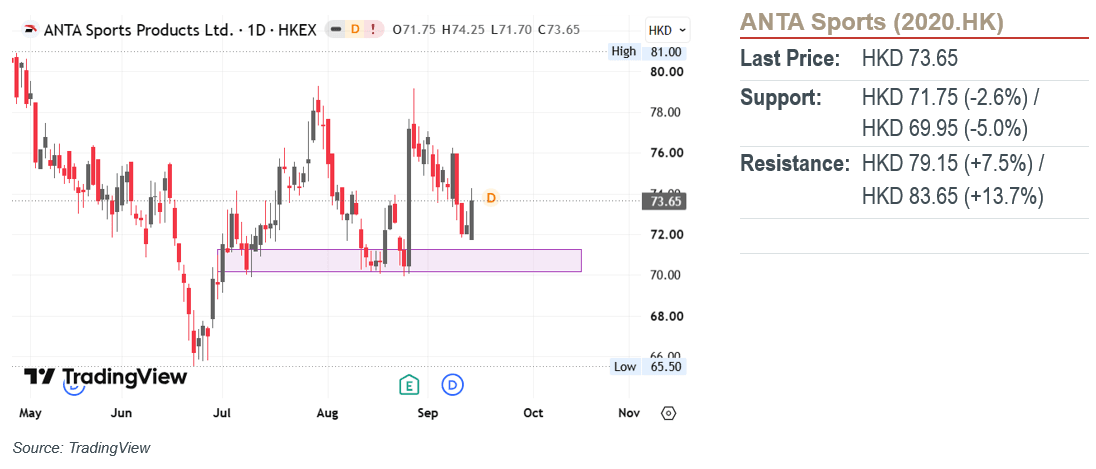
Our Technical View
Price managed to hold above its previous low support zone, keeping the market anchored within its broader range-bound framework.
The RSI is turning upward and approaching its neutral 50-midline, signaling early momentum recovery.
As long as price holds above this support, we could expect a technical rebound toward the previous price high resistance ceiling to complete the range rotation, with a confirmed breakout opening the path for further upside expansion.
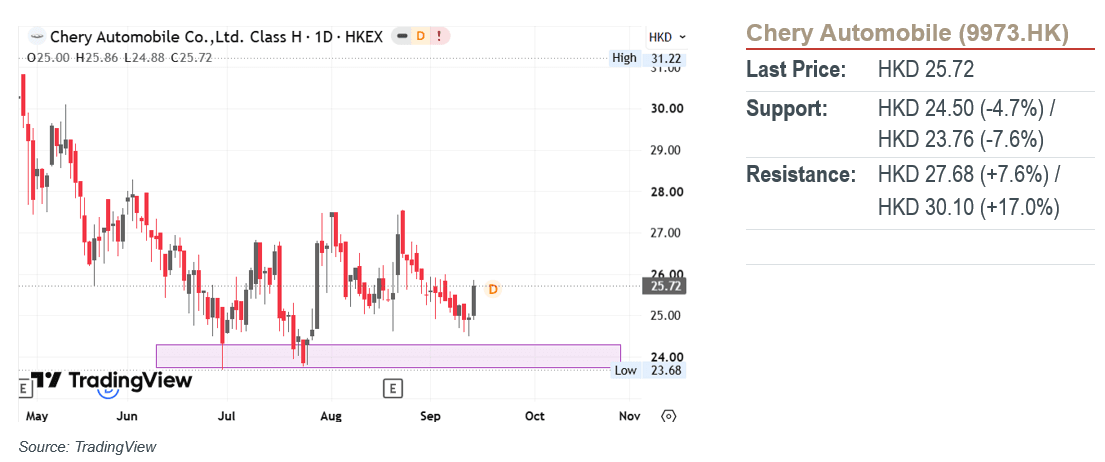
Our Technical View
Price managed to hold above its previous low support zone, keeping the broader market anchored above a critical demand floor.
The RSI has turned bullish and continues to expand upward, confirming that buyer control is actively re-establishing.
As long as price holds above this support, path-of-least-resistance dynamics heavily favours a sustained upward trajectory toward higher expansion targets.
Market Movers: At Monday’s 14 September US close, Nvidia (NVDA US) fell 3.36% as weekend AI-safety warnings weighed on chipmakers. CrowdStrike (CRWD US) rose 13.85% as the same debate lifted cybersecurity demand expectations. Earlier at the Tokyo close, SoftBank Group (9984 JP) lost 10.72% as investors reassessed its AI exposure. The contrasting reactions reveal how a slower development cycle could affect hardware orders, funding needs and security spending differently. The repricing spans suppliers and investors, but it reflects changed expectations rather than newly announced cuts to committed capital expenditure. (Reuters / Dow Jones / AP)
FICC: Brent November futures settled at US$105.68 a barrel on Monday as fresh regional attacks kept supply concerns elevated. The US 10-year Treasury yield briefly reached 5% intraday; the official daily constant-maturity reading was 4.97%. Higher energy costs and borrowing rates leave equity valuations exposed even where earnings remain firm. The S&P 500 closed down 0.48%, while the Nasdaq Composite lost 0.56%. WTI October settled at US$101.39, while December gold finished at US$4,351.90 an ounce, down 1.29%. Bullion’s decline shows the session did not produce a uniform shift into defensive assets. The next policy test is the FOMC decision at 02:00 SGT on 17 September, followed by the press conference at 02:30. (AP / US Treasury / Federal Reserve / eOption / Reuters) Nvidia (NVDA US) is our Core Recommendation.
AI
Nvidia falls as investors reassess AI spending. Nvidia (NVDA US) lost 3.36% to US$210.96 in Monday's regular session, from US$218.29 on Friday, as investors reacted to weekend calls for slower frontier-model development. The Philadelphia semiconductor index fell about 5.9%. The fresh market reaction highlights hardware suppliers' sensitivity to deployment schedules: a voluntary slowdown could defer orders, even before customers announce any reduction in committed capital spending. (Reuters) Nvidia (NVDA US) is our Core Recommendation.
Cybersecurity suppliers gain from the AI safety debate. CrowdStrike (CRWD US) rose 13.85% to US$235.38 on Monday, from US$206.74, while Palo Alto Networks (PANW US) gained 13.09% to US$373.94, from US$330.65. Dow Jones linked the rally to expectations of greater protection against increasingly capable AI systems, following weekend warnings from leading labs. The divergence from chips suggests security budgets may benefit even if frontier-development spending slows. (Dow Jones)
Microsoft opens its AI conduct rules to public scrutiny. Microsoft (MSFT US) began a six-week consultation on Monday on draft rules for its MAI models. The proposed standards require human control, acceptance of shutdown and limits on autonomous goals, while permitting enterprise configuration. A revised version is planned later this year. Customers gain a clearer basis for evaluating safeguards, although the consultation does not establish that future models will reliably meet every constraint. (Microsoft) Microsoft (MSFT US) is our Core Recommendation.
Americas
Bank of America warns that fee momentum is weakening. Bank of America (BAC US) expects third-quarter investment-banking fees of US$1.6bn–US$1.8bn, versus US$2bn a year earlier, and broadly flat trading revenue, Brian Moynihan said at Monday's Barclays conference. The implied 10%–20% fee decline suggests a softer contribution from dealmaking despite volatile markets. Slower capital-markets income would reduce the bank's earnings cushion as investors assess how higher interest rates affect borrowers and transaction activity. (Bloomberg / Investing.com)
Elmet secures government backing for a domestic tungsten network. Elmet (ELMT US) announced a US$450m committed US government investment on Monday, including a US$200m initial draw and warrants for up to 19.9% of post-transaction shares. A separate stockpile contract has a US$2bn ceiling but only US$150m guaranteed. The package can finance processing expansion and diversified supply; investors must weigh that support against dilution and the production ramp required before stockpile deliveries begin. (Elmet)
Enterprise-software shares recover as AI disruption fears ease. ServiceNow (NOW US) gained 7.41% to US$142.35 on Monday, from US$132.53 on Friday; Adobe (ADBE US) and Workday (WDAY US) also advanced. Reuters described a rebound after recent concerns that AI competition could squeeze margins. The divergence from falling chip shares suggests investors are reassessing software's competitive outlook if frontier development slows, rather than responding to new revenue or earnings upgrades. (Reuters)
Baldwin agrees to a US$7.7bn take-private transaction. Baldwin (BWIN US) signed a definitive agreement on Monday with Sequence Holdings and Michael Dell's family office. Shareholders would receive US$32.50 in cash; the approximately US$7.7bn enterprise value includes US$4.6bn of equity and US$3.1bn of net debt. Completion is expected in the first quarter of 2027, subject to approvals. The deal provides an insurance-broker valuation benchmark, with shareholder and regulatory clearance still required. (Baldwin)
Vista explores strategic options for Finastra. Vista Equity is considering a sale, stake disposal or other combination involving Finastra, Reuters reported on Monday, citing four people familiar with the discussions. One source suggested a valuation as high as US$12bn and expected annual EBITDA of US$650m. The process is preliminary, and the companies declined comment. The potential transaction tests appetite for established banking software while AI disruption complicates valuation and private-equity exit decisions. (Reuters)
Corteva approves the next step in its seed-business separation. Corteva (CTVA US) said on Monday its board approved distributing Vylor, its seed business, on a one-for-one basis to eligible shareholders. Distribution is intended before 1 October at 21:30 SGT, with regular trading expected to begin then, subject to customary conditions. Separating seed genetics from crop protection should clarify each business's investment priorities, while execution and the eventual standalone valuations remain unresolved. (Corteva)
Addus expands personal care through an AccentCare acquisition. Addus HomeCare (ADUS US) agreed on Monday to buy AccentCare's personal-care operations outside New York for approximately US$275m. Management expects about US$280m in annual revenue, expanding Addus's revenue base roughly 19%, with around 13,700 daily customers across ten states. Cash and revolving credit will fund the purchase. Greater scale could improve efficiency, although regulatory approval and integration are needed before expected earnings benefits materialise. (Addus)
Revolution Medicines gains a new pathway for combination treatment. Revolution Medicines (RVMD US) received FDA breakthrough-therapy designation for Rasonque combined with two chemotherapy agents in metastatic pancreatic cancer, Dow Jones reported after Monday's close. Preliminary Phase 1/2 findings informed a Phase 3 trial. The drug's earlier approval covered a different treatment setting. Faster regulatory engagement could support expansion, but the new designation establishes neither approval nor commercial success for the combination. (Dow Jones)
Greater China
GAC–FAW plan advances state-sector auto consolidation. GAC Group (601238.SH) said on Monday it plans to issue shares for part of an unnamed vehicle joint venture held by FAW and raise accompanying funds. FAW would become its second-largest shareholder, without changing ultimate control. A-shares were suspended from 14 September for up to ten trading days. Pricing and the acquired stake remain undisclosed, leaving valuation and integration benefits unresolved. (Nanfang)
China Gas expands contracted US LNG supply. China Gas (0384.HK) and Venture Global (VG US) announced a new 20-year agreement on Monday for 0.5mn tonnes of LNG annually from 2030. It increases their total long-term contracted volume to 2.5mn tonnes a year across Venture Global’s portfolio. The additional supply supports China Gas’s international energy-trading ambitions, although deliveries begin years ahead and provide no immediate relief from current supply disruptions. (Company)
China’s receivables cleanup reduces supplier financing pressure. At Monday’s policy briefing, the PBOC said outstanding electronic receivables certificates had fallen 20% from RMB3tn to RMB2.4tn by July, while average maturities shortened by 92 days YoY. Some large companies that delayed payments while charging suppliers financing fees have exited the business. The figures indicate progress in reducing financing costs shifted onto smaller suppliers, although the remaining balance shows that working-capital exposure remains substantial. (Securities Times)
China Chippacking forecasts an earnings turnaround. China Chippacking Technology (688216.SH) guided on Monday evening to approximately RMB330mn of 3Q26 revenue, up 61.26% YoY, and RMB21.5mn net profit against a RMB18.0mn loss a year earlier. Management cited recovering semiconductor demand, including AI applications, higher capacity utilisation and lower unit manufacturing costs. The preliminary, unaudited forecast points to operating leverage as new products and customers scale; formal quarterly results must confirm the improvement. (National Business Daily)
TCL adds Thai refrigerator capacity as overseas sales expand. TCL Smart Home (002668.SZ) disclosed after Monday’s close that its Thai plant’s second phase, with annual capacity of 1.4mn refrigerators, has entered trial production. Its existing 300,000-freezer line is near full utilisation. Overseas revenue rose 16.01% to RMB8.407bn in 1H26, accounting for 84.63% of sales. The expansion improves supply flexibility, but commissioning and ramp-up leave the timing of earnings contributions uncertain. (National Business Daily)
Asia ex. China
SoftBank and SK hynix price in slower AI development. At Monday’s Tokyo and Seoul closes, SoftBank Group (9984 JP) fell 10.72% to JPY5,839 and SK hynix (000660 KS) lost 6.35% to KRW1,697,000 versus Friday. AP linked the selling to weekend calls by AI leaders to slow development. OpenAI also ruled out a 2026 IPO, adding uncertainty for its investor SoftBank. The reaction highlights financing and demand sensitivity across AI investments and memory suppliers. (AP)
Indonesia changes finance minister as fiscal credibility is tested. President Prabowo Subianto replaced Purbaya Yudhi Sadewa with deputy Suahasil Nazara on Monday, appointing his third finance minister in under two years. Suahasil pledged to keep the deficit below the statutory 3% of GDP ceiling and improve budget credibility. The change follows negative credit-outlook revisions by Fitch and Moody’s amid policy and spending concerns. Investors will assess whether the technocratic appointment produces more predictable financing and expenditure decisions. (Reuters)
Grab scales Singapore’s autonomous-vehicle deployment. Grab (GRAB US) said on Monday it will expand its Singapore fleet from ten to 50 vehicles over six months and prepare on-demand rides in Punggol. Its WeRide GXR vehicles have covered more than 110,000km and served over 12,000 unique riders, up from 90,000km and 9,000 in July. Expansion beyond Punggol requires regulatory approval, making deployment permissions and service reliability central to commercial scaling. (Business Times)
Malaysia and Thailand extend shared gas development. Petronas said on Monday that its subsidiary and a PTT unit secured approvals for a 35-year production-sharing contract for Block A-18-01, effective from 1 January 2026. It extends development beyond the old contract’s April 2029 expiry and adds exploration acreage. The wider joint-development area has approximately 700mn standard cubic feet of daily gas capacity, equally shared by both countries, supporting regional supply security amid LNG disruptions. (Reuters)
Gulf revives Vietnam gas-power ambitions. Gulf Development (GULF TB) CEO Sarath Ratanavadi said on Monday the company is reviving a shelved Vietnamese gas-fired power project. The 2019 study covered a 6,000MW plant and LNG terminal; no new investment amount was specified. Gulf operates three Vietnamese renewable projects totalling 247MW. Growing electricity demand supports expansion, but financing and construction commitments remain undisclosed. (Bloomberg)
Singapore’s debt market broadens its funding role. MAS’s survey released on Monday showed 2025 long-term bond issuance rose 21.8% to a record US$95bn. Broader new debt issuance grew 10% to S$339bn; outstanding debt reached S$659bn, up 6.8%. Participation widened into digital infrastructure and consumer finance, strengthening Singapore’s funding role. MAS warned that renewed inflation and higher yields have made 2026 financing conditions less favourable. (Business Times)
EMEA and Others
GlobalData cuts profit expectations as AI investment weighs. GlobalData (DATA LN) fell 18.72% to GBp58.20 at Monday’s London close versus Friday, after warning FY26 adjusted EBITDA will miss the £121.0mn–126.7mn consensus. Revenue is expected near the low end of the £325.3mn–335.7mn range. First-half revenue grew 4% to £162.9mn, but underlying growth was only 1%. Investment in AI-native workflows and proprietary data keeps expected margins near 34%, delaying profit recovery. (Sharecast)
ASML examines another step-up in EUV output. JPMorgan analysts said on Monday, after talks with ASML’s CFO, that ASML (ASML NA) is examining production above 110 EUV systems in 2028. It can make at least 80 in 2027, with output nearly sold out. Assembly speed is the constraint. Strong order visibility supports expansion, while delivery execution determines how quickly demand converts into revenue. (Reuters)
CVC joins JC Flowers in the Aldermore sale process. Reuters reported on Monday that CVC and JC Flowers are preparing a joint bid for FirstRand’s UK bank, citing people familiar with the matter. RBC estimates Aldermore’s value at £1.35bn excluding motor finance or £1.45bn including it. FirstRand previously raised motor-loan redress provisions to £750mn. The potential transaction extends UK specialist-bank consolidation, but it remains a bidding process with valuation and liability allocation unresolved. (Reuters)
Traders’ corner
Our Technical View
Price managed to hold above its previous low support zone, keeping the market anchored within its broader range-bound framework.
The RSI is turning upward and approaching its neutral 50-midline, signaling early momentum recovery.
As long as price holds above this support, we could expect a technical rebound toward the previous price high resistance ceiling to complete the range rotation, with a confirmed breakout opening the path for further upside expansion.
Our Technical View
Price managed to hold above its previous low support zone, keeping the broader market anchored above a critical demand floor.
The RSI has turned bullish and continues to expand upward, confirming that buyer control is actively re-establishing.
As long as price holds above this support, path-of-least-resistance dynamics heavily favours a sustained upward trajectory toward higher expansion targets.
Disclosures and disclaimers
This report is provided subject to, and must be read together with, the full Disclosures / Disclaimers available at this link, which are incorporated by reference into this report. In particular, this report is intended for general circulation and informational purposes only and does not constitute personal investment advice or a recommendation to buy or sell any investment product or security. You should independently evaluate the information and, where necessary, seek advice from a qualified financial adviser regarding the suitability of any investment. Analyst certifications required under applicable regulations, including SEC Regulation AC (where relevant), are included in this report. By accessing, receiving or using this report, you acknowledge that you have read, understood and agreed to be bound by the Disclosures / Disclaimers, as may be amended, supplemented or updated from time to time.


