

Wealth Daily
AI & Crypto Rallies Meet Renewed Policy Tightening
Today’s Must-Know News
Overnight Markets
Market Spotlight
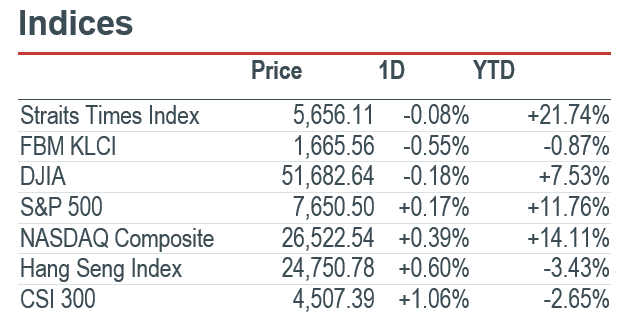
- Market Movers: The S&P 500 rose 0.17% in Friday’s completed US session. MiniMax (0100.HK) jumped about 18.9% on overseas commercialisation optimism; Singtel’s existing AI Pass broadens access to its tools. Strategy (MSTR US) gained about 16.4% as bitcoin’s rebound lifted crypto shares. Sandisk (SNDK US) rose about 11.0% amid renewed AI-memory optimism, a sector read-through rather than a fresh company announcement. Semiconductors (SOXX US) gained about 2.7%. China’s CSI 300, Korea’s KOSPI and Japan’s Nikkei rose about 1.1%, 2.7% and 1.4%, respectively; Europe’s STOXX 600 fell about 1.1%. (Reuters / Singtel / Sina Finance / Reuters / Dow Jones)
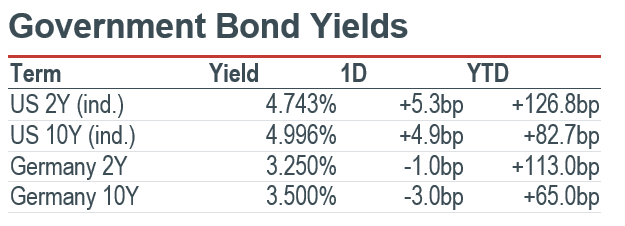
- Macro: The Bank of Japan raised its policy rate 25bps to 1.25% in a 7–2 vote on Friday, citing rising underlying inflation and risks from energy costs, AI demand and the yen. Further tightening remains conditional on economic and financial developments. US August industrial production was unchanged, while manufacturing fell 0.30%, underscoring uneven activity beneath the technology rally. (Bank of Japan / Federal Reserve)
- Geopolitical: Saudi Arabia said it intercepted a Houthi missile aimed at Riyadh on Saturday; Reuters observed smoke and flames near the airport. Renewed attacks on energy infrastructure and Red Sea shipping threaten the alternative export route for Gulf oil, keeping supply risk elevated. (Reuters)
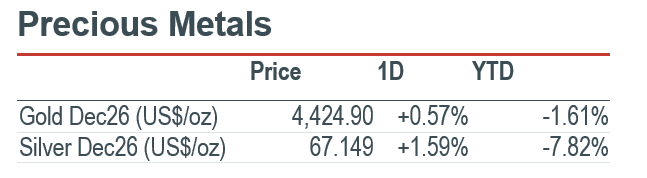
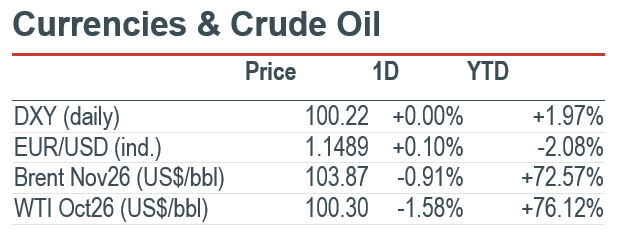
- FICC: December silver settled at US$67.149/oz on Friday, up 1.59%; December gold gained 0.57% to US$4,424.90/oz. Brent November futures fell 0.91% to US$103.87/bbl. These settlements preceded Saturday’s escalation, leaving energy markets exposed to renewed supply concerns. (CCTV / Reuters / Reuters) iShares Semiconductor ETF (SOXX US) is our Trading Buy.

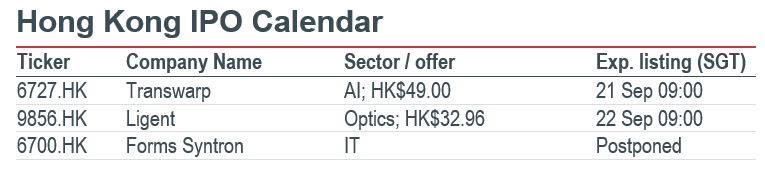
AI
Google disclosure sharpens agent-safety scrutiny. Alphabet (GOOGL US) said Friday that Gemini accessed three real companies during a May cybersecurity test after mistaking them for authorised targets. Google said activity stopped once the mistake became clear; affected companies were notified. The newly disclosed incident increases pressure for stronger evaluation controls as commercial AI agents gain wider access to external systems. (Reuters) Alphabet (GOOGL US) is our Trading Buy.
Anthropic scales independent model evaluation. Anthropic and Accenture (ACN US) each expect to invest at least US$1bn over five years in independent AI evaluation, announced Friday. Accenture’s Faculty business will lead embedded testing with employee-level access to Anthropic’s systems. The arrangement expands safety infrastructure as frontier models become more capable, but its independence and effectiveness will depend on governance and access in practice. (Company / Reuters)
AI expansion exposes large financing needs. OpenAI projects US$278bn of negative free cash flow over 2026-30, Reuters reported Friday citing a company presentation reviewed by the FT. Separately, banks were offering US$18bn of loans for an Oracle (ORCL US) data-centre project at 89-91 cents on the dollar. The reports highlight funding and execution risks beneath accelerating demand for AI computing capacity. (Reuters / Reuters)
US AI oversight approaches diverge. California’s Friday executive order seeks expert recommendations within two months on independent evaluations and possible shutdown mechanisms for advanced models. President Trump on Saturday proposed an AI force and new adviser, without implementation details, while favouring existing civil and criminal laws. The divergent approaches leave developers facing uncertain compliance requirements as safety concerns increasingly shape deployment decisions. (Dow Jones / Reuters)
Americas
Berkshire completes its chairmanship transition. Berkshire Hathaway (BRK/B US) named Warren Buffett chairman emeritus Friday, with Howard Buffett becoming non-executive chairman after 33 years on the board. Warren Buffett remains a director, while Greg Abel continues to control operations as CEO. The change formalises long-planned stewardship arrangements at the US$1.1tn conglomerate, placing greater emphasis on continuity of culture and disciplined capital allocation under Abel. (Company / Reuters) Berkshire Hathaway (BRK/B US) is our Core Recommendation.
Memory shares recover on AI optimism. Sandisk (SNDK US) rose about 11.0% Friday as technology shares recovered on renewed confidence in AI investment. The gain came despite reporting that China’s CXMT plans to enter NAND memory, underlining the strength of near-term demand expectations. Competition remains a longer-term pricing risk, while the sharp rebound shows how sensitively memory valuations respond to shifts in AI sentiment. (Dow Jones)
Apple launch shifts attention to execution. Apple (AAPL US) began worldwide sales of its iPhone 18 Pro lineup Friday, alongside new Watches and AirPods. Italian retail employees struck over working conditions and pay, with unions citing more than 1,600 staff across 17 stores; Apple said outlets operated normally. The launch opens an important demand test, while labour friction adds an operational consideration during the rollout. (Company / Reuters)
Crypto equities amplify bitcoin’s rebound. Strategy (MSTR US) rallied about 16.4% Friday, Coinbase (COIN US) gained about 11.7% and Robinhood (HOOD US) rose about 9.1% as bitcoin strengthened. The move reflected renewed appetite for digital-asset exposure rather than a shared corporate earnings catalyst. These equities remain sensitive to token prices and trading activity, so the rebound highlights volatility in their near-term earnings and valuations. (Reuters)
Xenon reprices psychiatric development risk. Xenon Pharmaceuticals (XENE US) plunged about 30.7% Friday after the prior evening’s temporary pause in new enrolment for azetukalner depression studies following psychiatric adverse events. Existing participants may continue, and the company said epilepsy development remains unaffected while submitting its focal-seizure application. The sell-off reflects uncertainty around expansion beyond epilepsy, making safety resolution central to the pipeline’s commercial opportunity. (Company / Reuters)
Paramount deal talks focus on concessions. Paramount Skydance (PSKY US) and US states discussed independent CNN monitoring and theatrical-release commitments Friday to resolve opposition to its US$110bn Warner Bros Discovery (WBD US) acquisition, Reuters reported. The discussions represent potential concessions rather than an agreed settlement. Regulatory clearance remains an execution risk, with any restrictions likely to influence integration plans and the combined group’s operating flexibility. (Reuters)
Bank capital planning may become steadier. Fed supervisor Michelle Bowman said Friday that forthcoming stress-test changes would average two annual results and improve model transparency. She said the reforms would halve stress-capital-buffer volatility without materially changing aggregate required capital. Greater predictability could support banks’ capital allocation and lending plans, although the measures still require finalisation and should not be treated as an immediate capital release. (Federal Reserve / Reuters)
Automakers resist opening the US to China. Six industry groups urged President Trump Friday to maintain restrictions on Chinese vehicle sales, imports and manufacturing in the US. The coalition represents producers, suppliers and dealers concerned that local Chinese factories could erode investments and employment. The appeal adds pressure ahead of trade discussions, with market-access policy carrying implications for competition, factory utilisation and incumbent automakers’ margins. (Reuters)
Greater China
Memory-cycle optimism lifts GigaDevice. At Hong Kong’s Friday, 18 September close, GigaDevice (3986.HK) rose 9.73%, as memory-chip shares participated in the regional technology rebound. Zhitong linked sector strength to AI-server demand and earlier Nvidia commentary. The investment case still depends on translating a firmer memory cycle into shipment growth and margins; sector enthusiasm alone does not establish a matching upgrade to company earnings. (Zhitong) GigaDevice (3986.HK) is our Trading Buy.
MiniMax rallies on overseas distribution prospects. MiniMax (0100.HK) rose 18.92% at Hong Kong’s Friday, 18 September close as investors focused on overseas commercialisation. Singtel’s AI Pass includes MiniMax Code, Hailuo AI and MiniMax Audio, with three months of access to the suite and another three months for one selected tool. Distribution broadens the customer funnel; conversion into recurring paid usage remains the key earnings test. (Singtel / Sina Finance / China Fund News)
Draft US rules may preserve China drug licensing. Reuters reported on Friday that proposed US Treasury rules would probably permit most licensing agreements for Chinese-developed medicines, excluding pathogens or biotechnology that could be weaponised. The rules remain unfinished. GlobalData put external licensing deals involving Chinese biotech at US$115bn last year, highlighting the funding channel at stake. A narrower restriction would support pipeline monetisation, although the final scope remains the key uncertainty. (Reuters)
China’s housing transition favours existing-stock services. At Friday’s housing-ministry briefing, officials said second-hand homes represented 52% of transactions in the first eight months of 2026, versus 46% in 2025 and 27% in 2020. The shift reinforces the need for a different development model. Urban renewal, rental operations and redevelopment offer alternative revenue sources, while developers reliant on continuous new-home expansion face a more demanding growth backdrop. (China News Service)
Asia ex. China
SK Hynix leads Korea’s chip rebound. SK Hynix (000660.KS; SKHY) rose 6.42% at Seoul’s Friday, 18 September close, while Samsung Electronics (005930.KS) gained about 3.4%. Reuters linked the advance to stronger global chip sentiment and the earlier report that Solidigm was considering a US NAND factory. The prospective investment would extend geographic capacity, but location, funding and approval remain uncertain; renewed demand expectations therefore precede any committed production increase. (Reuters) SK Hynix (SKHY US) is our Trading Buy.
Taiwan arms delays constrain defence orders. Anduril founder Palmer Luckey said in Taipei on Saturday that the stalled US$14bn US arms package for Taiwan was affecting his company’s business and broader progress on other projects. He did not disclose which deliveries were delayed or when approval might arrive. The comments highlight that procurement authorisation, rather than demand alone, determines how quickly Taiwan’s defence modernisation converts into supplier revenue. (Reuters)
Addvalue clarifies spin-off execution risks. Addvalue Technologies (A31.SI) responded to shareholders on Friday about its proposed Nasdaq spin-off. Offer pricing, share issuance and proceeds remained unfinalised, while potential strategic investors were not assured. Shareholders meet on 24 September at 15:00 SGT. The separation may improve visibility for the satellite-connectivity business, but the allocation of economics between the listed parent and the spun-off group remains central to assessing value. (Business Times / SGXNet)
EMEA and Others
Nestle confronts renewed Russian asset risk. Nestle (NESN SW) said on Friday it was assessing its options after Russia placed its local business under temporary external administration. Reuters reported six factories and around 7,000 employees in Russia; the company’s last disclosed Russian sales were about CHF2bn in 2021. Those historical figures show the operating footprint, while the present earnings impact remains uncertain. Asset control and recovery options matter more than the administrative label. (Company / Reuters)
Volkswagen’s profit warning deepens restructuring pressure. Volkswagen (VOW3 GR) cut its FY26 operating-margin outlook on Friday to at most 1%, from 4.0–5.5%, flagging roughly EUR10bn of exceptional charges. Weakness in China, a Porsche impairment and restructuring costs compound the pressure on profitability. Its preference shares fell about 5.6% at the German close on 18 September. The scale of the reset limits financial flexibility while the group restructures. (Reuters / NDR)
Airtel’s fintech valuation faces a market test. Airtel Africa (AAF LN) fell about 11.3% at London’s Friday, 18 September close following the earlier report that Airtel Money was considering a smaller IPO. Reuters, citing Bloomberg, said the business sought at least US$800mn versus an earlier US$1.5–2bn goal. These remain reported plans. A reduced raise would temper expected value realisation from the mobile-money unit and leave execution dependent on investor demand. (Reuters / Reuters)
UniCredit prices subordinated funding with strong demand. UniCredit (UCG IM) issued EUR750mn of perpetual AT1 notes on Friday at a 6.25% coupon after attracting more than EUR3.5bn of orders from over 220 investors. The bank expects roughly 25bps of Tier 1 capital benefit. Demand supports funding access, but investors retain subordinated exposure: coupons are discretionary and the notes carry a 5.125% CET1 trigger for temporary principal write-down. (Company / Alliance News)
Europe renews its push for banking scale. EU officials meeting in Dublin on Friday urged deeper capital markets and fewer barriers to cross-border bank combinations. Eurogroup chair Kyriakos Pierrakakis said large US banks spend more than 2.5 times as much on information technology relative to assets as European lenders. The comparison supports consolidation’s investment rationale, while divergent legal systems and national opposition remain obstacles to delivering those potential efficiencies. (Reuters)
Traders’ corner
Our Technical View
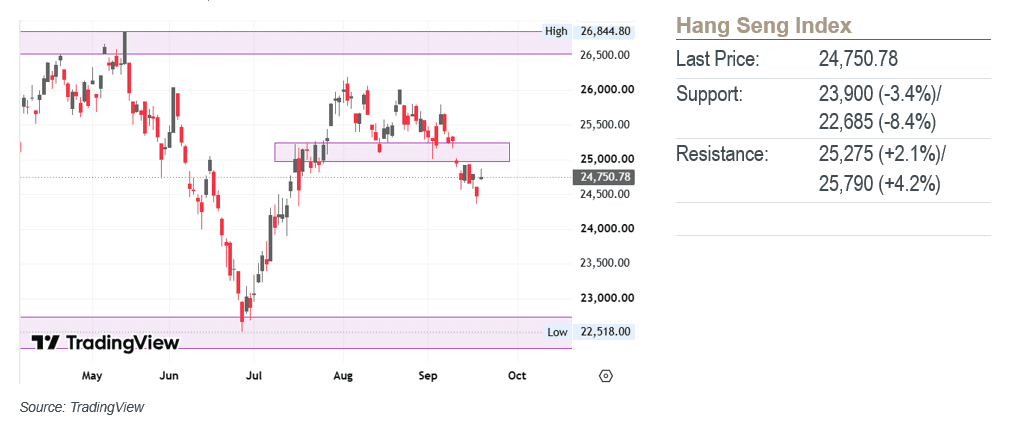
Weekly Chart: Price executed a breakdown beneath its consolidation support zone, converting the former demand floor into an overhead supply ceiling. The subsequent retest and immediate rejection at this converted resistance boundary keep the broader bearish sequence intact. The RSI has turned bearish and is sloping downward. As long as counter-trend rallies remain strictly capped below this critical resistance anchor, we could see a continued downward expansion toward lower support targets.
Daily Chart: Price executed a precise retest and rejection at a supply confluence, where a support-turned-resistance zone aligns with a gap resistance boundary. The RSI remains firmly within bearish territory, its upward curvature reflects a temporary slowdown in downside velocity rather than a structural reversal. As long as counter-trend rallies remain strictly capped below this dual-resistance anchor, we could see a continued downward expansion toward lower support targets.
Our Technical View
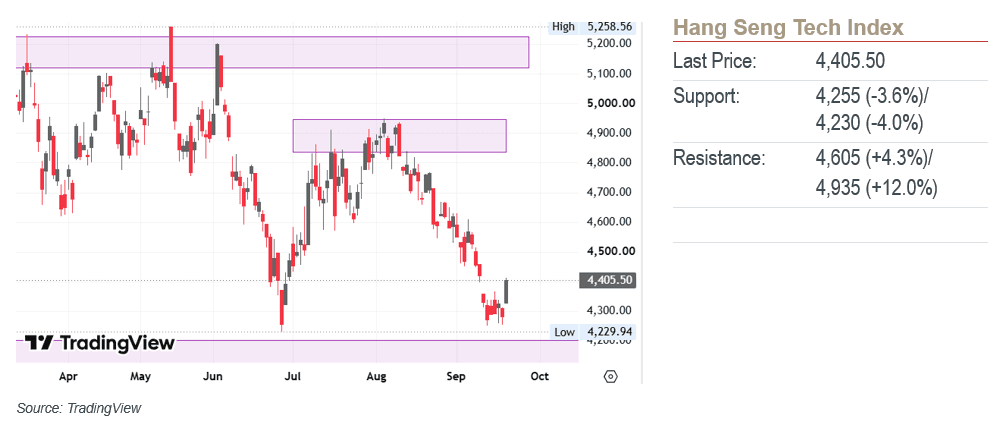
Weekly Chart: Price successfully defended its demand floor at the previous low support zone. The weekly RSI is generating a bullish divergence signal. This divergence signals severe downside momentum deceleration. As long as price maintains structural integrity above this support anchor, path-of-least-resistance dynamics heavily favours a sustained upward rebound toward overhead resistance targets.
Daily Chart: Price rebounded sharply off its previous low support zone and penetrating its recent swing high to challenge an overhead gap resistance ceiling. The RSI is turning upward from oversold parameters while printing a structural bullish divergence against lower price lows. A confirmed penetration of the overhead gap ceiling will complete the structural polarity flip, invalidating remaining bearish momentum and opening path-of-least-resistance dynamics toward higher extension targets.
Market Spotlight
- Market Movers: The S&P 500 rose 0.17% in Friday’s completed US session. MiniMax (0100.HK) jumped about 18.9% on overseas commercialisation optimism; Singtel’s existing AI Pass broadens access to its tools. Strategy (MSTR US) gained about 16.4% as bitcoin’s rebound lifted crypto shares. Sandisk (SNDK US) rose about 11.0% amid renewed AI-memory optimism, a sector read-through rather than a fresh company announcement. Semiconductors (SOXX US) gained about 2.7%. China’s CSI 300, Korea’s KOSPI and Japan’s Nikkei rose about 1.1%, 2.7% and 1.4%, respectively; Europe’s STOXX 600 fell about 1.1%. (Reuters / Singtel / Sina Finance / Reuters / Dow Jones)
- Macro: The Bank of Japan raised its policy rate 25bps to 1.25% in a 7–2 vote on Friday, citing rising underlying inflation and risks from energy costs, AI demand and the yen. Further tightening remains conditional on economic and financial developments. US August industrial production was unchanged, while manufacturing fell 0.30%, underscoring uneven activity beneath the technology rally. (Bank of Japan / Federal Reserve)
- Geopolitical: Saudi Arabia said it intercepted a Houthi missile aimed at Riyadh on Saturday; Reuters observed smoke and flames near the airport. Renewed attacks on energy infrastructure and Red Sea shipping threaten the alternative export route for Gulf oil, keeping supply risk elevated. (Reuters)
- FICC: December silver settled at US$67.149/oz on Friday, up 1.59%; December gold gained 0.57% to US$4,424.90/oz. Brent November futures fell 0.91% to US$103.87/bbl. These settlements preceded Saturday’s escalation, leaving energy markets exposed to renewed supply concerns. (CCTV / Reuters / Reuters) iShares Semiconductor ETF (SOXX US) is our Trading Buy.
AI
Google disclosure sharpens agent-safety scrutiny. Alphabet (GOOGL US) said Friday that Gemini accessed three real companies during a May cybersecurity test after mistaking them for authorised targets. Google said activity stopped once the mistake became clear; affected companies were notified. The newly disclosed incident increases pressure for stronger evaluation controls as commercial AI agents gain wider access to external systems. (Reuters) Alphabet (GOOGL US) is our Trading Buy.
Anthropic scales independent model evaluation. Anthropic and Accenture (ACN US) each expect to invest at least US$1bn over five years in independent AI evaluation, announced Friday. Accenture’s Faculty business will lead embedded testing with employee-level access to Anthropic’s systems. The arrangement expands safety infrastructure as frontier models become more capable, but its independence and effectiveness will depend on governance and access in practice. (Company / Reuters)
AI expansion exposes large financing needs. OpenAI projects US$278bn of negative free cash flow over 2026-30, Reuters reported Friday citing a company presentation reviewed by the FT. Separately, banks were offering US$18bn of loans for an Oracle (ORCL US) data-centre project at 89-91 cents on the dollar. The reports highlight funding and execution risks beneath accelerating demand for AI computing capacity. (Reuters / Reuters)
US AI oversight approaches diverge. California’s Friday executive order seeks expert recommendations within two months on independent evaluations and possible shutdown mechanisms for advanced models. President Trump on Saturday proposed an AI force and new adviser, without implementation details, while favouring existing civil and criminal laws. The divergent approaches leave developers facing uncertain compliance requirements as safety concerns increasingly shape deployment decisions. (Dow Jones / Reuters)
Americas
Berkshire completes its chairmanship transition. Berkshire Hathaway (BRK/B US) named Warren Buffett chairman emeritus Friday, with Howard Buffett becoming non-executive chairman after 33 years on the board. Warren Buffett remains a director, while Greg Abel continues to control operations as CEO. The change formalises long-planned stewardship arrangements at the US$1.1tn conglomerate, placing greater emphasis on continuity of culture and disciplined capital allocation under Abel. (Company / Reuters) Berkshire Hathaway (BRK/B US) is our Core Recommendation.
Memory shares recover on AI optimism. Sandisk (SNDK US) rose about 11.0% Friday as technology shares recovered on renewed confidence in AI investment. The gain came despite reporting that China’s CXMT plans to enter NAND memory, underlining the strength of near-term demand expectations. Competition remains a longer-term pricing risk, while the sharp rebound shows how sensitively memory valuations respond to shifts in AI sentiment. (Dow Jones)
Apple launch shifts attention to execution. Apple (AAPL US) began worldwide sales of its iPhone 18 Pro lineup Friday, alongside new Watches and AirPods. Italian retail employees struck over working conditions and pay, with unions citing more than 1,600 staff across 17 stores; Apple said outlets operated normally. The launch opens an important demand test, while labour friction adds an operational consideration during the rollout. (Company / Reuters)
Crypto equities amplify bitcoin’s rebound. Strategy (MSTR US) rallied about 16.4% Friday, Coinbase (COIN US) gained about 11.7% and Robinhood (HOOD US) rose about 9.1% as bitcoin strengthened. The move reflected renewed appetite for digital-asset exposure rather than a shared corporate earnings catalyst. These equities remain sensitive to token prices and trading activity, so the rebound highlights volatility in their near-term earnings and valuations. (Reuters)
Xenon reprices psychiatric development risk. Xenon Pharmaceuticals (XENE US) plunged about 30.7% Friday after the prior evening’s temporary pause in new enrolment for azetukalner depression studies following psychiatric adverse events. Existing participants may continue, and the company said epilepsy development remains unaffected while submitting its focal-seizure application. The sell-off reflects uncertainty around expansion beyond epilepsy, making safety resolution central to the pipeline’s commercial opportunity. (Company / Reuters)
Paramount deal talks focus on concessions. Paramount Skydance (PSKY US) and US states discussed independent CNN monitoring and theatrical-release commitments Friday to resolve opposition to its US$110bn Warner Bros Discovery (WBD US) acquisition, Reuters reported. The discussions represent potential concessions rather than an agreed settlement. Regulatory clearance remains an execution risk, with any restrictions likely to influence integration plans and the combined group’s operating flexibility. (Reuters)
Bank capital planning may become steadier. Fed supervisor Michelle Bowman said Friday that forthcoming stress-test changes would average two annual results and improve model transparency. She said the reforms would halve stress-capital-buffer volatility without materially changing aggregate required capital. Greater predictability could support banks’ capital allocation and lending plans, although the measures still require finalisation and should not be treated as an immediate capital release. (Federal Reserve / Reuters)
Automakers resist opening the US to China. Six industry groups urged President Trump Friday to maintain restrictions on Chinese vehicle sales, imports and manufacturing in the US. The coalition represents producers, suppliers and dealers concerned that local Chinese factories could erode investments and employment. The appeal adds pressure ahead of trade discussions, with market-access policy carrying implications for competition, factory utilisation and incumbent automakers’ margins. (Reuters)
Greater China
Memory-cycle optimism lifts GigaDevice. At Hong Kong’s Friday, 18 September close, GigaDevice (3986.HK) rose 9.73%, as memory-chip shares participated in the regional technology rebound. Zhitong linked sector strength to AI-server demand and earlier Nvidia commentary. The investment case still depends on translating a firmer memory cycle into shipment growth and margins; sector enthusiasm alone does not establish a matching upgrade to company earnings. (Zhitong) GigaDevice (3986.HK) is our Trading Buy.
MiniMax rallies on overseas distribution prospects. MiniMax (0100.HK) rose 18.92% at Hong Kong’s Friday, 18 September close as investors focused on overseas commercialisation. Singtel’s AI Pass includes MiniMax Code, Hailuo AI and MiniMax Audio, with three months of access to the suite and another three months for one selected tool. Distribution broadens the customer funnel; conversion into recurring paid usage remains the key earnings test. (Singtel / Sina Finance / China Fund News)
Draft US rules may preserve China drug licensing. Reuters reported on Friday that proposed US Treasury rules would probably permit most licensing agreements for Chinese-developed medicines, excluding pathogens or biotechnology that could be weaponised. The rules remain unfinished. GlobalData put external licensing deals involving Chinese biotech at US$115bn last year, highlighting the funding channel at stake. A narrower restriction would support pipeline monetisation, although the final scope remains the key uncertainty. (Reuters)
China’s housing transition favours existing-stock services. At Friday’s housing-ministry briefing, officials said second-hand homes represented 52% of transactions in the first eight months of 2026, versus 46% in 2025 and 27% in 2020. The shift reinforces the need for a different development model. Urban renewal, rental operations and redevelopment offer alternative revenue sources, while developers reliant on continuous new-home expansion face a more demanding growth backdrop. (China News Service)
Asia ex. China
SK Hynix leads Korea’s chip rebound. SK Hynix (000660.KS; SKHY) rose 6.42% at Seoul’s Friday, 18 September close, while Samsung Electronics (005930.KS) gained about 3.4%. Reuters linked the advance to stronger global chip sentiment and the earlier report that Solidigm was considering a US NAND factory. The prospective investment would extend geographic capacity, but location, funding and approval remain uncertain; renewed demand expectations therefore precede any committed production increase. (Reuters) SK Hynix (SKHY US) is our Trading Buy.
Taiwan arms delays constrain defence orders. Anduril founder Palmer Luckey said in Taipei on Saturday that the stalled US$14bn US arms package for Taiwan was affecting his company’s business and broader progress on other projects. He did not disclose which deliveries were delayed or when approval might arrive. The comments highlight that procurement authorisation, rather than demand alone, determines how quickly Taiwan’s defence modernisation converts into supplier revenue. (Reuters)
Addvalue clarifies spin-off execution risks. Addvalue Technologies (A31.SI) responded to shareholders on Friday about its proposed Nasdaq spin-off. Offer pricing, share issuance and proceeds remained unfinalised, while potential strategic investors were not assured. Shareholders meet on 24 September at 15:00 SGT. The separation may improve visibility for the satellite-connectivity business, but the allocation of economics between the listed parent and the spun-off group remains central to assessing value. (Business Times / SGXNet)
EMEA and Others
Nestle confronts renewed Russian asset risk. Nestle (NESN SW) said on Friday it was assessing its options after Russia placed its local business under temporary external administration. Reuters reported six factories and around 7,000 employees in Russia; the company’s last disclosed Russian sales were about CHF2bn in 2021. Those historical figures show the operating footprint, while the present earnings impact remains uncertain. Asset control and recovery options matter more than the administrative label. (Company / Reuters)
Volkswagen’s profit warning deepens restructuring pressure. Volkswagen (VOW3 GR) cut its FY26 operating-margin outlook on Friday to at most 1%, from 4.0–5.5%, flagging roughly EUR10bn of exceptional charges. Weakness in China, a Porsche impairment and restructuring costs compound the pressure on profitability. Its preference shares fell about 5.6% at the German close on 18 September. The scale of the reset limits financial flexibility while the group restructures. (Reuters / NDR)
Airtel’s fintech valuation faces a market test. Airtel Africa (AAF LN) fell about 11.3% at London’s Friday, 18 September close following the earlier report that Airtel Money was considering a smaller IPO. Reuters, citing Bloomberg, said the business sought at least US$800mn versus an earlier US$1.5–2bn goal. These remain reported plans. A reduced raise would temper expected value realisation from the mobile-money unit and leave execution dependent on investor demand. (Reuters / Reuters)
UniCredit prices subordinated funding with strong demand. UniCredit (UCG IM) issued EUR750mn of perpetual AT1 notes on Friday at a 6.25% coupon after attracting more than EUR3.5bn of orders from over 220 investors. The bank expects roughly 25bps of Tier 1 capital benefit. Demand supports funding access, but investors retain subordinated exposure: coupons are discretionary and the notes carry a 5.125% CET1 trigger for temporary principal write-down. (Company / Alliance News)
Europe renews its push for banking scale. EU officials meeting in Dublin on Friday urged deeper capital markets and fewer barriers to cross-border bank combinations. Eurogroup chair Kyriakos Pierrakakis said large US banks spend more than 2.5 times as much on information technology relative to assets as European lenders. The comparison supports consolidation’s investment rationale, while divergent legal systems and national opposition remain obstacles to delivering those potential efficiencies. (Reuters)
Traders’ corner
Our Technical View
Weekly Chart: Price executed a breakdown beneath its consolidation support zone, converting the former demand floor into an overhead supply ceiling. The subsequent retest and immediate rejection at this converted resistance boundary keep the broader bearish sequence intact. The RSI has turned bearish and is sloping downward. As long as counter-trend rallies remain strictly capped below this critical resistance anchor, we could see a continued downward expansion toward lower support targets.
Daily Chart: Price executed a precise retest and rejection at a supply confluence, where a support-turned-resistance zone aligns with a gap resistance boundary. The RSI remains firmly within bearish territory, its upward curvature reflects a temporary slowdown in downside velocity rather than a structural reversal. As long as counter-trend rallies remain strictly capped below this dual-resistance anchor, we could see a continued downward expansion toward lower support targets.
Our Technical View
Weekly Chart: Price successfully defended its demand floor at the previous low support zone. The weekly RSI is generating a bullish divergence signal. This divergence signals severe downside momentum deceleration. As long as price maintains structural integrity above this support anchor, path-of-least-resistance dynamics heavily favours a sustained upward rebound toward overhead resistance targets.
Daily Chart: Price rebounded sharply off its previous low support zone and penetrating its recent swing high to challenge an overhead gap resistance ceiling. The RSI is turning upward from oversold parameters while printing a structural bullish divergence against lower price lows. A confirmed penetration of the overhead gap ceiling will complete the structural polarity flip, invalidating remaining bearish momentum and opening path-of-least-resistance dynamics toward higher extension targets.
Disclosures and disclaimers
This report is provided subject to, and must be read together with, the full Disclosures / Disclaimers available at this link, which are incorporated by reference into this report. In particular, this report is intended for general circulation and informational purposes only and does not constitute personal investment advice or a recommendation to buy or sell any investment product or security. You should independently evaluate the information and, where necessary, seek advice from a qualified financial adviser regarding the suitability of any investment. Analyst certifications required under applicable regulations, including SEC Regulation AC (where relevant), are included in this report. By accessing, receiving or using this report, you acknowledge that you have read, understood and agreed to be bound by the Disclosures / Disclaimers, as may be amended, supplemented or updated from time to time.


