

Wealth Flash
The Knowledge Share
China Maxxing Part III: C-Beauty as China’s Next Branded Export
When lipsticks re-entered China following the Reform and Opening-Up in the early 1980s, there were only a handful of brands and predominantly one color – rose pink. Today, Chinese beauty products (C-beauty) are becoming a global phenomenon, joining the ranks of other successful Chinese branded exports such as home appliances, smartphones and EVs. What’s driving this transformation?
CIO Summary
- C-beauty is emerging as China’s next branded export. Chinese beauty brands are gaining international traction, particularly in ASEAN, the Middle East, and other emerging markets. Their key advantage lies in China's highly responsive supply chain, enabling rapid product innovation, hyper-localization and competitive pricing.
- "China Maxxing" and algorithm-driven media accelerate global adoption. TikTok and other algorithm-driven platforms are reshaping how brands are built globally, lowering traditional barriers to international expansion. C-beauty is leveraging this wave to attract mainstream, non-Chinese consumers, transforming perceptions from "cheap alternatives" to aspirational lifestyle brands.
- Biggest hurdle: marketing investment, not product quality. Overseas marketing investment and further brand building are C-beauty’s main bottlenecks currently. Many Chinese brands remain trapped in a chicken-and-egg dilemma: they want proven sales before investing in marketing, yet meaningful sales growth requires upfront promotional spending.
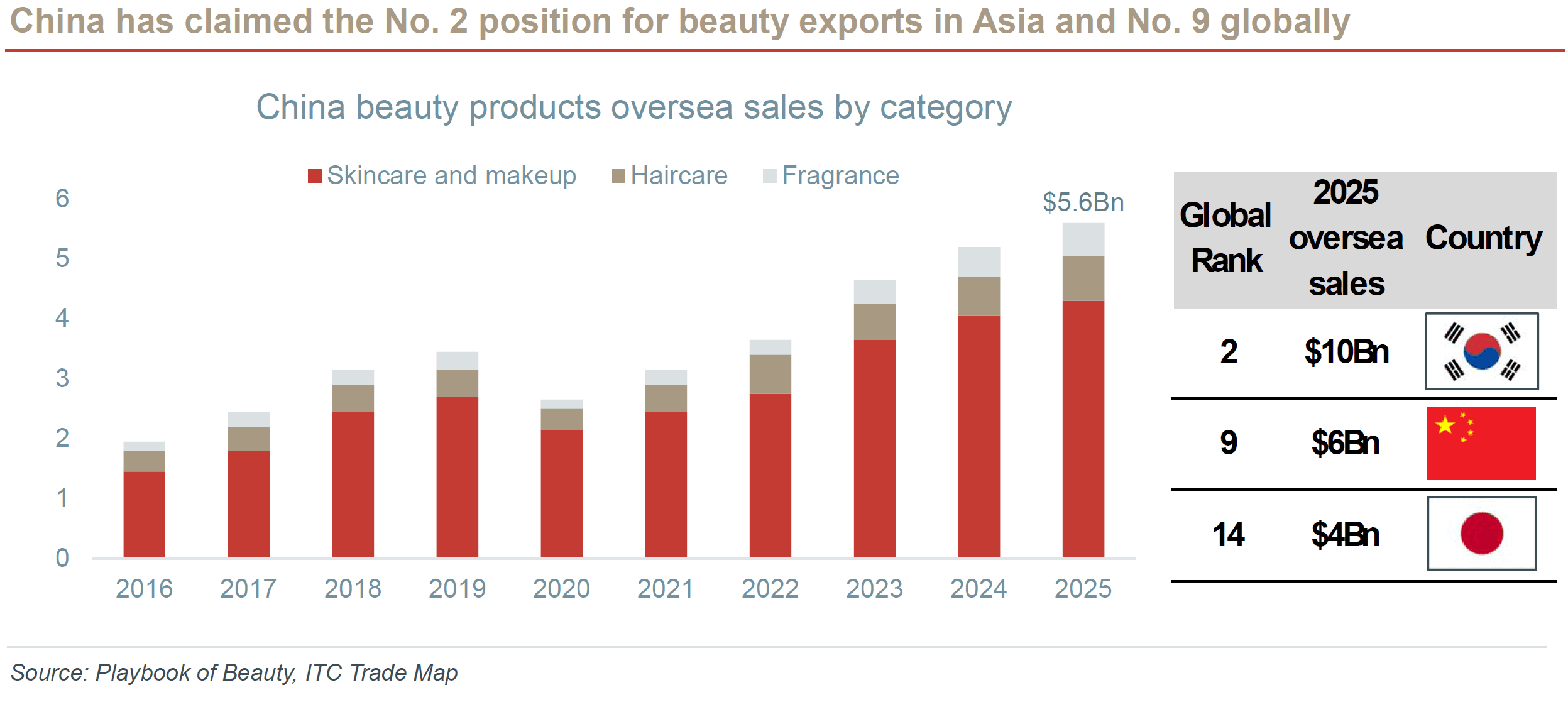
China has claimed the No. 2 position for beauty exports in Asia and No. 9 globally
In case you are not familiar with the concept of China Maxxing, below are Parts I & II of this series for background.
- China Maxxing Part I: A New Model for Global Consumer Influence
- China Maxxing Part II: The Geopolitical Parallel
Bloomberg Opinion recently published an article titled "China's next soft-power export could be beauty", highlighting the rising global influence of Chinese cosmetics and personal care products. Below are the key takeaways from this article, along with our own channel insights. Hope you find them useful.
- Accelerating global market penetration. China's beauty exports totaled USD 5.7 billion in 2025, with notable momentum as Chinese brands gain recognition and become increasingly competitive. Exports to ASEAN countries have more than doubled over the past five years, with Indonesia emerging as the top destination. This regional-first strategy allows Chinese beauty products (C-beauty) to dominate high-growth, emerging markets before scaling up the value chain.
- Asymmetric advantage of customization. C-beauty’s key differentiator lies in supply chain responsiveness. Chinese vendors are rapidly outpacing legacy players by catering to hyper-local needs, such as offering formulas for a broader range of skin-tones, and securing formal Halal certifications. While some Japanese/Korean brands have offered vegan or halal-friendly features, they rarely pursue the rigorous, formal certification required to effectively capture share among over 200 million Muslim consumers in Southeast Asia and the Middle East.
- The "China Maxxing" tailwind. As highlighted in our previous research on “China Maxxing”, algorithm-driven social media such as TikTok is subtly reshaping global perceptions of Chinese brands. Among Gen Z and younger millennials globally, C-beauty is increasingly shedding its "cheap alternative" stigma, and is instead being framed as a trendy, utility-driven, and highly aesthetic lifestyle choice. China maxxing provides a favorable cultural foundation for C-beauty brands to gain market share and increase pricing power overseas.
Channel checks with a major Beauty E-Retailer
We recently met with the Head of C-Beauty at a leading cross-border e-commerce platform (the “platform”), spanning 150 countries with 200+ C-beauty and 400+ K-beauty brands in its portfolio. Its on-the-ground observations reveal a nuanced picture of C-beauty’s overseas expansion.
- C-beauty going global: early, flexible and strategic. With top livestreamers retreating and intense domestic competition, C-beauty brands have been actively seeking incremental growth abroad. The industry’s overseas rollout began only 2–3 years ago and remains in its early innings. The dominant go-to-market model is online-first via cross-border D2C platforms and local distributors. Cross-border online channels grant C-beauty much-needed regulatory flexibility for local labeling and registration (such as EU CPNP), allowing brands to test markets with minimal compliance costs upfront. Geographically, developed markets such as the US have high customer acquisition costs. Hence, many brands start their globalization from Southeast Asia, the Middle East, and even Russia.
- Winning global consumers beyond diaspora demand. Contrary to the common belief of diaspora-driven demand, the majority of the platform’s C-beauty customers abroad are non-Chinese. Young shoppers in Europe especially exhibit little to no "China bias": they are embracing Asian/Chinese brands for "value for money” while turning away from legacy luxury markups, despite living in a global beauty hub. Incidentally, this is also a trend that we noted in our recent global luxury report. For marketing, C-beauty brands are replicating the domestic KOL playbook overseas, by actively creating content across social media channels and collaborating with local KOLs. On the product front, these brands are strategically avoiding head-on competition with L'Oréal and Estée Lauder in skincare—a category dominated by leading Western brands. Instead, they are leveraging China's unmatched supply chain advantages to dominate disruptive, niche color cosmetics, e.g. avant-garde eyeshadow palettes that legacy brands fail to offer. This trend represents a key intersection of our “China Export Shock 2.0” and “China Maxxing” themes.
- Biggest hurdle: marketing investment, not product quality. C-beauty's product quality and diversity are clear wins, yet existing business practices have become a key hurdle. Many brands are accustomed to the domestic approach of demanding guaranteed order volumes before committing meaningful overseas marketing budgets. Without adequate promotion, however, sales in new markets can hardly scale. The result is a structural underinvestment in overseas brand building. This forms a stark contrast with K-beauty: Korean brands have benefited significantly from the K-pop cultural spillover, government support for celebrity endorsers, and a "spend-first, harvest-later" mentality to boost global expansion. The potential for C-beauty is enormous, but the industry seems to be caught in a chicken-and-egg dilemma in terms of marketing investment.
- Despite these hurdles, several C-beauty brands have established successful overseas models:
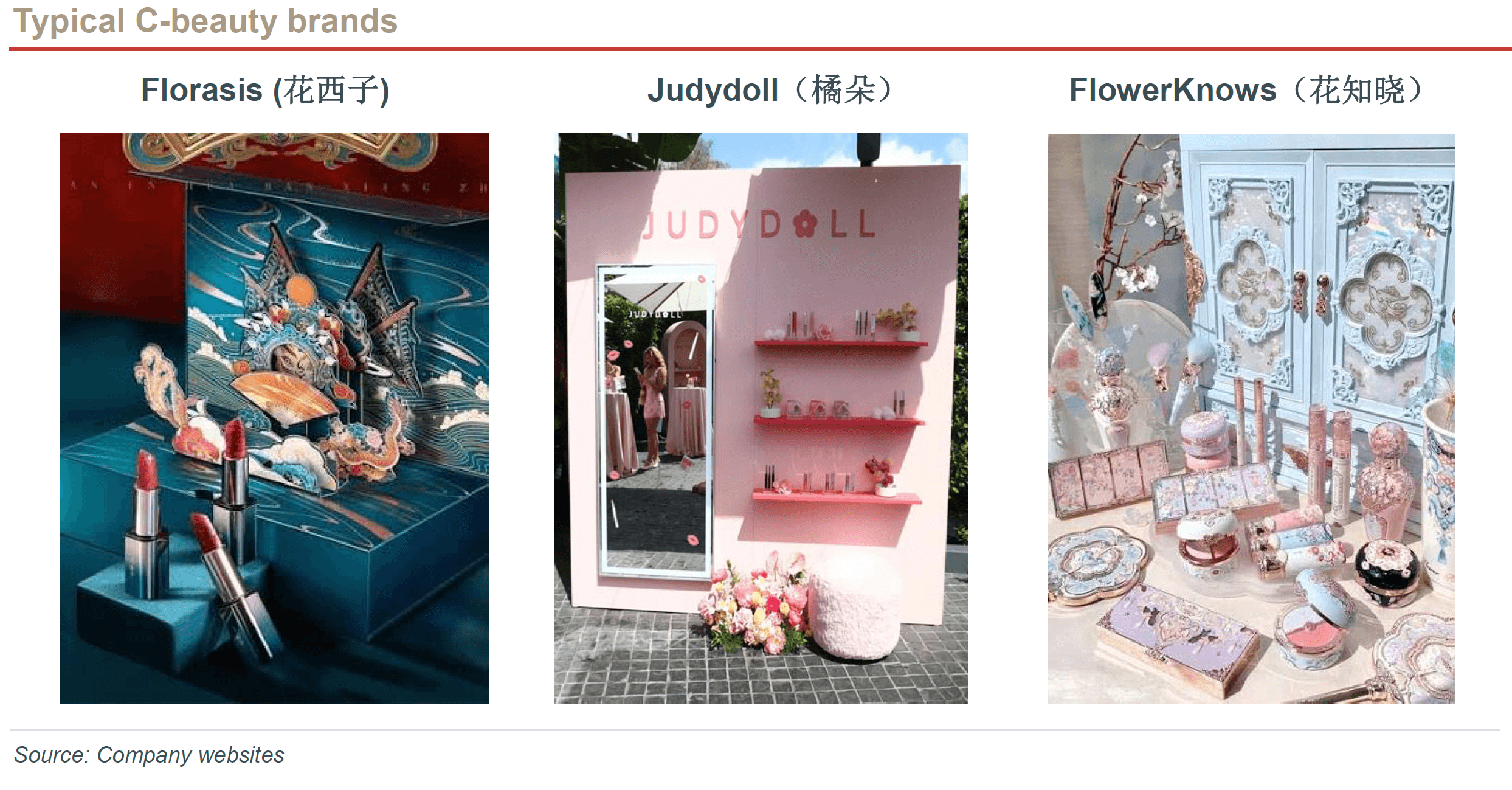
- Judydoll (unlisted) operates a dedicated US social media team, posting up to 1,000 videos monthly and now expanding from color cosmetics to skincare through ingredient-marketing.
- Florasis (unlisted), renowned for its ornate oriental packaging, has built formidable brand equity overseas. It has also completed CPNP registration and multi-country labeling.
- FlowerKnows, acquired by Proya (603605.CH), is a standout case of "born-global" model, winning over young consumers through its hyper-feminine aesthetic and strong social media presence.
Our Take
- Why should investors care? The C-beauty proliferation is a tangible manifestation of our "China Maxxing" theme. It reinforces China’s evolution from low-end manufacturing exports to culturally resonant, algorithm-amplified brands. For investors, this presents a compelling opportunity to capitalize on China’s export upgrade, with sustainable growth and higher margins.
- Why C-beauty’s global rise may be sustainable. Algorithm-driven social media is fundamentally reshaping global brand building. China appears to be at the forefront of this structural change, with the globalization of C-beauty as a prime example. Unlike the science-heavy marketing of high-tech products, C-beauty's overseas success relies on visual appeal, rapid iteration, and hyper-localization (e.g. Halal certifications in ASEAN/Middle East). This validates our earlier thesis that China's soft power is indeed spreading through algo-driven, utility-based content, creating a sustainable runway for Chinese branded exports across multiple categories.
- From industrial might to cultural mindshare. C-beauty appears to be at a similar inflection point to where K-beauty occupied a decade ago. Just as Korean cosmetics evolved from regional challengers to a global powerhouse, C-beauty is well positioned to replicate the same trajectory. The parallels are striking: both have superb “hardware” (strong R&D needed to create new ingredients and products) and improving “software” (rising cultural influence backed by fashion, entertainment and social media). As younger demographics gradually enter their peak spending years, their algorithmic familiarity with and affinity for Chinese aesthetics will likely provide a powerful, long-term tailwind for Chinese brands.
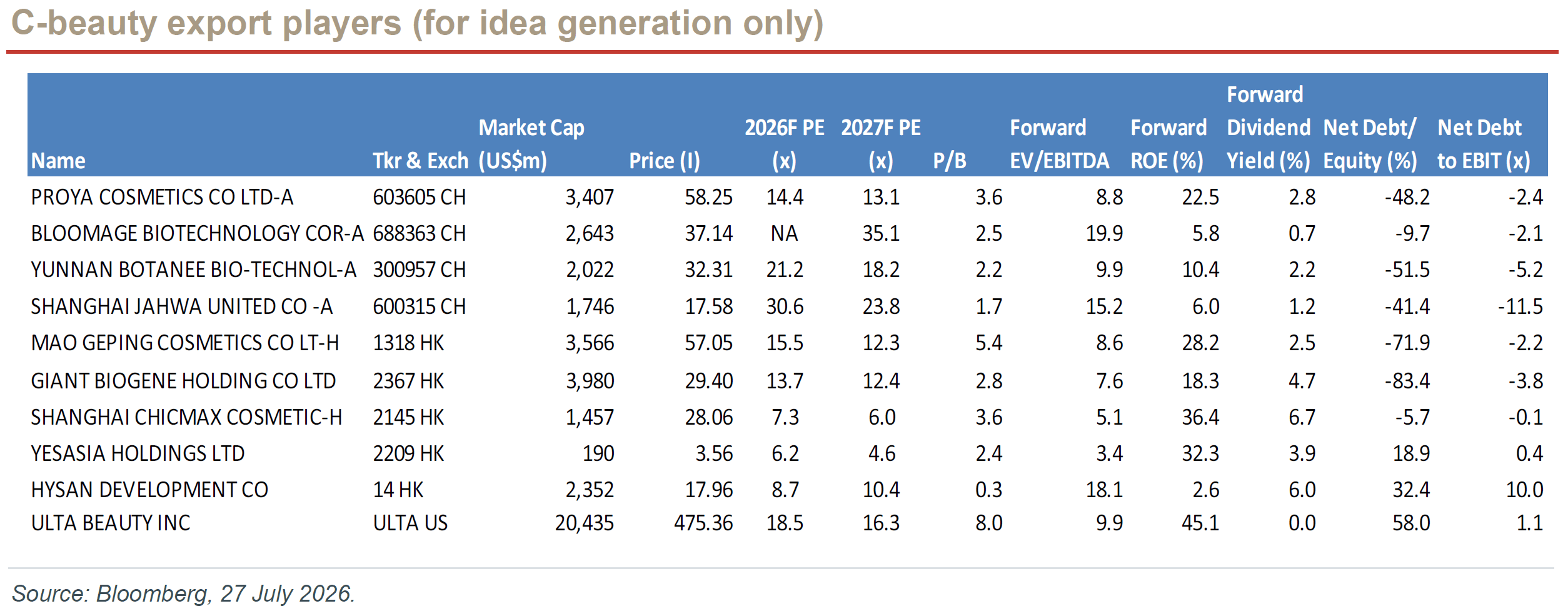
- Tentative investment implications. While pure-play C-beauty pioneers (e.g. Judydoll, Florasis) remain largely unlisted, investors can gain exposure to the trend through listed beneficiaries in the supply chain. These include C-beauty conglomerates actively acquiring and incubating niche brands, as well as cross-border retail and distribution platforms. See table below for idea generation purposes only.
When lipsticks re-entered China following the Reform and Opening-Up in the early 1980s, there were only a handful of brands and predominantly one color – rose pink. Today, Chinese beauty products (C-beauty) are becoming a global phenomenon, joining the ranks of other successful Chinese branded exports such as home appliances, smartphones and EVs. What’s driving this transformation?
CIO Summary
- C-beauty is emerging as China’s next branded export. Chinese beauty brands are gaining international traction, particularly in ASEAN, the Middle East, and other emerging markets. Their key advantage lies in China's highly responsive supply chain, enabling rapid product innovation, hyper-localization and competitive pricing.
- "China Maxxing" and algorithm-driven media accelerate global adoption. TikTok and other algorithm-driven platforms are reshaping how brands are built globally, lowering traditional barriers to international expansion. C-beauty is leveraging this wave to attract mainstream, non-Chinese consumers, transforming perceptions from "cheap alternatives" to aspirational lifestyle brands.
- Biggest hurdle: marketing investment, not product quality. Overseas marketing investment and further brand building are C-beauty’s main bottlenecks currently. Many Chinese brands remain trapped in a chicken-and-egg dilemma: they want proven sales before investing in marketing, yet meaningful sales growth requires upfront promotional spending.
China has claimed the No. 2 position for beauty exports in Asia and No. 9 globally
In case you are not familiar with the concept of China Maxxing, below are Parts I & II of this series for background.
- China Maxxing Part I: A New Model for Global Consumer Influence
- China Maxxing Part II: The Geopolitical Parallel
Bloomberg Opinion recently published an article titled "China's next soft-power export could be beauty", highlighting the rising global influence of Chinese cosmetics and personal care products. Below are the key takeaways from this article, along with our own channel insights. Hope you find them useful.
- Accelerating global market penetration. China's beauty exports totaled USD 5.7 billion in 2025, with notable momentum as Chinese brands gain recognition and become increasingly competitive. Exports to ASEAN countries have more than doubled over the past five years, with Indonesia emerging as the top destination. This regional-first strategy allows Chinese beauty products (C-beauty) to dominate high-growth, emerging markets before scaling up the value chain.
- Asymmetric advantage of customization. C-beauty’s key differentiator lies in supply chain responsiveness. Chinese vendors are rapidly outpacing legacy players by catering to hyper-local needs, such as offering formulas for a broader range of skin-tones, and securing formal Halal certifications. While some Japanese/Korean brands have offered vegan or halal-friendly features, they rarely pursue the rigorous, formal certification required to effectively capture share among over 200 million Muslim consumers in Southeast Asia and the Middle East.
- The "China Maxxing" tailwind. As highlighted in our previous research on “China Maxxing”, algorithm-driven social media such as TikTok is subtly reshaping global perceptions of Chinese brands. Among Gen Z and younger millennials globally, C-beauty is increasingly shedding its "cheap alternative" stigma, and is instead being framed as a trendy, utility-driven, and highly aesthetic lifestyle choice. China maxxing provides a favorable cultural foundation for C-beauty brands to gain market share and increase pricing power overseas.
Channel checks with a major Beauty E-Retailer
We recently met with the Head of C-Beauty at a leading cross-border e-commerce platform (the “platform”), spanning 150 countries with 200+ C-beauty and 400+ K-beauty brands in its portfolio. Its on-the-ground observations reveal a nuanced picture of C-beauty’s overseas expansion.
- C-beauty going global: early, flexible and strategic. With top livestreamers retreating and intense domestic competition, C-beauty brands have been actively seeking incremental growth abroad. The industry’s overseas rollout began only 2–3 years ago and remains in its early innings. The dominant go-to-market model is online-first via cross-border D2C platforms and local distributors. Cross-border online channels grant C-beauty much-needed regulatory flexibility for local labeling and registration (such as EU CPNP), allowing brands to test markets with minimal compliance costs upfront. Geographically, developed markets such as the US have high customer acquisition costs. Hence, many brands start their globalization from Southeast Asia, the Middle East, and even Russia.
- Winning global consumers beyond diaspora demand. Contrary to the common belief of diaspora-driven demand, the majority of the platform’s C-beauty customers abroad are non-Chinese. Young shoppers in Europe especially exhibit little to no "China bias": they are embracing Asian/Chinese brands for "value for money” while turning away from legacy luxury markups, despite living in a global beauty hub. Incidentally, this is also a trend that we noted in our recent global luxury report. For marketing, C-beauty brands are replicating the domestic KOL playbook overseas, by actively creating content across social media channels and collaborating with local KOLs. On the product front, these brands are strategically avoiding head-on competition with L'Oréal and Estée Lauder in skincare—a category dominated by leading Western brands. Instead, they are leveraging China's unmatched supply chain advantages to dominate disruptive, niche color cosmetics, e.g. avant-garde eyeshadow palettes that legacy brands fail to offer. This trend represents a key intersection of our “China Export Shock 2.0” and “China Maxxing” themes.
- Biggest hurdle: marketing investment, not product quality. C-beauty's product quality and diversity are clear wins, yet existing business practices have become a key hurdle. Many brands are accustomed to the domestic approach of demanding guaranteed order volumes before committing meaningful overseas marketing budgets. Without adequate promotion, however, sales in new markets can hardly scale. The result is a structural underinvestment in overseas brand building. This forms a stark contrast with K-beauty: Korean brands have benefited significantly from the K-pop cultural spillover, government support for celebrity endorsers, and a "spend-first, harvest-later" mentality to boost global expansion. The potential for C-beauty is enormous, but the industry seems to be caught in a chicken-and-egg dilemma in terms of marketing investment.
- Despite these hurdles, several C-beauty brands have established successful overseas models:
- Judydoll (unlisted) operates a dedicated US social media team, posting up to 1,000 videos monthly and now expanding from color cosmetics to skincare through ingredient-marketing.
- Florasis (unlisted), renowned for its ornate oriental packaging, has built formidable brand equity overseas. It has also completed CPNP registration and multi-country labeling.
- FlowerKnows, acquired by Proya (603605.CH), is a standout case of "born-global" model, winning over young consumers through its hyper-feminine aesthetic and strong social media presence.
Our Take
- Why should investors care? The C-beauty proliferation is a tangible manifestation of our "China Maxxing" theme. It reinforces China’s evolution from low-end manufacturing exports to culturally resonant, algorithm-amplified brands. For investors, this presents a compelling opportunity to capitalize on China’s export upgrade, with sustainable growth and higher margins.
- Why C-beauty’s global rise may be sustainable. Algorithm-driven social media is fundamentally reshaping global brand building. China appears to be at the forefront of this structural change, with the globalization of C-beauty as a prime example. Unlike the science-heavy marketing of high-tech products, C-beauty's overseas success relies on visual appeal, rapid iteration, and hyper-localization (e.g. Halal certifications in ASEAN/Middle East). This validates our earlier thesis that China's soft power is indeed spreading through algo-driven, utility-based content, creating a sustainable runway for Chinese branded exports across multiple categories.
- From industrial might to cultural mindshare. C-beauty appears to be at a similar inflection point to where K-beauty occupied a decade ago. Just as Korean cosmetics evolved from regional challengers to a global powerhouse, C-beauty is well positioned to replicate the same trajectory. The parallels are striking: both have superb “hardware” (strong R&D needed to create new ingredients and products) and improving “software” (rising cultural influence backed by fashion, entertainment and social media). As younger demographics gradually enter their peak spending years, their algorithmic familiarity with and affinity for Chinese aesthetics will likely provide a powerful, long-term tailwind for Chinese brands.
- Tentative investment implications. While pure-play C-beauty pioneers (e.g. Judydoll, Florasis) remain largely unlisted, investors can gain exposure to the trend through listed beneficiaries in the supply chain. These include C-beauty conglomerates actively acquiring and incubating niche brands, as well as cross-border retail and distribution platforms. See table below for idea generation purposes only.
Disclosures and disclaimers
This report is provided subject to, and must be read together with, the full Disclosures / Disclaimers available at the following link: https://research-api.uobkayhian.com/assets/disclaimer/b2112181-0bf2-4c07-af37-3d7129735e61, which are incorporated by reference into this report. In particular, this report is intended for general circulation and informational purposes only and does not constitute personal investment advice or a recommendation to buy or sell any investment product or security. You should independently evaluate the information and, where necessary, seek advice from a qualified financial adviser regarding the suitability of any investment. Analyst certifications required under applicable regulations, including SEC Regulation AC (where relevant), are included in this report. By accessing, receiving or using this report, you acknowledge that you have read, understood and agreed to be bound by the Disclosures / Disclaimers, as may be amended, supplemented or updated from time to time.


