

Company Coverage
Tencent Holdings (700 HK): 2Q26: Healthy Earnings Growth; Accelerating AI-driven Marketing Revenue Growth
BUY (Maintained)
Current price:
Target price:
Upside:
Previous TP :
HK$461.60
HK$608.00
31.7%
HK$670.00
Analyst
Highlights
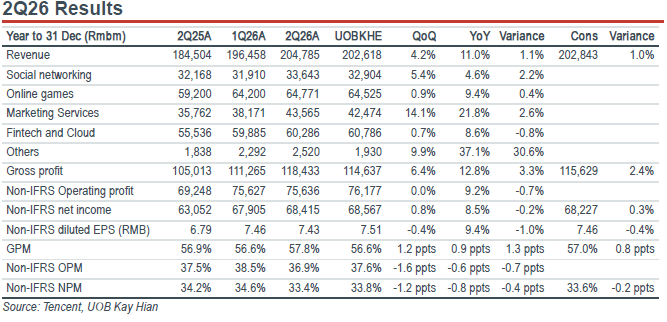
- Tencent’s 2Q26 earnings came in within expectations. 2Q26 revenue grew 11% yoy to Rmb204.8b, broadly in line with consensus estimates. Gross profit increased 13% yoy to Rmb118.4b, with gross margin rising 1ppt yoy to 58%. Non-IFRS profit attributable to shareholders increased 9% yoy to Rmb68.4b, while non-IFRS net profit margin deteriorated slightly by 0.8ppt yoy to 33.4%, largely consistent with expectations.
- Maintain BUY with a lower target price of HK$608.00.
Analysis
- Online games revenue grew 8% yoy to Rmb64.2b. Domestic games increased 17% yoy to Rmb47.3b, ahead of our 8% growth expectation, with: a) Delta Force and VALORANT PC/MOBILE reaching lifetime highs in average DAU, and b) Roco Kingdom: World ranking first by both average DAU and gross receipts among new mobile titles released in China ytd. International games declined 0.8% yoy to Rmb18.6b due to forex, or grew 4% in constant currency, as Wuthering Waves and VALORANT PC gains were offset by weaker Supercell titles.
- Marketing services revenue increased 22% yoy to Rmb43.6b, ahead of our Rmb42.5b estimate. AI-driven ad recommendation, AIM+ and closedloop Weixin marketing continued to improve ad performance and advertiser ROI. We view this as an increasingly important structural growth driver.
- FinTech and business services grew 9% yoy to Rmb60.3b, broadly in line with our Rmb60.5b estimate. Cloud growth remained healthy, supported by AI-related demand, international expansion and improved pricing, while FinTech growth reflected commercial payments, wealth management and consumer lending.
- Gross margin expanded to 58% from 57% a year ago, supported by higher contributions from high-margin internally developed games and marketing services. VAS gross margin improved to 64% from 60%, while marketing services margin was 57% vs 58% a year ago. Non-IFRS operating profit was broadly flat qoq at Rmb75.6b, but increased 9% yoy. Excluding new AI products, non-IFRS operating profit rose 19% yoy to Rmb86.1b. This suggests the core business continues to absorb higher AI-related R&D and infrastructure costs reasonably well. G&A expenses increased 22% yoy, mainly due to higher R&D spending on Hy model enhancements, Weixin AI initiatives and AI capabilities across Tencent’s products and services. Selling and marketing expenses increased 26% yoy, reflecting higher spending on games and AI-native products.
- AI investment drove higher capex and near-term FCF pressure. Capex increased to Rmb59.3b in 2Q26, from Rmb31.9b in 1Q26 and Rmb19.1b in
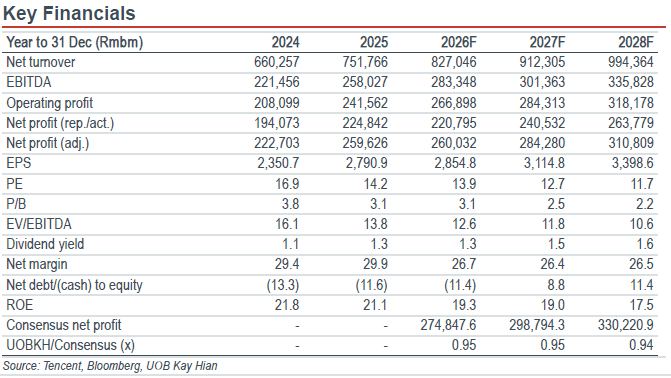
2Q25, primarily reflecting higher investment in IT infrastructure and compute capacity. Tencent recorded negative FCF of Rmb13.8b during the quarter, while operating cash flow also included large AI-related prepayments to support Hy model enhancements, WorkBuddy and CodeBuddy inference, Weixin AI initiatives and growing cloud demand. FCF would have been Rmb37.6b excluding these prepayments, vs reported FCF of -Rmb13.8b, implying roughly Rmb51.4b of AI-related prepayments. We therefore liftour capex assumption for 2026/27/28 to Rmb181b/Rmb200b/Rmb178b respectively, resulting a negative net cash this year of -Rmb65b.
- Hy3’s production release in July delivered a meaningful performance uplift and has ranked among the global top 3 models by token consumption on OpenRouter since 7 Jul 26. WorkBuddy continues to see rapid user growth and healthy retention, while CodeBuddy is also gaining traction. With both products sharing the same subscription account, individual plans span Standard/Advanced/Flagship tiers at Rmb70/Rmb140/Rmb700 per month, while Enterprise SaaS/Dedicated Enterprise plans are priced at Rmb198/Rmb316 per user per month. We estimate WorkBuddy/CodeBuddy has 1.0m-1.5m paid licences, implying Rmb1.1b–1.65b annualised subscription revenue based on ~Rmb110/month blended ARPU. We see paid-seat growth and rising usage intensity as key near-term monetisation indicators.
- Weixin’s Xiaowei agent has entered small-scale prototype testing, powered by a customised WeLM model focused on privacy, Weixin-specific use cases and inference efficiency. We see this as an important early step toward Tencent’s broader agentic ecosystem.
- AI ecosystem entering the next phase of model and application upgrades. Tencent plans to launch the larger-parameter Hunyuan 4 later this year, followed by Hunyuan 5 as it progresses toward SOTA-level capability, supporting more complex and higher-value AI use cases. On the consumer side, Xiaowei is positioned as a key AI gateway within Weixin, leveraging its social graph, Mini Programs, merchants and payments to enable increasingly agentic workflows and, longer term, agent-to-agent transactions.
Highlights
- Tencent’s 2Q26 earnings came in within expectations. 2Q26 revenue grew 11% yoy to Rmb204.8b, broadly in line with consensus estimates. Gross profit increased 13% yoy to Rmb118.4b, with gross margin rising 1ppt yoy to 58%. Non-IFRS profit attributable to shareholders increased 9% yoy to Rmb68.4b, while non-IFRS net profit margin deteriorated slightly by 0.8ppt yoy to 33.4%, largely consistent with expectations.
- Maintain BUY with a lower target price of HK$608.00.
Analysis
- Online games revenue grew 8% yoy to Rmb64.2b. Domestic games increased 17% yoy to Rmb47.3b, ahead of our 8% growth expectation, with: a) Delta Force and VALORANT PC/MOBILE reaching lifetime highs in average DAU, and b) Roco Kingdom: World ranking first by both average DAU and gross receipts among new mobile titles released in China ytd. International games declined 0.8% yoy to Rmb18.6b due to forex, or grew 4% in constant currency, as Wuthering Waves and VALORANT PC gains were offset by weaker Supercell titles.
- Marketing services revenue increased 22% yoy to Rmb43.6b, ahead of our Rmb42.5b estimate. AI-driven ad recommendation, AIM+ and closedloop Weixin marketing continued to improve ad performance and advertiser ROI. We view this as an increasingly important structural growth driver.
- FinTech and business services grew 9% yoy to Rmb60.3b, broadly in line with our Rmb60.5b estimate. Cloud growth remained healthy, supported by AI-related demand, international expansion and improved pricing, while FinTech growth reflected commercial payments, wealth management and consumer lending.
- Gross margin expanded to 58% from 57% a year ago, supported by higher contributions from high-margin internally developed games and marketing services. VAS gross margin improved to 64% from 60%, while marketing services margin was 57% vs 58% a year ago. Non-IFRS operating profit was broadly flat qoq at Rmb75.6b, but increased 9% yoy. Excluding new AI products, non-IFRS operating profit rose 19% yoy to Rmb86.1b. This suggests the core business continues to absorb higher AI-related R&D and infrastructure costs reasonably well. G&A expenses increased 22% yoy, mainly due to higher R&D spending on Hy model enhancements, Weixin AI initiatives and AI capabilities across Tencent’s products and services. Selling and marketing expenses increased 26% yoy, reflecting higher spending on games and AI-native products.
- AI investment drove higher capex and near-term FCF pressure. Capex increased to Rmb59.3b in 2Q26, from Rmb31.9b in 1Q26 and Rmb19.1b in
2Q25, primarily reflecting higher investment in IT infrastructure and compute capacity. Tencent recorded negative FCF of Rmb13.8b during the quarter, while operating cash flow also included large AI-related prepayments to support Hy model enhancements, WorkBuddy and CodeBuddy inference, Weixin AI initiatives and growing cloud demand. FCF would have been Rmb37.6b excluding these prepayments, vs reported FCF of -Rmb13.8b, implying roughly Rmb51.4b of AI-related prepayments. We therefore liftour capex assumption for 2026/27/28 to Rmb181b/Rmb200b/Rmb178b respectively, resulting a negative net cash this year of -Rmb65b.
- Hy3’s production release in July delivered a meaningful performance uplift and has ranked among the global top 3 models by token consumption on OpenRouter since 7 Jul 26. WorkBuddy continues to see rapid user growth and healthy retention, while CodeBuddy is also gaining traction. With both products sharing the same subscription account, individual plans span Standard/Advanced/Flagship tiers at Rmb70/Rmb140/Rmb700 per month, while Enterprise SaaS/Dedicated Enterprise plans are priced at Rmb198/Rmb316 per user per month. We estimate WorkBuddy/CodeBuddy has 1.0m-1.5m paid licences, implying Rmb1.1b–1.65b annualised subscription revenue based on ~Rmb110/month blended ARPU. We see paid-seat growth and rising usage intensity as key near-term monetisation indicators.
- Weixin’s Xiaowei agent has entered small-scale prototype testing, powered by a customised WeLM model focused on privacy, Weixin-specific use cases and inference efficiency. We see this as an important early step toward Tencent’s broader agentic ecosystem.
- AI ecosystem entering the next phase of model and application upgrades. Tencent plans to launch the larger-parameter Hunyuan 4 later this year, followed by Hunyuan 5 as it progresses toward SOTA-level capability, supporting more complex and higher-value AI use cases. On the consumer side, Xiaowei is positioned as a key AI gateway within Weixin, leveraging its social graph, Mini Programs, merchants and payments to enable increasingly agentic workflows and, longer term, agent-to-agent transactions.
BUY (Maintained)
Current price:
Target price:
Upside:
Previous TP :
HK$461.60
HK$608.00
31.7%
HK$670.00
Analyst
IMPORTANT NOTICE - DISCLOSURES AND DISCLAIMERS
This report is provided subject to, and must be read together with, the full Disclosures / Disclaimers available at this link, which are incorporated by reference into this report. In particular, this report is intended for general circulation and informational purposes only and does not constitute personal investment advice or a recommendation to buy or sell any investment product or security. You should independently evaluate the information and, where necessary, seek advice from a qualified financial adviser regarding the suitability of any investment. Analyst certifications required under applicable regulations, including SEC Regulation AC (where relevant), are included in this report. By accessing, receiving or using this report, you acknowledge that you have read, understood and agreed to be bound by the Disclosures / Disclaimers, as may be amended, supplemented or updated from time to time.
Related articles

17 Aug 2026
CSE Global (CSE SP) 1H26: Earnings Impacted by One-Offs; 2H26 Earnings To Be Stronger

13 Aug 2026
Food Empire Holdings (FEH SP): 1H26: Solid Growth In Key Markets; Surprise Dividend Hike Of 60% yoy

17 Aug 2026
First Resources (FR SP): 1H26: Above Expectations On Volume Growth And Stronger Downstream Margins
Our latest research

29 Sept 2026
City Developments (CIT SP): Sharpening And Refreshing Its Growth Strategy

28 Sept 2026
UI Boustead REIT (UIBREIT SP) : On Track To Meet Forecast; Expect Higher Reversions In 2HFY27

28 Sept 2026