

Wealth Flash
The Knowledge Share
AI Outage Risk: A Two-Pronged US-China Tech Hedge
Analyst
Wendy Chen
wendy.chen@uobkh.comFor AI adopters, diversification across US and alternative model sources is increasingly essential. For AI investors, investing in what the US and China each do best is also strongly advised. Read on for more information.
CIO Summary
|
Singapore’s reported AI adoption at 61%, among the highest globally
|
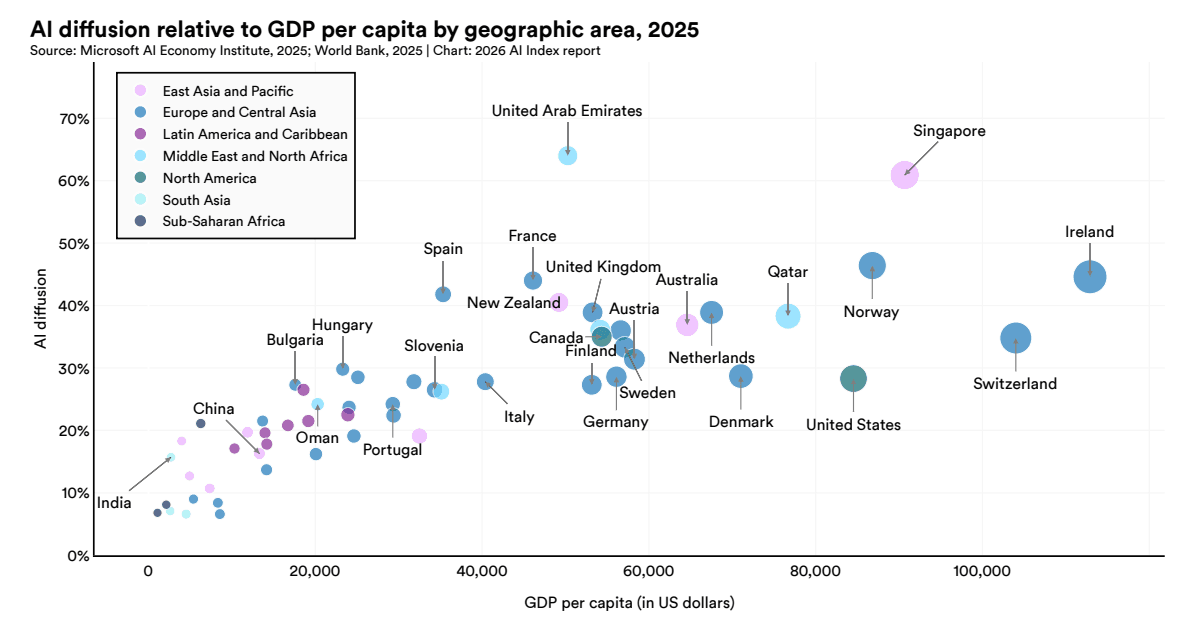
Source: AI Index Report 2026, Stanford University.
The Strait Times recently featured an article, "Is Singapore ready for an AI outage?", highlighting a structural vulnerability related to AI. We’d like to share a few key takeaways from this piece. Hope you find them useful.
Concentration risk. Singaporean businesses and government services increasingly rely on a handful of American AI models. This creates an “all eggs in one basket” risk where a sudden service cut could halt critical operations in the city-state – from banks to hospitals.
AI as a US national security concern. The US is clearly tightening foreign access to its AI models, including suspending foreign access to Anthropic's Fable 5/Mythos 5 and OpenAI's GPT 5.6. This signals that the White House now views frontier AI as a national security asset, which could lead to export control and eventually cutting off non-US access.
Diversification rather than isolation. The article suggests Singapore doesn’t need to build frontier models from scratch. Instead, resilience comes from owning the application layer, allowing systems to swap models seamlessly and to strengthen open-source and regional models as backups.
Our Take
Weaponization of AI technology. The latest LLM restrictions suggest that frontier AI models are no longer just commercial tools, but national security assets. This both validates and extends our 2026 top prediction of the "US-China AI Arms Race," where AI becomes a core instrument of strategic competition between countries.
"Compute sovereignty" bottleneck for rest of the world. The recent US limits on “bleeding edge” models (Fable 5, Mythos 5, GPT-5.6 and counting) further demonstrate how Washington plans to control AI advancement as a geopolitical chokepoint. For international economies, overreliance on US frontier models could become an unexpected liability rather than a competitive advantage.
Bifurcated AI landscape demands diversification. The world is rapidly moving toward a fractured AI ecosystem, with US-controlled “walled garden” models subject to policy whims, and a parallel open ecosystem of Asian alternatives (mostly Chinese). As we noted before, budget-friendly, more efficient Chinese AI models are gaining global traction. Corporates should prioritize diversification across both ecosystems, in order to mitigate the risk of sudden, policy-driven blackouts and capture the best each side can offer.
No need to take sides – just invest in the best of each. For investors, we also advise a diversified, "two-pronged" strategy. There is no need to take sides, but simply invest in what each of the US and China does best. For example, the US continues to dominate in AI computing hardware, while China is increasingly competitive in low-cost, high-efficiency models. Therefore, our Core Recommendations include Nvidia (NVDA) and Broadcom (AVGO) as leading US chip suppliers, as well as Tencent (0700.HK) and Alibaba (9988.HK / BABA) as Chinese model enablers.
For AI adopters, diversification across US and alternative model sources is increasingly essential. For AI investors, investing in what the US and China each do best is also strongly advised. Read on for more information.
CIO Summary
|
Singapore’s reported AI adoption at 61%, among the highest globally
|
Source: AI Index Report 2026, Stanford University.
The Strait Times recently featured an article, "Is Singapore ready for an AI outage?", highlighting a structural vulnerability related to AI. We’d like to share a few key takeaways from this piece. Hope you find them useful.
Concentration risk. Singaporean businesses and government services increasingly rely on a handful of American AI models. This creates an “all eggs in one basket” risk where a sudden service cut could halt critical operations in the city-state – from banks to hospitals.
AI as a US national security concern. The US is clearly tightening foreign access to its AI models, including suspending foreign access to Anthropic's Fable 5/Mythos 5 and OpenAI's GPT 5.6. This signals that the White House now views frontier AI as a national security asset, which could lead to export control and eventually cutting off non-US access.
Diversification rather than isolation. The article suggests Singapore doesn’t need to build frontier models from scratch. Instead, resilience comes from owning the application layer, allowing systems to swap models seamlessly and to strengthen open-source and regional models as backups.
Our Take
Weaponization of AI technology. The latest LLM restrictions suggest that frontier AI models are no longer just commercial tools, but national security assets. This both validates and extends our 2026 top prediction of the "US-China AI Arms Race," where AI becomes a core instrument of strategic competition between countries.
"Compute sovereignty" bottleneck for rest of the world. The recent US limits on “bleeding edge” models (Fable 5, Mythos 5, GPT-5.6 and counting) further demonstrate how Washington plans to control AI advancement as a geopolitical chokepoint. For international economies, overreliance on US frontier models could become an unexpected liability rather than a competitive advantage.
Bifurcated AI landscape demands diversification. The world is rapidly moving toward a fractured AI ecosystem, with US-controlled “walled garden” models subject to policy whims, and a parallel open ecosystem of Asian alternatives (mostly Chinese). As we noted before, budget-friendly, more efficient Chinese AI models are gaining global traction. Corporates should prioritize diversification across both ecosystems, in order to mitigate the risk of sudden, policy-driven blackouts and capture the best each side can offer.
No need to take sides – just invest in the best of each. For investors, we also advise a diversified, "two-pronged" strategy. There is no need to take sides, but simply invest in what each of the US and China does best. For example, the US continues to dominate in AI computing hardware, while China is increasingly competitive in low-cost, high-efficiency models. Therefore, our Core Recommendations include Nvidia (NVDA) and Broadcom (AVGO) as leading US chip suppliers, as well as Tencent (0700.HK) and Alibaba (9988.HK / BABA) as Chinese model enablers.
Analyst
Wendy Chen
wendy.chen@uobkh.comDisclosures and disclaimers
This report is provided subject to, and must be read together with, the full Disclosures / Disclaimers available at the following link: https://research-api.uobkayhian.com/assets/disclaimer/b2112181-0bf2-4c07-af37-3d7129735e61, which are incorporated by reference into this report. In particular, this report is intended for general circulation and informational purposes only and does not constitute personal investment advice or a recommendation to buy or sell any investment product or security. You should independently evaluate the information and, where necessary, seek advice from a qualified financial adviser regarding the suitability of any investment. Analyst certifications required under applicable regulations, including SEC Regulation AC (where relevant), are included in this report. By accessing, receiving or using this report, you acknowledge that you have read, understood and agreed to be bound by the Disclosures / Disclaimers, as may be amended, supplemented or updated from time to time.


