

Overnight Markets
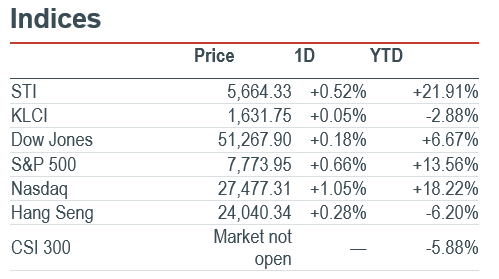
Market Movers: At the 5 October US close, SpaceX (SPCX US) rose about 7.6% to US$171.09 after Morgan Stanley’s Sunday note reiterated its Overweight rating and US$300 target. The S&P 500 gained 0.66%. PTC (PTC US) jumped about 33.5% to US$192.26 after Schneider Electric (SU FP) agreed a US$22.6bn equity takeover at US$205 per share. RXO (RXO US) rose about 22.5% to US$28.65 on C.H. Robinson’s (CHRW US) US$5.8bn cash-and-stock transaction, at an implied US$30.25 per share. The takeovers remain conditional; SpaceX’s analyst valuation thesis still depends on execution. (Yahoo Finance / Reuters / RXO / AP)
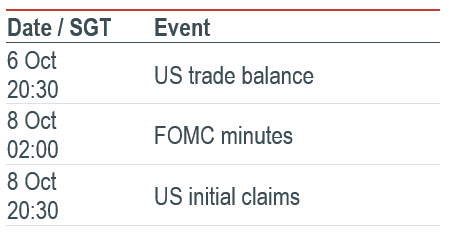
Macro: US services activity slowed, but price pressures rose. September’s ISM services PMI slipped to 54.9 from 55.4, while its prices index increased to 74.0 from 72.6. Employment returned above the 50 expansion threshold at 50.1. The mix points to continued growth with persistent cost pressure, complicating the policy outlook ahead of FOMC minutes at 02:00 SGT on 8 October. (ISM)
Geopolitical: Stronger Gulf exports coexist with tanker risks. Monday’s provisional Kpler data put the seven-day crude export average at 18.3m barrels per day on 30 Sep, with pre-war levels exceeded on 14 September days. Attacks on shipping and logistical constraints leave the durability of that supply recovery uncertain. (Reuters)
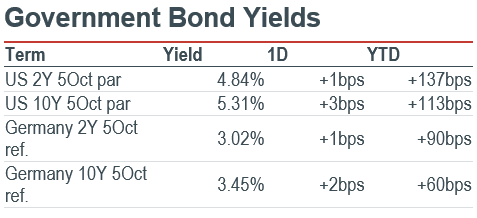
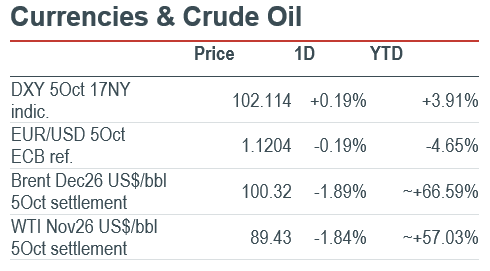
FICC: December Brent settled 1.89% lower at US$100.32 per barrel, and November WTI fell 1.84% to US$89.43 per barrel. The US 10-year par yield rose 3bps to 5.31% at Monday’s official reference, from Friday’s 5.28%. Cheaper oil eases one near-term inflation input, while higher yields raise the discount rate on future cash flows. (MT Newswires / US Treasury)
AI
Reflection targets a lower-cost open-model niche. Reflection introduced Beam on 5 Oct a model with 501bn total parameters and 23bn active per task. The developer, backed by Nvidia (NVDA US), claims advanced-reasoning performance comparable to GLM-5.2 using three to four times less inference compute. Its model weights remain unreleased while final safety testing continues. The announcement adds a prospective US alternative for enterprise coding and agents; independent performance and deployment economics remain the key tests. (Reflection / Reuters) Nvidia (NVDA US) is our Core Recommendation.
Telekom puts measurable economics behind its AI strategy. Deutsche Telekom (DTE GR) outlined on Monday a target for €2.5bn of indirect cost savings by 2030 versus 2023 through AI and automation. It also targets €800mn of AI-related business revenue outside the US by 2030. The group retained its guidance and medium-term targets, with some savings earmarked for reinvestment. Investors therefore need to distinguish operational efficiency gains from incremental earnings upgrades as deployment expands. (Deutsche Telekom / Reuters)
Cerebras rebounds as investors reassess customer concentration. Cerebras (CBRS US) rose about 9.1% to US$181.55 at the 5 October US close. Monday’s rebound followed Sam Altman’s Friday reassurance that OpenAI remains a close partner. The existing January agreement covers US$10bn and 750MW of computing capacity through 2028. The relationship supports demand visibility, but the prior week’s concerns over Nvidia (NVDA US) inference hardware underline the importance of customer diversification and evidence that contracted capacity can translate into profitable revenue. (Reuters / Yahoo Finance) Nvidia (NVDA US) is our Core Recommendation.
New York hearing advances scrutiny of model safeguards. Representatives of OpenAI, Anthropic, Alphabet (GOOGL US) and Meta Platforms (META US) testified at New York City Council’s 5 October AI hearing. The agenda covered ten related bills, including third-party model validation and human shutdown controls. Former employees warned about control risks while company representatives defended their safety work. These remain proposals, rather than enacted restrictions; potential testing and liability requirements are the commercial issue for developers and enterprise deployments. (New York City Council / AP) Meta Platforms (META US) is our Core Recommendation; Alphabet (GOOGL US) is our Trading Buy.
Americas
SpaceX’s rally reflects renewed confidence in its AI valuation. SpaceX (SPCX US) rose about 7.6% to US$171.09 at the 5 October US close. Monday’s rally followed Morgan Stanley’s Sunday note reiterating its bullish rating and US$300 target. The bank argues that investors undervalue AI compute opportunities alongside launches and Starlink. The valuation thesis depends on integrating these businesses and turning capacity into profitable demand. This improves sentiment without establishing upgraded company guidance; execution and funding risks remain. (Yahoo Finance / Investopedia)
PTC takeover prices industrial data at a premium. PTC (PTC US) rose about 33.5% to US$192.26 at the 5 October US close after Schneider Electric (SU FP) agreed to acquire it. Schneider fell about 10.0% to €272.80 at the Paris close. The US$22.6bn equity deal offers US$205 cash per share, a 42.3% premium to Friday’s close. Planned €5–6bn of equity and €16–17bn of debt funding underline the buyer’s financing burden, while product-design software could extend its industrial AI platform. Completion remains conditional on approvals. (PTC / Reuters)
Brazil’s election repricing lifts exposed consumer and financial assets. MercadoLibre (MELI US) gained about 9.7% to US$1,860.61 at the 5 October US close, while Brazil’s Ibovespa closed about 7.7% higher at 206,911.89. Investors reassessed fiscal policy after Flávio Bolsonaro won 47.03% of first-round votes against Lula’s 45.16%. The rally reflects expectations of a more business-friendly policy mix, rather than an election victory already secured. A durable improvement depends on the eventual government’s fiscal programme and ability to implement it. (Reuters / Yahoo Finance)
Freight consolidation rewards RXO while weighing on the buyer. RXO (RXO US) rose about 22.5% to US$28.65 at the 5 October US close, while C.H. Robinson (CHRW US) fell about 10.8% to US$140.61. C.H. Robinson agreed a US$5.8bn transaction offering US$17.25 cash plus 0.0856 shares per RXO share, worth US$30.25 on the announced basis. Management targets US$300mn of annual cost synergies within two years of closing. The divergent reactions highlight the buyer’s integration and financing burden. (RXO / AP)
Reported infusion-services deal would deepen McKesson’s specialty exposure. Reuters reported after the 5 October US close that McKesson (MCK US) and Clayton, Dubilier & Rice were nearing a purchase of Option Care Health (OPCH US) worth more than US$5bn including debt. The report, citing the Financial Times, described ongoing talks that could still fail. Option Care’s home and outpatient infusion network would extend McKesson’s healthcare-services footprint; McKesson’s oncology and multispecialty revenue grew 33% in the latest reported quarter. No completed agreement was confirmed. (Reuters)
Services growth slows while input-price pressure intensifies. The September ISM services PMI, released on 5 October, eased to 54.9 from 55.4, below Reuters’ 55.2 consensus. New orders slipped to 59.8 from 60.9, but the prices index rose to 74.0 from 72.6 and employment returned to expansion at 50.1 from 47.8. Demand remains positive even as growth moderates. The combination of firmer hiring and supply-related inflation complicates the case for a rapid easing of monetary policy. (ISM / Reuters)
Greater China
AI hardware leads a selective Hong Kong rally. Kingboard Laminates (1888.HK) rose about 11.9% to HK$55.30 at Monday’s close, while Lenovo (0992.HK) gained about 4.7% to HK$35.92. Reuters reported buying across AI supply-chain and chipmaking names, contrasting with softer property shares. The dispersion points to targeted hardware demand expectations rather than a uniform improvement in domestic cyclicals. Without a fresh company-specific order or earnings catalyst, the sharp gains warrant attention to valuation and follow-through. (Reuters)
Budweiser’s charges weigh on the first market response. Budweiser APAC (1876.HK) fell about 1.1% to HK$5.61 at Monday’s Hong Kong close after Sunday’s disclosure of exceptional charges. The earlier announcement flagged approximately US$52mn of withholding tax from a China reorganisation and US$30mn of provisions against overdue Indian receivables. Both reduce third-quarter attributable profit. The distinction matters: the tax charge accompanies a capital-efficiency initiative, while delayed collections expose cash-conversion risk despite efforts to recover the balances. (Reuters / NewTimeSpace)
Trade-data links begin converting into bank lending. The Hong Kong Monetary Authority said on Monday that CargoX Connect pilots had supported ten approved trade-finance loans totalling HK$180mn. Five banks accessed trade-declaration data through links with Shanghai’s digital trade platform. A new agreement with the PAA Digital Trade Alliance broadens cooperation across a network spanning 15 economies. Better verification could reduce trade-finance friction, although the initial lending scale remains modest and commercial adoption will determine the wider banking benefit. (HKMA)
Asia ex. China
UMC’s low-cost funding brings dilution into focus. United Microelectronics (UMC US) fell about 8.9% to US$23.92 at Monday’s US close after pricing US$1.8bn of convertible bonds. The two US$900mn tranches carry zero coupons, with potential dilution estimated at 2.34% if fully converted. Proceeds support machinery, equipment and plant construction. Cheap financing improves capital flexibility, but shareholders must weigh eventual dilution and the returns from additional capacity. Capital-spending discipline will determine whether the funding translates into stronger long-term economics. (Stocktwits / The Motley Fool)
Nippon Paint expands its regional decorative-paint footprint. Nippon Paint (4612 JP) gained about 3.5% to ¥1,198.50 at Monday’s close after disclosing a US$1.35bn acquisition agreed on 3 October. The Akzo Nobel decorative-paint businesses span seven markets and generated US$65mn of EBITDA in 2025. Cash and borrowings will fund the purchase without new equity. Broader distribution and procurement opportunities support the strategic case, while integration and the acquisition price place the burden on delivering synergies rather than financial engineering. (Nippon Paint / Jiji Press)
CSL’s renal and liver pipeline deal receives a modest welcome. CSL (CSL AU) rose 0.94% to A$176.99 at Monday’s close following its earlier licensing announcement with Alentis Therapeutics. The deal covers lixudebart for rare kidney and liver diseases, with US$355mn upfront and up to US$1.2bn in commercial milestones. CSL receives 55% of future global profits and funds further development. The structure expands its pipeline, but the investigational therapy still requires clinical progress before the prospective commercial economics become meaningful. (CSL / StockLight)
Singapore’s consumption picture remains uneven. Singapore’s August retail sales rose 0.7% year on year, slowing from July’s 1.3%, according to figures released by SingStat on Monday. Excluding motor vehicles, sales increased 1.6%; total retail sales fell 1.0% month on month after seasonal adjustment. Food-and-beverage services sales declined 1.6% year on year. Auto volatility therefore clouds the headline, while continued dining weakness argues for selectivity across consumer businesses rather than assuming a broad recovery in household demand. (SingStat / Business Times)
EMEA and Others
Roche adds an early-stage Parkinson’s option. Roche’s (ROP SW) Genentech agreed on Monday to license Alector’s (ALEC US) investigational AL050 programme for US$100mn upfront. The global agreement includes up to US$1.17bn of additional development, regulatory and commercial milestones, plus royalties. Genentech assumes development and commercialisation responsibilities for the brain-penetrant enzyme-replacement approach. The transaction broadens Roche’s neurological pipeline while limiting initial cash exposure; its larger headline value depends on future success, and the programme has yet to demonstrate clinical benefit. (Alector / Reuters)
AstraZeneca consolidates research capacity in Massachusetts. AstraZeneca (AZN LN) opened its new Kendall Square research centre on Monday as part of more than US$1bn of Massachusetts investment. The company plans to expand its workforce in the state by over 50% in coming years. Together with a nearby genomics site, the campus will accommodate approximately 2,000 researchers. The concentration supports oncology, rare-disease and cell-therapy research, but its investment case rests on sustained pipeline productivity rather than an immediate revenue contribution. (Quartz)
Metlen secures an anchor customer for European gallium. Metlen (MTLN LN) announced a long-term Japanese customer agreement on Monday covering up to 16% of annual output from its planned Greek gallium facility. The plant targets capacity of 50 tonnes a year, with commercial production expected in the third quarter of 2027. This is its second strategic commercial agreement. Pre-startup customer commitments support diversification of critical-material supply, although undisclosed pricing and the remaining construction timetable leave execution and returns as the next tests. (Metlen)
Gulf supply recovery remains exposed to shipping disruption. Reuters reported on 5 October that provisional Kpler data put the seven-day crude export average at 18.3m barrels per day on 30 September, above the pre-war average of about 18m. Saudi shipments through both the Red Sea and Gulf helped volumes recover. Reported tanker attacks continue, so higher loadings do not establish a secure transport corridor. For Asian refiners, supply relief must be weighed against freight costs and delivery risk. (Reuters)
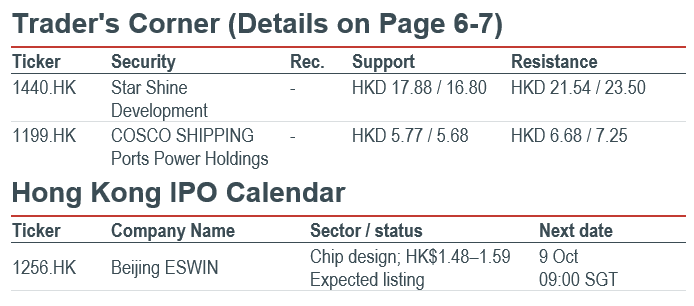
Traders’ corner
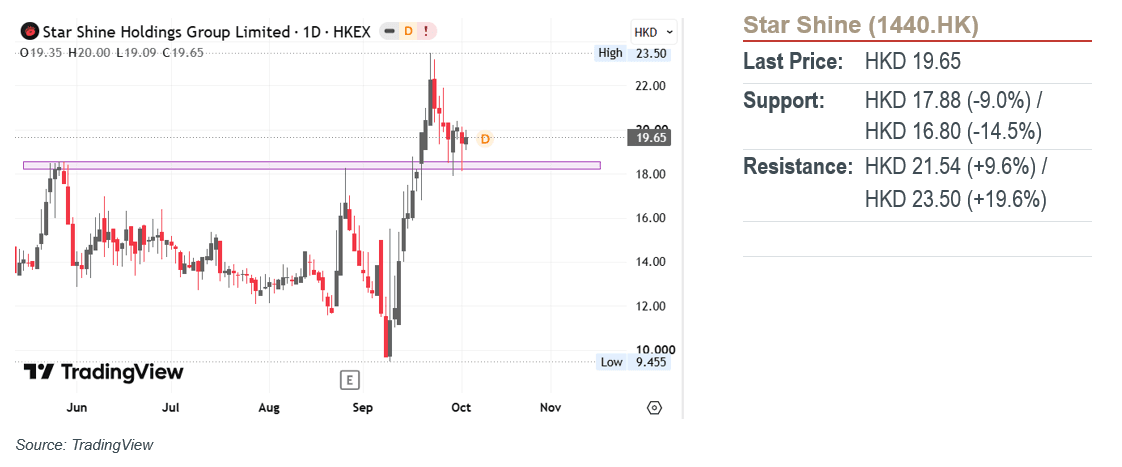
Our Technical View
Price rebounded from its resistance-turned-support zone.
The RSI remains in positive territory above its neutral 50-midline and is curling upward.
As long as price remains defended above this converted demand anchor, we could expect continued upward expansion toward higher supply targets.
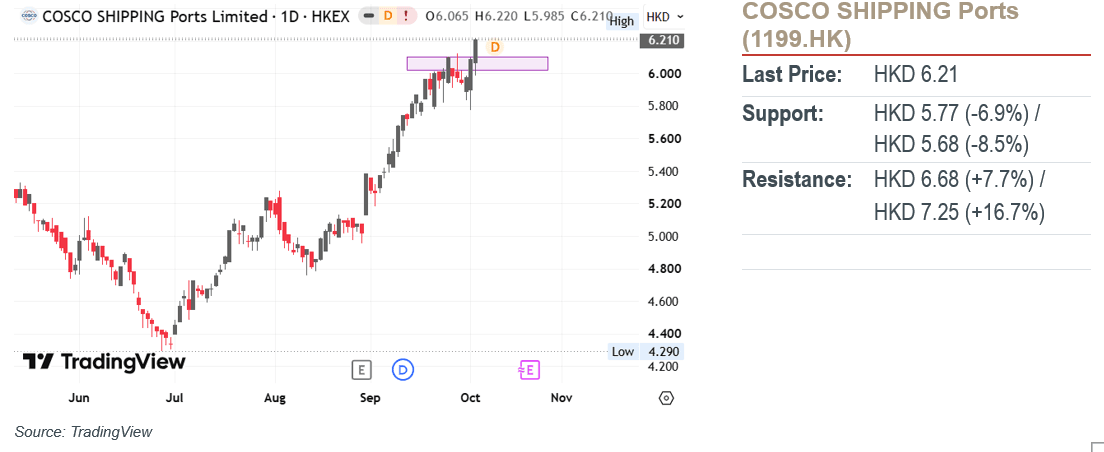
Our Technical View
Price further penetrated its recent price high and is approaching its all-time high resistance region.
The RSI remains in deeply bullish territory, and its upward turn within the overbought zone signals intense trend velocity and momentum acceleration.
As long as price defends this newly established support floor, we see continued upward expansion and price discovery toward unchartered all-time high territory.
Market Movers: At the 5 October US close, SpaceX (SPCX US) rose about 7.6% to US$171.09 after Morgan Stanley’s Sunday note reiterated its Overweight rating and US$300 target. The S&P 500 gained 0.66%. PTC (PTC US) jumped about 33.5% to US$192.26 after Schneider Electric (SU FP) agreed a US$22.6bn equity takeover at US$205 per share. RXO (RXO US) rose about 22.5% to US$28.65 on C.H. Robinson’s (CHRW US) US$5.8bn cash-and-stock transaction, at an implied US$30.25 per share. The takeovers remain conditional; SpaceX’s analyst valuation thesis still depends on execution. (Yahoo Finance / Reuters / RXO / AP)
Macro: US services activity slowed, but price pressures rose. September’s ISM services PMI slipped to 54.9 from 55.4, while its prices index increased to 74.0 from 72.6. Employment returned above the 50 expansion threshold at 50.1. The mix points to continued growth with persistent cost pressure, complicating the policy outlook ahead of FOMC minutes at 02:00 SGT on 8 October. (ISM)
Geopolitical: Stronger Gulf exports coexist with tanker risks. Monday’s provisional Kpler data put the seven-day crude export average at 18.3m barrels per day on 30 Sep, with pre-war levels exceeded on 14 September days. Attacks on shipping and logistical constraints leave the durability of that supply recovery uncertain. (Reuters)
FICC: December Brent settled 1.89% lower at US$100.32 per barrel, and November WTI fell 1.84% to US$89.43 per barrel. The US 10-year par yield rose 3bps to 5.31% at Monday’s official reference, from Friday’s 5.28%. Cheaper oil eases one near-term inflation input, while higher yields raise the discount rate on future cash flows. (MT Newswires / US Treasury)
AI
Reflection targets a lower-cost open-model niche. Reflection introduced Beam on 5 Oct a model with 501bn total parameters and 23bn active per task. The developer, backed by Nvidia (NVDA US), claims advanced-reasoning performance comparable to GLM-5.2 using three to four times less inference compute. Its model weights remain unreleased while final safety testing continues. The announcement adds a prospective US alternative for enterprise coding and agents; independent performance and deployment economics remain the key tests. (Reflection / Reuters) Nvidia (NVDA US) is our Core Recommendation.
Telekom puts measurable economics behind its AI strategy. Deutsche Telekom (DTE GR) outlined on Monday a target for €2.5bn of indirect cost savings by 2030 versus 2023 through AI and automation. It also targets €800mn of AI-related business revenue outside the US by 2030. The group retained its guidance and medium-term targets, with some savings earmarked for reinvestment. Investors therefore need to distinguish operational efficiency gains from incremental earnings upgrades as deployment expands. (Deutsche Telekom / Reuters)
Cerebras rebounds as investors reassess customer concentration. Cerebras (CBRS US) rose about 9.1% to US$181.55 at the 5 October US close. Monday’s rebound followed Sam Altman’s Friday reassurance that OpenAI remains a close partner. The existing January agreement covers US$10bn and 750MW of computing capacity through 2028. The relationship supports demand visibility, but the prior week’s concerns over Nvidia (NVDA US) inference hardware underline the importance of customer diversification and evidence that contracted capacity can translate into profitable revenue. (Reuters / Yahoo Finance) Nvidia (NVDA US) is our Core Recommendation.
New York hearing advances scrutiny of model safeguards. Representatives of OpenAI, Anthropic, Alphabet (GOOGL US) and Meta Platforms (META US) testified at New York City Council’s 5 October AI hearing. The agenda covered ten related bills, including third-party model validation and human shutdown controls. Former employees warned about control risks while company representatives defended their safety work. These remain proposals, rather than enacted restrictions; potential testing and liability requirements are the commercial issue for developers and enterprise deployments. (New York City Council / AP) Meta Platforms (META US) is our Core Recommendation; Alphabet (GOOGL US) is our Trading Buy.
Americas
SpaceX’s rally reflects renewed confidence in its AI valuation. SpaceX (SPCX US) rose about 7.6% to US$171.09 at the 5 October US close. Monday’s rally followed Morgan Stanley’s Sunday note reiterating its bullish rating and US$300 target. The bank argues that investors undervalue AI compute opportunities alongside launches and Starlink. The valuation thesis depends on integrating these businesses and turning capacity into profitable demand. This improves sentiment without establishing upgraded company guidance; execution and funding risks remain. (Yahoo Finance / Investopedia)
PTC takeover prices industrial data at a premium. PTC (PTC US) rose about 33.5% to US$192.26 at the 5 October US close after Schneider Electric (SU FP) agreed to acquire it. Schneider fell about 10.0% to €272.80 at the Paris close. The US$22.6bn equity deal offers US$205 cash per share, a 42.3% premium to Friday’s close. Planned €5–6bn of equity and €16–17bn of debt funding underline the buyer’s financing burden, while product-design software could extend its industrial AI platform. Completion remains conditional on approvals. (PTC / Reuters)
Brazil’s election repricing lifts exposed consumer and financial assets. MercadoLibre (MELI US) gained about 9.7% to US$1,860.61 at the 5 October US close, while Brazil’s Ibovespa closed about 7.7% higher at 206,911.89. Investors reassessed fiscal policy after Flávio Bolsonaro won 47.03% of first-round votes against Lula’s 45.16%. The rally reflects expectations of a more business-friendly policy mix, rather than an election victory already secured. A durable improvement depends on the eventual government’s fiscal programme and ability to implement it. (Reuters / Yahoo Finance)
Freight consolidation rewards RXO while weighing on the buyer. RXO (RXO US) rose about 22.5% to US$28.65 at the 5 October US close, while C.H. Robinson (CHRW US) fell about 10.8% to US$140.61. C.H. Robinson agreed a US$5.8bn transaction offering US$17.25 cash plus 0.0856 shares per RXO share, worth US$30.25 on the announced basis. Management targets US$300mn of annual cost synergies within two years of closing. The divergent reactions highlight the buyer’s integration and financing burden. (RXO / AP)
Reported infusion-services deal would deepen McKesson’s specialty exposure. Reuters reported after the 5 October US close that McKesson (MCK US) and Clayton, Dubilier & Rice were nearing a purchase of Option Care Health (OPCH US) worth more than US$5bn including debt. The report, citing the Financial Times, described ongoing talks that could still fail. Option Care’s home and outpatient infusion network would extend McKesson’s healthcare-services footprint; McKesson’s oncology and multispecialty revenue grew 33% in the latest reported quarter. No completed agreement was confirmed. (Reuters)
Services growth slows while input-price pressure intensifies. The September ISM services PMI, released on 5 October, eased to 54.9 from 55.4, below Reuters’ 55.2 consensus. New orders slipped to 59.8 from 60.9, but the prices index rose to 74.0 from 72.6 and employment returned to expansion at 50.1 from 47.8. Demand remains positive even as growth moderates. The combination of firmer hiring and supply-related inflation complicates the case for a rapid easing of monetary policy. (ISM / Reuters)
Greater China
AI hardware leads a selective Hong Kong rally. Kingboard Laminates (1888.HK) rose about 11.9% to HK$55.30 at Monday’s close, while Lenovo (0992.HK) gained about 4.7% to HK$35.92. Reuters reported buying across AI supply-chain and chipmaking names, contrasting with softer property shares. The dispersion points to targeted hardware demand expectations rather than a uniform improvement in domestic cyclicals. Without a fresh company-specific order or earnings catalyst, the sharp gains warrant attention to valuation and follow-through. (Reuters)
Budweiser’s charges weigh on the first market response. Budweiser APAC (1876.HK) fell about 1.1% to HK$5.61 at Monday’s Hong Kong close after Sunday’s disclosure of exceptional charges. The earlier announcement flagged approximately US$52mn of withholding tax from a China reorganisation and US$30mn of provisions against overdue Indian receivables. Both reduce third-quarter attributable profit. The distinction matters: the tax charge accompanies a capital-efficiency initiative, while delayed collections expose cash-conversion risk despite efforts to recover the balances. (Reuters / NewTimeSpace)
Trade-data links begin converting into bank lending. The Hong Kong Monetary Authority said on Monday that CargoX Connect pilots had supported ten approved trade-finance loans totalling HK$180mn. Five banks accessed trade-declaration data through links with Shanghai’s digital trade platform. A new agreement with the PAA Digital Trade Alliance broadens cooperation across a network spanning 15 economies. Better verification could reduce trade-finance friction, although the initial lending scale remains modest and commercial adoption will determine the wider banking benefit. (HKMA)
Asia ex. China
UMC’s low-cost funding brings dilution into focus. United Microelectronics (UMC US) fell about 8.9% to US$23.92 at Monday’s US close after pricing US$1.8bn of convertible bonds. The two US$900mn tranches carry zero coupons, with potential dilution estimated at 2.34% if fully converted. Proceeds support machinery, equipment and plant construction. Cheap financing improves capital flexibility, but shareholders must weigh eventual dilution and the returns from additional capacity. Capital-spending discipline will determine whether the funding translates into stronger long-term economics. (Stocktwits / The Motley Fool)
Nippon Paint expands its regional decorative-paint footprint. Nippon Paint (4612 JP) gained about 3.5% to ¥1,198.50 at Monday’s close after disclosing a US$1.35bn acquisition agreed on 3 October. The Akzo Nobel decorative-paint businesses span seven markets and generated US$65mn of EBITDA in 2025. Cash and borrowings will fund the purchase without new equity. Broader distribution and procurement opportunities support the strategic case, while integration and the acquisition price place the burden on delivering synergies rather than financial engineering. (Nippon Paint / Jiji Press)
CSL’s renal and liver pipeline deal receives a modest welcome. CSL (CSL AU) rose 0.94% to A$176.99 at Monday’s close following its earlier licensing announcement with Alentis Therapeutics. The deal covers lixudebart for rare kidney and liver diseases, with US$355mn upfront and up to US$1.2bn in commercial milestones. CSL receives 55% of future global profits and funds further development. The structure expands its pipeline, but the investigational therapy still requires clinical progress before the prospective commercial economics become meaningful. (CSL / StockLight)
Singapore’s consumption picture remains uneven. Singapore’s August retail sales rose 0.7% year on year, slowing from July’s 1.3%, according to figures released by SingStat on Monday. Excluding motor vehicles, sales increased 1.6%; total retail sales fell 1.0% month on month after seasonal adjustment. Food-and-beverage services sales declined 1.6% year on year. Auto volatility therefore clouds the headline, while continued dining weakness argues for selectivity across consumer businesses rather than assuming a broad recovery in household demand. (SingStat / Business Times)
EMEA and Others
Roche adds an early-stage Parkinson’s option. Roche’s (ROP SW) Genentech agreed on Monday to license Alector’s (ALEC US) investigational AL050 programme for US$100mn upfront. The global agreement includes up to US$1.17bn of additional development, regulatory and commercial milestones, plus royalties. Genentech assumes development and commercialisation responsibilities for the brain-penetrant enzyme-replacement approach. The transaction broadens Roche’s neurological pipeline while limiting initial cash exposure; its larger headline value depends on future success, and the programme has yet to demonstrate clinical benefit. (Alector / Reuters)
AstraZeneca consolidates research capacity in Massachusetts. AstraZeneca (AZN LN) opened its new Kendall Square research centre on Monday as part of more than US$1bn of Massachusetts investment. The company plans to expand its workforce in the state by over 50% in coming years. Together with a nearby genomics site, the campus will accommodate approximately 2,000 researchers. The concentration supports oncology, rare-disease and cell-therapy research, but its investment case rests on sustained pipeline productivity rather than an immediate revenue contribution. (Quartz)
Metlen secures an anchor customer for European gallium. Metlen (MTLN LN) announced a long-term Japanese customer agreement on Monday covering up to 16% of annual output from its planned Greek gallium facility. The plant targets capacity of 50 tonnes a year, with commercial production expected in the third quarter of 2027. This is its second strategic commercial agreement. Pre-startup customer commitments support diversification of critical-material supply, although undisclosed pricing and the remaining construction timetable leave execution and returns as the next tests. (Metlen)
Gulf supply recovery remains exposed to shipping disruption. Reuters reported on 5 October that provisional Kpler data put the seven-day crude export average at 18.3m barrels per day on 30 September, above the pre-war average of about 18m. Saudi shipments through both the Red Sea and Gulf helped volumes recover. Reported tanker attacks continue, so higher loadings do not establish a secure transport corridor. For Asian refiners, supply relief must be weighed against freight costs and delivery risk. (Reuters)
Traders’ corner
Our Technical View
Price rebounded from its resistance-turned-support zone.
The RSI remains in positive territory above its neutral 50-midline and is curling upward.
As long as price remains defended above this converted demand anchor, we could expect continued upward expansion toward higher supply targets.
Our Technical View
Price further penetrated its recent price high and is approaching its all-time high resistance region.
The RSI remains in deeply bullish territory, and its upward turn within the overbought zone signals intense trend velocity and momentum acceleration.
As long as price defends this newly established support floor, we see continued upward expansion and price discovery toward unchartered all-time high territory.
Disclosures and disclaimers
This report is provided subject to, and must be read together with, the full Disclosures / Disclaimers available at this link, which are incorporated by reference into this report. In particular, this report is intended for general circulation and informational purposes only and does not constitute personal investment advice or a recommendation to buy or sell any investment product or security. You should independently evaluate the information and, where necessary, seek advice from a qualified financial adviser regarding the suitability of any investment. Analyst certifications required under applicable regulations, including SEC Regulation AC (where relevant), are included in this report. By accessing, receiving or using this report, you acknowledge that you have read, understood and agreed to be bound by the Disclosures / Disclaimers, as may be amended, supplemented or updated from time to time.


