

Wealth Daily
Jobs strength and Hormuz risk reset the rate path
Today’s Must-Know News
Overnight Markets
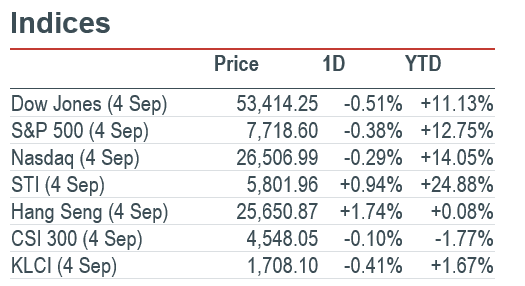
Market Movers: Wall Street finished 4 September lower after a much stronger US jobs report: the Dow fell 0.51%, the S&P 500 down 0.38% and the Nasdaq down 0.29%. The index decline masked a 3.4% semiconductor rally; Sandisk rose 11.9%, Micron 6.1%, AMD 4.7% and Nvidia 0.8%. Lululemon dropped 17.4% and Fair Isaac 16.7%. Earlier, the Hang Seng gained 1.74%, as Tencent rose 2.26% and Alibaba 2.42%, while Volkswagen advanced 5.9% in Europe. (Reuters, AP, Xinhua)
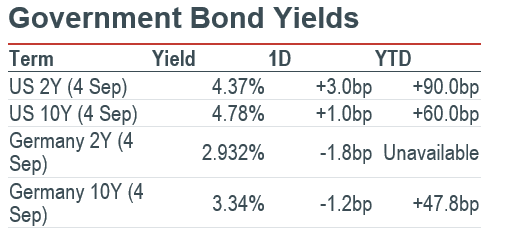
Macro: US August payrolls increased by 162,000 versus the 56,000 Reuters consensus; unemployment held at 4.1% and prior months were revised up by 55,000. The two-year Treasury yield rose to 4.37% and the ten-year to 4.78%. Implied odds of a September Fed increase briefly reached 65% before easing to about 57%. Thursday's producer prices, Friday's consumer prices and the ECB decision now form the next test of whether the labour-market surprise can translate into another tightening step. (BLS, Reuters, US Treasury)
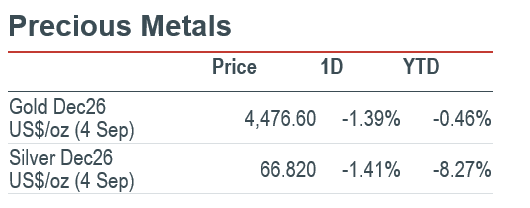
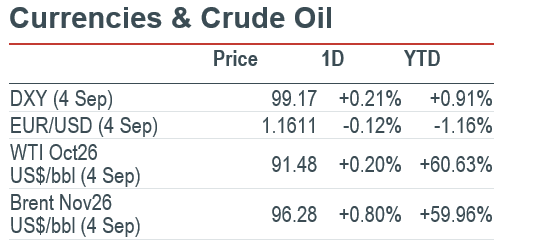
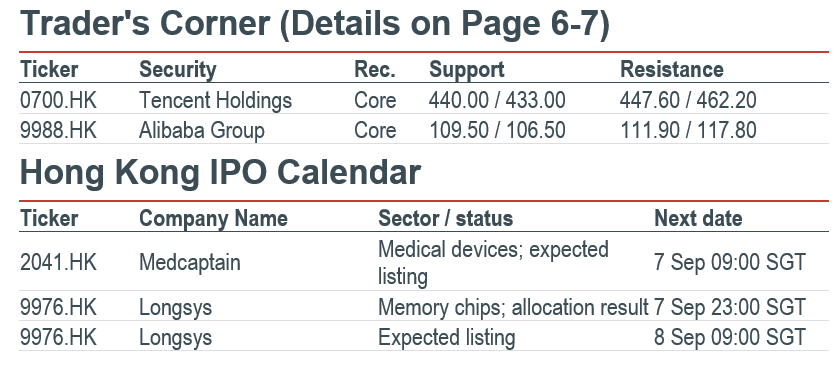
FICC: The dollar index added 0.21% to 99.17 and December gold futures settled 1.39% lower at US$4,476.60 an ounce. October WTI rose 0.20% to US$91.48 a barrel and November Brent gained 0.80% to US$96.28. Weekend US strikes on three Iranian tankers and Tehran's plan for an exclusion zone near Hormuz keep the energy-inflation channel active while US cash equities are closed for Labor Day. Nvidia (NVDA US), Tencent Holdings (0700.HK) and Alibaba Group (9988.HK) are our Core Recommendations. (AP, Reuters)
Americas
Payrolls force a fast repricing of September Fed risk. US nonfarm payrolls increased by 162,000 in August, almost three times the Reuters consensus of 56,000, while July was revised to a gain of 21,000 from a previously reported decline. Unemployment held at 4.1%, labour-force participation was 61.6% and average hourly earnings rose 0.3% month on month and 3.1% year on year. The surprise reduces the urgency to support demand and leaves inflation as the binding policy constraint. (BLS / Reuters)
Wall Street slips as yields and the dollar rise. At the 4 September close, the Dow lost 271.86 points to 53,414.25, the S&P 500 fell 29.11 points to 7,718.60 and the Nasdaq declined 77.07 points to 26,506.99. The US two-year yield rose 3bp to 4.37% and the ten-year added 1bp to 4.78%. Rate-sensitive consumer and healthcare shares led the index weakness, while the dollar index rose 0.21% to 99.17. (Reuters / US Treasury)
Semiconductors advance against the broader market. The Philadelphia semiconductor index gained about 3.4%. Sandisk rose 11.9%, Micron 6.1%, AMD 4.7% and Nvidia 0.8%. The strength suggests investors continued to distinguish AI and memory demand from the broader duration shock. Nvidia (NVDA US) is our Core Recommendation; the other moves are reported market reactions rather than recommendation changes. (Reuters / AP)
Lululemon and Fair Isaac lead the downside. Lululemon fell 17.4%, the largest decline in the S&P 500, after its outlook and weak comparable-sales backdrop met a less forgiving rate environment. Fair Isaac lost 16.7% and Adobe fell 6.7% after announcing a CEO transition. These moves reinforce the premium on clear demand visibility and execution when higher yields compress the value of uncertain earnings. (Reuters / AP)
Weekend tanker strikes deepen the energy tail risk. US forces said they struck three Iranian oil tankers after Navy vessels were targeted with ballistic missiles; two tankers were permanently disabled and an unladen vessel destroyed. Iran then said it planned an exclusion zone outside the Strait of Hormuz. With Brent and WTI already up 7.6% and nearly 10% for the week, respectively, another disruption could feed inflation expectations before Thursday's PPI and Friday's CPI releases. (AP)
Greater China
Hong Kong rebounds while mainland shares lag. The Hang Seng ended 4 September up 1.74% at 25,650.87 on turnover of HK$276.86bn; the Hang Seng Tech Index rose 2.27% and the HSCEI 2.02%. The CSI 300 slipped 0.10% to 4,548.05 and the Shanghai Composite lost 0.3%. The offshore recovery therefore remained stronger than the mainland tape, led by renewed buying in large-cap technology shares. (Xinhua / RTHK)
Tencent and Alibaba recover, but remain below trend. Tencent closed at HK$442.80, up 2.26%, and Alibaba at HK$110.10, up 2.42%. Tencent remains below its 20-day and 50-day averages of HK$448.90 and HK$455.21; Alibaba remains below HK$118.23 and HK$113.51. First resistance sits at HK$447.60 and HK$111.90. Both are our Core Recommendations; a close above those levels would strengthen the rebound. (Xinhua / RTHK)
Hong Kong links its first five-year plan to new growth areas. Chief Executive John Lee said on Saturday that the forthcoming plan would set macro strategy, align with China's 15th Five-Year Plan and seek new opportunities in finance, innovation, technology and education. The plan and Policy Address are due on 16 September. Investors should distinguish the strategic signal from policy measures that will only be clear when the documents are released. (RTHK)
China targets AI adoption by smaller businesses. China's industry ministry released a 2026-2028 plan to foster more than 10,000 technology-based and innovative SMEs, over 2,000 specialised 'little giant' firms and a group of gazelles and unicorns. The policy supports domestic AI diffusion and regional cooperation, but the investable effect will depend on funding, adoption and the ability of smaller firms to turn pilots into recurring revenue. (Xinhua)
Asia ex. China
Singapore's banks lift the STI into the weekend. The Straits Times Index closed 4 September at 5,801.96, up 54.25 points or 0.94%. DBS rose 0.90% to S$78.65, OCBC gained 1.10% to S$32.27 and UOB added 0.65% to S$42.01. Yangzijiang Shipbuilding gained 4.66% to S$4.94, while Sembcorp Industries fell 1.13% to S$6.11. The breadth of the gain offered support beyond the bank-heavy index. (SGInvestors)
Singapore activates haze-response measures. The 24-hour PSI entered the Unhealthy range in central Singapore on 4 September for the first time because of haze since October 2023. Government agencies activated preparedness measures, while NEA forecast air quality from high-Moderate to mid-Unhealthy. Operationally, employers with outdoor work and consumer-facing activities should monitor the 24-hour PSI rather than treating the episode as a one-day weather event. (NEA)
Sunday's outlook keeps the regional haze risk active. NEA reported moderate-to-dense plumes across parts of Sumatra, Singapore and southern Peninsular Malaysia, with some stations in Borneo at Unhealthy to Very Unhealthy levels. Dry conditions were expected to persist in parts of the southern ASEAN region. The investment consequence is chiefly operational—outdoor activity, healthcare demand and transport visibility—rather than an immediate change to Singapore's macro trend. (NEA)
Korean and Japanese equities end Friday higher. The KOSPI rose 1.64% to 6,687.21, helped by semiconductor shares, although it still lost 1.5% over the week. Japan's Nikkei added 1.26% to 65,020 while the TOPIX was nearly flat. The divergence between the price-weighted Nikkei and broader TOPIX shows that selected exporters and technology names, rather than a uniform risk-on move, carried the Japanese session. (Reuters / Xinhua)
EMEA and Others
European shares stabilise but finish the week lower. The STOXX 600 rose 0.1% to 649.88 on Friday but lost 0.8% for the week. Strong US employment data reinforced expectations of further tightening, while higher energy prices and government-bond yields continued to pressure valuations. The small final-session gain therefore looks more like stabilisation than a broad easing of the macro headwinds. (Reuters)
Volkswagen rallies on a negotiated turnaround plan. Volkswagen gained 5.9% after its supervisory board reached an agreement with unions and Lower Saxony on a transformation plan that includes 50,000 job reductions. The stock remains about 22% lower year to date. The market welcomed the scope of the cost action, but implementation, labour relations and margin delivery remain the relevant tests. (Reuters)
Autos outperform as investors price cost discipline. The broader European autos index gained 1.1%, supported by Volkswagen's move. European manufacturers still face US tariffs, a stagnant home market and aggressive Chinese competition. Cost reductions can protect near-term earnings, but excessive cuts could weaken capacity when demand recovers; the quality of savings matters more than the headline number. (Reuters)
The ECB meeting becomes the next regional catalyst. The ECB Governing Council meets on 9-10 September, with the monetary-policy decision and press conference on Thursday. Reuters reported that markets widely expected a 25bp increase, while JPMorgan and BNP Paribas also anticipated another move in December because of elevated energy prices. The risk for European assets is a combination of tighter policy and weak growth rather than either factor in isolation. (ECB / Reuters)
German yields ease at both ends of the curve. Germany's two-year yield closed Friday at 2.932%, down 1.8bp, while the ten-year slipped about 1.2bp to 3.338%. The move contrasts with rising US Treasury yields after payrolls and reflects Europe's distinct growth-policy balance. With the ECB decision approaching, the German curve remains the cleanest market gauge of how investors weigh energy-driven inflation against sluggish activity. (Bundesbank / Investing.com)
Traders’ corner
Our Technical View
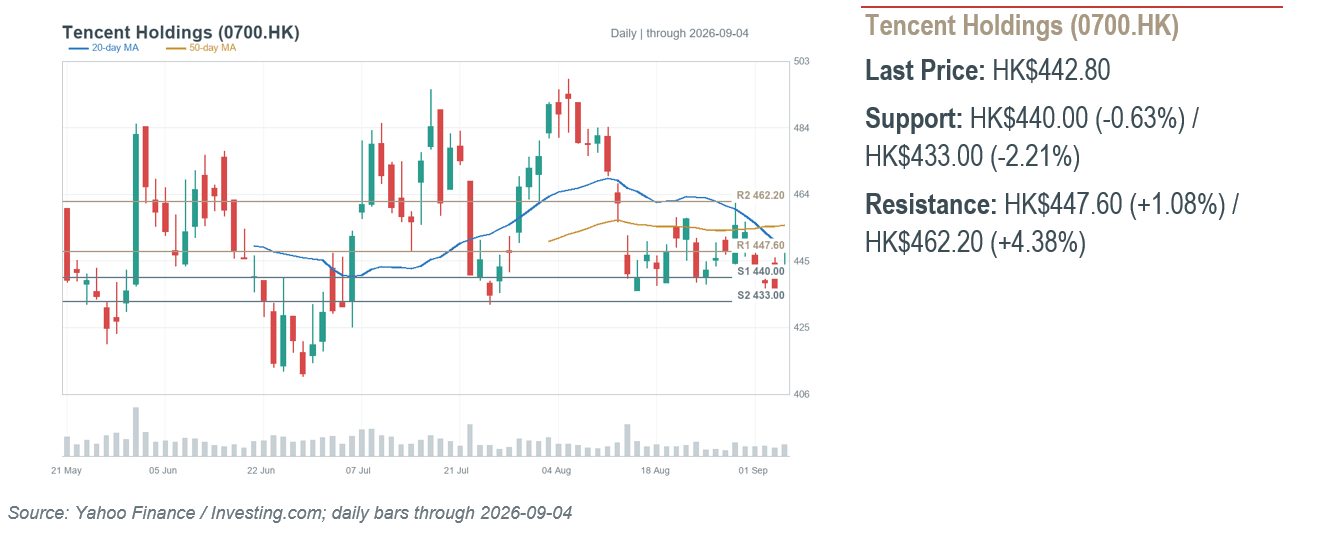
At the Hong Kong close on 4 September, Tencent Holdings rose 2.26% to HK$442.80. Price is below its 20-day average at HK$448.90 and below its 50-day average at HK$455.21. First resistance is HK$447.60.
The latest session low at HK$440.00 is immediate support; the earlier visible pivot at HK$433.00 is the next floor. A daily break below the lower level would weaken near-term stabilisation. A close above HK$462.20 would improve the recovery case.
The 14-day Wilder RSI is 45.7, below neutral. Price confirmation at support and resistance remains important before treating the setup as a sustained reversal. Tencent Holdings (0700.HK) is our Core Recommendation.Price was firmly capped by its previous price high resistance zone for a third occasion.
Our Technical View
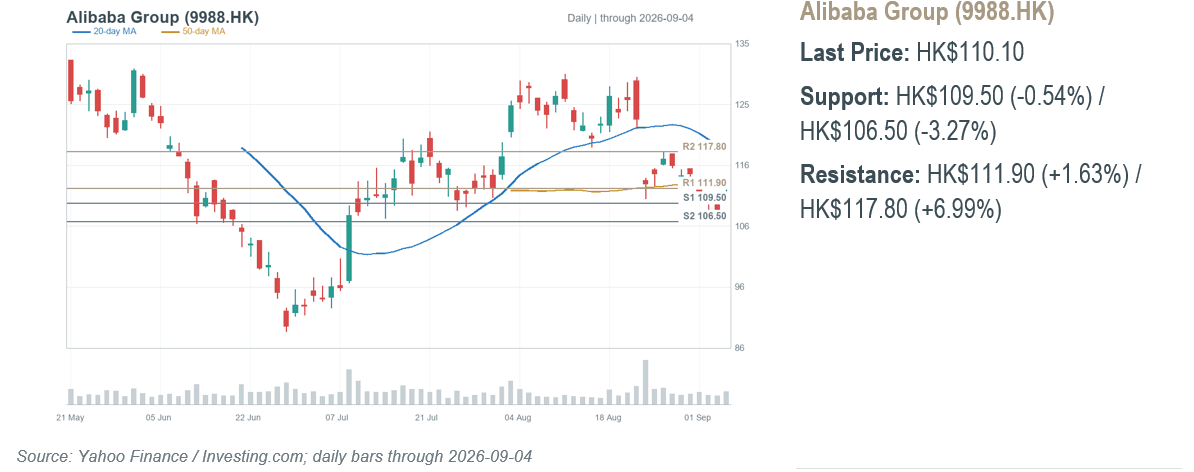
At the Hong Kong close on 4 September, Alibaba Group rose 2.42% to HK$110.10. Price is below its 20-day average at HK$118.23 and below its 50-day average at HK$113.51. First resistance is HK$111.90.
The latest session low at HK$109.50 is immediate support; the earlier visible pivot at HK$106.50 is the next floor. A daily break below the lower level would weaken near-term stabilisation. A close above HK$117.80 would improve the recovery case.
The 14-day Wilder RSI is 41.3, below neutral. Price confirmation at support and resistance remains important before treating the setup as a sustained reversal. Alibaba Group (9988.HK) is our Core Recommendation.
Market Movers: Wall Street finished 4 September lower after a much stronger US jobs report: the Dow fell 0.51%, the S&P 500 down 0.38% and the Nasdaq down 0.29%. The index decline masked a 3.4% semiconductor rally; Sandisk rose 11.9%, Micron 6.1%, AMD 4.7% and Nvidia 0.8%. Lululemon dropped 17.4% and Fair Isaac 16.7%. Earlier, the Hang Seng gained 1.74%, as Tencent rose 2.26% and Alibaba 2.42%, while Volkswagen advanced 5.9% in Europe. (Reuters, AP, Xinhua)
Macro: US August payrolls increased by 162,000 versus the 56,000 Reuters consensus; unemployment held at 4.1% and prior months were revised up by 55,000. The two-year Treasury yield rose to 4.37% and the ten-year to 4.78%. Implied odds of a September Fed increase briefly reached 65% before easing to about 57%. Thursday's producer prices, Friday's consumer prices and the ECB decision now form the next test of whether the labour-market surprise can translate into another tightening step. (BLS, Reuters, US Treasury)
FICC: The dollar index added 0.21% to 99.17 and December gold futures settled 1.39% lower at US$4,476.60 an ounce. October WTI rose 0.20% to US$91.48 a barrel and November Brent gained 0.80% to US$96.28. Weekend US strikes on three Iranian tankers and Tehran's plan for an exclusion zone near Hormuz keep the energy-inflation channel active while US cash equities are closed for Labor Day. Nvidia (NVDA US), Tencent Holdings (0700.HK) and Alibaba Group (9988.HK) are our Core Recommendations. (AP, Reuters)
Americas
Payrolls force a fast repricing of September Fed risk. US nonfarm payrolls increased by 162,000 in August, almost three times the Reuters consensus of 56,000, while July was revised to a gain of 21,000 from a previously reported decline. Unemployment held at 4.1%, labour-force participation was 61.6% and average hourly earnings rose 0.3% month on month and 3.1% year on year. The surprise reduces the urgency to support demand and leaves inflation as the binding policy constraint. (BLS / Reuters)
Wall Street slips as yields and the dollar rise. At the 4 September close, the Dow lost 271.86 points to 53,414.25, the S&P 500 fell 29.11 points to 7,718.60 and the Nasdaq declined 77.07 points to 26,506.99. The US two-year yield rose 3bp to 4.37% and the ten-year added 1bp to 4.78%. Rate-sensitive consumer and healthcare shares led the index weakness, while the dollar index rose 0.21% to 99.17. (Reuters / US Treasury)
Semiconductors advance against the broader market. The Philadelphia semiconductor index gained about 3.4%. Sandisk rose 11.9%, Micron 6.1%, AMD 4.7% and Nvidia 0.8%. The strength suggests investors continued to distinguish AI and memory demand from the broader duration shock. Nvidia (NVDA US) is our Core Recommendation; the other moves are reported market reactions rather than recommendation changes. (Reuters / AP)
Lululemon and Fair Isaac lead the downside. Lululemon fell 17.4%, the largest decline in the S&P 500, after its outlook and weak comparable-sales backdrop met a less forgiving rate environment. Fair Isaac lost 16.7% and Adobe fell 6.7% after announcing a CEO transition. These moves reinforce the premium on clear demand visibility and execution when higher yields compress the value of uncertain earnings. (Reuters / AP)
Weekend tanker strikes deepen the energy tail risk. US forces said they struck three Iranian oil tankers after Navy vessels were targeted with ballistic missiles; two tankers were permanently disabled and an unladen vessel destroyed. Iran then said it planned an exclusion zone outside the Strait of Hormuz. With Brent and WTI already up 7.6% and nearly 10% for the week, respectively, another disruption could feed inflation expectations before Thursday's PPI and Friday's CPI releases. (AP)
Greater China
Hong Kong rebounds while mainland shares lag. The Hang Seng ended 4 September up 1.74% at 25,650.87 on turnover of HK$276.86bn; the Hang Seng Tech Index rose 2.27% and the HSCEI 2.02%. The CSI 300 slipped 0.10% to 4,548.05 and the Shanghai Composite lost 0.3%. The offshore recovery therefore remained stronger than the mainland tape, led by renewed buying in large-cap technology shares. (Xinhua / RTHK)
Tencent and Alibaba recover, but remain below trend. Tencent closed at HK$442.80, up 2.26%, and Alibaba at HK$110.10, up 2.42%. Tencent remains below its 20-day and 50-day averages of HK$448.90 and HK$455.21; Alibaba remains below HK$118.23 and HK$113.51. First resistance sits at HK$447.60 and HK$111.90. Both are our Core Recommendations; a close above those levels would strengthen the rebound. (Xinhua / RTHK)
Hong Kong links its first five-year plan to new growth areas. Chief Executive John Lee said on Saturday that the forthcoming plan would set macro strategy, align with China's 15th Five-Year Plan and seek new opportunities in finance, innovation, technology and education. The plan and Policy Address are due on 16 September. Investors should distinguish the strategic signal from policy measures that will only be clear when the documents are released. (RTHK)
China targets AI adoption by smaller businesses. China's industry ministry released a 2026-2028 plan to foster more than 10,000 technology-based and innovative SMEs, over 2,000 specialised 'little giant' firms and a group of gazelles and unicorns. The policy supports domestic AI diffusion and regional cooperation, but the investable effect will depend on funding, adoption and the ability of smaller firms to turn pilots into recurring revenue. (Xinhua)
Asia ex. China
Singapore's banks lift the STI into the weekend. The Straits Times Index closed 4 September at 5,801.96, up 54.25 points or 0.94%. DBS rose 0.90% to S$78.65, OCBC gained 1.10% to S$32.27 and UOB added 0.65% to S$42.01. Yangzijiang Shipbuilding gained 4.66% to S$4.94, while Sembcorp Industries fell 1.13% to S$6.11. The breadth of the gain offered support beyond the bank-heavy index. (SGInvestors)
Singapore activates haze-response measures. The 24-hour PSI entered the Unhealthy range in central Singapore on 4 September for the first time because of haze since October 2023. Government agencies activated preparedness measures, while NEA forecast air quality from high-Moderate to mid-Unhealthy. Operationally, employers with outdoor work and consumer-facing activities should monitor the 24-hour PSI rather than treating the episode as a one-day weather event. (NEA)
Sunday's outlook keeps the regional haze risk active. NEA reported moderate-to-dense plumes across parts of Sumatra, Singapore and southern Peninsular Malaysia, with some stations in Borneo at Unhealthy to Very Unhealthy levels. Dry conditions were expected to persist in parts of the southern ASEAN region. The investment consequence is chiefly operational—outdoor activity, healthcare demand and transport visibility—rather than an immediate change to Singapore's macro trend. (NEA)
Korean and Japanese equities end Friday higher. The KOSPI rose 1.64% to 6,687.21, helped by semiconductor shares, although it still lost 1.5% over the week. Japan's Nikkei added 1.26% to 65,020 while the TOPIX was nearly flat. The divergence between the price-weighted Nikkei and broader TOPIX shows that selected exporters and technology names, rather than a uniform risk-on move, carried the Japanese session. (Reuters / Xinhua)
EMEA and Others
European shares stabilise but finish the week lower. The STOXX 600 rose 0.1% to 649.88 on Friday but lost 0.8% for the week. Strong US employment data reinforced expectations of further tightening, while higher energy prices and government-bond yields continued to pressure valuations. The small final-session gain therefore looks more like stabilisation than a broad easing of the macro headwinds. (Reuters)
Volkswagen rallies on a negotiated turnaround plan. Volkswagen gained 5.9% after its supervisory board reached an agreement with unions and Lower Saxony on a transformation plan that includes 50,000 job reductions. The stock remains about 22% lower year to date. The market welcomed the scope of the cost action, but implementation, labour relations and margin delivery remain the relevant tests. (Reuters)
Autos outperform as investors price cost discipline. The broader European autos index gained 1.1%, supported by Volkswagen's move. European manufacturers still face US tariffs, a stagnant home market and aggressive Chinese competition. Cost reductions can protect near-term earnings, but excessive cuts could weaken capacity when demand recovers; the quality of savings matters more than the headline number. (Reuters)
The ECB meeting becomes the next regional catalyst. The ECB Governing Council meets on 9-10 September, with the monetary-policy decision and press conference on Thursday. Reuters reported that markets widely expected a 25bp increase, while JPMorgan and BNP Paribas also anticipated another move in December because of elevated energy prices. The risk for European assets is a combination of tighter policy and weak growth rather than either factor in isolation. (ECB / Reuters)
German yields ease at both ends of the curve. Germany's two-year yield closed Friday at 2.932%, down 1.8bp, while the ten-year slipped about 1.2bp to 3.338%. The move contrasts with rising US Treasury yields after payrolls and reflects Europe's distinct growth-policy balance. With the ECB decision approaching, the German curve remains the cleanest market gauge of how investors weigh energy-driven inflation against sluggish activity. (Bundesbank / Investing.com)
Traders’ corner
Our Technical View
At the Hong Kong close on 4 September, Tencent Holdings rose 2.26% to HK$442.80. Price is below its 20-day average at HK$448.90 and below its 50-day average at HK$455.21. First resistance is HK$447.60.
The latest session low at HK$440.00 is immediate support; the earlier visible pivot at HK$433.00 is the next floor. A daily break below the lower level would weaken near-term stabilisation. A close above HK$462.20 would improve the recovery case.
The 14-day Wilder RSI is 45.7, below neutral. Price confirmation at support and resistance remains important before treating the setup as a sustained reversal. Tencent Holdings (0700.HK) is our Core Recommendation.Price was firmly capped by its previous price high resistance zone for a third occasion.
Our Technical View
At the Hong Kong close on 4 September, Alibaba Group rose 2.42% to HK$110.10. Price is below its 20-day average at HK$118.23 and below its 50-day average at HK$113.51. First resistance is HK$111.90.
The latest session low at HK$109.50 is immediate support; the earlier visible pivot at HK$106.50 is the next floor. A daily break below the lower level would weaken near-term stabilisation. A close above HK$117.80 would improve the recovery case.
The 14-day Wilder RSI is 41.3, below neutral. Price confirmation at support and resistance remains important before treating the setup as a sustained reversal. Alibaba Group (9988.HK) is our Core Recommendation.
Disclosures and disclaimers
This report is provided subject to, and must be read together with, the full Disclosures / Disclaimers available at this link, which are incorporated by reference into this report. In particular, this report is intended for general circulation and informational purposes only and does not constitute personal investment advice or a recommendation to buy or sell any investment product or security. You should independently evaluate the information and, where necessary, seek advice from a qualified financial adviser regarding the suitability of any investment. Analyst certifications required under applicable regulations, including SEC Regulation AC (where relevant), are included in this report. By accessing, receiving or using this report, you acknowledge that you have read, understood and agreed to be bound by the Disclosures / Disclaimers, as may be amended, supplemented or updated from time to time.


