

Wealth Daily
Asian Chip Stocks Plunge Despite TSMC’s Record Profit
Today’s Must-Know News
Overnight Markets
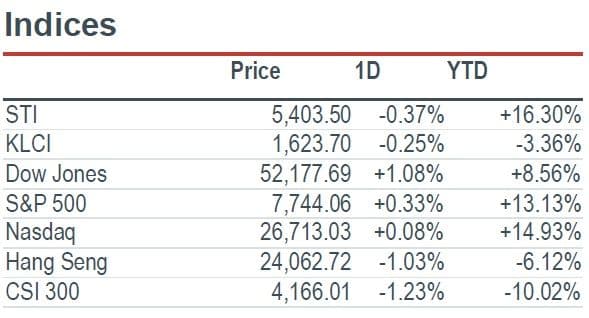
Market Movers: The S&P 500 recovered 0.33% in the Thursday, 15 October US session, following a 7.57% plunge in Korea’s KOSPI. In Seoul, SK Hynix (000660 KS) fell 11.06% and Samsung Electronics (005930 KS) lost 9.48% amid concerns about AI investment sustainability and higher borrowing costs. TSMC (TSM US) fell 1.80% despite reporting quarterly profit of US$23.59bn, up 68.7% YoY, and forecasting fourth-quarter revenue of US$52.3–54.3bn. It maintained 2026 capital spending guidance of US$60–64bn. Management’s prudent 2027 planning signals uncertainty about future capital spending. (Reuters / Yonhap / Market data / Yahoo Finance)
Macro: US September producer prices jumped 1.3% month on month, versus 0.5% expected, and 6.3% YoY. Retail sales rose 0.8% to US$745bn, up 6.3% YoY, but gasoline inflated the nominal gain. The control group increased just 0.1%, after 1.2% in August. The combination complicates the Fed’s inflation–growth trade-off. (Reuters / Census)
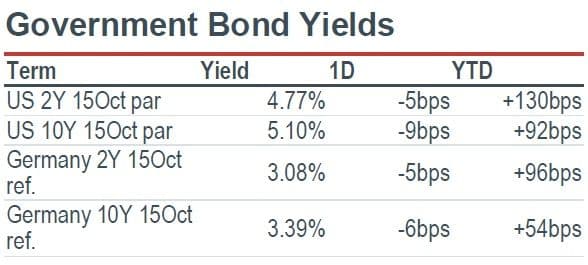
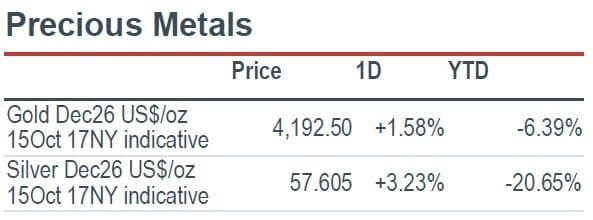
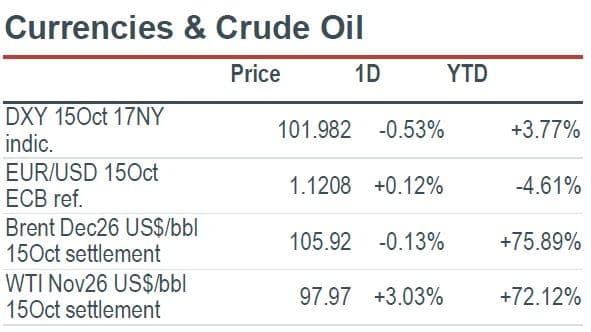
FICC: The 15 October US 10-year par yield fell 9bps from 5.19% to 5.10%. December gold gained 1.58% and silver 3.23%, while DXY fell 0.53%, at matched 17:00 New York indicative snapshots. November WTI settled 3.03% higher at US$97.97/bbl, alongside an 8.6mn-barrel US inventory draw; December Brent slipped 0.13% to US$105.92. Diverging crude benchmarks underscore the importance of regional supply and shipping conditions. (US Treasury / Yahoo Finance / Newsquawk / EIA) TSMC (TSM US) is our Core Recommendation.
AI
- TSMC’s record profit meets a cautious market. TSMC (TSM US) reported third-quarter net profit of NT$763.06bn, up 68.7% YoY, and guided fourth-quarter revenue to US$52.3–54.3bn on 15 October. Its US ADR closed 1.80% lower at US$422.25 after the release. Robust AI demand supports capacity investment, but management’s cautious 2027 planning highlights macroeconomic uncertainty and the market’s sensitivity to expectations. (TSMC / Reuters / Market data)
TSMC (TSM US) is our Core Recommendation.
- Meta Platforms (META US) broadens access to local AI. The 15 October Muse Spark Open release has 816bn total parameters, 42bn active parameters and a 1mn-token context window. Meta says it runs on two Apple (AAPL US) M5 Ultra Mac Studios, with downloadable weights and hosted access. Local deployment expands developer choice, although commercial licence restrictions qualify the scope of unrestricted adoption. (Meta)
Meta Platforms (META US) is our Core Recommendation.
- Anthropic embeds independent evaluators within its safety operations. The company announced employee-like access for six METR researchers on 15 October, including internal tools and systems. METR can publish risk findings without Anthropic veto, subject to narrowly defined redactions covering sensitive information. Deeper scrutiny could strengthen confidence in frontier-model governance, but voluntary access does not establish that models are safe. (Anthropic)
- CoreWeave (CRWV US) rebounds while financing risk persists. Shares closed 15 October up 5.94% at US$69.69. Nvidia (NVDA US) chief Jensen Huang said financial strength was improving and no backstop was needed, while Reuters reported roughly 16% yields on CoreWeave’s 2031 bonds. The equity recovery offers little assurance about funding costs; debt service and cash conversion remain central to infrastructure returns. (Reuters / Market data)
Americas
- Coca-Cola (KO US) wins KFC’s US fountain business. KFC announced a switch from PepsiCo (PEP US) across its 3,718 US restaurants, with the transition beginning in January 2027 and full rollout expected by spring. The agreement ends roughly four decades of Pepsi supply; financial terms were not disclosed. Wider restaurant distribution supports brand reach, although incremental profit cannot yet be quantified. (KFC / PR Newswire / Reuters)
Coca-Cola (KO US) is our Trading Buy.
- Charles Schwab (SCHW US) grows earnings alongside client inflows. 3Q adjusted EPS increased 29% YoY to US$1.69 and revenue rose 17% to US$7.17bn. Core net new assets reached US$190.4bn, up 38% YoY. Shares closed 15 October down 2.73% at US$94.16. Client acquisition supports recurring asset-based fees, although asset values and trading activity remain sensitive to market conditions. (Charles Schwab / Market data)
- Prologis (PLD US) improves operating earnings but trims GAAP guidance. 3Q core FFO rose 7.4% YoY to US$1.60 per share, while cash same-store NOI increased 5.9%. Full-year core FFO guidance narrowed to US$6.25–6.29, but EPS guidance fell to US$4.05–4.15 from US$4.40–4.55. Shares closed 15 October down 2.70% at US$126.94. The divergence warrants separating property performance from reported accounting earnings. (Prologis / Market data)
- Marsh (MRSH US) grows earnings despite weaker reinsurance revenue. 3Q revenue rose 8% YoY to US$6.9bn, with 5% underlying growth, while adjusted EPS increased 10% to US$2.03. Reinsurance revenue nevertheless fell 6% YoY to US$374mn. Shares closed 15 October up 4.56% at US$186.54. Diversified advisory and insurance operations support earnings, but reinsurance weakness tempers the headline growth. (Marsh / Market data)
- BNY (BNY US) converts fee growth into higher profitability. 3Q EPS rose 24% YoY to US$2.34 and revenue increased 12% to US$5.68bn. Fee revenue also gained 12%, while net interest income rose 15% YoY but slipped 2% QoQ. Shares closed 15 October up 3.23% at US$142.09. Fee growth broadens earnings support as sequential interest-income momentum moderates. (BNY / Market data)
- Interactive Brokers (IBKR US) expands earnings through client growth. After the 15 October US close, 3Q adjusted EPS rose 17.5% YoY to US$0.67, while adjusted revenue increased 16.3% to US$1.87bn. Client accounts rose 35% YoY to 5.58mn. Greater scale supports earnings, although customer margin loans rising 36% YoY to US$105.2bn increase sensitivity to stressed markets. (Interactive Brokers)
Greater China
- Lenovo falls as AI hardware risk is repriced. Lenovo (0992 HK) closed 14.54% lower at HK$25.98 on 15 October, amid broader weakness in AI hardware. Reuters reported tighter financing conditions and delayed fundraising across Asian data-centre businesses. The move highlights sensitivity to spending assumptions and customers’ funding costs; it does not by itself establish a deterioration in Lenovo’s earnings outlook or orders. (NewTimeSpace / Reuters / Market data)
- TikTok faces a setback in its EU appeal. An EU court adviser recommended on 15 October that ByteDance’s TikTok remain a Digital Markets Act gatekeeper. The opinion is non-binding; the court has yet to rule. Breaches of the rules can attract fines of up to 10% of annual global turnover, keeping compliance costs and restrictions on platform practices relevant to the business outlook. (Reuters)
Asia ex. China
- Korean memory shares intensify the AI sell-off. SK Hynix (000660 KS) fell 11.06% to KRW1,262,000 and Samsung Electronics (005930 KS) lost 9.48% to KRW210,000 at the 15 October close. The KOSPI dropped 7.57%, with foreign investors selling a net KRW3.62tn. The breadth of the retreat points to funding and valuation concerns across the AI trade, beyond any single company’s earnings release. (Yonhap / Market data / Market data)
- Nestlé India’s volume growth strengthens quarterly earnings. Nestlé India (NESTLEIND IN) reported September-quarter consolidated revenue of INR67.88bn, up 20.3% YoY, and net profit of INR10.10bn, up 35.9%, on 15 October. Management cited broad volume growth but warned of food inflation. Stronger demand supports earnings resilience; sustained commodity pressure and heavier brand investment could still limit how much sales growth converts into future profit. (Nestlé India)
EMEA and Others
- UBS explores options as capital rules tighten. Reuters reported on 15 October that UBS (UBSG SW) is considering contingency options including a headquarters move or bank deals if Swiss rules prove too restrictive; no active talks are underway. The government’s proposed foreign-subsidiary capital requirement could tie up over US$20bn. Strategic uncertainty therefore remains linked to the final rules, rather than an announced relocation or transaction. (Reuters)
- AstraZeneca expands AI-assisted drug discovery. AstraZeneca (AZN LN) agreed on 15 October to pay insitro US$40m upfront for research into liver and heart diseases, with up to US$1.46bn in contingent milestones plus royalties. AstraZeneca will fund subsequent clinical trials. The partnership broadens target discovery, but milestone payments and commercial value depend on research progress and eventual clinical validation rather than the initial AI collaboration. (Reuters)
- TotalEnergies flags a sharp refining windfall. TotalEnergies (TTE FP) said on 15 October that third-quarter refining margins were expected at US$33.2 a barrel, versus US$8.4 a year earlier. Refining and chemicals cash flow could reach around US$4bn, double the previous quarter. Elevated energy prices support near-term cash generation, although supply disruption and dependence on unusually strong margins increase the risk of subsequent normalisation. (Reuters)
- UniCredit clears a major Commerzbank hurdle. UniCredit (UCG IM) said on 15 October that the ECB authorised control of Commerzbank, following its July offer that lifted its stake to 48%. It expects around 50% of voting rights after remaining conditions are met. Regulatory progress advances the strategic case, but integration, political resistance and minority interests still complicate the path to a full merger. (Reuters)
- Nordea’s buyback pause weakens the capital-return case. Nordea (NDAFI FH) fell 7.83% to €15.65 on 15 October after pausing buybacks pending an ECB capital-model review. Third-quarter operating profit declined 4% YoY to €1.54bn, below the €1.63bn consensus. With decisions not expected before 2027, uncertainty over risk-weighted assets clouds surplus-capital distributions even as higher interest rates could support future lending income. (Nordea / Reuters / Market data)
- Ericsson beats forecasts but flags cost pressure. Ericsson (ERICB SS) rose 6.80% to SEK103.70 on 15 October. Third-quarter organic sales grew 7% YoY and adjusted EBITA reached SEK10.1bn, exceeding the SEK7.87bn consensus; the prior-year profit included a large divestment gain. Execution and cost discipline support earnings, but management’s warning about component costs leaves next year’s margins exposed despite the stronger quarter. (Ericsson / PR Newswire / Reuters / Market data)
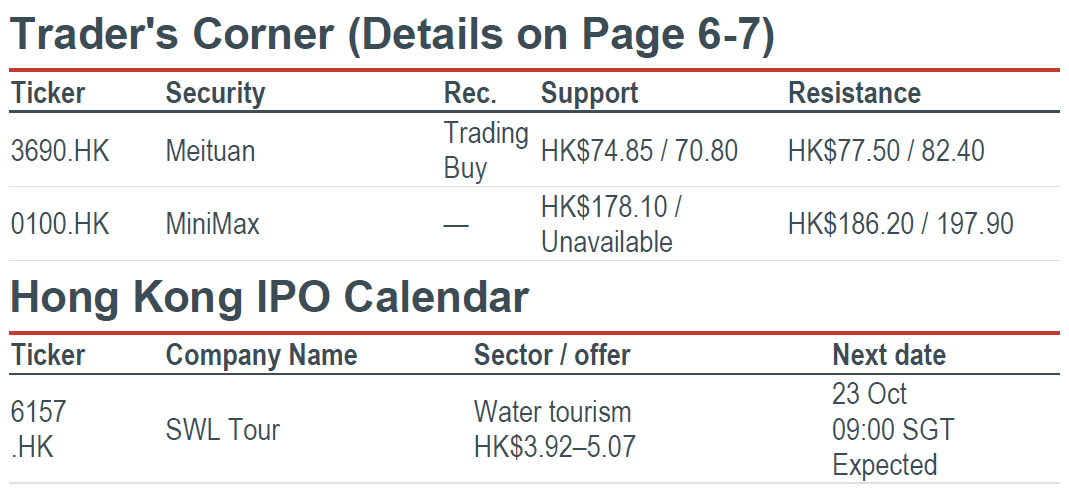
Traders' Corner
Our Technical View
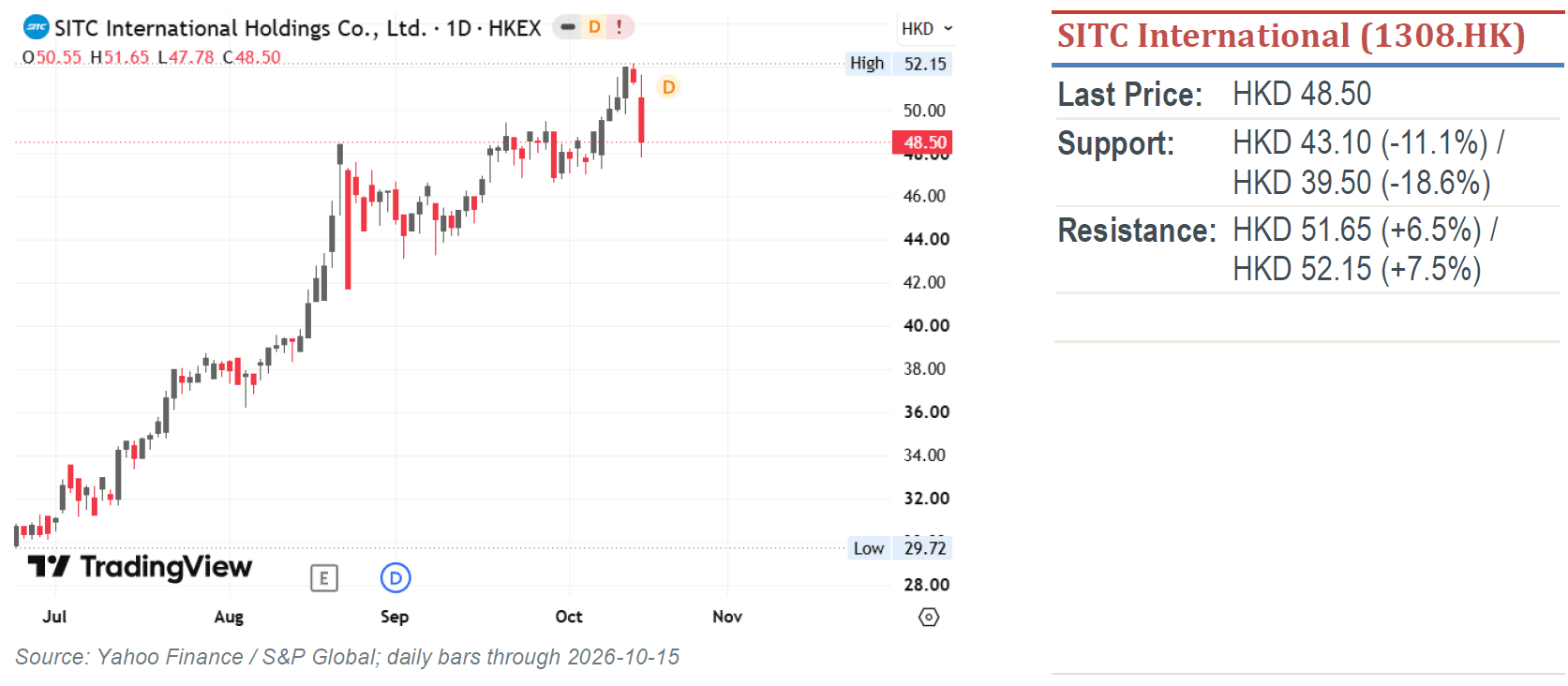
- Price formed a bearish harami candlestick pattern, forming a swing high at HK$52.15.
- A key technical warning is confirmed by a prominent RSI bearish divergence.
- As long as price remains capped underneath this high on transient upward pullbacks, we see a downward reversal toward lower support.
Our Technical View
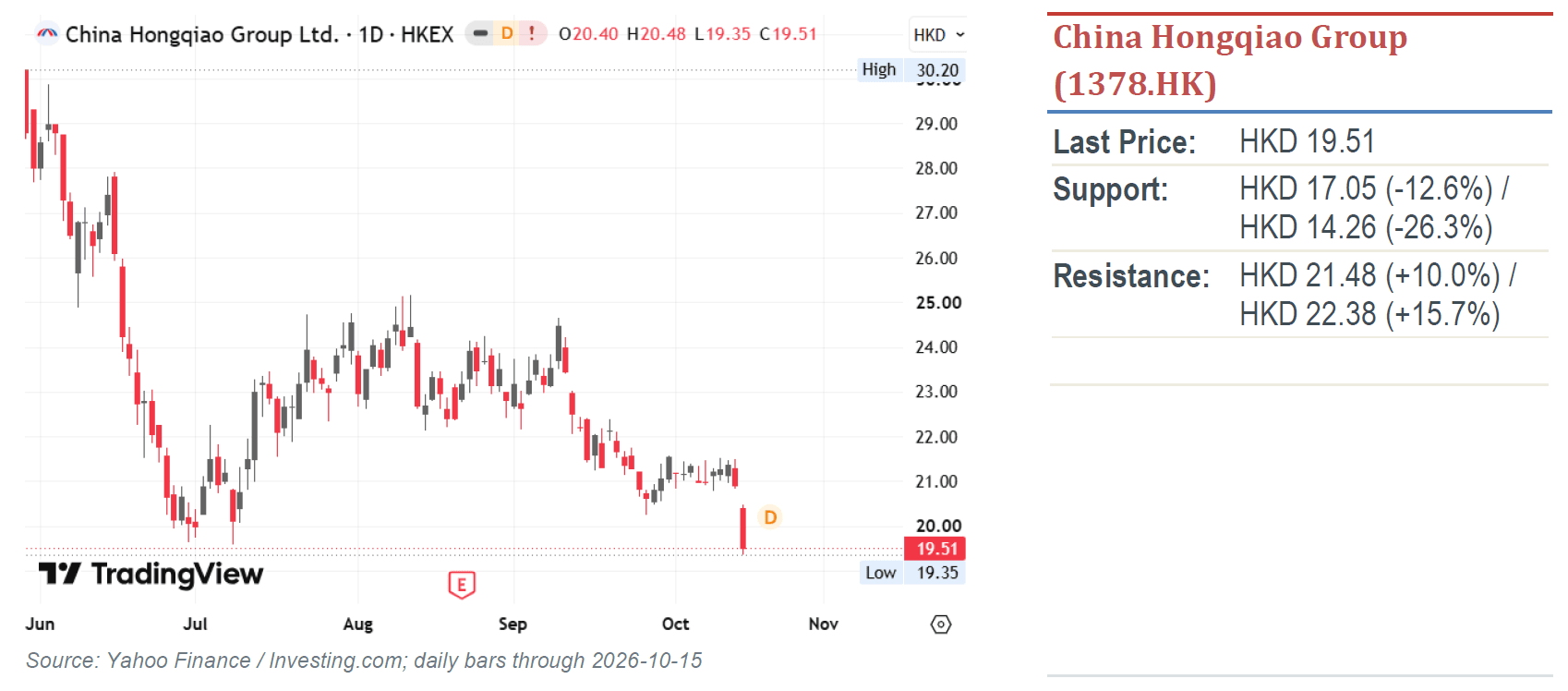
- Price violated its recent price low via a falling window.
- The RSI remains in bearish territory and continues to slope downward with negative velocity.
- As long as price strictly remains capped underneath the lower gap boundary and converted resistance ceiling, we could expect continued downward expansion toward deeper support targets.
Market Movers: The S&P 500 recovered 0.33% in the Thursday, 15 October US session, following a 7.57% plunge in Korea’s KOSPI. In Seoul, SK Hynix (000660 KS) fell 11.06% and Samsung Electronics (005930 KS) lost 9.48% amid concerns about AI investment sustainability and higher borrowing costs. TSMC (TSM US) fell 1.80% despite reporting quarterly profit of US$23.59bn, up 68.7% YoY, and forecasting fourth-quarter revenue of US$52.3–54.3bn. It maintained 2026 capital spending guidance of US$60–64bn. Management’s prudent 2027 planning signals uncertainty about future capital spending. (Reuters / Yonhap / Market data / Yahoo Finance)
Macro: US September producer prices jumped 1.3% month on month, versus 0.5% expected, and 6.3% YoY. Retail sales rose 0.8% to US$745bn, up 6.3% YoY, but gasoline inflated the nominal gain. The control group increased just 0.1%, after 1.2% in August. The combination complicates the Fed’s inflation–growth trade-off. (Reuters / Census)
FICC: The 15 October US 10-year par yield fell 9bps from 5.19% to 5.10%. December gold gained 1.58% and silver 3.23%, while DXY fell 0.53%, at matched 17:00 New York indicative snapshots. November WTI settled 3.03% higher at US$97.97/bbl, alongside an 8.6mn-barrel US inventory draw; December Brent slipped 0.13% to US$105.92. Diverging crude benchmarks underscore the importance of regional supply and shipping conditions. (US Treasury / Yahoo Finance / Newsquawk / EIA) TSMC (TSM US) is our Core Recommendation.
AI
- TSMC’s record profit meets a cautious market. TSMC (TSM US) reported third-quarter net profit of NT$763.06bn, up 68.7% YoY, and guided fourth-quarter revenue to US$52.3–54.3bn on 15 October. Its US ADR closed 1.80% lower at US$422.25 after the release. Robust AI demand supports capacity investment, but management’s cautious 2027 planning highlights macroeconomic uncertainty and the market’s sensitivity to expectations. (TSMC / Reuters / Market data)
TSMC (TSM US) is our Core Recommendation.
- Meta Platforms (META US) broadens access to local AI. The 15 October Muse Spark Open release has 816bn total parameters, 42bn active parameters and a 1mn-token context window. Meta says it runs on two Apple (AAPL US) M5 Ultra Mac Studios, with downloadable weights and hosted access. Local deployment expands developer choice, although commercial licence restrictions qualify the scope of unrestricted adoption. (Meta)
Meta Platforms (META US) is our Core Recommendation.
- Anthropic embeds independent evaluators within its safety operations. The company announced employee-like access for six METR researchers on 15 October, including internal tools and systems. METR can publish risk findings without Anthropic veto, subject to narrowly defined redactions covering sensitive information. Deeper scrutiny could strengthen confidence in frontier-model governance, but voluntary access does not establish that models are safe. (Anthropic)
- CoreWeave (CRWV US) rebounds while financing risk persists. Shares closed 15 October up 5.94% at US$69.69. Nvidia (NVDA US) chief Jensen Huang said financial strength was improving and no backstop was needed, while Reuters reported roughly 16% yields on CoreWeave’s 2031 bonds. The equity recovery offers little assurance about funding costs; debt service and cash conversion remain central to infrastructure returns. (Reuters / Market data)
Americas
- Coca-Cola (KO US) wins KFC’s US fountain business. KFC announced a switch from PepsiCo (PEP US) across its 3,718 US restaurants, with the transition beginning in January 2027 and full rollout expected by spring. The agreement ends roughly four decades of Pepsi supply; financial terms were not disclosed. Wider restaurant distribution supports brand reach, although incremental profit cannot yet be quantified. (KFC / PR Newswire / Reuters)
Coca-Cola (KO US) is our Trading Buy.
- Charles Schwab (SCHW US) grows earnings alongside client inflows. 3Q adjusted EPS increased 29% YoY to US$1.69 and revenue rose 17% to US$7.17bn. Core net new assets reached US$190.4bn, up 38% YoY. Shares closed 15 October down 2.73% at US$94.16. Client acquisition supports recurring asset-based fees, although asset values and trading activity remain sensitive to market conditions. (Charles Schwab / Market data)
- Prologis (PLD US) improves operating earnings but trims GAAP guidance. 3Q core FFO rose 7.4% YoY to US$1.60 per share, while cash same-store NOI increased 5.9%. Full-year core FFO guidance narrowed to US$6.25–6.29, but EPS guidance fell to US$4.05–4.15 from US$4.40–4.55. Shares closed 15 October down 2.70% at US$126.94. The divergence warrants separating property performance from reported accounting earnings. (Prologis / Market data)
- Marsh (MRSH US) grows earnings despite weaker reinsurance revenue. 3Q revenue rose 8% YoY to US$6.9bn, with 5% underlying growth, while adjusted EPS increased 10% to US$2.03. Reinsurance revenue nevertheless fell 6% YoY to US$374mn. Shares closed 15 October up 4.56% at US$186.54. Diversified advisory and insurance operations support earnings, but reinsurance weakness tempers the headline growth. (Marsh / Market data)
- BNY (BNY US) converts fee growth into higher profitability. 3Q EPS rose 24% YoY to US$2.34 and revenue increased 12% to US$5.68bn. Fee revenue also gained 12%, while net interest income rose 15% YoY but slipped 2% QoQ. Shares closed 15 October up 3.23% at US$142.09. Fee growth broadens earnings support as sequential interest-income momentum moderates. (BNY / Market data)
- Interactive Brokers (IBKR US) expands earnings through client growth. After the 15 October US close, 3Q adjusted EPS rose 17.5% YoY to US$0.67, while adjusted revenue increased 16.3% to US$1.87bn. Client accounts rose 35% YoY to 5.58mn. Greater scale supports earnings, although customer margin loans rising 36% YoY to US$105.2bn increase sensitivity to stressed markets. (Interactive Brokers)
Greater China
- Lenovo falls as AI hardware risk is repriced. Lenovo (0992 HK) closed 14.54% lower at HK$25.98 on 15 October, amid broader weakness in AI hardware. Reuters reported tighter financing conditions and delayed fundraising across Asian data-centre businesses. The move highlights sensitivity to spending assumptions and customers’ funding costs; it does not by itself establish a deterioration in Lenovo’s earnings outlook or orders. (NewTimeSpace / Reuters / Market data)
- TikTok faces a setback in its EU appeal. An EU court adviser recommended on 15 October that ByteDance’s TikTok remain a Digital Markets Act gatekeeper. The opinion is non-binding; the court has yet to rule. Breaches of the rules can attract fines of up to 10% of annual global turnover, keeping compliance costs and restrictions on platform practices relevant to the business outlook. (Reuters)
Asia ex. China
- Korean memory shares intensify the AI sell-off. SK Hynix (000660 KS) fell 11.06% to KRW1,262,000 and Samsung Electronics (005930 KS) lost 9.48% to KRW210,000 at the 15 October close. The KOSPI dropped 7.57%, with foreign investors selling a net KRW3.62tn. The breadth of the retreat points to funding and valuation concerns across the AI trade, beyond any single company’s earnings release. (Yonhap / Market data / Market data)
- Nestlé India’s volume growth strengthens quarterly earnings. Nestlé India (NESTLEIND IN) reported September-quarter consolidated revenue of INR67.88bn, up 20.3% YoY, and net profit of INR10.10bn, up 35.9%, on 15 October. Management cited broad volume growth but warned of food inflation. Stronger demand supports earnings resilience; sustained commodity pressure and heavier brand investment could still limit how much sales growth converts into future profit. (Nestlé India)
EMEA and Others
- UBS explores options as capital rules tighten. Reuters reported on 15 October that UBS (UBSG SW) is considering contingency options including a headquarters move or bank deals if Swiss rules prove too restrictive; no active talks are underway. The government’s proposed foreign-subsidiary capital requirement could tie up over US$20bn. Strategic uncertainty therefore remains linked to the final rules, rather than an announced relocation or transaction. (Reuters)
- AstraZeneca expands AI-assisted drug discovery. AstraZeneca (AZN LN) agreed on 15 October to pay insitro US$40m upfront for research into liver and heart diseases, with up to US$1.46bn in contingent milestones plus royalties. AstraZeneca will fund subsequent clinical trials. The partnership broadens target discovery, but milestone payments and commercial value depend on research progress and eventual clinical validation rather than the initial AI collaboration. (Reuters)
- TotalEnergies flags a sharp refining windfall. TotalEnergies (TTE FP) said on 15 October that third-quarter refining margins were expected at US$33.2 a barrel, versus US$8.4 a year earlier. Refining and chemicals cash flow could reach around US$4bn, double the previous quarter. Elevated energy prices support near-term cash generation, although supply disruption and dependence on unusually strong margins increase the risk of subsequent normalisation. (Reuters)
- UniCredit clears a major Commerzbank hurdle. UniCredit (UCG IM) said on 15 October that the ECB authorised control of Commerzbank, following its July offer that lifted its stake to 48%. It expects around 50% of voting rights after remaining conditions are met. Regulatory progress advances the strategic case, but integration, political resistance and minority interests still complicate the path to a full merger. (Reuters)
- Nordea’s buyback pause weakens the capital-return case. Nordea (NDAFI FH) fell 7.83% to €15.65 on 15 October after pausing buybacks pending an ECB capital-model review. Third-quarter operating profit declined 4% YoY to €1.54bn, below the €1.63bn consensus. With decisions not expected before 2027, uncertainty over risk-weighted assets clouds surplus-capital distributions even as higher interest rates could support future lending income. (Nordea / Reuters / Market data)
- Ericsson beats forecasts but flags cost pressure. Ericsson (ERICB SS) rose 6.80% to SEK103.70 on 15 October. Third-quarter organic sales grew 7% YoY and adjusted EBITA reached SEK10.1bn, exceeding the SEK7.87bn consensus; the prior-year profit included a large divestment gain. Execution and cost discipline support earnings, but management’s warning about component costs leaves next year’s margins exposed despite the stronger quarter. (Ericsson / PR Newswire / Reuters / Market data)
Traders' Corner
Our Technical View
- Price formed a bearish harami candlestick pattern, forming a swing high at HK$52.15.
- A key technical warning is confirmed by a prominent RSI bearish divergence.
- As long as price remains capped underneath this high on transient upward pullbacks, we see a downward reversal toward lower support.
Our Technical View
- Price violated its recent price low via a falling window.
- The RSI remains in bearish territory and continues to slope downward with negative velocity.
- As long as price strictly remains capped underneath the lower gap boundary and converted resistance ceiling, we could expect continued downward expansion toward deeper support targets.
Disclosures and disclaimers
This report is provided subject to, and must be read together with, the full Disclosures / Disclaimers available at this link, which are incorporated by reference into this report. In particular, this report is intended for general circulation and informational purposes only and does not constitute personal investment advice or a recommendation to buy or sell any investment product or security. You should independently evaluate the information and, where necessary, seek advice from a qualified financial adviser regarding the suitability of any investment. Analyst certifications required under applicable regulations, including SEC Regulation AC (where relevant), are included in this report. By accessing, receiving or using this report, you acknowledge that you have read, understood and agreed to be bound by the Disclosures / Disclaimers, as may be amended, supplemented or updated from time to time.


