

Wealth Daily
Oil And Yield Surge Weigh On Global Equities
Today’s Must-Know News
Overnight Markets
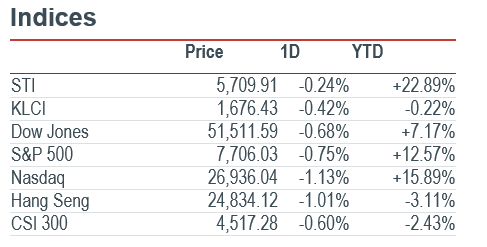
Market Movers: At Wednesday’s US close, the S&P 500 fell 0.75% and Nasdaq lost about 1.1%. McDonald’s (MCD US) fell 4.81% as its investor day outlined US$8.5bn of restaurant support through 2036, testing franchisees’ investment capacity. Paychex (PAYX US) dropped 8.77% following quarterly results: Management Solutions revenue grew 4%, while full-year growth guidance was maintained. The reactions highlight scrutiny of operating momentum as financing costs climb. (Yahoo Finance / Paychex / AP)
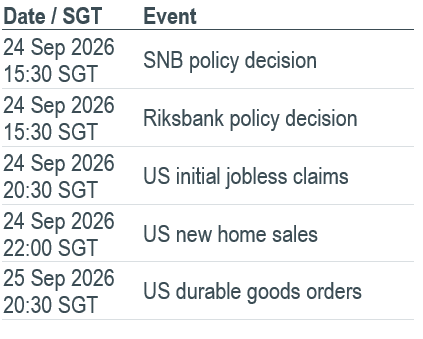
Macro: The US flash composite PMI rose to 58.4 from 56.0 in September, reinforcing inflation concerns as demand strains capacity. SNB and Riksbank decisions are due on 24 September at 15:30 SGT. DBS expects the SNB to hold at 0%; FX Blue’s consensus puts Sweden at 1.75%. Watch inflation forecasts and tightening guidance: persistent energy pressures could produce a more hawkish message than the unchanged-rate expectations imply. (Reuters / DBS / FX Blue)
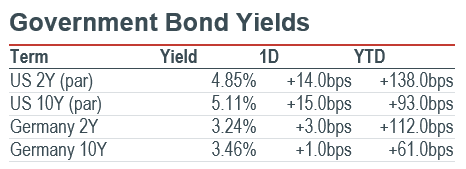
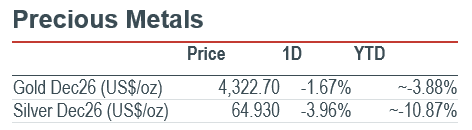
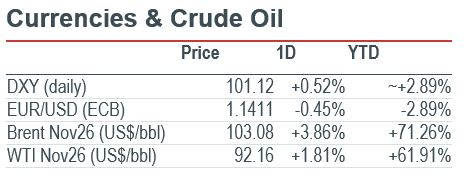
FICC: At Wednesday’s US Treasury par-curve fixing, the 10-year yield rose 15bps from 4.96% to 5.11%. November Brent settled 3.86% higher at US$103.08/bbl as Iran’s president rejected surrender, tempering hopes of a swift peace deal. At 17:00 New York on 23 September, December gold and silver futures were down 1.67% and 3.96%, respectively. Higher discount rates and renewed energy inflation threaten both duration and corporate margins. (US Treasury / Reuters / Yahoo Finance)
AI
Anthropic extends AI research into experimental biology. The company disclosed that around 950 Claude agents searched for 21 hours and helped identify previously uncharacterised enzyme systems in bacteriophages. The work points to a possible commercial role for AI beyond coding and office workflows, supporting demand for specialised research compute. However, the systems’ biological function remains unknown; laboratory validation is still needed before applications in gene editing or medicine can be established. (Anthropic / Reuters)
Google broadens the market for programmable speech. Gemini 3.8 Flash TTS and Flash-Lite TTS launched with more than 100 languages and dialects and over 2,000 production voices, with access rolling out through the Gemini API and Google AI Studio. Flash-Lite targets high-volume workloads. The expansion could widen enterprise adoption and intensify competition in synthetic voice services, although Google disclosed no incremental revenue or customer-spending commitment. (Google) Alphabet (GOOGL US) is our Trading Buy.
AI booking agents keep pressure on travel intermediaries. Expedia (EXPE US) and Airbnb (ABNB US) fell about 7.7% and about 7.6%, respectively, in the September 23 US session as concern over Meta’s Muse agent continued to unsettle online travel platforms. The issue is whether an assistant that arranges travel can divert customer visits and commission revenue from established websites. This was a further market repricing of an existing product, rather than evidence that material booking volumes had already migrated. (StockStory / Stock Analysis / Stock Analysis)
OpenAI brings voice into connected work tasks. The September 23 release expanded Live to plugins across web, iOS and Android, and added Voice to Work on web and mobile. Users can initiate tasks involving documents, spreadsheets, presentations, connected apps and browsers while existing permissions and usage limits remain in force. The investment implication is broader competition over the interface to enterprise workflows; the release supplied no adoption figures or evidence of near-term revenue acceleration. (OpenAI)
Americas
McDonald’s asks franchisees to fund a lengthy productivity reset. Shares fell about 4.8% in the September 23 US session after the company outlined US$8.5bn of support through 2036, including US$5bn by 2030. US franchisees would invest around US$800,000 per restaurant in additional technology and operational upgrades. The plan targets 250bps of restaurant-efficiency gains, but the capital burden and long implementation period make execution and franchisee returns central to the investment case. (Yahoo Finance / Stock Analysis)
Paychex’s core growth draws scrutiny despite higher earnings. Shares fell about 8.8% in the September 23 US session following first-quarter results. Management Solutions revenue rose about 4.0% to US$1.21bn, while total revenue reached US$1.63bn and adjusted EPS was US$1.34. Full-year revenue growth of about 5.0%–6.0% and adjusted EPS growth of about 7.0%–9.0% were maintained. The unchanged outlook leaves accelerating the largest operating segment important to rebuilding confidence. (Paychex / Stock Analysis)
Boeing (BA US) gains union backing ahead of a decisive contract vote. SPEEA’s professional and technical councils recommended that members accept the latest four-year offer following their September 22 evening meeting in the US Pacific time zone. Voting runs from September 24 to October 1, Pacific time. The endorsement may reduce labour uncertainty as Boeing rebuilds production, but members still have to ratify the agreement; higher wage commitments also remain a cost consideration. (SPEEA / Reuters)
Royal Caribbean (RCL US) expands from cruises into all-inclusive resorts. The group agreed to buy half of Sandals and Beaches Resorts for US$3bn, at approximately ten times forward EBITDA, with committed debt financing. Closing is expected in early 2027, subject to approvals, and the company expects the deal to add to next year’s earnings. The investment broadens its land-based holiday offering, while financing costs and integration determine how much of that strategic expansion reaches shareholders. (Royal Caribbean)
Grail (GRAL US) clears an advisory hurdle while efficacy remains contested. An FDA panel backed Galleri’s safety by 10–0, efficacy by 6–4 and its benefit-risk balance by 7–2, with one abstention on the last question. The recommendation advances the blood-based multi-cancer screening test’s regulatory path, but the narrower efficacy vote highlights uncertainty over clinical benefit. The FDA’s final decision is still pending, so the vote does not yet establish approval or commercial reimbursement. (Reuters)
Cintas (CTAS US) lifts its outlook as organic demand supports margins. First-quarter revenue reached US$3.01bn with organic growth of about 8.9%, while adjusted EPS was US$1.39. The uniform and workplace-services group raised full-year adjusted EPS guidance to US$5.45–US$5.54 from US$5.36–US$5.50. The stronger outlook supports confidence in recurring service demand and operating leverage, although it excludes the proposed UniFirst acquisition and associated nonrecurring costs, leaving transaction execution a separate issue. (Cintas)
General Mills (GIS US) stabilises organic sales while margins remain pressured. First-quarter sales were US$4.4bn and organic growth was flat, but North America Retail’s organic sales fell about 3.0%. Adjusted gross margin declined 90bps to about 33.3%, and adjusted EPS was US$0.75. The company reaffirmed its full-year outlook. Stable group sales therefore offer only partial reassurance: restoring US retail momentum while absorbing costs remains necessary to convert the top-line stabilisation into stronger earnings. (General Mills)
Greater China
Geely raises the charging benchmark. Geely (0175.HK) unveiled a 2.2-megawatt charging system and upgraded Galaxy E5 on 23 September, saying its next-generation battery can charge from 10% to 70% in 4.5 minutes, or to 97% in eight minutes 40 seconds under normal ambient conditions. Faster replenishment strengthens its competitive pitch against BYD and could ease consumer range concerns. Commercial returns will depend on compatible infrastructure, deployment costs and reliable performance beyond controlled launch conditions. (Reuters) Geely (0175.HK) is our Core Recommendation.
Xiaomi advances its premium handset range. Xiaomi (1810.HK) launched the Xiaomi 18 Pro and Pro Max on 23 September, with starting prices of RMB5,999 and RMB6,999 respectively. The Pro combines a 2nm Snapdragon platform with a 7,000mAh battery and upgraded imaging hardware, according to launch coverage. The higher-specification range gives Xiaomi another route to improve product mix and average selling prices; the investment test is conversion into profitable demand, rather than specifications alone, in a competitive smartphone market. (Beijing Daily / IT Home)
Vanke gains on financing-relief hopes. China Vanke (2202.HK) rose 4.00% to HK$2.60 at the Hong Kong close on 23 September, versus HK$2.50 in the prior session. The reaction followed Reuters’ 22 September report that regulators had asked banks to avoid classifying overdue Vanke loans as bad debt and allow repayment relief. Bank loans represented 72% of its RMB351bn debt at June-end. Forbearance could buy refinancing time, but does not itself restore property sales, cash collections or solvency. (Reuters)
PBOC prepares holiday liquidity support. The People’s Bank of China announced on 23 September that it could inject up to RMB1trn a day through overnight reverse repos around the Golden Week holiday period. The programme is intended to cushion seasonal funding demand and keep banking-system liquidity ample. For investors, the immediate transmission is through smoother money-market conditions and reduced quarter-end funding stress; the announcement should not be read as a policy-rate cut or a permanent increase of the same size in credit supply. (Reuters)
Asia ex. China
Korean TV groups face an Indian tariff dispute. Reuters reported on 23 September that LG Electronics (066570.KS) and Samsung Electronics (005930.KS) faced an Indian investigation over duties on OLED television components. Authorities were examining whether a 15% rate should have applied instead of 5%; the potential liability was undisclosed. Samsung said it was reviewing the matter and cooperating. The newly disclosed dispute introduces a possible landed-cost and provisioning risk, although classification remains contested and no final liability should yet be assumed. (Reuters)
Australian regulator blocks IAG’s RAC acquisition. The Australian Competition and Consumer Commission rejected Insurance Australia Group’s (IAG.AX) proposed RAC Insurance acquisition on 23 September after a Phase 2 assessment. It estimated combined Western Australian shares of 55–65% in motor insurance and 50–60% in home and contents cover, finding rivals would not sufficiently offset the loss of competition. A public-benefit application remains an available route. The decision delays acquisition-led expansion and makes regulatory approval, rather than prospective integration synergies, the immediate investment constraint. (ACCC)
StarHub and Keppel reopen M1 consolidation options. StarHub (CC3.SI) and Keppel (BN4.SI) confirmed on 23 September that discussions concerning M1 were ongoing, while stressing that no definitive transaction was assured. No new price was disclosed. The earlier S$1.43bn Simba proposal had fallen through following regulatory complications. The renewed talks restore a possible consolidation route for Singapore telecoms and a monetisation option for Keppel, but valuation, competitive safeguards and execution remain unresolved; the former proposal’s price is not a valuation for these discussions. (CNA)
Singapore core inflation edges higher. Singapore’s August core inflation rose to 2.20% year on year from 2.00% in July, while headline inflation increased to 2.30% from 2.20%, according to the 23 September release. Core and headline prices increased 0.30% and 0.60% respectively month on month. Firmer services, retail goods and food prices lifted core inflation. The breadth of domestic price pressure matters for household purchasing power and companies’ cost recovery, while limiting the case for assuming rapid monetary easing. (MTI / MAS)
EMEA and Others
Adyen falls despite unchanged objectives. Adyen (ADYEN NA) closed 4.70% lower at EUR860.60 in Amsterdam on 23 September, versus EUR903.00 in the previous session. The move followed its 22 September nomination of former Klarna finance chief Niclas Neglen as CFO, subject to regulatory and shareholder approval. Adyen explicitly maintained its financial objectives. The leadership transition therefore warrants monitoring for execution and continuity, while the share-price decline alone does not establish any deterioration in the company’s stated earnings outlook. (Adyen / Reuters)
MPS preserves options in Italy’s bank contest. Monte dei Paschi di Siena (BMPS IM) CEO Luigi Lovaglio said on 23 September that shareholders could support the bank’s defence plan and still accept Intesa Sanpaolo’s (ISP IM) existing EUR36bn cash-and-stock offer. MPS has proposed a separate EUR38bn all-share combination with Banco BPM and Banca Generali. The fresh remarks frame authorisation as optionality rather than an exclusive choice, leaving investors to weigh dilution, execution and competing deal economics; neither transaction was newly announced that day. (Reuters)
JD Sports’ earnings pressure persists. JD Sports Fashion (JD LN) reported a 19.70% fall in first-half adjusted pre-tax profit to GBP282m on 23 September, while sales slipped 0.70% to GBP5.90bn. Management retained its previously reduced FY27 profit guidance of GBP700–800m. North American weakness remains the central operating challenge, and stable full-year guidance does not remove the need for better trading in the second half. Investors should distinguish the adjusted earnings decline from statutory profit, which benefited from a different exceptional-item comparison. (JD Sports / Reuters)
- Airtel Money formalises its London listing plan. Airtel Africa (AAF LN) announced on 23 September that Airtel Money intends to list separately on London’s Main Market. The proposed offering consists of existing shareholders’ shares, with no new capital raised by Airtel Money itself. Airtel Africa currently owns 77.85% and expects to remain a long-term strategic shareholder. A separate listing could make the payments business’s valuation more transparent and create shareholder liquidity, while final pricing and the amount sold will determine the actual value crystallised. (Company)
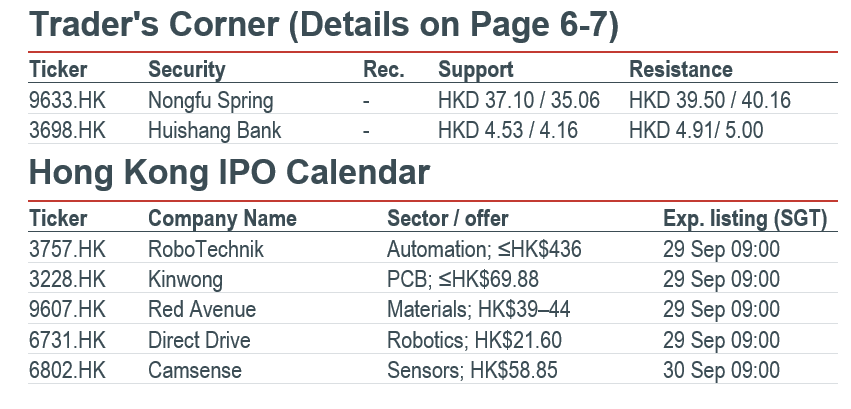
Traders’ corner
Our Technical View
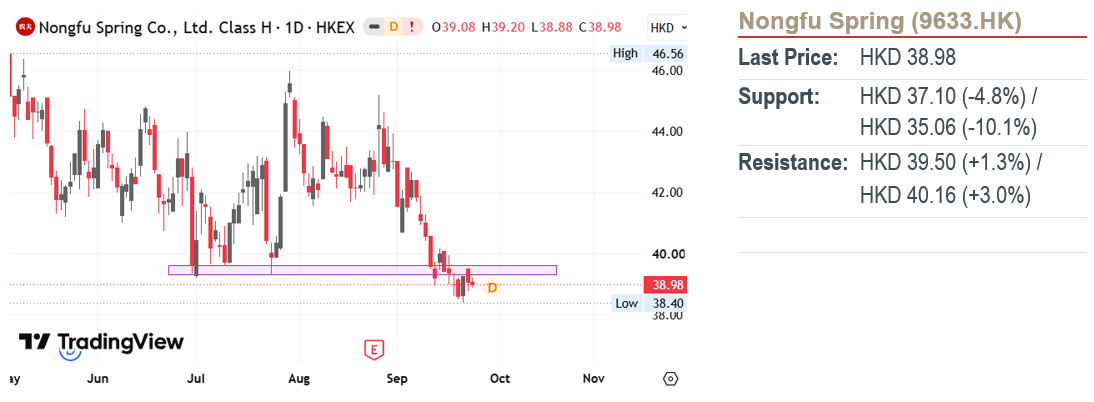
Price executed a precise retest and rejection at its support-turned-resistance zone, establishing the newly converted anchor as a dominant supply ceiling.
The RSI is established in bearish territory and continues to slope downward, signaling accelerating downward trend velocity.
- As long as counter-trend rallies remain strictly capped below this resistance, we could see a continued downward expansion toward lower support targets.
Our Technical View
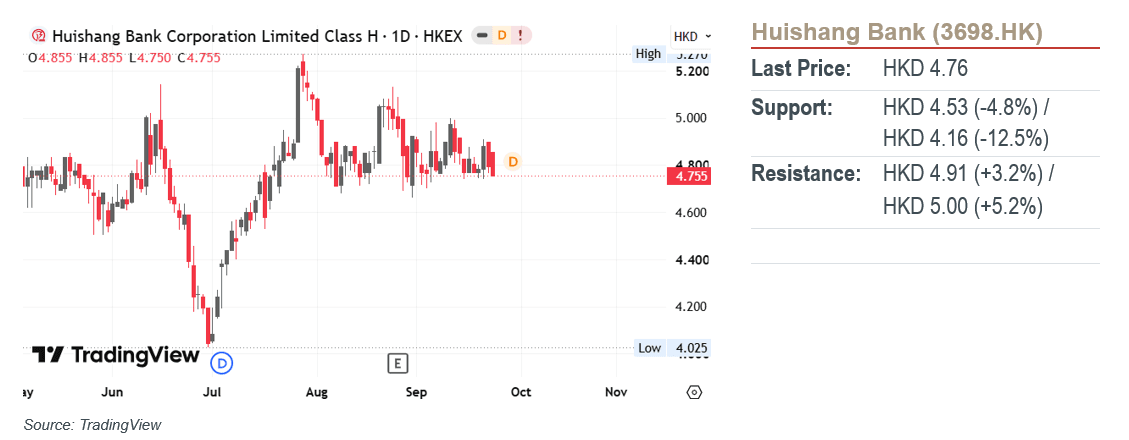
Price exhibits structural deterioration marked by a clear sequence of lower highs, an inability to challenge overhead supply anchors.
The RSI is hovering around the neutral 50-midline, signaling a transition from bullish posture into momentum compression immediately above the critical support pivot at HK$4.68.
A decisive structural breach below the HK$4.68 demand floor will complete the bearish breakdown sequence, opening path-of-least-resistance dynamics for an accelerated downward expansion toward lower support targets.
Market Movers: At Wednesday’s US close, the S&P 500 fell 0.75% and Nasdaq lost about 1.1%. McDonald’s (MCD US) fell 4.81% as its investor day outlined US$8.5bn of restaurant support through 2036, testing franchisees’ investment capacity. Paychex (PAYX US) dropped 8.77% following quarterly results: Management Solutions revenue grew 4%, while full-year growth guidance was maintained. The reactions highlight scrutiny of operating momentum as financing costs climb. (Yahoo Finance / Paychex / AP)
Macro: The US flash composite PMI rose to 58.4 from 56.0 in September, reinforcing inflation concerns as demand strains capacity. SNB and Riksbank decisions are due on 24 September at 15:30 SGT. DBS expects the SNB to hold at 0%; FX Blue’s consensus puts Sweden at 1.75%. Watch inflation forecasts and tightening guidance: persistent energy pressures could produce a more hawkish message than the unchanged-rate expectations imply. (Reuters / DBS / FX Blue)
FICC: At Wednesday’s US Treasury par-curve fixing, the 10-year yield rose 15bps from 4.96% to 5.11%. November Brent settled 3.86% higher at US$103.08/bbl as Iran’s president rejected surrender, tempering hopes of a swift peace deal. At 17:00 New York on 23 September, December gold and silver futures were down 1.67% and 3.96%, respectively. Higher discount rates and renewed energy inflation threaten both duration and corporate margins. (US Treasury / Reuters / Yahoo Finance)
AI
Anthropic extends AI research into experimental biology. The company disclosed that around 950 Claude agents searched for 21 hours and helped identify previously uncharacterised enzyme systems in bacteriophages. The work points to a possible commercial role for AI beyond coding and office workflows, supporting demand for specialised research compute. However, the systems’ biological function remains unknown; laboratory validation is still needed before applications in gene editing or medicine can be established. (Anthropic / Reuters)
Google broadens the market for programmable speech. Gemini 3.8 Flash TTS and Flash-Lite TTS launched with more than 100 languages and dialects and over 2,000 production voices, with access rolling out through the Gemini API and Google AI Studio. Flash-Lite targets high-volume workloads. The expansion could widen enterprise adoption and intensify competition in synthetic voice services, although Google disclosed no incremental revenue or customer-spending commitment. (Google) Alphabet (GOOGL US) is our Trading Buy.
AI booking agents keep pressure on travel intermediaries. Expedia (EXPE US) and Airbnb (ABNB US) fell about 7.7% and about 7.6%, respectively, in the September 23 US session as concern over Meta’s Muse agent continued to unsettle online travel platforms. The issue is whether an assistant that arranges travel can divert customer visits and commission revenue from established websites. This was a further market repricing of an existing product, rather than evidence that material booking volumes had already migrated. (StockStory / Stock Analysis / Stock Analysis)
OpenAI brings voice into connected work tasks. The September 23 release expanded Live to plugins across web, iOS and Android, and added Voice to Work on web and mobile. Users can initiate tasks involving documents, spreadsheets, presentations, connected apps and browsers while existing permissions and usage limits remain in force. The investment implication is broader competition over the interface to enterprise workflows; the release supplied no adoption figures or evidence of near-term revenue acceleration. (OpenAI)
Americas
McDonald’s asks franchisees to fund a lengthy productivity reset. Shares fell about 4.8% in the September 23 US session after the company outlined US$8.5bn of support through 2036, including US$5bn by 2030. US franchisees would invest around US$800,000 per restaurant in additional technology and operational upgrades. The plan targets 250bps of restaurant-efficiency gains, but the capital burden and long implementation period make execution and franchisee returns central to the investment case. (Yahoo Finance / Stock Analysis)
Paychex’s core growth draws scrutiny despite higher earnings. Shares fell about 8.8% in the September 23 US session following first-quarter results. Management Solutions revenue rose about 4.0% to US$1.21bn, while total revenue reached US$1.63bn and adjusted EPS was US$1.34. Full-year revenue growth of about 5.0%–6.0% and adjusted EPS growth of about 7.0%–9.0% were maintained. The unchanged outlook leaves accelerating the largest operating segment important to rebuilding confidence. (Paychex / Stock Analysis)
Boeing (BA US) gains union backing ahead of a decisive contract vote. SPEEA’s professional and technical councils recommended that members accept the latest four-year offer following their September 22 evening meeting in the US Pacific time zone. Voting runs from September 24 to October 1, Pacific time. The endorsement may reduce labour uncertainty as Boeing rebuilds production, but members still have to ratify the agreement; higher wage commitments also remain a cost consideration. (SPEEA / Reuters)
Royal Caribbean (RCL US) expands from cruises into all-inclusive resorts. The group agreed to buy half of Sandals and Beaches Resorts for US$3bn, at approximately ten times forward EBITDA, with committed debt financing. Closing is expected in early 2027, subject to approvals, and the company expects the deal to add to next year’s earnings. The investment broadens its land-based holiday offering, while financing costs and integration determine how much of that strategic expansion reaches shareholders. (Royal Caribbean)
Grail (GRAL US) clears an advisory hurdle while efficacy remains contested. An FDA panel backed Galleri’s safety by 10–0, efficacy by 6–4 and its benefit-risk balance by 7–2, with one abstention on the last question. The recommendation advances the blood-based multi-cancer screening test’s regulatory path, but the narrower efficacy vote highlights uncertainty over clinical benefit. The FDA’s final decision is still pending, so the vote does not yet establish approval or commercial reimbursement. (Reuters)
Cintas (CTAS US) lifts its outlook as organic demand supports margins. First-quarter revenue reached US$3.01bn with organic growth of about 8.9%, while adjusted EPS was US$1.39. The uniform and workplace-services group raised full-year adjusted EPS guidance to US$5.45–US$5.54 from US$5.36–US$5.50. The stronger outlook supports confidence in recurring service demand and operating leverage, although it excludes the proposed UniFirst acquisition and associated nonrecurring costs, leaving transaction execution a separate issue. (Cintas)
General Mills (GIS US) stabilises organic sales while margins remain pressured. First-quarter sales were US$4.4bn and organic growth was flat, but North America Retail’s organic sales fell about 3.0%. Adjusted gross margin declined 90bps to about 33.3%, and adjusted EPS was US$0.75. The company reaffirmed its full-year outlook. Stable group sales therefore offer only partial reassurance: restoring US retail momentum while absorbing costs remains necessary to convert the top-line stabilisation into stronger earnings. (General Mills)
Greater China
Geely raises the charging benchmark. Geely (0175.HK) unveiled a 2.2-megawatt charging system and upgraded Galaxy E5 on 23 September, saying its next-generation battery can charge from 10% to 70% in 4.5 minutes, or to 97% in eight minutes 40 seconds under normal ambient conditions. Faster replenishment strengthens its competitive pitch against BYD and could ease consumer range concerns. Commercial returns will depend on compatible infrastructure, deployment costs and reliable performance beyond controlled launch conditions. (Reuters) Geely (0175.HK) is our Core Recommendation.
Xiaomi advances its premium handset range. Xiaomi (1810.HK) launched the Xiaomi 18 Pro and Pro Max on 23 September, with starting prices of RMB5,999 and RMB6,999 respectively. The Pro combines a 2nm Snapdragon platform with a 7,000mAh battery and upgraded imaging hardware, according to launch coverage. The higher-specification range gives Xiaomi another route to improve product mix and average selling prices; the investment test is conversion into profitable demand, rather than specifications alone, in a competitive smartphone market. (Beijing Daily / IT Home)
Vanke gains on financing-relief hopes. China Vanke (2202.HK) rose 4.00% to HK$2.60 at the Hong Kong close on 23 September, versus HK$2.50 in the prior session. The reaction followed Reuters’ 22 September report that regulators had asked banks to avoid classifying overdue Vanke loans as bad debt and allow repayment relief. Bank loans represented 72% of its RMB351bn debt at June-end. Forbearance could buy refinancing time, but does not itself restore property sales, cash collections or solvency. (Reuters)
PBOC prepares holiday liquidity support. The People’s Bank of China announced on 23 September that it could inject up to RMB1trn a day through overnight reverse repos around the Golden Week holiday period. The programme is intended to cushion seasonal funding demand and keep banking-system liquidity ample. For investors, the immediate transmission is through smoother money-market conditions and reduced quarter-end funding stress; the announcement should not be read as a policy-rate cut or a permanent increase of the same size in credit supply. (Reuters)
Asia ex. China
Korean TV groups face an Indian tariff dispute. Reuters reported on 23 September that LG Electronics (066570.KS) and Samsung Electronics (005930.KS) faced an Indian investigation over duties on OLED television components. Authorities were examining whether a 15% rate should have applied instead of 5%; the potential liability was undisclosed. Samsung said it was reviewing the matter and cooperating. The newly disclosed dispute introduces a possible landed-cost and provisioning risk, although classification remains contested and no final liability should yet be assumed. (Reuters)
Australian regulator blocks IAG’s RAC acquisition. The Australian Competition and Consumer Commission rejected Insurance Australia Group’s (IAG.AX) proposed RAC Insurance acquisition on 23 September after a Phase 2 assessment. It estimated combined Western Australian shares of 55–65% in motor insurance and 50–60% in home and contents cover, finding rivals would not sufficiently offset the loss of competition. A public-benefit application remains an available route. The decision delays acquisition-led expansion and makes regulatory approval, rather than prospective integration synergies, the immediate investment constraint. (ACCC)
StarHub and Keppel reopen M1 consolidation options. StarHub (CC3.SI) and Keppel (BN4.SI) confirmed on 23 September that discussions concerning M1 were ongoing, while stressing that no definitive transaction was assured. No new price was disclosed. The earlier S$1.43bn Simba proposal had fallen through following regulatory complications. The renewed talks restore a possible consolidation route for Singapore telecoms and a monetisation option for Keppel, but valuation, competitive safeguards and execution remain unresolved; the former proposal’s price is not a valuation for these discussions. (CNA)
Singapore core inflation edges higher. Singapore’s August core inflation rose to 2.20% year on year from 2.00% in July, while headline inflation increased to 2.30% from 2.20%, according to the 23 September release. Core and headline prices increased 0.30% and 0.60% respectively month on month. Firmer services, retail goods and food prices lifted core inflation. The breadth of domestic price pressure matters for household purchasing power and companies’ cost recovery, while limiting the case for assuming rapid monetary easing. (MTI / MAS)
EMEA and Others
Adyen falls despite unchanged objectives. Adyen (ADYEN NA) closed 4.70% lower at EUR860.60 in Amsterdam on 23 September, versus EUR903.00 in the previous session. The move followed its 22 September nomination of former Klarna finance chief Niclas Neglen as CFO, subject to regulatory and shareholder approval. Adyen explicitly maintained its financial objectives. The leadership transition therefore warrants monitoring for execution and continuity, while the share-price decline alone does not establish any deterioration in the company’s stated earnings outlook. (Adyen / Reuters)
MPS preserves options in Italy’s bank contest. Monte dei Paschi di Siena (BMPS IM) CEO Luigi Lovaglio said on 23 September that shareholders could support the bank’s defence plan and still accept Intesa Sanpaolo’s (ISP IM) existing EUR36bn cash-and-stock offer. MPS has proposed a separate EUR38bn all-share combination with Banco BPM and Banca Generali. The fresh remarks frame authorisation as optionality rather than an exclusive choice, leaving investors to weigh dilution, execution and competing deal economics; neither transaction was newly announced that day. (Reuters)
JD Sports’ earnings pressure persists. JD Sports Fashion (JD LN) reported a 19.70% fall in first-half adjusted pre-tax profit to GBP282m on 23 September, while sales slipped 0.70% to GBP5.90bn. Management retained its previously reduced FY27 profit guidance of GBP700–800m. North American weakness remains the central operating challenge, and stable full-year guidance does not remove the need for better trading in the second half. Investors should distinguish the adjusted earnings decline from statutory profit, which benefited from a different exceptional-item comparison. (JD Sports / Reuters)
- Airtel Money formalises its London listing plan. Airtel Africa (AAF LN) announced on 23 September that Airtel Money intends to list separately on London’s Main Market. The proposed offering consists of existing shareholders’ shares, with no new capital raised by Airtel Money itself. Airtel Africa currently owns 77.85% and expects to remain a long-term strategic shareholder. A separate listing could make the payments business’s valuation more transparent and create shareholder liquidity, while final pricing and the amount sold will determine the actual value crystallised. (Company)
Traders’ corner
Our Technical View
Price executed a precise retest and rejection at its support-turned-resistance zone, establishing the newly converted anchor as a dominant supply ceiling.
The RSI is established in bearish territory and continues to slope downward, signaling accelerating downward trend velocity.
- As long as counter-trend rallies remain strictly capped below this resistance, we could see a continued downward expansion toward lower support targets.
Our Technical View
Price exhibits structural deterioration marked by a clear sequence of lower highs, an inability to challenge overhead supply anchors.
The RSI is hovering around the neutral 50-midline, signaling a transition from bullish posture into momentum compression immediately above the critical support pivot at HK$4.68.
A decisive structural breach below the HK$4.68 demand floor will complete the bearish breakdown sequence, opening path-of-least-resistance dynamics for an accelerated downward expansion toward lower support targets.
Disclosures and disclaimers
This report is provided subject to, and must be read together with, the full Disclosures / Disclaimers available at this link, which are incorporated by reference into this report. In particular, this report is intended for general circulation and informational purposes only and does not constitute personal investment advice or a recommendation to buy or sell any investment product or security. You should independently evaluate the information and, where necessary, seek advice from a qualified financial adviser regarding the suitability of any investment. Analyst certifications required under applicable regulations, including SEC Regulation AC (where relevant), are included in this report. By accessing, receiving or using this report, you acknowledge that you have read, understood and agreed to be bound by the Disclosures / Disclaimers, as may be amended, supplemented or updated from time to time.


