

Wealth Flash
CIO Series Recap
AI to the World: More Chips, More Memory, More Power
AI is expanding relentlessly, but markets often fret about overcapacity. The disconnect drives stock volatility yet also creates investment opportunities. Read on to find out why we still love AI hardware.
CIO Summary
- Scaling Laws are intact and accelerating AI compute demand. Recent advances – from emerging self‑training LLMs to Kimi K3 – reaffirm that AI performance scales with more compute, more data, and larger models. Even open‑source models require massive GPU clusters and compute power.
- Open‑source models benefit hyperscalers and supercharge hardware players. Open‑source reduces hyperscalers’ model‑training capex while expanding cloud margins and accelerating AI adoption. This significantly increases total compute capacities, making hardware the most certain part of the AI value chain.
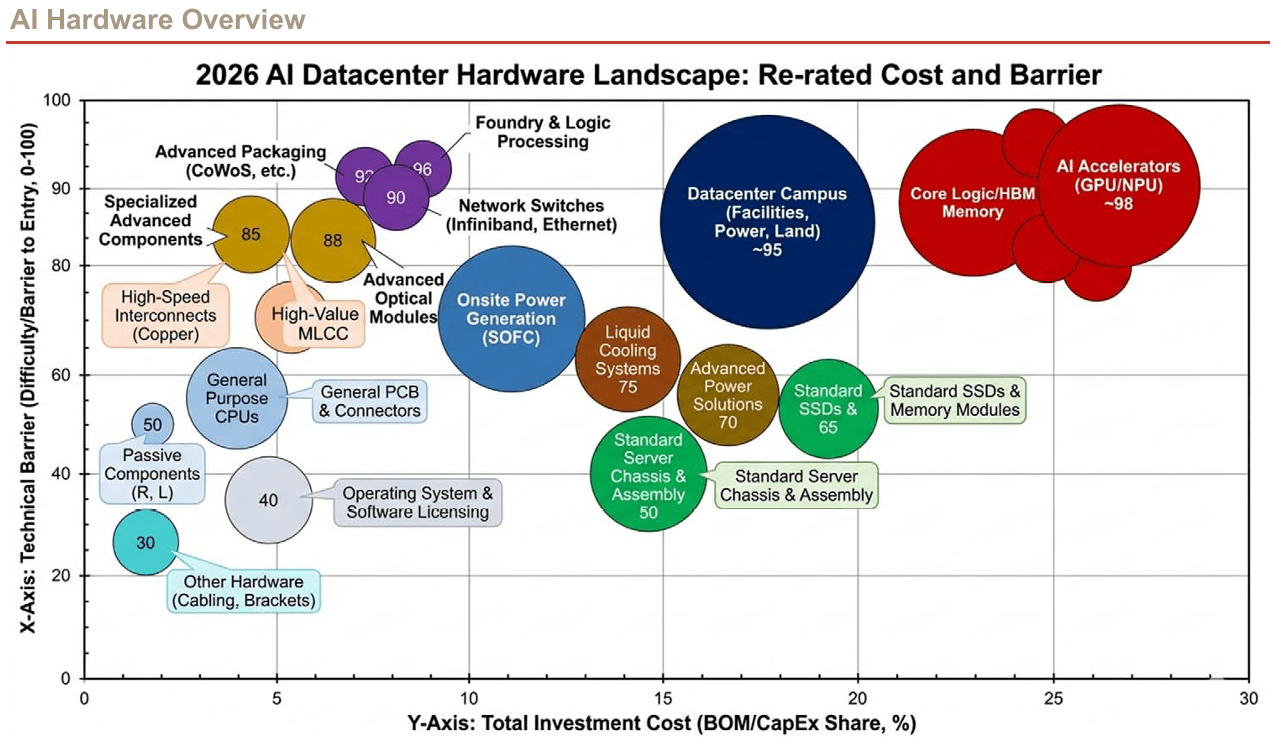
- AI hardware remains our top AI sub-theme, including accelerators, memory, optics and power infrastructure. See our stock recommendations and model portfolio inside.
We hosted two CIO Series webinars in July – one in Chinese and one in English – both focused on AI. Below are the replay links, along with key takeaways from our discussions.
Date | Language | Title | Replay Link |
22 July | Chinese | 直击美股财报,捕捉AI轮动先机 | |
28 July | English | AI Rotation: Finding the Next Winners |
Recent tech developments reaffirm AI Scaling Laws. From the self‑training of LLMs to the launch of Kimi K3, these latest innovations again prove that AI performance can scale with more compute, data and model parameters. For example, running Kimi K3 requires 62 GPU super-pods connected in parallel, underscoring that even open-source models require massive infrastructure and complex maintenance. This dynamic bodes well for AI infrastructure and hardware demand.
Rise of open-source models should benefit cloud providers (with some caveats). The open-source movement is net-positive for hyperscalers like Amazon (AMZN) and Microsoft (MSFT), in our view. It enables them to reduce their own model training capex while leveraging open models to earn higher margins on their cloud services. Open-source models can also accelerate AI adoption and the migration from on-premises to hyperscalers, both of which are positive for cloud volume growth. However, a potential side-effect is that open source models may displace proprietary frontier models (e.g. Anthropic, OpenAI), causing a temporary dip in overall compute demand.
Open-source is overwhelmingly positive for hardware. While Kimi K3 triggered a brief panic across the AI ecosystem (another DeepSeek moment), it is actually positive for AI hardware – GPUs, memory, optics and power etc. This is because open-source models dramatically increase the amount of compute required to train, fine-tune and run AI (see the logic above). This makes hardware (picks and shovels) the most certain and attractive part of the AI value chain.
Tech earnings confirmed continuing strong AI capex and robust hardware demand. Whether before our webinars (TSMC, ASML, Google etc.) or after (Amazon, Microsoft, Meta etc.), the message from the current earnings season is loud and clear: AI capex is strengthening not weakening. This goes against our “Great AI Cooldown” prediction for 2026, but it’s a “beautiful mistake” as our caution turns out to be unwarranted.
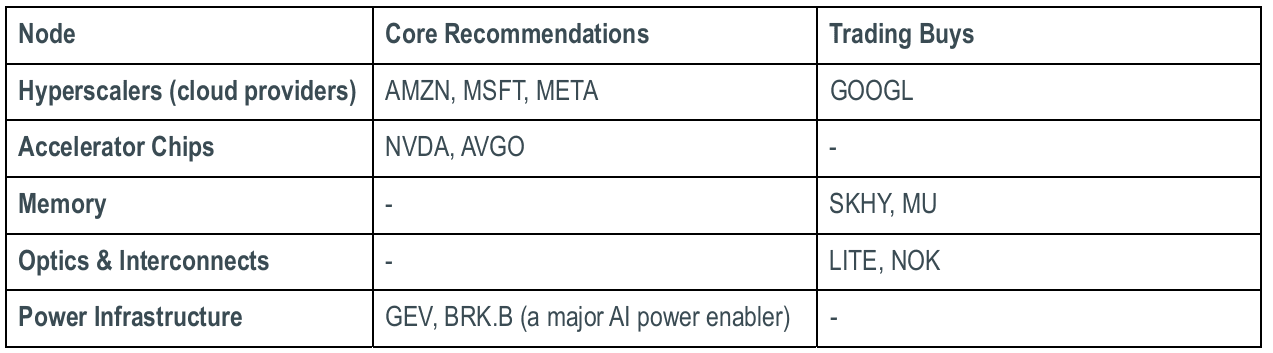
Accelerator chips remain our top pick in AI hardware. Nvidia (NVDA) remains the undisputed leader in GPUs, while Broadcom (AVGO) continues to dominate ASICs – both critical to AI compute. They are not only must-owns, but also important to monitor for major technological shifts.
Memory is another top pick within AI hardware. AI compute relies heavily on memory products – high-bandwidth memory (HBM), DDR5 and NAND flash. Meanwhile, memory supply is expected to remain tight through 1H2027, with limited impact from Chinese suppliers like CXMT (1-2% incremental supply globally). Memory stocks are currently oversold amid the Korean market deleveraging – a technical unwind largely unrelated to fundamentals. Hynix (SKHY) is the global leader in HBM, while Micron (MU) is a US-based leader in HBM, DDR5 and flash.
Optics and interconnects as a sustainable long-term theme. As copper interconnects hit physical constraints and power consumption limits in high-speed GPU clustering, datacenters are increasingly transitioning to 1.6T and 3.2T optical solutions. Lumentum (LITE) provides high-power laser components required in next-gen datacenter optical networking, while Nokia (NOK) is a leading full-stack system provider.
Call to Action
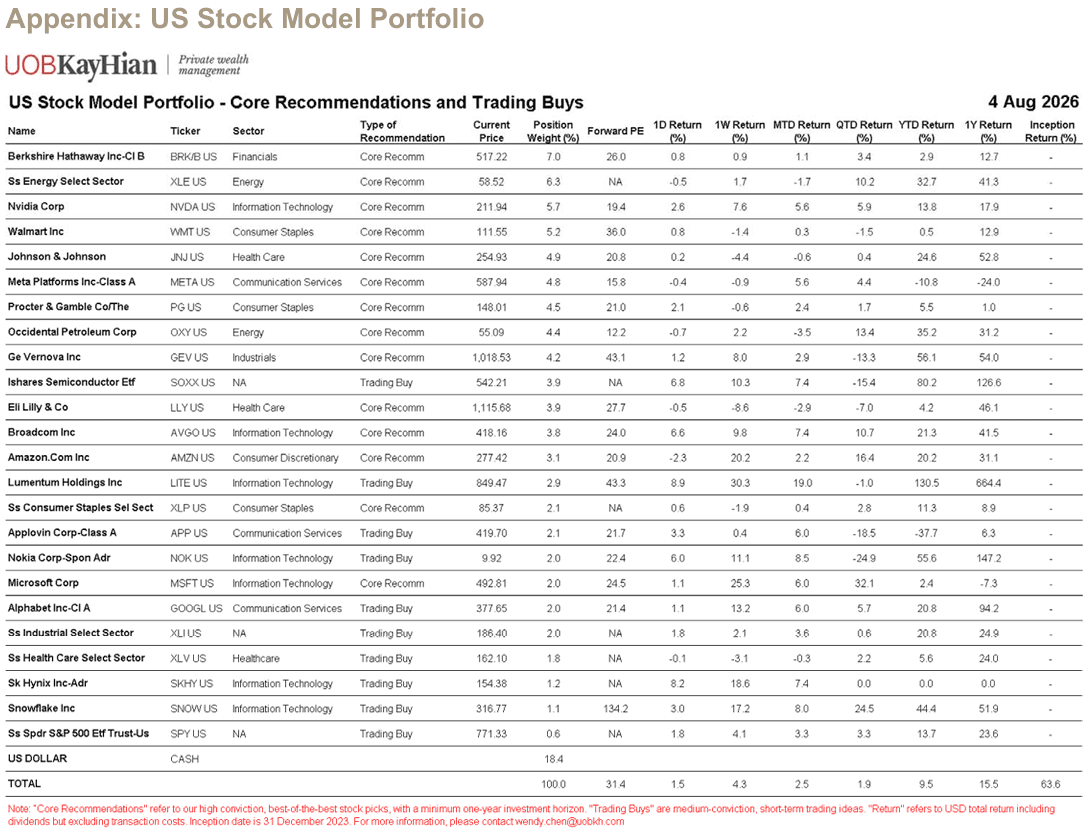
- Both during our calls and in this report, we’d like to reiterate our US stock recommendations for AI infrastructure and hardware, as part of our US Stock Model Portfolio (see Appendix).
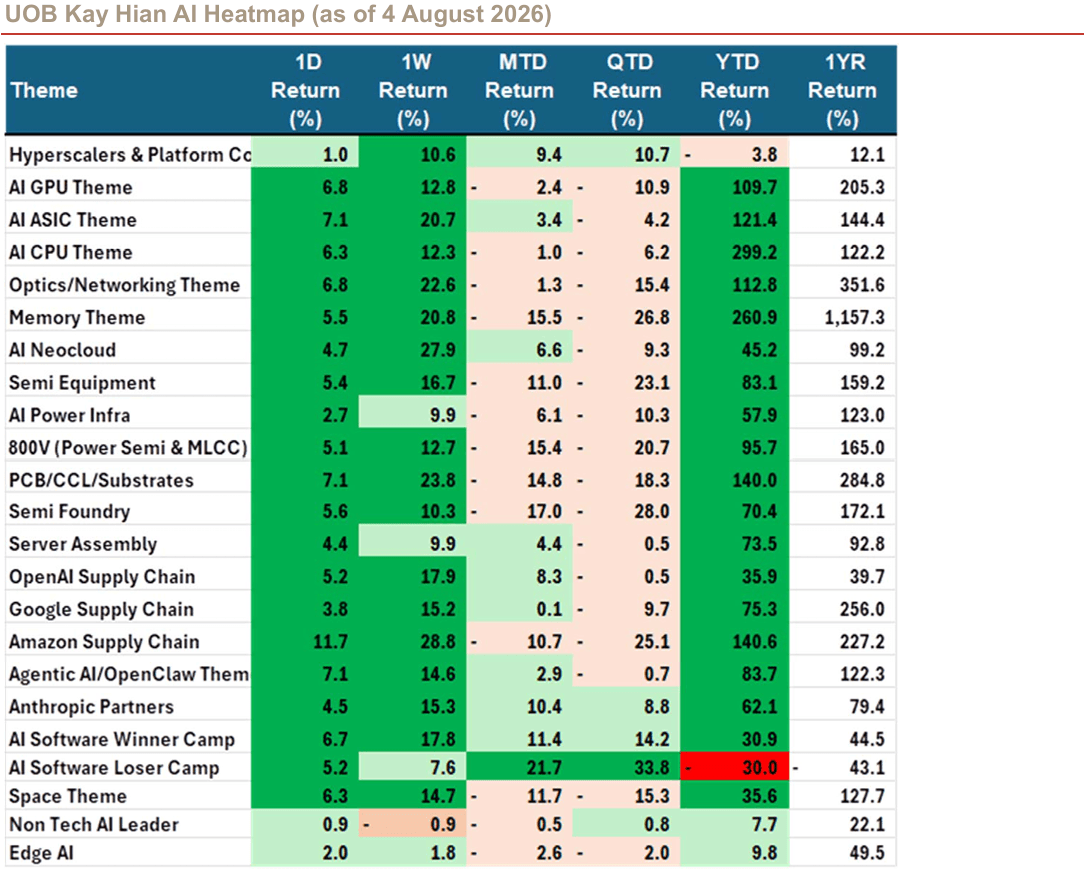
- Follow our research and read our reports. In addition to the usual publications, our US Tech Lead Garrick Li has launched a list of AI Hot Topics and a proprietary AI Heatmap – daily performance updates on nearly 100 stocks across 20+ AI subsectors to help you stay ahead of the game. Please contact your UOB Kay Hian representative or email research@uobk.com for access.
AI is expanding relentlessly, but markets often fret about overcapacity. The disconnect drives stock volatility yet also creates investment opportunities. Read on to find out why we still love AI hardware.
CIO Summary
- Scaling Laws are intact and accelerating AI compute demand. Recent advances – from emerging self‑training LLMs to Kimi K3 – reaffirm that AI performance scales with more compute, more data, and larger models. Even open‑source models require massive GPU clusters and compute power.
- Open‑source models benefit hyperscalers and supercharge hardware players. Open‑source reduces hyperscalers’ model‑training capex while expanding cloud margins and accelerating AI adoption. This significantly increases total compute capacities, making hardware the most certain part of the AI value chain.
- AI hardware remains our top AI sub-theme, including accelerators, memory, optics and power infrastructure. See our stock recommendations and model portfolio inside.
We hosted two CIO Series webinars in July – one in Chinese and one in English – both focused on AI. Below are the replay links, along with key takeaways from our discussions.
Date | Language | Title | Replay Link |
22 July | Chinese | 直击美股财报,捕捉AI轮动先机 | |
28 July | English | AI Rotation: Finding the Next Winners |
Recent tech developments reaffirm AI Scaling Laws. From the self‑training of LLMs to the launch of Kimi K3, these latest innovations again prove that AI performance can scale with more compute, data and model parameters. For example, running Kimi K3 requires 62 GPU super-pods connected in parallel, underscoring that even open-source models require massive infrastructure and complex maintenance. This dynamic bodes well for AI infrastructure and hardware demand.
Rise of open-source models should benefit cloud providers (with some caveats). The open-source movement is net-positive for hyperscalers like Amazon (AMZN) and Microsoft (MSFT), in our view. It enables them to reduce their own model training capex while leveraging open models to earn higher margins on their cloud services. Open-source models can also accelerate AI adoption and the migration from on-premises to hyperscalers, both of which are positive for cloud volume growth. However, a potential side-effect is that open source models may displace proprietary frontier models (e.g. Anthropic, OpenAI), causing a temporary dip in overall compute demand.
Open-source is overwhelmingly positive for hardware. While Kimi K3 triggered a brief panic across the AI ecosystem (another DeepSeek moment), it is actually positive for AI hardware – GPUs, memory, optics and power etc. This is because open-source models dramatically increase the amount of compute required to train, fine-tune and run AI (see the logic above). This makes hardware (picks and shovels) the most certain and attractive part of the AI value chain.
Tech earnings confirmed continuing strong AI capex and robust hardware demand. Whether before our webinars (TSMC, ASML, Google etc.) or after (Amazon, Microsoft, Meta etc.), the message from the current earnings season is loud and clear: AI capex is strengthening not weakening. This goes against our “Great AI Cooldown” prediction for 2026, but it’s a “beautiful mistake” as our caution turns out to be unwarranted.
Accelerator chips remain our top pick in AI hardware. Nvidia (NVDA) remains the undisputed leader in GPUs, while Broadcom (AVGO) continues to dominate ASICs – both critical to AI compute. They are not only must-owns, but also important to monitor for major technological shifts.
Memory is another top pick within AI hardware. AI compute relies heavily on memory products – high-bandwidth memory (HBM), DDR5 and NAND flash. Meanwhile, memory supply is expected to remain tight through 1H2027, with limited impact from Chinese suppliers like CXMT (1-2% incremental supply globally). Memory stocks are currently oversold amid the Korean market deleveraging – a technical unwind largely unrelated to fundamentals. Hynix (SKHY) is the global leader in HBM, while Micron (MU) is a US-based leader in HBM, DDR5 and flash.
Optics and interconnects as a sustainable long-term theme. As copper interconnects hit physical constraints and power consumption limits in high-speed GPU clustering, datacenters are increasingly transitioning to 1.6T and 3.2T optical solutions. Lumentum (LITE) provides high-power laser components required in next-gen datacenter optical networking, while Nokia (NOK) is a leading full-stack system provider.
Call to Action
- Both during our calls and in this report, we’d like to reiterate our US stock recommendations for AI infrastructure and hardware, as part of our US Stock Model Portfolio (see Appendix).
- Follow our research and read our reports. In addition to the usual publications, our US Tech Lead Garrick Li has launched a list of AI Hot Topics and a proprietary AI Heatmap – daily performance updates on nearly 100 stocks across 20+ AI subsectors to help you stay ahead of the game. Please contact your UOB Kay Hian representative or email research@uobk.com for access.
Disclosures and disclaimers
This report is provided subject to, and must be read together with, the full Disclosures / Disclaimers available at this link, which are incorporated by reference into this report. In particular, this report is intended for general circulation and informational purposes only and does not constitute personal investment advice or a recommendation to buy or sell any investment product or security. You should independently evaluate the information and, where necessary, seek advice from a qualified financial adviser regarding the suitability of any investment. Analyst certifications required under applicable regulations, including SEC Regulation AC (where relevant), are included in this report. By accessing, receiving or using this report, you acknowledge that you have read, understood and agreed to be bound by the Disclosures / Disclaimers, as may be amended, supplemented or updated from time to time.


