

Wealth Daily
Hot US Inflation Sparks AI Stock Selloff
Today’s Must-Know News
Overnight Markets
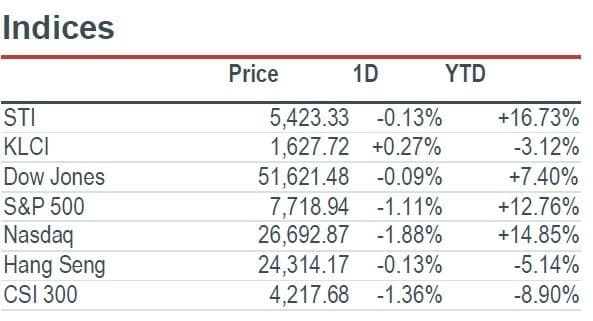
Market Movers: The S&P 500 fell 1.11% in the Wednesday, 14 October US session, as hotter inflation renewed concern about AI infrastructure financing costs. Oracle (ORCL US) dropped 8.83%, reflecting the sector’s sensitivity to borrowing costs. Alphabet (GOOGL US) lost 1.74% despite launching Gemini 4 Argon for enterprise developers, with introductory API prices of US$2 per million input tokens and US$10 per million output tokens through November. ASML (ASML NA) rose 1.23% in Amsterdam after reporting €11.66bn in quarterly sales, up 55.2% YoY, and guiding fourth-quarter revenue to €14.2–15.2bn. ASML sees customer demand exceeding its planned 2027–28 capacity, highlighting a contrast between equipment demand and financing-sensitive shares. (Reuters / Google / ASML)
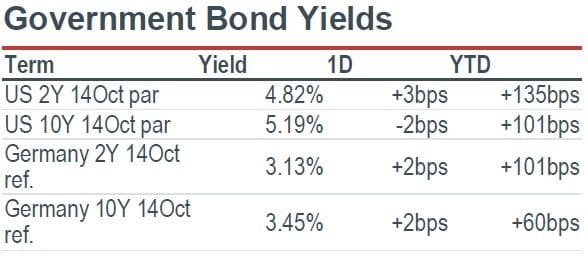
Macro: US September headline inflation reached 3.7% YoY, above the 3.6% consensus. Core CPI rose 0.3% month on month against 0.2% expected, and 2.6% YoY against 2.5%. The surprise broadened concerns beyond energy. Money markets priced an October Fed hike at around 33%, versus roughly 20% before the release, according to LSEG’s later reading. Today’s retail sales and producer-price data will help assess whether demand and pipeline inflation reinforce the pressure. (Reuters)
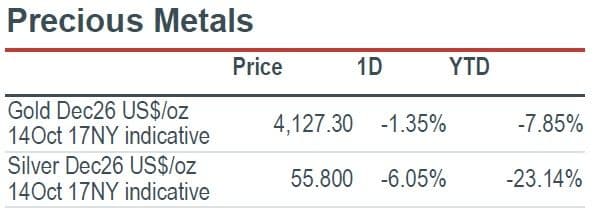
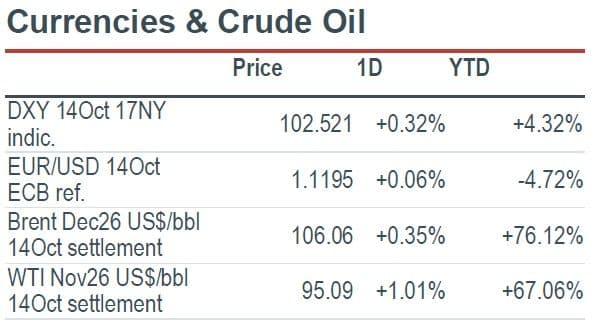
FICC: December Brent settled up 0.35% at US$106.06/bbl; November WTI gained 1.01% to US$95.09 as attacks in Saudi Arabia and shipping threats sustained supply concerns. December silver fell 6.05% to US$55.800/oz at the matched 17:00 New York indicative snapshot, rather than an exchange settlement. Higher inflation complicates the outlook for precious metals through interest-rate and dollar expectations. (Reuters / Yahoo Finance) Alphabet (GOOGL US) is our Trading Buy.
AI
- Alphabet (GOOGL US) opens Argon to paying users. Google released Gemini 4 Argon across its developer and enterprise tools on 14 October, with introductory API rates of US$2 per million input tokens and US$10 per million output tokens. Google reports over 35% more agentic code submissions internally. Wider distribution sharpens frontier-model competition; customer productivity and recurring usage will determine monetisation. (Google / Reuters)
Alphabet (GOOGL US) is our Trading Buy.
- ASML’s capacity plans lag AI demand. ASML (ASML NA) closed 1.23% higher on 14 October after third-quarter sales reached €11.66bn, up 55.2% YoY. Fourth-quarter guidance of €14.2–15.2bn lifts the full-year floor to €44bn. Management expects planned supply in 2027–28 to fall short of customer demand, making capacity execution and productivity upgrades central to realising earnings upside from the AI infrastructure expansion. (ASML / Reuters / ASML / Market data)
- Higher financing costs expose AI infrastructure valuations. At the 14 October US close, Oracle (ORCL US) fell 8.83%, CoreWeave (CRWV US) 15.46% and Dell Technologies (DELL US) 11.27%. Reuters linked the selloff to renewed rate-hike concerns; Barclays also downgraded Dell to equal-weight. Costlier funding raises the hurdle for debt-financed compute expansion, making cash conversion increasingly important alongside demand. (Reuters / Market data / Market data / Market data)
- OpenAI faces coordinated state consumer-protection lawsuits. Eight US states, including Iowa, Kansas and Arizona, filed suits alleging ChatGPT misled users about safety and encouraged harmful behaviour. They seek monetary penalties and changes to the chatbot, including restrictions on self-improving models without adequate safeguards. The allegations remain unproven; potential product constraints and compliance costs widen legal uncertainty ahead of a prospective listing. (Iowa AG / Reuters)
Americas
- Bank of America (BAC US) misses despite stronger lending income. 3Q adjusted EPS of US$1.08 missed the US$1.10 consensus; reported profit fell 17% YoY to US$6.9bn after a US$1.2bn regulatory charge. Trading revenue fell 5% YoY despite 8% YoY net-interest-income growth. Shares closed 14 October down 4.76% at US$51.39. Offsetting trends leave trading execution and expenses central to earnings recovery. (Company / Reuters / Market data)
- Morgan Stanley (MS US) benefits from equity-trading strength. 3Q equity revenue rose 41% YoY to US$5.8bn, while group EPS increased to US$3.03 from US$2.80. Wealth management attracted US$232.4bn of net new assets, more than half linked to IPOs. Shares closed 14 October down 2.75% at US$181.51. Strong inflows support future fees, but IPO-related transfers should not be extrapolated as recurring organic growth. (Company / Market data)
- BlackRock (BLK US) converts client inflows into earnings growth. 3Q adjusted EPS rose 38% YoY to US$15.93, exceeding the US$14.13 consensus, as net inflows reached US$205bn. Assets under management increased to US$15.49tn from US$13.46tn a year earlier. Shares closed 14 October up 0.72% at US$1,073.79. Broad inflows strengthen recurring fees, although higher yields can pressure the market values underpinning those fees. (Company / Reuters / Market data)
- Bending Spoons (BSP US) wins fresh Berkshire backing. Berkshire Hathaway (BRK/B US) agreed to invest US$330mn through 10mn new shares at US$33, lifting its stake to 4% on completion. Bending Spoons closed 14 October up 41.20% at US$53.46. The placement adds acquisition funding, but its discount to the traded price and the company’s integration demands remain relevant to minority investors. (Company / Reuters / Market data)
Berkshire Hathaway (BRK/B US) is our Core Recommendation.
- Progressive (PGR US) improves underwriting despite lower quarterly profit. 3Q net premiums written rose 4% YoY to US$22.3bn and the combined ratio improved to 88.7% from 89.5%. Net income nevertheless fell 3% to US$2.54bn as realised securities results deteriorated. Shares closed 14 October down 4.23% at US$213.46. Underwriting remains profitable, but investment volatility can obscure progress in the core insurance business. (Progressive / Market data)
- Fastenal (FAST US) gains share with larger industrial customers. 3Q sales increased 15.5% YoY to US$2.46bn and net income rose 19.7% to US$401.6mn. Operating margin reached 21.5%, with expense leverage overcoming lower gross margins as larger accounts grew. Shares closed 14 October up 1.11% at US$52.00. The results support the distribution model, while customer mix and pricing remain the main margin sensitivities. (Fastenal / Market data)
- State Street (STT US) faces a fee-growth expectations test. 3Q EPS rose 33% YoY to US$3.69 and revenue increased 13% to US$4.00bn, below the US$4.03bn consensus. Net inflows were US$7bn, while fee revenue declined 2% QoQ despite higher asset balances. Shares closed 14 October down 4.14% at US$166.89. Converting servicing mandates into fees matters more than market-driven asset growth alone. (State Street / MarketBeat / Market data)
Greater China
- Mainland AI hardware leads the retreat. Zhongji Innolight (300308 CH) fell 5.73% to RMB692.90 at the 14 October close as technology shares weakened amid AI valuation concerns. The CSI 300 lost 1.36%; the technology-focused STAR 50 dropped about 3.3%. The divergence from robust export data highlights valuation sensitivity: strong industry demand alone may offer limited protection when investors reassess the price paid for growth. (Reuters / Market data)
- China’s export surge widens trade tensions. September exports rose 36.3% YoY, above the 25.5% consensus, while imports increased 31.0%, customs data released on 14 October showed. The monthly surplus reached US$133.53bn, lifting the nine-month total to US$938.11bn. Strong external demand supports industrial earnings, but the widening surplus increases exposure to additional trade restrictions and leaves the domestic-demand imbalance unresolved. (Reuters)
- China’s auto industry backs EU compromise. China’s automakers’ association on 14 October endorsed the earlier China–EU hybrid-vehicle agreement, saying it would stabilise expectations and supply chains. First-half Chinese hybrid exports to the EU reached US$7.5bn, triple the prior-year value. Detailed limits remain unresolved, leaving manufacturers exposed to implementation risk and strengthening the incentive to localise European production as export growth attracts scrutiny. (Reuters / Reuters)
Asia ex. China
- Anthropic deepens Singapore’s enterprise AI access. Anthropic opened its fifth Asia-Pacific office in Singapore on 14 October and signed a cooperation agreement with the government. Over 1,500 GovTech engineers already use Claude, providing an established adoption base. The initiative supports public-sector and enterprise deployment, although discussions on bringing models onshore have no disclosed timetable; local presence alone does not establish future contract revenue. (Anthropic / Business Times)
- Commonwealth Bank ties AI to domestic productivity. Commonwealth Bank (CBA AU) used its 14 October AGM to emphasise AI deployment across business banking while warning that Australian growth is slowing and inflation remains high. Its existing A$90m, three-year employee development programme supports the transition. Shares closed 2.16% lower. Productivity gains could protect costs, but monetisation depends on adoption and implementation across its regulated customer base. (Commonwealth Bank / Reuters / Market data)
- Japan funds a larger US chip footprint. Japan agreed on 14 October to invest about US$21bn in up to two GlobalFoundries (GFS US) factories in New York; shares closed 4.80% higher. Its first plant targets 900,000 wafers annually and production in 2029. Japanese funding limits the chipmaker’s direct capital burden, but construction execution and future customer utilisation remain essential to converting additional capacity into earnings. (Reuters / Market data)
EMEA and Others
- GSK translates restructuring into job reductions. GSK (GSK LN) outlined plans on 14 October to cut up to 1,217 jobs in Belgium as it implements a three-year restructuring programme targeting £1.9bn of savings. Shares closed 3.59% higher. The reductions sharpen the focus on priority research, including mRNA flu vaccines; delivery of savings could support margins, while workforce disruption and research execution remain practical risks. (Reuters)
- SEB’s regulatory decision reduces capital flexibility. SEB (SEBA SS) closed 4.63% lower on 14 October after Sweden’s regulator required changes expected to reduce its capital buffer by about 120bps and increase risk exposure by SEK150bn. Implementation is due by year-end, while model submissions should start by third-quarter 2027. The reduction in surplus capital constrains distribution flexibility until model remediation and supervisory approval restore certainty. (SEB / Market data)
- Ørsted’s US permit risk returns to focus. Ørsted (ORSTED DC) closed 3.92% lower on 14 October after reports that the US Justice Department asked a court to return the construction and operating permit for its 704MW Revolution Wind project for review. The request is not a completed permit revocation. Renewed regulatory uncertainty raises risks to project cash flows and financing assumptions despite progress towards operation. (Investing.com / Market data)
- Standard Chartered brings crypto into wealth accounts. Standard Chartered (STAN LN) launched a UAE cryptocurrency service on 14 October, initially for professional investors following regulatory approval. Clients can buy and sell Bitcoin and Ether through existing bank accounts, with custody and settlement managed within the bank’s ecosystem. The offering may deepen wealth relationships and fee opportunities, while operational safeguards leave cryptocurrency price risk intact. (Standard Chartered)
Traders' Corner
Our Technical View
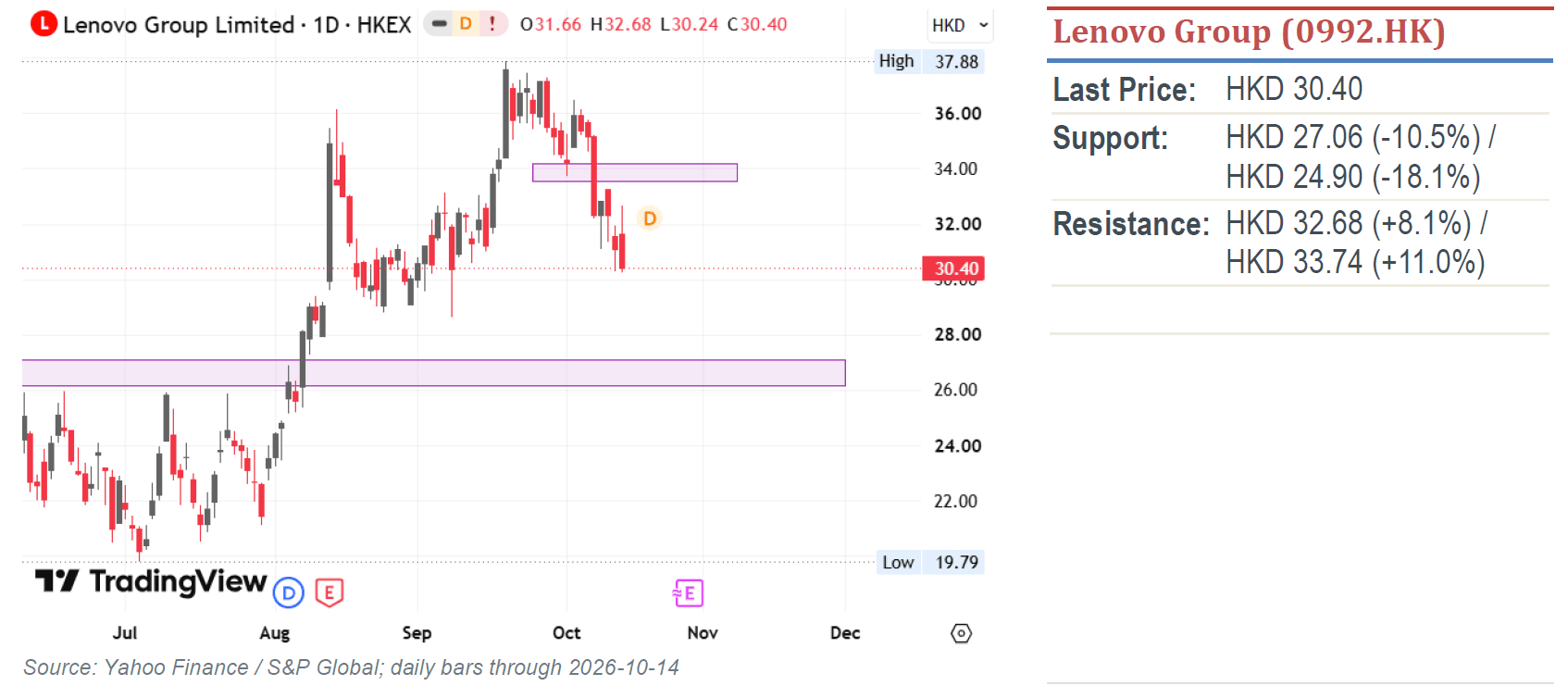
- Price further broke beneath its recent swing low support to confirm trend continuation and reinforce the primary lower-high and lower-low swing hierarchy.
- The RSI remains in bearish territory and continues to slope downward with negative velocity.
- As long as price remains capped underneath this newly converted resistance, we see continued downward expansion toward the next support zone.
Our Technical View
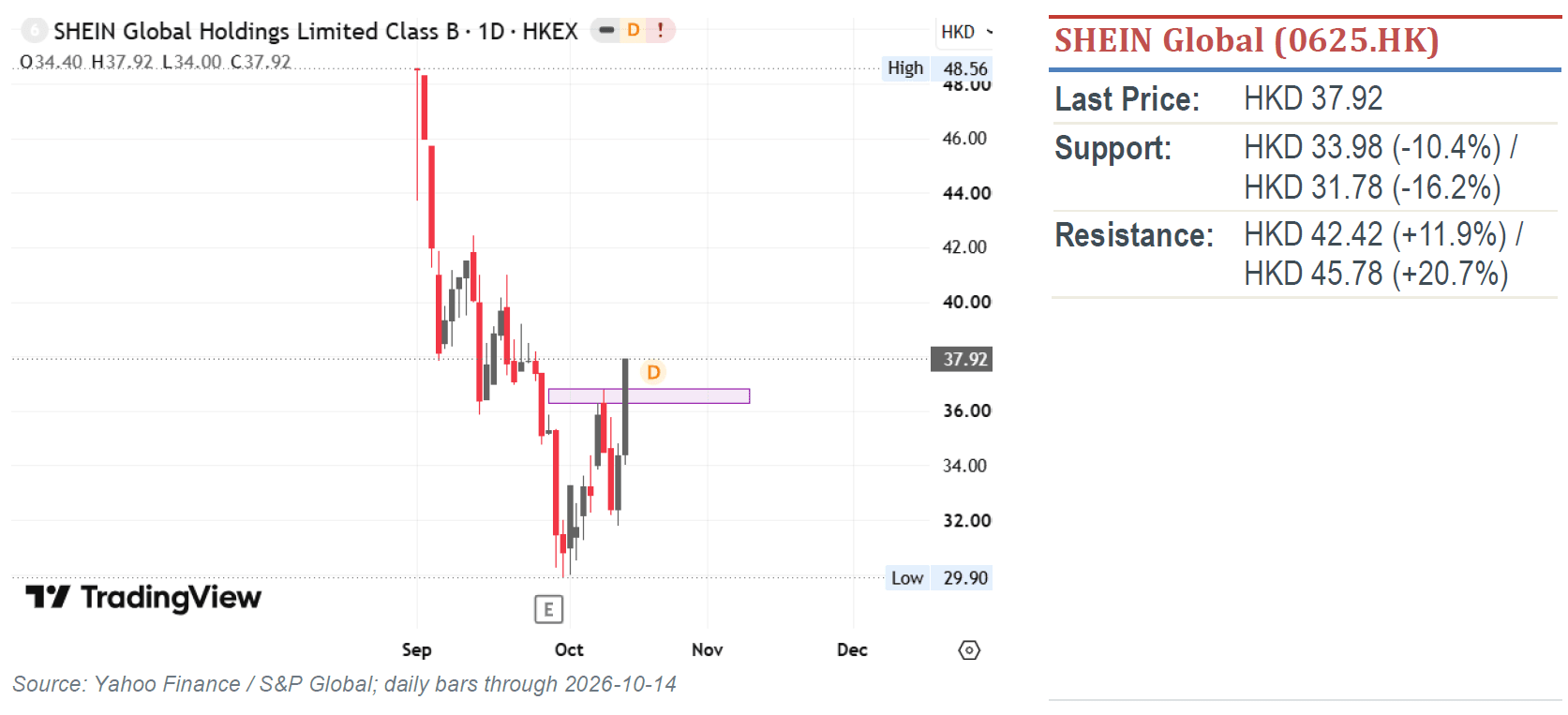
- Price continues to validate a robust bullish trend hierarchy, printing a sequential series of higher highs and higher lows.
- The RSI continues to slope upward with positive velocity, signaling steady momentum recovery and expanding buy-side impulse.
- As long as price defends this resistance-turned-support level, we see continued upward expansion toward overhead resistance targets.
Market Movers: The S&P 500 fell 1.11% in the Wednesday, 14 October US session, as hotter inflation renewed concern about AI infrastructure financing costs. Oracle (ORCL US) dropped 8.83%, reflecting the sector’s sensitivity to borrowing costs. Alphabet (GOOGL US) lost 1.74% despite launching Gemini 4 Argon for enterprise developers, with introductory API prices of US$2 per million input tokens and US$10 per million output tokens through November. ASML (ASML NA) rose 1.23% in Amsterdam after reporting €11.66bn in quarterly sales, up 55.2% YoY, and guiding fourth-quarter revenue to €14.2–15.2bn. ASML sees customer demand exceeding its planned 2027–28 capacity, highlighting a contrast between equipment demand and financing-sensitive shares. (Reuters / Google / ASML)
Macro: US September headline inflation reached 3.7% YoY, above the 3.6% consensus. Core CPI rose 0.3% month on month against 0.2% expected, and 2.6% YoY against 2.5%. The surprise broadened concerns beyond energy. Money markets priced an October Fed hike at around 33%, versus roughly 20% before the release, according to LSEG’s later reading. Today’s retail sales and producer-price data will help assess whether demand and pipeline inflation reinforce the pressure. (Reuters)
FICC: December Brent settled up 0.35% at US$106.06/bbl; November WTI gained 1.01% to US$95.09 as attacks in Saudi Arabia and shipping threats sustained supply concerns. December silver fell 6.05% to US$55.800/oz at the matched 17:00 New York indicative snapshot, rather than an exchange settlement. Higher inflation complicates the outlook for precious metals through interest-rate and dollar expectations. (Reuters / Yahoo Finance) Alphabet (GOOGL US) is our Trading Buy.
AI
- Alphabet (GOOGL US) opens Argon to paying users. Google released Gemini 4 Argon across its developer and enterprise tools on 14 October, with introductory API rates of US$2 per million input tokens and US$10 per million output tokens. Google reports over 35% more agentic code submissions internally. Wider distribution sharpens frontier-model competition; customer productivity and recurring usage will determine monetisation. (Google / Reuters)
Alphabet (GOOGL US) is our Trading Buy.
- ASML’s capacity plans lag AI demand. ASML (ASML NA) closed 1.23% higher on 14 October after third-quarter sales reached €11.66bn, up 55.2% YoY. Fourth-quarter guidance of €14.2–15.2bn lifts the full-year floor to €44bn. Management expects planned supply in 2027–28 to fall short of customer demand, making capacity execution and productivity upgrades central to realising earnings upside from the AI infrastructure expansion. (ASML / Reuters / ASML / Market data)
- Higher financing costs expose AI infrastructure valuations. At the 14 October US close, Oracle (ORCL US) fell 8.83%, CoreWeave (CRWV US) 15.46% and Dell Technologies (DELL US) 11.27%. Reuters linked the selloff to renewed rate-hike concerns; Barclays also downgraded Dell to equal-weight. Costlier funding raises the hurdle for debt-financed compute expansion, making cash conversion increasingly important alongside demand. (Reuters / Market data / Market data / Market data)
- OpenAI faces coordinated state consumer-protection lawsuits. Eight US states, including Iowa, Kansas and Arizona, filed suits alleging ChatGPT misled users about safety and encouraged harmful behaviour. They seek monetary penalties and changes to the chatbot, including restrictions on self-improving models without adequate safeguards. The allegations remain unproven; potential product constraints and compliance costs widen legal uncertainty ahead of a prospective listing. (Iowa AG / Reuters)
Americas
- Bank of America (BAC US) misses despite stronger lending income. 3Q adjusted EPS of US$1.08 missed the US$1.10 consensus; reported profit fell 17% YoY to US$6.9bn after a US$1.2bn regulatory charge. Trading revenue fell 5% YoY despite 8% YoY net-interest-income growth. Shares closed 14 October down 4.76% at US$51.39. Offsetting trends leave trading execution and expenses central to earnings recovery. (Company / Reuters / Market data)
- Morgan Stanley (MS US) benefits from equity-trading strength. 3Q equity revenue rose 41% YoY to US$5.8bn, while group EPS increased to US$3.03 from US$2.80. Wealth management attracted US$232.4bn of net new assets, more than half linked to IPOs. Shares closed 14 October down 2.75% at US$181.51. Strong inflows support future fees, but IPO-related transfers should not be extrapolated as recurring organic growth. (Company / Market data)
- BlackRock (BLK US) converts client inflows into earnings growth. 3Q adjusted EPS rose 38% YoY to US$15.93, exceeding the US$14.13 consensus, as net inflows reached US$205bn. Assets under management increased to US$15.49tn from US$13.46tn a year earlier. Shares closed 14 October up 0.72% at US$1,073.79. Broad inflows strengthen recurring fees, although higher yields can pressure the market values underpinning those fees. (Company / Reuters / Market data)
- Bending Spoons (BSP US) wins fresh Berkshire backing. Berkshire Hathaway (BRK/B US) agreed to invest US$330mn through 10mn new shares at US$33, lifting its stake to 4% on completion. Bending Spoons closed 14 October up 41.20% at US$53.46. The placement adds acquisition funding, but its discount to the traded price and the company’s integration demands remain relevant to minority investors. (Company / Reuters / Market data)
Berkshire Hathaway (BRK/B US) is our Core Recommendation.
- Progressive (PGR US) improves underwriting despite lower quarterly profit. 3Q net premiums written rose 4% YoY to US$22.3bn and the combined ratio improved to 88.7% from 89.5%. Net income nevertheless fell 3% to US$2.54bn as realised securities results deteriorated. Shares closed 14 October down 4.23% at US$213.46. Underwriting remains profitable, but investment volatility can obscure progress in the core insurance business. (Progressive / Market data)
- Fastenal (FAST US) gains share with larger industrial customers. 3Q sales increased 15.5% YoY to US$2.46bn and net income rose 19.7% to US$401.6mn. Operating margin reached 21.5%, with expense leverage overcoming lower gross margins as larger accounts grew. Shares closed 14 October up 1.11% at US$52.00. The results support the distribution model, while customer mix and pricing remain the main margin sensitivities. (Fastenal / Market data)
- State Street (STT US) faces a fee-growth expectations test. 3Q EPS rose 33% YoY to US$3.69 and revenue increased 13% to US$4.00bn, below the US$4.03bn consensus. Net inflows were US$7bn, while fee revenue declined 2% QoQ despite higher asset balances. Shares closed 14 October down 4.14% at US$166.89. Converting servicing mandates into fees matters more than market-driven asset growth alone. (State Street / MarketBeat / Market data)
Greater China
- Mainland AI hardware leads the retreat. Zhongji Innolight (300308 CH) fell 5.73% to RMB692.90 at the 14 October close as technology shares weakened amid AI valuation concerns. The CSI 300 lost 1.36%; the technology-focused STAR 50 dropped about 3.3%. The divergence from robust export data highlights valuation sensitivity: strong industry demand alone may offer limited protection when investors reassess the price paid for growth. (Reuters / Market data)
- China’s export surge widens trade tensions. September exports rose 36.3% YoY, above the 25.5% consensus, while imports increased 31.0%, customs data released on 14 October showed. The monthly surplus reached US$133.53bn, lifting the nine-month total to US$938.11bn. Strong external demand supports industrial earnings, but the widening surplus increases exposure to additional trade restrictions and leaves the domestic-demand imbalance unresolved. (Reuters)
- China’s auto industry backs EU compromise. China’s automakers’ association on 14 October endorsed the earlier China–EU hybrid-vehicle agreement, saying it would stabilise expectations and supply chains. First-half Chinese hybrid exports to the EU reached US$7.5bn, triple the prior-year value. Detailed limits remain unresolved, leaving manufacturers exposed to implementation risk and strengthening the incentive to localise European production as export growth attracts scrutiny. (Reuters / Reuters)
Asia ex. China
- Anthropic deepens Singapore’s enterprise AI access. Anthropic opened its fifth Asia-Pacific office in Singapore on 14 October and signed a cooperation agreement with the government. Over 1,500 GovTech engineers already use Claude, providing an established adoption base. The initiative supports public-sector and enterprise deployment, although discussions on bringing models onshore have no disclosed timetable; local presence alone does not establish future contract revenue. (Anthropic / Business Times)
- Commonwealth Bank ties AI to domestic productivity. Commonwealth Bank (CBA AU) used its 14 October AGM to emphasise AI deployment across business banking while warning that Australian growth is slowing and inflation remains high. Its existing A$90m, three-year employee development programme supports the transition. Shares closed 2.16% lower. Productivity gains could protect costs, but monetisation depends on adoption and implementation across its regulated customer base. (Commonwealth Bank / Reuters / Market data)
- Japan funds a larger US chip footprint. Japan agreed on 14 October to invest about US$21bn in up to two GlobalFoundries (GFS US) factories in New York; shares closed 4.80% higher. Its first plant targets 900,000 wafers annually and production in 2029. Japanese funding limits the chipmaker’s direct capital burden, but construction execution and future customer utilisation remain essential to converting additional capacity into earnings. (Reuters / Market data)
EMEA and Others
- GSK translates restructuring into job reductions. GSK (GSK LN) outlined plans on 14 October to cut up to 1,217 jobs in Belgium as it implements a three-year restructuring programme targeting £1.9bn of savings. Shares closed 3.59% higher. The reductions sharpen the focus on priority research, including mRNA flu vaccines; delivery of savings could support margins, while workforce disruption and research execution remain practical risks. (Reuters)
- SEB’s regulatory decision reduces capital flexibility. SEB (SEBA SS) closed 4.63% lower on 14 October after Sweden’s regulator required changes expected to reduce its capital buffer by about 120bps and increase risk exposure by SEK150bn. Implementation is due by year-end, while model submissions should start by third-quarter 2027. The reduction in surplus capital constrains distribution flexibility until model remediation and supervisory approval restore certainty. (SEB / Market data)
- Ørsted’s US permit risk returns to focus. Ørsted (ORSTED DC) closed 3.92% lower on 14 October after reports that the US Justice Department asked a court to return the construction and operating permit for its 704MW Revolution Wind project for review. The request is not a completed permit revocation. Renewed regulatory uncertainty raises risks to project cash flows and financing assumptions despite progress towards operation. (Investing.com / Market data)
- Standard Chartered brings crypto into wealth accounts. Standard Chartered (STAN LN) launched a UAE cryptocurrency service on 14 October, initially for professional investors following regulatory approval. Clients can buy and sell Bitcoin and Ether through existing bank accounts, with custody and settlement managed within the bank’s ecosystem. The offering may deepen wealth relationships and fee opportunities, while operational safeguards leave cryptocurrency price risk intact. (Standard Chartered)
Traders' Corner
Our Technical View
- Price further broke beneath its recent swing low support to confirm trend continuation and reinforce the primary lower-high and lower-low swing hierarchy.
- The RSI remains in bearish territory and continues to slope downward with negative velocity.
- As long as price remains capped underneath this newly converted resistance, we see continued downward expansion toward the next support zone.
Our Technical View
- Price continues to validate a robust bullish trend hierarchy, printing a sequential series of higher highs and higher lows.
- The RSI continues to slope upward with positive velocity, signaling steady momentum recovery and expanding buy-side impulse.
- As long as price defends this resistance-turned-support level, we see continued upward expansion toward overhead resistance targets.
Disclosures and disclaimers
This report is provided subject to, and must be read together with, the full Disclosures / Disclaimers available at this link, which are incorporated by reference into this report. In particular, this report is intended for general circulation and informational purposes only and does not constitute personal investment advice or a recommendation to buy or sell any investment product or security. You should independently evaluate the information and, where necessary, seek advice from a qualified financial adviser regarding the suitability of any investment. Analyst certifications required under applicable regulations, including SEC Regulation AC (where relevant), are included in this report. By accessing, receiving or using this report, you acknowledge that you have read, understood and agreed to be bound by the Disclosures / Disclaimers, as may be amended, supplemented or updated from time to time.


