

Overnight Markets
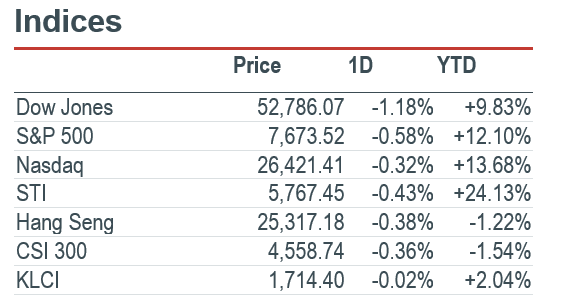
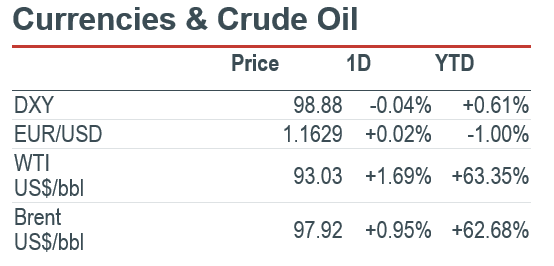
Market Movers: Wall Street returned from the long weekend under pressure as a renewed oil shock revived inflation risk: the Dow fell 1.18% to 52,786.07, the S&P 500 lost 0.58% to 7,673.52 and the Nasdaq slipped 0.32% to 26,421.41. Brent settled 0.9% higher at US$97.92 after Houthi attacks disrupted Saudi energy facilities; WTI gained 1.7% to US$93.03. Europe was nearly flat, while Novartis dropped 13.9% after a second late-stage drug setback. Qualcomm rose 3.2% on a multi-generation Amazon AI-data-centre collaboration. The tape split between energy and selected AI infrastructure strength versus healthcare and cyclical weakness, keeping breadth defensive despite the Nasdaq's resilience. (AP, Reuters, Qualcomm, Novartis)
Macro: China's August exports rose 25% year on year in US-dollar terms and imports increased 28.2%, widening the trade surplus to US$119.1 billion. The stronger external pulse did not prevent the Hang Seng from falling 0.38% or the CSI 300 from losing 0.36%. Japan's Nikkei declined 1.70% as the yen strengthened ahead of next week's Bank of Japan decision, while Korea's KOSPI reversed an intraday move above 7,100 to finish 0.58% lower. Singapore's STI fell 0.43% and Malaysia's KLCI was virtually unchanged. Export strength improved the growth signal without dislodging the day's dominant oil, currency and duration risks for portfolios. (AP, Business Times, Bernama, Seoul Economic Daily)
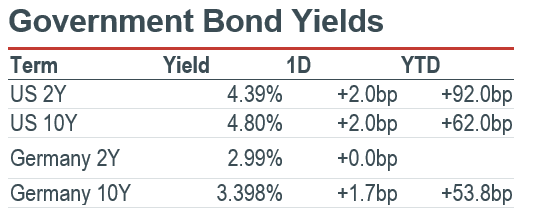
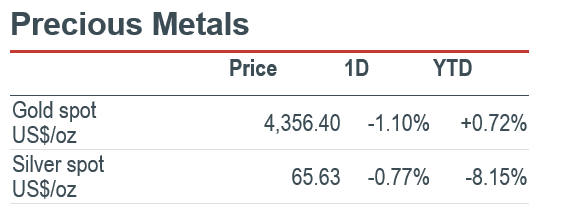
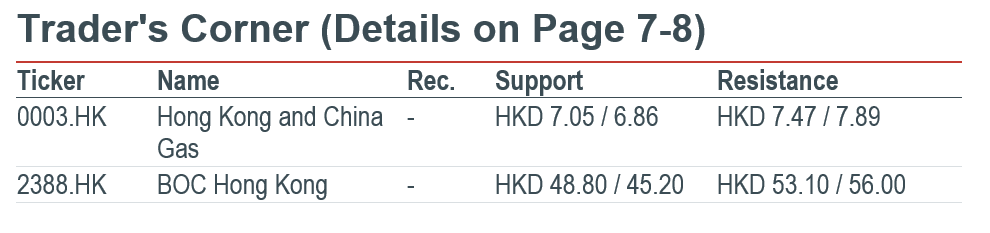
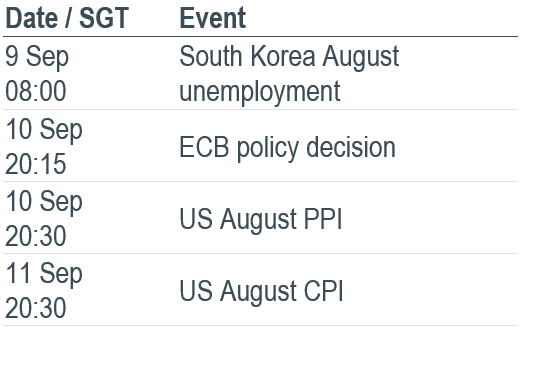
FICC: The US Treasury curve bear-steepened modestly: the two-year constant-maturity yield rose 2bp to 4.39% and the ten-year increased 2bp to 4.80%. Markets assigned nearly a 60% chance to a Federal Reserve increase on 16 September, putting Thursday's US PPI and Friday's CPI in focus. Germany's ten-year yield touched a 15-year high of 3.398% before Thursday's expected ECB increase. Spot gold eased to US$4,356.40 and the dollar index was around 98.88. The combination raises the hurdle for long-duration growth and argues for sizing duration, currency and energy exposure around incoming data. Hong Kong and China Gas (0003.HK) and BOC Hong Kong Holdings (2388.HK) carry no current model recommendation (-). (US Treasury, AP, Reuters)
Americas
Oil and yields pressure US equities. The Dow fell 628.18 points, or 1.18%, while the S&P 500 lost 0.58% and the Nasdaq 0.32%. Brent's approach to US$100 reinforced the risk that energy costs feed inflation and keep policy tighter; the official US two- and ten-year CMT yields both rose 2bp. (AP / US Treasury)
Qualcomm expands its Amazon AI role. Qualcomm rose 3.2% after announcing multi-generation customized silicon for Amazon's AI infrastructure and optical connectivity extending to 1.6T. The strategic signal is a broader addressable market beyond handsets; the key uncertainty is execution timing and economics. (Qualcomm / AP)
Boston Scientific flags a material cyber hit. An SEC filing said an August network outage disrupted manufacturing, order processing and shipping. The company now considers prior third-quarter and full-year sales-growth and adjusted-EPS guidance unlikely to be met; the stock fell 5.9%. (SEC / AP)
Canada's counter-tariffs take effect. Duties of 15% to 50% began on about US$20 billion of US goods after bilateral talks collapsed. The direct macro impulse is limited, but escalation risk matters for North American industrial supply chains and business confidence. (Reuters)
Greater China
Trade volumes accelerate in August. Exports rose 25% and imports 28.2% from a year earlier in US-dollar terms, lifting the surplus to US$119.1 billion. Auto exports increased 43% and semiconductor exports 129.8%, showing technology and manufactured goods remain the external-growth engine. (AP)
Hong Kong tech absorbs the risk-off tone. The Hang Seng Index fell 0.38% to 25,317.18, the HSCEI also lost 0.38%, and the Hang Seng Tech Index dropped 1.61%. Mainland large caps were more resilient but still slipped: the CSI 300 ended down 0.36% at 4,558.74. (Xinhua / market data)
Supplier-payment rules tighten for automakers. Regulators clarified when the 60-day payment clock starts, discouraged forced use of non-cash instruments and added reporting plus enforcement. Faster settlement could support smaller suppliers' cash conversion, while raising discipline and working-capital pressure for automakers. (Reuters)
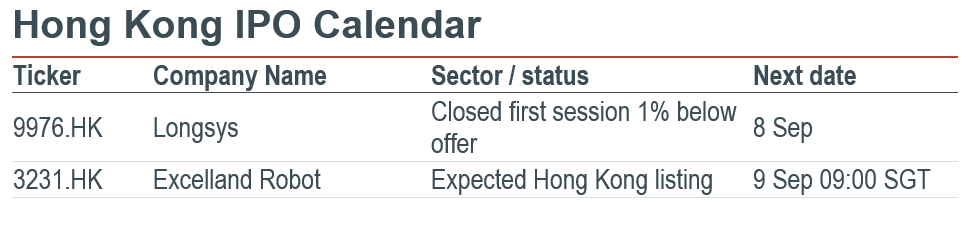
Longsys closes below offer on debut. The memory-products company ended at HK$233.60 versus its HK$236 offer price after raising HK$7.08 billion. A 1% first-day decline despite strong AI-memory interest underlines selective IPO price discovery rather than indiscriminate demand. (Reuters)
Asia ex. China
Japan and Korea reverse early chip strength. The Nikkei fell 1.70% to 65,269.33 as a firmer yen hit exporters. Korea's KOSPI reached 7,171.52 intraday but closed down 0.58% at 6,954.52; SK Hynix retained a 0.56% gain while Samsung Electronics slipped 0.19%. (Business Times / Seoul Economic Daily)
Singapore ends lower with weak breadth. The STI lost 24.83 points, or 0.43%, to 5,767.45. Yangzijiang Shipbuilding rose 4.0%, but UOL fell 3.8% and all three local banks declined; market losers outnumbered gainers 340 to 215. (Business Times)
Malaysia is flat despite construction demand. The KLCI slipped 0.39 point, or 0.02%, to 1,714.40. Buying rotated toward smaller construction names while index heavyweights were mixed; 548 decliners narrowly exceeded 546 gainers on RM3.14 billion of turnover. (Bernama)
Higher oil raises regional policy trade-offs. Energy importers face renewed inflation pressure just as Japan's currency strength and Korea's sharp intraday reversal point to positioning risk. The dispersion argues for selective exposure rather than treating the regional technology complex as a single trade. (AP / regional closes)
EMEA and Others
Europe closes nearly flat. The STOXX 600 eased 0.05% to 649.60 as a 0.6% energy-sector gain and a 2% mining rally offset healthcare weakness. Brent near US$98 supported producers but reinforced concern that the inflation impulse will last longer. (Reuters)
Novartis records its worst day. The Swiss-listed shares fell 10.9% after Phase III HARBOR missed its primary endpoint in myotonic dystrophy type 1, the second pipeline setback in two sessions. Secondary evidence of activity preserves optionality, but the company must determine the program's path with regulators. (Novartis / Reuters)
Bund yields stay near multi-year highs. Germany's ten-year yield touched 3.398%, its highest in 15 years, while the two-year yield held around 2.99%. The ECB is widely expected to raise rates Thursday; markets also price substantial odds of another move by December. (Reuters)
Computacenter lifts its profit floor. The UK technology-services group expects at least GBP380 million of 2026 adjusted pretax profit versus GBP340.9 million consensus, supported by North American AI data-centre demand. It was the third guidance upgrade since April. (Reuters)
Traders’ corner
Our Technical View
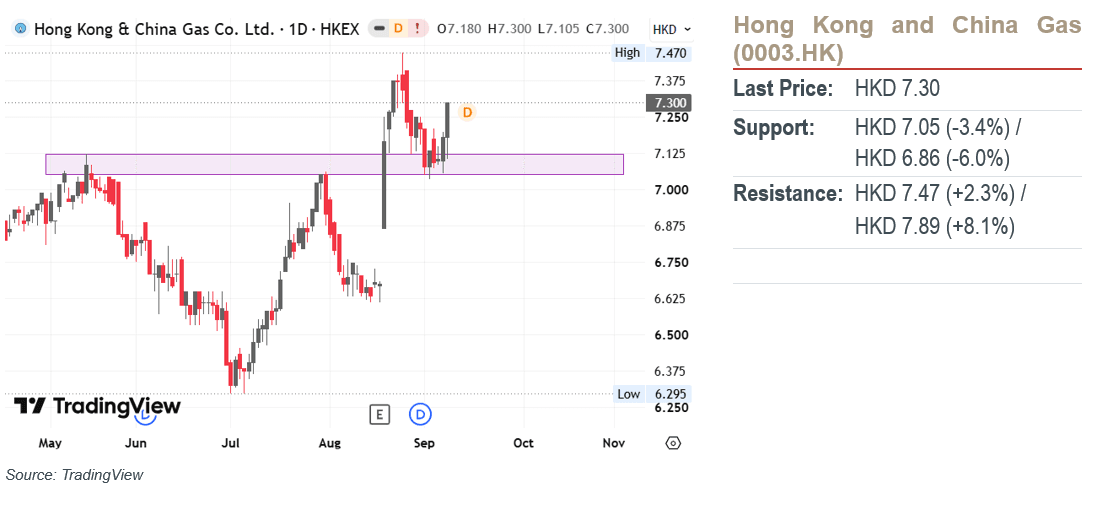
Price retested its resistance-turned-support zone, keeping the uptrend firmly intact.
The successful defense of this former supply ceiling reflects strong buyer absorption of lingering profit-taking rather than distribution.
The RSI remains securely positioned above its neutral 50-midline to signal ongoing buyer control.
- The path-of-least-resistance dynamics favours a continued upward drift, where a decisive penetration above the recent swing high will confirm trend continuation and open the pathway toward higher overhead targets.
Our Technical View
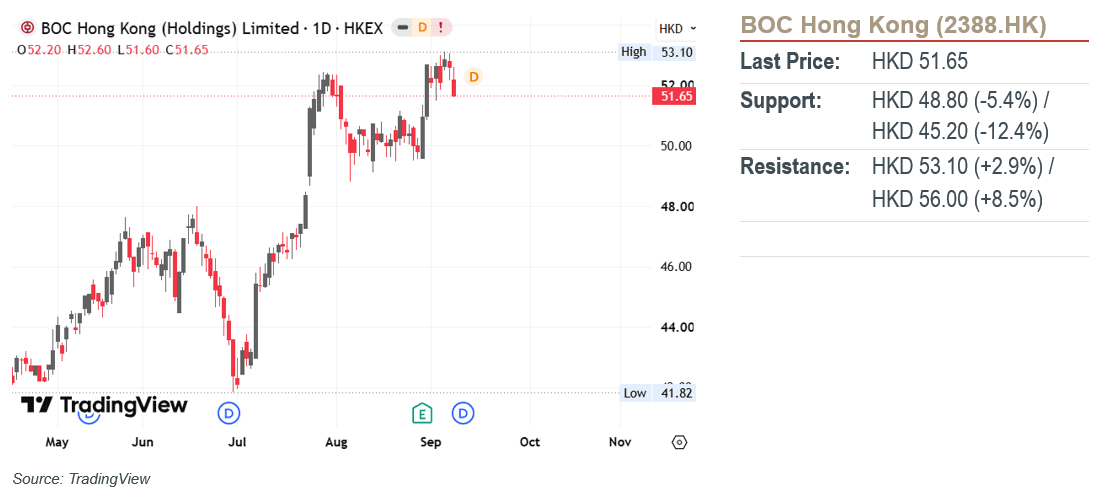
Price indicates a potential double top chart pattern, signaling an exhaustion of buy-side initiative.
Technical momentum aligns with this top-reversal structure, as a distinct bearish RSI divergence has developed while the oscillator curls downward despite maintaining position above its neutral 50-midline.
A decisive breakdown below the HK$48.82 neckline support pivot will complete the double top pattern, opening a clear pathway for accelerated downside expansion toward lower primary targets.
Market Movers: Wall Street returned from the long weekend under pressure as a renewed oil shock revived inflation risk: the Dow fell 1.18% to 52,786.07, the S&P 500 lost 0.58% to 7,673.52 and the Nasdaq slipped 0.32% to 26,421.41. Brent settled 0.9% higher at US$97.92 after Houthi attacks disrupted Saudi energy facilities; WTI gained 1.7% to US$93.03. Europe was nearly flat, while Novartis dropped 13.9% after a second late-stage drug setback. Qualcomm rose 3.2% on a multi-generation Amazon AI-data-centre collaboration. The tape split between energy and selected AI infrastructure strength versus healthcare and cyclical weakness, keeping breadth defensive despite the Nasdaq's resilience. (AP, Reuters, Qualcomm, Novartis)
Macro: China's August exports rose 25% year on year in US-dollar terms and imports increased 28.2%, widening the trade surplus to US$119.1 billion. The stronger external pulse did not prevent the Hang Seng from falling 0.38% or the CSI 300 from losing 0.36%. Japan's Nikkei declined 1.70% as the yen strengthened ahead of next week's Bank of Japan decision, while Korea's KOSPI reversed an intraday move above 7,100 to finish 0.58% lower. Singapore's STI fell 0.43% and Malaysia's KLCI was virtually unchanged. Export strength improved the growth signal without dislodging the day's dominant oil, currency and duration risks for portfolios. (AP, Business Times, Bernama, Seoul Economic Daily)
FICC: The US Treasury curve bear-steepened modestly: the two-year constant-maturity yield rose 2bp to 4.39% and the ten-year increased 2bp to 4.80%. Markets assigned nearly a 60% chance to a Federal Reserve increase on 16 September, putting Thursday's US PPI and Friday's CPI in focus. Germany's ten-year yield touched a 15-year high of 3.398% before Thursday's expected ECB increase. Spot gold eased to US$4,356.40 and the dollar index was around 98.88. The combination raises the hurdle for long-duration growth and argues for sizing duration, currency and energy exposure around incoming data. Hong Kong and China Gas (0003.HK) and BOC Hong Kong Holdings (2388.HK) carry no current model recommendation (-). (US Treasury, AP, Reuters)
Americas
Oil and yields pressure US equities. The Dow fell 628.18 points, or 1.18%, while the S&P 500 lost 0.58% and the Nasdaq 0.32%. Brent's approach to US$100 reinforced the risk that energy costs feed inflation and keep policy tighter; the official US two- and ten-year CMT yields both rose 2bp. (AP / US Treasury)
Qualcomm expands its Amazon AI role. Qualcomm rose 3.2% after announcing multi-generation customized silicon for Amazon's AI infrastructure and optical connectivity extending to 1.6T. The strategic signal is a broader addressable market beyond handsets; the key uncertainty is execution timing and economics. (Qualcomm / AP)
Boston Scientific flags a material cyber hit. An SEC filing said an August network outage disrupted manufacturing, order processing and shipping. The company now considers prior third-quarter and full-year sales-growth and adjusted-EPS guidance unlikely to be met; the stock fell 5.9%. (SEC / AP)
Canada's counter-tariffs take effect. Duties of 15% to 50% began on about US$20 billion of US goods after bilateral talks collapsed. The direct macro impulse is limited, but escalation risk matters for North American industrial supply chains and business confidence. (Reuters)
Greater China
Trade volumes accelerate in August. Exports rose 25% and imports 28.2% from a year earlier in US-dollar terms, lifting the surplus to US$119.1 billion. Auto exports increased 43% and semiconductor exports 129.8%, showing technology and manufactured goods remain the external-growth engine. (AP)
Hong Kong tech absorbs the risk-off tone. The Hang Seng Index fell 0.38% to 25,317.18, the HSCEI also lost 0.38%, and the Hang Seng Tech Index dropped 1.61%. Mainland large caps were more resilient but still slipped: the CSI 300 ended down 0.36% at 4,558.74. (Xinhua / market data)
Supplier-payment rules tighten for automakers. Regulators clarified when the 60-day payment clock starts, discouraged forced use of non-cash instruments and added reporting plus enforcement. Faster settlement could support smaller suppliers' cash conversion, while raising discipline and working-capital pressure for automakers. (Reuters)
Longsys closes below offer on debut. The memory-products company ended at HK$233.60 versus its HK$236 offer price after raising HK$7.08 billion. A 1% first-day decline despite strong AI-memory interest underlines selective IPO price discovery rather than indiscriminate demand. (Reuters)
Asia ex. China
Japan and Korea reverse early chip strength. The Nikkei fell 1.70% to 65,269.33 as a firmer yen hit exporters. Korea's KOSPI reached 7,171.52 intraday but closed down 0.58% at 6,954.52; SK Hynix retained a 0.56% gain while Samsung Electronics slipped 0.19%. (Business Times / Seoul Economic Daily)
Singapore ends lower with weak breadth. The STI lost 24.83 points, or 0.43%, to 5,767.45. Yangzijiang Shipbuilding rose 4.0%, but UOL fell 3.8% and all three local banks declined; market losers outnumbered gainers 340 to 215. (Business Times)
Malaysia is flat despite construction demand. The KLCI slipped 0.39 point, or 0.02%, to 1,714.40. Buying rotated toward smaller construction names while index heavyweights were mixed; 548 decliners narrowly exceeded 546 gainers on RM3.14 billion of turnover. (Bernama)
Higher oil raises regional policy trade-offs. Energy importers face renewed inflation pressure just as Japan's currency strength and Korea's sharp intraday reversal point to positioning risk. The dispersion argues for selective exposure rather than treating the regional technology complex as a single trade. (AP / regional closes)
EMEA and Others
Europe closes nearly flat. The STOXX 600 eased 0.05% to 649.60 as a 0.6% energy-sector gain and a 2% mining rally offset healthcare weakness. Brent near US$98 supported producers but reinforced concern that the inflation impulse will last longer. (Reuters)
Novartis records its worst day. The Swiss-listed shares fell 10.9% after Phase III HARBOR missed its primary endpoint in myotonic dystrophy type 1, the second pipeline setback in two sessions. Secondary evidence of activity preserves optionality, but the company must determine the program's path with regulators. (Novartis / Reuters)
Bund yields stay near multi-year highs. Germany's ten-year yield touched 3.398%, its highest in 15 years, while the two-year yield held around 2.99%. The ECB is widely expected to raise rates Thursday; markets also price substantial odds of another move by December. (Reuters)
Computacenter lifts its profit floor. The UK technology-services group expects at least GBP380 million of 2026 adjusted pretax profit versus GBP340.9 million consensus, supported by North American AI data-centre demand. It was the third guidance upgrade since April. (Reuters)
Traders’ corner
Our Technical View
Price retested its resistance-turned-support zone, keeping the uptrend firmly intact.
The successful defense of this former supply ceiling reflects strong buyer absorption of lingering profit-taking rather than distribution.
The RSI remains securely positioned above its neutral 50-midline to signal ongoing buyer control.
- The path-of-least-resistance dynamics favours a continued upward drift, where a decisive penetration above the recent swing high will confirm trend continuation and open the pathway toward higher overhead targets.
Our Technical View
Price indicates a potential double top chart pattern, signaling an exhaustion of buy-side initiative.
Technical momentum aligns with this top-reversal structure, as a distinct bearish RSI divergence has developed while the oscillator curls downward despite maintaining position above its neutral 50-midline.
A decisive breakdown below the HK$48.82 neckline support pivot will complete the double top pattern, opening a clear pathway for accelerated downside expansion toward lower primary targets.
Disclosures and disclaimers
This report is provided subject to, and must be read together with, the full Disclosures / Disclaimers available at this link, which are incorporated by reference into this report. In particular, this report is intended for general circulation and informational purposes only and does not constitute personal investment advice or a recommendation to buy or sell any investment product or security. You should independently evaluate the information and, where necessary, seek advice from a qualified financial adviser regarding the suitability of any investment. Analyst certifications required under applicable regulations, including SEC Regulation AC (where relevant), are included in this report. By accessing, receiving or using this report, you acknowledge that you have read, understood and agreed to be bound by the Disclosures / Disclaimers, as may be amended, supplemented or updated from time to time.


