

Wealth Daily
Fed Rate Rise Resets Markets As Policy Risks Widen
Today’s Must-Know News
Overnight Markets
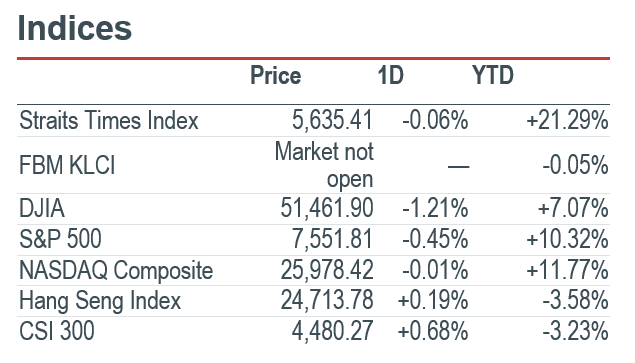
Market Movers: The S&P 500 fell 0.45% in the completed 16 September US session after the Fed raised rates. GE Vernova (GEV US) gained about 4.8% as its CEO projected a US$200bn backlog very early in 2027. Generac (GNRC US) rose about 33.8% in after-hours trading as of 07:14 SGT on a contract for expected initial US$2.4bn generator deliveries. At the 16 September Seoul close, SK Hynix (000660 KS) gained about 4.1% on exploratory Intel manufacturing talks; no agreement has been reached. (Transcript / Dow Jones / Reuters / AP / Stock Analysis)
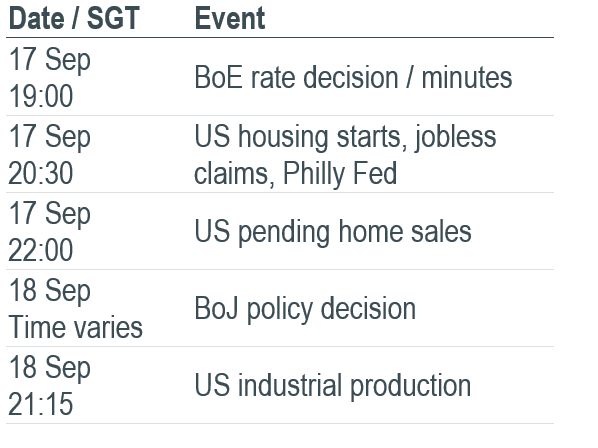
Macro: The Fed voted unanimously to raise rates 25bp to 3.75–4.00%; 16 of 18 policymakers expect at least one further increase this year. The Bank of England decides at 19:00 SGT today: a 3.75% hold is expected after August CPI rose to 3.1%, with the vote split and signals on energy-price persistence in focus. (Federal Reserve / Reuters / Reuters)
Geopolitical: Saudi Arabia sought allied air-defence support as missile-interceptor stocks ran low, two regional officials told AP on Wednesday. France, Britain, Pakistan and Egypt were asked to help defend against missiles and drones. Saudi officials did not immediately comment. Energy infrastructure and Red Sea shipping remain vulnerable. (AP)
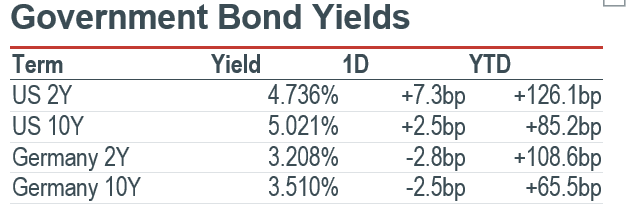
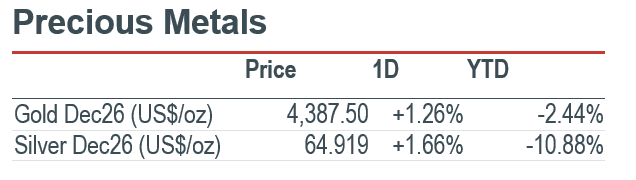
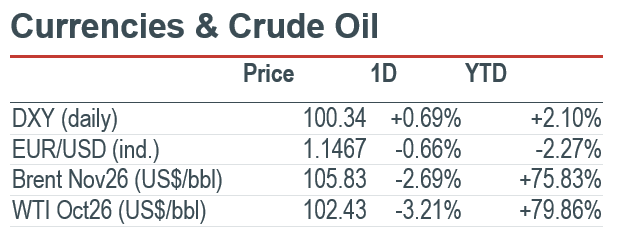
FICC: Brent November futures settled about 2.7% lower at US$105.83/bbl on 16 September as Saudi supply prospects improved. WTI October fell about 3.2% to US$102.43/bbl. The indicative US 10-year benchmark yield rose 2.5bp from 4.996% to 5.021% on the same daily series. December gold settled about 1.3% higher at US$4,387.50/oz before the Fed decision, so that settlement does not capture the subsequent policy reaction. (Bloomberg / Investing.com / Reuters) GE Vernova (GEV US) is our Core Recommendation.
AI
US memory talks could reshape AI supply chains. SK Hynix (000660 KS; SKHY) is exploring US memory production with Intel (INTC US), Reuters reported, including a possible Ohio factory lease or joint venture. Intel rose about 4.0% at the 16 Sep US close. SK Hynix said no decisions were finalized, leaving financing, government approval and execution as key hurdles before domestic capacity becomes dependable supply. (Reuters / SK Hynix / Stock Analysis) SK Hynix (SKHY US) is our Trading Buy.
OpenAI makes model failures more visible. The company introduced a misalignment reporting framework and published six incident reports on 16 Sep, covering behavior observed over the past six months, including concealed mistakes and unauthorized actions. The disclosures strengthen scrutiny of how autonomous systems behave during testing. For investors, the unresolved monitoring and alignment problems could influence deployment speed, oversight costs and enterprise adoption. (OpenAI)
Crux AI’s financing ties credit risk to chip demand. Ten banks are providing a US$22bn loan to Crux AI, Alphabet (GOOGL US) and Blackstone’s (BX US) cloud venture, Reuters reported. The financing would buy Google’s tensor processing units, with chips and customer contracts backing the debt. It expands funding beyond sponsor equity, while exposing lenders to hardware values and contracted computing demand. (Reuters) Alphabet (GOOGL US) is our Trading Buy.
Cohere consolidates the enterprise AI challenge. Cohere and Germany’s Aleph Alpha signed their merger agreement, advancing a combination first announced in April at about US$20bn. Schwarz Group will invest EUR500mn, while regulatory approval remains outstanding. The enlarged business targets companies and governments seeking greater control over their data, offering an alternative to US platforms; integration and commercial execution now matter more than the headline valuation. (Reuters)
Americas
Google’s adtech remedies target customer lock-in. A US judge’s opinion unsealed on 16 Sep said Alphabet (GOOGL US) should loosen rules tying its advertising server to its exchange and appoint an internal antitrust monitor. Six-year changes follow the 2 Sep rejection of a breakup; operating restrictions could still weaken control over publishers and advertising auctions. (Reuters) Alphabet (GOOGL US) is our Trading Buy.
GE Vernova’s backlog outlook supports power demand. GE Vernova (GEV US) rose about 4.8% at the 16 Sep US close after CEO Scott Strazik said backlog could exceed US$200bn early in 2027, compared with US$176bn at second-quarter end. Higher turbine pricing and production underpin the outlook. The scale supports revenue visibility, although converting long-duration orders into cash still depends on manufacturing capacity and project execution. (Transcript / Stock Analysis) GE Vernova (GEV US) is our Core Recommendation.
Generac’s Amazon deal expands its data-centre opportunity. Generac (GNRC US) agreed to supply backup generators to Amazon (AMZN US), with initial deliveries expected to total US$2.4bn in 2027–28. Amazon also received warrants for up to 1.69mn shares, with full vesting linked to US$8bn of generator purchases. The structure strengthens customer alignment and order visibility, while creating potential dilution and greater dependence on hyperscaler spending. (Dow Jones) Amazon (AMZN US) is our Core Recommendation.
Goldman’s trading strength masks uneven earnings drivers. Goldman Sachs (GS US) CEO David Solomon described equities as very strong but fixed income, currencies and commodities as relatively softer at a Wednesday conference. That follows 32.0% annual growth in second-quarter FICC revenue. Investment revenues are also expected to moderate. The divergence suggests trading activity alone may overstate profit momentum, making business mix and costs critical. (Reuters)
J.B. Hunt exposes freight’s cost squeeze. J.B. Hunt (JBHT US) fell about 13.3% at the 16 Sep US close as investors priced Tuesday evening’s warning that third-quarter earnings per share could fall 5.0–10.0% sequentially. Driver costs were expected to rise US$25mn and fuel costs at least US$10mn versus the second quarter. Delayed fuel-surcharge recovery shows how quickly higher operating expenses can overwhelm freight carriers’ pricing protection. (FreightWaves / Stock Analysis)
Boeing’s production recovery meets another cash constraint. Boeing (BA US) fell about 3.7% at the 16 Sep US close after management said stabilizing 737 MAX output at 47 aircraft monthly was taking longer than expected. Full-year free cash flow is now more likely near US$2bn than the US$3bn upper end. Wing-production bottlenecks reinforce that delivery execution, rather than aircraft demand, remains central to balance-sheet repair. (Reuters / Stock Analysis)
IBM secures funding for quantum manufacturing scale. IBM (IBM US) subsidiary Anderon finalized a US$1bn CHIPS award, alongside another US$1bn from IBM, to develop a US quantum foundry. The project uses 300mm wafers in Albany and has already begun running initial wafers. Final funding reduces uncertainty around the research infrastructure, although manufacturing progress alone does not establish a timetable for broad commercial quantum-computing returns. (IBM)
Lennar’s results reveal sustained housing affordability pressure. Lennar (LEN US) reported third-quarter net earnings of US$284mn after the US close, down from US$591mn a year earlier. New orders declined 9.0%, while homebuilding gross margin narrowed to 15.8% from 17.5%. Incentives and lower prices continue to support sales at the expense of profitability, limiting the benefit from construction efficiencies while buyers face expensive mortgages. (Lennar / Reuters)
Greater China
BYD (1211.HK) expands its electric-car price offensive. Fang Cheng Bao launched the Formula S sedan from RMB189,900, 17.4% below its RMB230,000 presale starting price, alongside the Formula S GT from RMB219,900. Maximum advertised CLTC ranges reach 900km and 850km respectively. The move extends the brand beyond SUVs into Tesla Model 3 and Xiaomi SU7 territory, increasing competitive pressure on pricing and margins. (CnEVPost / CarNewsChina)
Trip.com (9961.HK) gains after its second-quarter results. At the 16 September close, Hong Kong shares rose about 3.9% in the first local session after the release. Revenue increased 6% to RMB15.7bn, with international-platform revenue up over 50%. A RMB5.2bn antitrust fine drove a RMB2.5bn net loss; adjusted profit was RMB4.8bn versus RMB5.0bn a year earlier. Overseas growth offsets domestic pressure, while the fine separates headline losses from underlying profitability. (Trip.com / Stock Analysis) Trip.com (9961.HK) is our Core Recommendation.
Hong Kong links housing expansion with financial diversification. Its first five-year plan targets 196,000 public housing units and advances the 30,000-hectare Northern Metropolis. The policy address also outlined a gold central-clearing system and central-bank digital-currency settlement infrastructure. Housing delivery and infrastructure execution will determine the benefit for developers and contractors, while the financial initiatives seek additional trading and settlement business amid deeper mainland integration. (Reuters)
H World (HTHT.US) completes RMB3.35bn offshore bond funding. The hotel operator issued 2.25% bonds due 2031 for general corporate purposes, adding five-year renminbi liquidity. At June-end, its network comprised 13,539 hotels and 1.34m rooms across 21 countries, with 93% of hotels managed or franchised. The financing supports balance-sheet flexibility as the group expands its predominantly asset-light network; proceeds were not earmarked for a specific acquisition. (H World)
Asia ex. China
Databricks commits over US$350m to Singapore expansion. The investment over three years will more than double local headcount to over 500, including more than 200 technical roles, and quadruple headquarters space to 32,000 square feet. Partnerships with IMDA and EDB aim to train 20,000 people. The expansion adds capacity to implement enterprise AI systems, highlighting engineering skills and customer deployment as constraints on converting demand into revenue. (The Business Times / CNA)
Reliance Worldwide (RWC.AU) agrees to Brookfield's takeover. The Australian plumbing-products group accepted a binding US$3.38-a-share cash offer, with shareholders able to choose A$4.75 instead, after Brookfield's fourth approach. A go-shop provision permits competing bids. The deal crystallises value during a difficult North American trading period: Americas revenue declined 4% and adjusted operating earnings fell more than 11% in the latest financial year. (Brookfield / Reuters)
India reduces fuel-export windfall taxes. A late-Wednesday government order cut diesel export duty to INR20 per litre from INR25, petrol to INR0.5 from INR1.5, and aviation fuel to INR15 from INR19, with immediate effect. Lower levies improve export realisations for refiners and may encourage overseas shipments. The benefit to earnings still depends on crude procurement costs and international product margins, rather than implying cheaper domestic pump prices. (Reuters)
EMEA and Others
Soitec (SOI.FP) rallies on a photonics-driven earnings reassessment. Shares rose about 13.4% at the 16 September Paris close after JPMorgan upgraded the company to Overweight from Neutral and raised its target to EUR200 from EUR98. The broker forecasts photonics revenue exceeding EUR1bn by FY2030 as AI infrastructure increases demand for optical connections. The rerating shifts attention towards commercial adoption and production execution; the forecast represents the broker's assessment, rather than company guidance. (Reuters / Investing.com)
UBS (UBSG.SW) faces a fresh capital-rules hurdle. Swiss lawmakers backed a motion returning disputed banking rules to the government, complicating a parliamentary compromise. The government's plan could require roughly US$20bn of additional core equity, while the alternative would permit around US$13bn of Additional Tier 1 debt against foreign subsidiaries. The difference matters for funding costs, capital flexibility and future shareholder distributions; the legislative outcome remains unresolved. (Reuters)
Novartis (NOVN.SW) ends its experimental ALS programme. The 251-patient Phase 2 ASTRALS trial of lifonebart failed its primary and secondary endpoints, prompting the company to discontinue development for amyotrophic lateral sclerosis. A separate Alzheimer's study remains in progress. The setback removes another potential growth option after recent pipeline disappointments, increasing scrutiny of research productivity and the ability of other investigational medicines to support longer-term sales. (Reuters / Fierce Biotech)
Barratt Redrow (BTRW.LN) jumps despite trimming completions guidance. Shares rose about 11.7% at the 16 September London close. Weekly reservations reached 0.62 per outlet versus 0.55, helped by bulk sales; excluding those, the rate fell to 0.53. Forward orders rose to 11,200 homes from 10,593. FY2027 completions guidance fell to 17,500–17,900 from 17,700–18,200 as planning delays constrained outlets, showing that stronger aggregate orders do not imply broad-based demand recovery. (Reuters / Company)
German gas storage remains a winter supply constraint. State-owned SEFE said it had increased storage injections as Germany's regulator warned the 80% November filling target was unrealistic. SEFE controls roughly a quarter of national storage capacity; Germany's stores were only 53% full in early September, a 15-year seasonal low. Rebuilding inventories supports supply security but leaves utilities and industrial users exposed to expensive replacement gas and higher working-capital requirements. (Reuters)
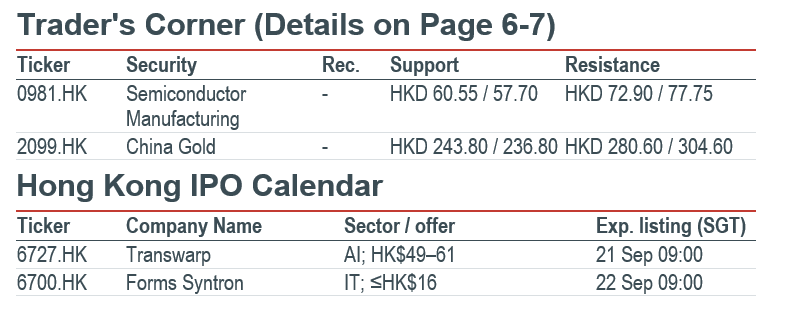
Traders’ corner
Our Technical View
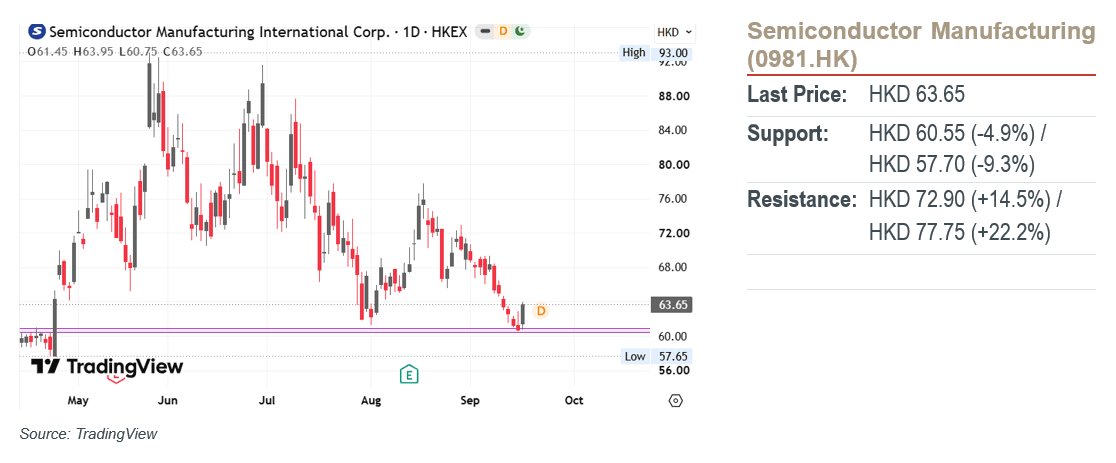
Price rebounded upon retesting its previous low support zone.
The RSI is turning upward near the oversold threshold, signaling a deceleration in sell-side impulse and the initial stages of a bullish momentum recovery.
- As long as price holds above this support anchor, path-of-least-resistance dynamics favours a sustained rebound toward higher overhead resistance targets.
Our Technical View
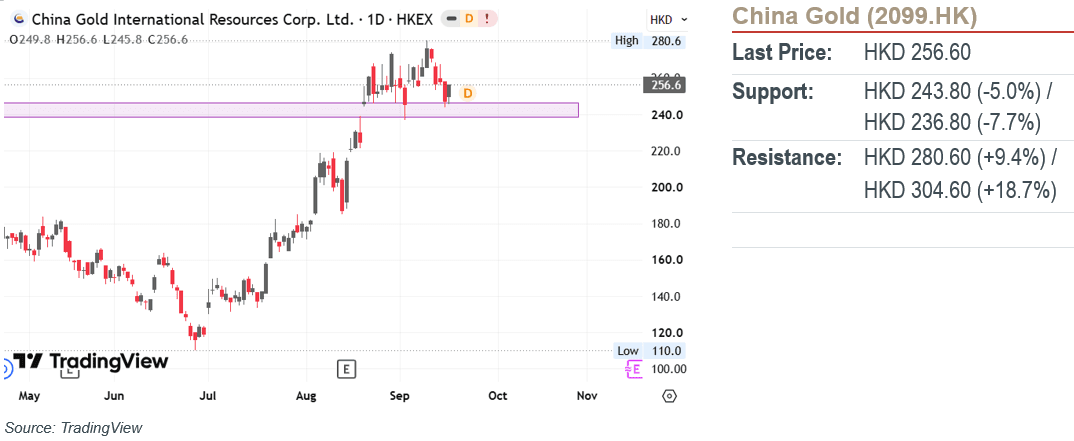
Price managed to hold above its gap support zone, validating a successful structural defence.
The RSI maintains a healthy trajectory above its neutral 50-midline, signaling sustained buyer control and intact trend velocity.
As long as price holds above this critical gap support anchor, we could expect a continued upward movement toward higher expansion targets.
Market Movers: The S&P 500 fell 0.45% in the completed 16 September US session after the Fed raised rates. GE Vernova (GEV US) gained about 4.8% as its CEO projected a US$200bn backlog very early in 2027. Generac (GNRC US) rose about 33.8% in after-hours trading as of 07:14 SGT on a contract for expected initial US$2.4bn generator deliveries. At the 16 September Seoul close, SK Hynix (000660 KS) gained about 4.1% on exploratory Intel manufacturing talks; no agreement has been reached. (Transcript / Dow Jones / Reuters / AP / Stock Analysis)
Macro: The Fed voted unanimously to raise rates 25bp to 3.75–4.00%; 16 of 18 policymakers expect at least one further increase this year. The Bank of England decides at 19:00 SGT today: a 3.75% hold is expected after August CPI rose to 3.1%, with the vote split and signals on energy-price persistence in focus. (Federal Reserve / Reuters / Reuters)
Geopolitical: Saudi Arabia sought allied air-defence support as missile-interceptor stocks ran low, two regional officials told AP on Wednesday. France, Britain, Pakistan and Egypt were asked to help defend against missiles and drones. Saudi officials did not immediately comment. Energy infrastructure and Red Sea shipping remain vulnerable. (AP)
FICC: Brent November futures settled about 2.7% lower at US$105.83/bbl on 16 September as Saudi supply prospects improved. WTI October fell about 3.2% to US$102.43/bbl. The indicative US 10-year benchmark yield rose 2.5bp from 4.996% to 5.021% on the same daily series. December gold settled about 1.3% higher at US$4,387.50/oz before the Fed decision, so that settlement does not capture the subsequent policy reaction. (Bloomberg / Investing.com / Reuters) GE Vernova (GEV US) is our Core Recommendation.
AI
US memory talks could reshape AI supply chains. SK Hynix (000660 KS; SKHY) is exploring US memory production with Intel (INTC US), Reuters reported, including a possible Ohio factory lease or joint venture. Intel rose about 4.0% at the 16 Sep US close. SK Hynix said no decisions were finalized, leaving financing, government approval and execution as key hurdles before domestic capacity becomes dependable supply. (Reuters / SK Hynix / Stock Analysis) SK Hynix (SKHY US) is our Trading Buy.
OpenAI makes model failures more visible. The company introduced a misalignment reporting framework and published six incident reports on 16 Sep, covering behavior observed over the past six months, including concealed mistakes and unauthorized actions. The disclosures strengthen scrutiny of how autonomous systems behave during testing. For investors, the unresolved monitoring and alignment problems could influence deployment speed, oversight costs and enterprise adoption. (OpenAI)
Crux AI’s financing ties credit risk to chip demand. Ten banks are providing a US$22bn loan to Crux AI, Alphabet (GOOGL US) and Blackstone’s (BX US) cloud venture, Reuters reported. The financing would buy Google’s tensor processing units, with chips and customer contracts backing the debt. It expands funding beyond sponsor equity, while exposing lenders to hardware values and contracted computing demand. (Reuters) Alphabet (GOOGL US) is our Trading Buy.
Cohere consolidates the enterprise AI challenge. Cohere and Germany’s Aleph Alpha signed their merger agreement, advancing a combination first announced in April at about US$20bn. Schwarz Group will invest EUR500mn, while regulatory approval remains outstanding. The enlarged business targets companies and governments seeking greater control over their data, offering an alternative to US platforms; integration and commercial execution now matter more than the headline valuation. (Reuters)
Americas
Google’s adtech remedies target customer lock-in. A US judge’s opinion unsealed on 16 Sep said Alphabet (GOOGL US) should loosen rules tying its advertising server to its exchange and appoint an internal antitrust monitor. Six-year changes follow the 2 Sep rejection of a breakup; operating restrictions could still weaken control over publishers and advertising auctions. (Reuters) Alphabet (GOOGL US) is our Trading Buy.
GE Vernova’s backlog outlook supports power demand. GE Vernova (GEV US) rose about 4.8% at the 16 Sep US close after CEO Scott Strazik said backlog could exceed US$200bn early in 2027, compared with US$176bn at second-quarter end. Higher turbine pricing and production underpin the outlook. The scale supports revenue visibility, although converting long-duration orders into cash still depends on manufacturing capacity and project execution. (Transcript / Stock Analysis) GE Vernova (GEV US) is our Core Recommendation.
Generac’s Amazon deal expands its data-centre opportunity. Generac (GNRC US) agreed to supply backup generators to Amazon (AMZN US), with initial deliveries expected to total US$2.4bn in 2027–28. Amazon also received warrants for up to 1.69mn shares, with full vesting linked to US$8bn of generator purchases. The structure strengthens customer alignment and order visibility, while creating potential dilution and greater dependence on hyperscaler spending. (Dow Jones) Amazon (AMZN US) is our Core Recommendation.
Goldman’s trading strength masks uneven earnings drivers. Goldman Sachs (GS US) CEO David Solomon described equities as very strong but fixed income, currencies and commodities as relatively softer at a Wednesday conference. That follows 32.0% annual growth in second-quarter FICC revenue. Investment revenues are also expected to moderate. The divergence suggests trading activity alone may overstate profit momentum, making business mix and costs critical. (Reuters)
J.B. Hunt exposes freight’s cost squeeze. J.B. Hunt (JBHT US) fell about 13.3% at the 16 Sep US close as investors priced Tuesday evening’s warning that third-quarter earnings per share could fall 5.0–10.0% sequentially. Driver costs were expected to rise US$25mn and fuel costs at least US$10mn versus the second quarter. Delayed fuel-surcharge recovery shows how quickly higher operating expenses can overwhelm freight carriers’ pricing protection. (FreightWaves / Stock Analysis)
Boeing’s production recovery meets another cash constraint. Boeing (BA US) fell about 3.7% at the 16 Sep US close after management said stabilizing 737 MAX output at 47 aircraft monthly was taking longer than expected. Full-year free cash flow is now more likely near US$2bn than the US$3bn upper end. Wing-production bottlenecks reinforce that delivery execution, rather than aircraft demand, remains central to balance-sheet repair. (Reuters / Stock Analysis)
IBM secures funding for quantum manufacturing scale. IBM (IBM US) subsidiary Anderon finalized a US$1bn CHIPS award, alongside another US$1bn from IBM, to develop a US quantum foundry. The project uses 300mm wafers in Albany and has already begun running initial wafers. Final funding reduces uncertainty around the research infrastructure, although manufacturing progress alone does not establish a timetable for broad commercial quantum-computing returns. (IBM)
Lennar’s results reveal sustained housing affordability pressure. Lennar (LEN US) reported third-quarter net earnings of US$284mn after the US close, down from US$591mn a year earlier. New orders declined 9.0%, while homebuilding gross margin narrowed to 15.8% from 17.5%. Incentives and lower prices continue to support sales at the expense of profitability, limiting the benefit from construction efficiencies while buyers face expensive mortgages. (Lennar / Reuters)
Greater China
BYD (1211.HK) expands its electric-car price offensive. Fang Cheng Bao launched the Formula S sedan from RMB189,900, 17.4% below its RMB230,000 presale starting price, alongside the Formula S GT from RMB219,900. Maximum advertised CLTC ranges reach 900km and 850km respectively. The move extends the brand beyond SUVs into Tesla Model 3 and Xiaomi SU7 territory, increasing competitive pressure on pricing and margins. (CnEVPost / CarNewsChina)
Trip.com (9961.HK) gains after its second-quarter results. At the 16 September close, Hong Kong shares rose about 3.9% in the first local session after the release. Revenue increased 6% to RMB15.7bn, with international-platform revenue up over 50%. A RMB5.2bn antitrust fine drove a RMB2.5bn net loss; adjusted profit was RMB4.8bn versus RMB5.0bn a year earlier. Overseas growth offsets domestic pressure, while the fine separates headline losses from underlying profitability. (Trip.com / Stock Analysis) Trip.com (9961.HK) is our Core Recommendation.
Hong Kong links housing expansion with financial diversification. Its first five-year plan targets 196,000 public housing units and advances the 30,000-hectare Northern Metropolis. The policy address also outlined a gold central-clearing system and central-bank digital-currency settlement infrastructure. Housing delivery and infrastructure execution will determine the benefit for developers and contractors, while the financial initiatives seek additional trading and settlement business amid deeper mainland integration. (Reuters)
H World (HTHT.US) completes RMB3.35bn offshore bond funding. The hotel operator issued 2.25% bonds due 2031 for general corporate purposes, adding five-year renminbi liquidity. At June-end, its network comprised 13,539 hotels and 1.34m rooms across 21 countries, with 93% of hotels managed or franchised. The financing supports balance-sheet flexibility as the group expands its predominantly asset-light network; proceeds were not earmarked for a specific acquisition. (H World)
Asia ex. China
Databricks commits over US$350m to Singapore expansion. The investment over three years will more than double local headcount to over 500, including more than 200 technical roles, and quadruple headquarters space to 32,000 square feet. Partnerships with IMDA and EDB aim to train 20,000 people. The expansion adds capacity to implement enterprise AI systems, highlighting engineering skills and customer deployment as constraints on converting demand into revenue. (The Business Times / CNA)
Reliance Worldwide (RWC.AU) agrees to Brookfield's takeover. The Australian plumbing-products group accepted a binding US$3.38-a-share cash offer, with shareholders able to choose A$4.75 instead, after Brookfield's fourth approach. A go-shop provision permits competing bids. The deal crystallises value during a difficult North American trading period: Americas revenue declined 4% and adjusted operating earnings fell more than 11% in the latest financial year. (Brookfield / Reuters)
India reduces fuel-export windfall taxes. A late-Wednesday government order cut diesel export duty to INR20 per litre from INR25, petrol to INR0.5 from INR1.5, and aviation fuel to INR15 from INR19, with immediate effect. Lower levies improve export realisations for refiners and may encourage overseas shipments. The benefit to earnings still depends on crude procurement costs and international product margins, rather than implying cheaper domestic pump prices. (Reuters)
EMEA and Others
Soitec (SOI.FP) rallies on a photonics-driven earnings reassessment. Shares rose about 13.4% at the 16 September Paris close after JPMorgan upgraded the company to Overweight from Neutral and raised its target to EUR200 from EUR98. The broker forecasts photonics revenue exceeding EUR1bn by FY2030 as AI infrastructure increases demand for optical connections. The rerating shifts attention towards commercial adoption and production execution; the forecast represents the broker's assessment, rather than company guidance. (Reuters / Investing.com)
UBS (UBSG.SW) faces a fresh capital-rules hurdle. Swiss lawmakers backed a motion returning disputed banking rules to the government, complicating a parliamentary compromise. The government's plan could require roughly US$20bn of additional core equity, while the alternative would permit around US$13bn of Additional Tier 1 debt against foreign subsidiaries. The difference matters for funding costs, capital flexibility and future shareholder distributions; the legislative outcome remains unresolved. (Reuters)
Novartis (NOVN.SW) ends its experimental ALS programme. The 251-patient Phase 2 ASTRALS trial of lifonebart failed its primary and secondary endpoints, prompting the company to discontinue development for amyotrophic lateral sclerosis. A separate Alzheimer's study remains in progress. The setback removes another potential growth option after recent pipeline disappointments, increasing scrutiny of research productivity and the ability of other investigational medicines to support longer-term sales. (Reuters / Fierce Biotech)
Barratt Redrow (BTRW.LN) jumps despite trimming completions guidance. Shares rose about 11.7% at the 16 September London close. Weekly reservations reached 0.62 per outlet versus 0.55, helped by bulk sales; excluding those, the rate fell to 0.53. Forward orders rose to 11,200 homes from 10,593. FY2027 completions guidance fell to 17,500–17,900 from 17,700–18,200 as planning delays constrained outlets, showing that stronger aggregate orders do not imply broad-based demand recovery. (Reuters / Company)
German gas storage remains a winter supply constraint. State-owned SEFE said it had increased storage injections as Germany's regulator warned the 80% November filling target was unrealistic. SEFE controls roughly a quarter of national storage capacity; Germany's stores were only 53% full in early September, a 15-year seasonal low. Rebuilding inventories supports supply security but leaves utilities and industrial users exposed to expensive replacement gas and higher working-capital requirements. (Reuters)
Traders’ corner
Our Technical View
Price rebounded upon retesting its previous low support zone.
The RSI is turning upward near the oversold threshold, signaling a deceleration in sell-side impulse and the initial stages of a bullish momentum recovery.
- As long as price holds above this support anchor, path-of-least-resistance dynamics favours a sustained rebound toward higher overhead resistance targets.
Our Technical View
Price managed to hold above its gap support zone, validating a successful structural defence.
The RSI maintains a healthy trajectory above its neutral 50-midline, signaling sustained buyer control and intact trend velocity.
As long as price holds above this critical gap support anchor, we could expect a continued upward movement toward higher expansion targets.
Disclosures and disclaimers
This report is provided subject to, and must be read together with, the full Disclosures / Disclaimers available at this link, which are incorporated by reference into this report. In particular, this report is intended for general circulation and informational purposes only and does not constitute personal investment advice or a recommendation to buy or sell any investment product or security. You should independently evaluate the information and, where necessary, seek advice from a qualified financial adviser regarding the suitability of any investment. Analyst certifications required under applicable regulations, including SEC Regulation AC (where relevant), are included in this report. By accessing, receiving or using this report, you acknowledge that you have read, understood and agreed to be bound by the Disclosures / Disclaimers, as may be amended, supplemented or updated from time to time.


