

Wealth Flash
The Knowledge Share
China’s Green Pivot: Win-win for the environment and economy?
When was the last time you visited China? Have you noticed that rivers are becoming clearer, the air is noticeably cleaner, and the overall environment is steadily improving? Well, this is unlikely to be a coincidence, as Beijing has been consistently pushing for environment improvement while driving a manufacturing upgrade. Read on and judge for yourself whether China is on the right path.
CIO Summary
- Impressive Yangzi River recovery. After decades of pollution, overfishing and dam building, the Yangzi is making a remarkable ecological comeback – a clear sign that China’s eco‑authoritarian approach is working.
- A win-win for the environment and economy? The environmental improvement brings meaningful gains to public health, tourism, agriculture and a “forced” industrial upgrade. Cities along the river have been shifting away from pollutive, chemical‑heavy industries toward a more sustainable model. Disposable income in adjacent provinces rose over 90% over the past decade.
- What’s next? If China’s environmental policy is indeed successful, we wonder what comes next as Beijing’s top agenda. Check our Wealth Flash series on China Export Shock 2.0 and China Maxxing to learn how these intentional priorities are reshaping China’s global positioning.
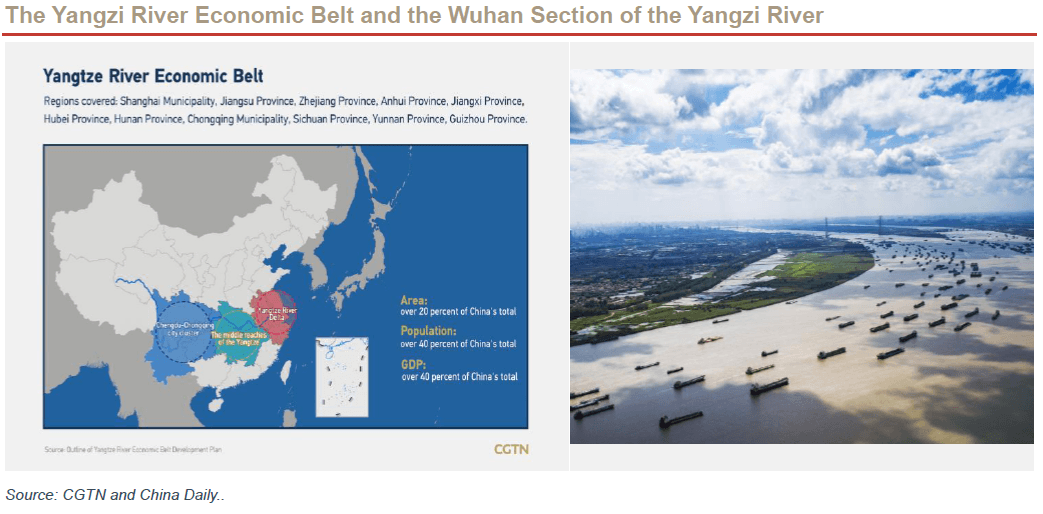
The Economist recently featured an article titled “China’s mightiest river is coming back from the brink” , highlighting China’s significant environmental progress. We’d like to share a few key takeaways from this piece. Hope you find them useful.
- Impressive Yangzi River recovery. After decades of pollution, overfishing and dam building, the Yangzi is making a remarkable ecological comeback. Fish biomass has risen by over 200% since 2021, reversing a 70‑year decline. Rare sturgeons are breeding in the wild for the first time in 20 years. The finless porpoise population has climbed to over 1,400 today, up from 1,000 in 2017.
- Controversial eco‑authoritarian approach. China’s top‑down environmental strategy has delivered fast and effective results, but it also comes with costs. The government enforces strict bans, relocates factories and ties officials’ promotions to ecological metrics. State media now calls China a “global biodiversity champion,” yet the model is intolerant of dissent. Environmentalists warn that the approach ignores affected communities and sometimes even scientific advice.
- Ten‑year fishing ban and related human cost. The core of the China’s strategy is a decade‑long commercial fishing ban introduced in 2021, allowing fish stocks and indicator species to rebound. Under strict enforcement, illegal fishing has dropped sharply, with criminal cases falling 40% in 2025. However, 230,000 fishermen lost their livelihoods, boats and income due to the ban, leading to sever social sequences.
- Industrial relocation has also helped. Thousands of chemical factories were closed or relocated away from the river. Forests were planted upstream to stabilize soil, and cities were “spongified” with wetlands and permeable surfaces to reduce flooding and filter stormwater. These measures have made the river more hospitable to wildlife.
- Dam building remains a threat. China’s long‑standing love of dams continues to harm biodiversity. The Yangzi already hosts a dozen mega‑dams, including the Three Gorges, plus thousands of smaller ones. Dams block fish migration and may have caused as much damage as overfishing. Experts warn that without removing or redesigning dams, the river’s recovery will hit a ceiling.
Our Take
- China’s authoritarian efficiency on display. The article confirms that, when the Chinese government sets its sights on something, it often delivers outstanding results with remarkable speed – the upside of authoritarianism, if you will.
- Economic dividends from the Yangzi’s recovery. The economic and financial benefits of the Yangzi’s recovery are difficult to quantify. However, it surely brings meaningful gains to public health, tourism, agriculture and a “forced” industrial upgrade. Under the Yangzi River Protection Law (2021) and related regulations, China drew strict “red lines” and prohibited pollutive production or transport along the river. The policy forced factory closures and accelerated the region’s shift toward advanced manufacturing, high-tech industries and even green production. For example, Yichang (宜昌), a major city along the Yangzi, has successfully transitioned from a highly pollutive, chemical-heavy base to a more diversified economy focused on advanced materials and clean energy, including a RMB 37.6bn (USD 5.6bn) plant by global energy storage leader CATL.
- A win-win for the environment and economy? In January 2026, China’s State Council announced that per capita disposable income across the 11 Yangzi River Economist Belt provinces rose over 90% over the past decade – from RMB 23,000 in 2015 to RMB 44,000 in 2025 – while the share of good-quality water improved significantly from 67% to 97%. While China’s authoritarian approach may impose real costs on affected groups (such as fishermen), the overall impact appears broadly positive for the general public.
- What’s next? If China’s environmental policy is indeed successful, we wonder what comes next as Beijing’s top agenda: energy security, tech self-sufficiency, winning the AI race, or raising its cultural exports and soft power. Whatever it is, we do not want to underestimate China’s capacity to mobilize the entire nation’s resources toward its chose target. Check our Wealth Flash series on China Export Shock 2.0 and China Maxxing to learn how these intentional priorities are reshaping China’s global positioning.
When was the last time you visited China? Have you noticed that rivers are becoming clearer, the air is noticeably cleaner, and the overall environment is steadily improving? Well, this is unlikely to be a coincidence, as Beijing has been consistently pushing for environment improvement while driving a manufacturing upgrade. Read on and judge for yourself whether China is on the right path.
CIO Summary
- Impressive Yangzi River recovery. After decades of pollution, overfishing and dam building, the Yangzi is making a remarkable ecological comeback – a clear sign that China’s eco‑authoritarian approach is working.
- A win-win for the environment and economy? The environmental improvement brings meaningful gains to public health, tourism, agriculture and a “forced” industrial upgrade. Cities along the river have been shifting away from pollutive, chemical‑heavy industries toward a more sustainable model. Disposable income in adjacent provinces rose over 90% over the past decade.
- What’s next? If China’s environmental policy is indeed successful, we wonder what comes next as Beijing’s top agenda. Check our Wealth Flash series on China Export Shock 2.0 and China Maxxing to learn how these intentional priorities are reshaping China’s global positioning.
The Economist recently featured an article titled “China’s mightiest river is coming back from the brink” , highlighting China’s significant environmental progress. We’d like to share a few key takeaways from this piece. Hope you find them useful.
- Impressive Yangzi River recovery. After decades of pollution, overfishing and dam building, the Yangzi is making a remarkable ecological comeback. Fish biomass has risen by over 200% since 2021, reversing a 70‑year decline. Rare sturgeons are breeding in the wild for the first time in 20 years. The finless porpoise population has climbed to over 1,400 today, up from 1,000 in 2017.
- Controversial eco‑authoritarian approach. China’s top‑down environmental strategy has delivered fast and effective results, but it also comes with costs. The government enforces strict bans, relocates factories and ties officials’ promotions to ecological metrics. State media now calls China a “global biodiversity champion,” yet the model is intolerant of dissent. Environmentalists warn that the approach ignores affected communities and sometimes even scientific advice.
- Ten‑year fishing ban and related human cost. The core of the China’s strategy is a decade‑long commercial fishing ban introduced in 2021, allowing fish stocks and indicator species to rebound. Under strict enforcement, illegal fishing has dropped sharply, with criminal cases falling 40% in 2025. However, 230,000 fishermen lost their livelihoods, boats and income due to the ban, leading to sever social sequences.
- Industrial relocation has also helped. Thousands of chemical factories were closed or relocated away from the river. Forests were planted upstream to stabilize soil, and cities were “spongified” with wetlands and permeable surfaces to reduce flooding and filter stormwater. These measures have made the river more hospitable to wildlife.
- Dam building remains a threat. China’s long‑standing love of dams continues to harm biodiversity. The Yangzi already hosts a dozen mega‑dams, including the Three Gorges, plus thousands of smaller ones. Dams block fish migration and may have caused as much damage as overfishing. Experts warn that without removing or redesigning dams, the river’s recovery will hit a ceiling.
Our Take
- China’s authoritarian efficiency on display. The article confirms that, when the Chinese government sets its sights on something, it often delivers outstanding results with remarkable speed – the upside of authoritarianism, if you will.
- Economic dividends from the Yangzi’s recovery. The economic and financial benefits of the Yangzi’s recovery are difficult to quantify. However, it surely brings meaningful gains to public health, tourism, agriculture and a “forced” industrial upgrade. Under the Yangzi River Protection Law (2021) and related regulations, China drew strict “red lines” and prohibited pollutive production or transport along the river. The policy forced factory closures and accelerated the region’s shift toward advanced manufacturing, high-tech industries and even green production. For example, Yichang (宜昌), a major city along the Yangzi, has successfully transitioned from a highly pollutive, chemical-heavy base to a more diversified economy focused on advanced materials and clean energy, including a RMB 37.6bn (USD 5.6bn) plant by global energy storage leader CATL.
- A win-win for the environment and economy? In January 2026, China’s State Council announced that per capita disposable income across the 11 Yangzi River Economist Belt provinces rose over 90% over the past decade – from RMB 23,000 in 2015 to RMB 44,000 in 2025 – while the share of good-quality water improved significantly from 67% to 97%. While China’s authoritarian approach may impose real costs on affected groups (such as fishermen), the overall impact appears broadly positive for the general public.
- What’s next? If China’s environmental policy is indeed successful, we wonder what comes next as Beijing’s top agenda: energy security, tech self-sufficiency, winning the AI race, or raising its cultural exports and soft power. Whatever it is, we do not want to underestimate China’s capacity to mobilize the entire nation’s resources toward its chose target. Check our Wealth Flash series on China Export Shock 2.0 and China Maxxing to learn how these intentional priorities are reshaping China’s global positioning.
Disclosures and disclaimers
This report is provided subject to, and must be read together with, the full Disclosures / Disclaimers available at this link, which are incorporated by reference into this report. In particular, this report is intended for general circulation and informational purposes only and does not constitute personal investment advice or a recommendation to buy or sell any investment product or security. You should independently evaluate the information and, where necessary, seek advice from a qualified financial adviser regarding the suitability of any investment. Analyst certifications required under applicable regulations, including SEC Regulation AC (where relevant), are included in this report. By accessing, receiving or using this report, you acknowledge that you have read, understood and agreed to be bound by the Disclosures / Disclaimers, as may be amended, supplemented or updated from time to time.


