

Wealth Flash
The Knowledge Share
The AI Race: Innovation vs Commercialization vs Manufacturing
“The race is really about who exploits the technology best. You know, the last industrial revolution, all of the inventors were Maxwell, Volta, Ampere. None of them were American… The last industrial revolution came from Europe, but we exploited it. We took advantage of it socially better than anybody else in the world. And look how it turned out for us.” Read on to learn how Jensen Huang’s Europe-US analogy could apply to the US-China AI Race today.
CIO Summary
- China’s AI strengths: too big to ignore. From open-source models to engineering talent, Jensen Huang’s latest remarks reinforce our US-China AI Race theme and highlight several areas where China has meaningful strategic advantages.
- The race is increasingly about adoption and commercialization, not just innovation. China’s open-source leadership, enormous consumer market, advanced digital ecosystem and strength in consumer hardware position it well for mass AI adoption, supporting our positive view on Tencent.
- Manufacturing: China’s underappreciated AI advantage. Huang’s argument that “AI is manufacturing” connects technological innovation with China’s proven strength in high-volume production. It also raises a provocative question: could the US lead in AI innovation today, only for China to ultimately win on AI adoption and commercialization in the future?
Amid the ongoing AI pacing debate, Nvidia CEO Jensen Huang shared his view at the recent All-In Summit, arguing strongly against slowing AI development and advising companies to “run as fast as you can”. The showstopper was a dramatic live call from President Trump, who also voiced his strong support for AI. But that was not the most interesting part of that event.
Below is what Huang said that really grabbed our attention – related to the AI issues at hand but more focused on the US-China AI Race. Readers can access his full speech here on YouTube.
- The world needs both open-source and closed AI models. Closed models offer leading capabilities and convenience, while open-source models are essential for sovereignty, privacy, proprietary applications and broader innovation.
- China is already a major force in open-source AI. Huang argues that much of the world’s open-source contribution is coming from China, supported by its enormous pool of engineering and scientific talent.
- Chinese open-source models do not pose a zero-sum threat. Once a model is openly available, developers elsewhere can download it, modify it and build on top of it. In Huang’s framing, the origin of an open-source model matters less than who ultimately makes the best use of it.
- The real AI race is about adoption, not just invention. Huang thinks the winner (of the US-China AI Race) will be whoever “exploits the technology best”. He drew a parallel with earlier industrial technologies that were invented in Europe (outside the US) but ultimately applied effectively by America.
- China takes a more pragmatic view of AI. In Huang’s view, China focuses on adopting AI as a technology that can advance its economy and society, rather than becoming consumed by catastrophic scenarios (e.g. existential risks to humanity).
- AI itself is becoming a manufacturing industry. Huang describes AI as a new industrial revolution that “requires manufacturing.” His logic is that intelligence must be produced through physical infrastructure: data centers, construction, electricity, power generation, land and supply chains.
- China’s manufacturing strength matters. When discussing China’s ability to develop advanced lithography, Huang says China is “really good at high-volume production” and portrays catching up as “just a matter of time.” He expects China to reach advanced lithography by 2030 and stresses that, from a decades-long perspective, a few years is not very long.
- AI will change engineering rather than eliminate it. Just as engineering existed before coding became central to the profession, Huang expects substantial engineering work to remain even if AI dramatically reduces the amount of coding humans need to do.
Our Take
Huang has spoken positively about China’s AI development on numerous occasions, saying that China is not far behind the US. His latest remarks further confirmed the US-China AI Race as one of our top predictions for 2026, while highlighting several of China’s strategic advantages.
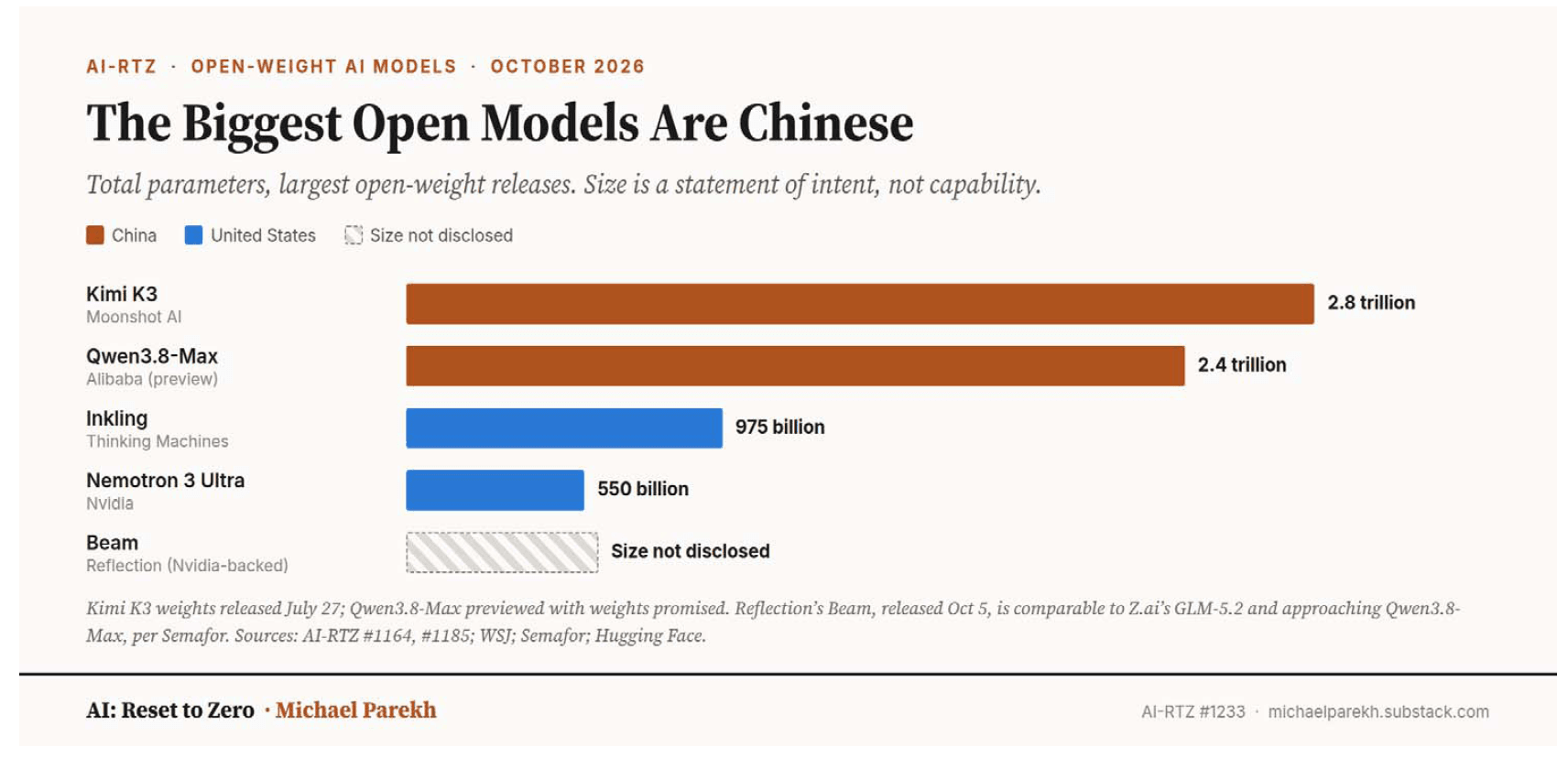
- China is indeed leading open-source AI. From DeepSeek to Kimi K3, China continues to push the frontier of open-source AI, impressing the world with ever-larger and more efficient models. A July 2026 analysis showed 41% of downloads on Hugging Face (leading open-source platform) were for Chinese models. It is necessary to note that, even though open source/weight models are rapidly gaining traction, closed models such as Anthropic’s Claude, OpenAI’s ChatGPT and Google’s Gemini remain highly competitive at the technological frontier.
- China could lead in consumer AI adoption. Huang’s emphasis on AI adoption aligns with our long-held view that AI usage is becoming increasingly important. China enjoys some real advantages in the consumer AI market, given its open-source leadership, enormous population, advanced digital ecosystem, strong consumer hardware industries (EVs, smartphones, home appliances and etc.,) and a more pragmatic approach by leading Chinese companies. We continue to view Tencent as one of the best-positioned companies to benefit from consumer AI adoption in China, given its extensive WeChat ecosystem, large user base and ability to integrate AI into existing consumer and enterprise services. We hereby reiterate our Core Recommendation on Tencent (0700.HK).
- Manufacturing as an underappreciated AI advantage. Huang’s argument that “AI is manufacturing” highlights the growing importance of physical infrastructure and industrial-scale production in AI development, potentially creating opportunities for countries with strong manufacturing ecosystems. If manufacturing is indeed a game changer for the AI industry, China's manufacturing strengths could support AI development through both infrastructure deployment and the mass production of AI-enabled consumer devices, potentially accelerating AI adoption and commercialization. We have written extensively about Chinese manufacturing in our Export Shock 2.0 series this year, including token exports, driverless technologies, robotics and new energy equipment – sectors benefiting from advances in AI to varying degrees.
- Could China become the next US? Huang’s Europe-US analogy is supported by historical precedent: Many foundational technologies of the first two Industrial Revolutions originated in Europe, while the US subsequently excelled at scaling their adoption and commercialization, capturing substantial economic value. This analogy invites a provocative possibility: Could the US lead in AI innovation today, only for China to ultimately win on large-scale AI adoption and commercialization in the future?
“The race is really about who exploits the technology best. You know, the last industrial revolution, all of the inventors were Maxwell, Volta, Ampere. None of them were American… The last industrial revolution came from Europe, but we exploited it. We took advantage of it socially better than anybody else in the world. And look how it turned out for us.” Read on to learn how Jensen Huang’s Europe-US analogy could apply to the US-China AI Race today.
CIO Summary
- China’s AI strengths: too big to ignore. From open-source models to engineering talent, Jensen Huang’s latest remarks reinforce our US-China AI Race theme and highlight several areas where China has meaningful strategic advantages.
- The race is increasingly about adoption and commercialization, not just innovation. China’s open-source leadership, enormous consumer market, advanced digital ecosystem and strength in consumer hardware position it well for mass AI adoption, supporting our positive view on Tencent.
- Manufacturing: China’s underappreciated AI advantage. Huang’s argument that “AI is manufacturing” connects technological innovation with China’s proven strength in high-volume production. It also raises a provocative question: could the US lead in AI innovation today, only for China to ultimately win on AI adoption and commercialization in the future?
Amid the ongoing AI pacing debate, Nvidia CEO Jensen Huang shared his view at the recent All-In Summit, arguing strongly against slowing AI development and advising companies to “run as fast as you can”. The showstopper was a dramatic live call from President Trump, who also voiced his strong support for AI. But that was not the most interesting part of that event.
Below is what Huang said that really grabbed our attention – related to the AI issues at hand but more focused on the US-China AI Race. Readers can access his full speech here on YouTube.
- The world needs both open-source and closed AI models. Closed models offer leading capabilities and convenience, while open-source models are essential for sovereignty, privacy, proprietary applications and broader innovation.
- China is already a major force in open-source AI. Huang argues that much of the world’s open-source contribution is coming from China, supported by its enormous pool of engineering and scientific talent.
- Chinese open-source models do not pose a zero-sum threat. Once a model is openly available, developers elsewhere can download it, modify it and build on top of it. In Huang’s framing, the origin of an open-source model matters less than who ultimately makes the best use of it.
- The real AI race is about adoption, not just invention. Huang thinks the winner (of the US-China AI Race) will be whoever “exploits the technology best”. He drew a parallel with earlier industrial technologies that were invented in Europe (outside the US) but ultimately applied effectively by America.
- China takes a more pragmatic view of AI. In Huang’s view, China focuses on adopting AI as a technology that can advance its economy and society, rather than becoming consumed by catastrophic scenarios (e.g. existential risks to humanity).
- AI itself is becoming a manufacturing industry. Huang describes AI as a new industrial revolution that “requires manufacturing.” His logic is that intelligence must be produced through physical infrastructure: data centers, construction, electricity, power generation, land and supply chains.
- China’s manufacturing strength matters. When discussing China’s ability to develop advanced lithography, Huang says China is “really good at high-volume production” and portrays catching up as “just a matter of time.” He expects China to reach advanced lithography by 2030 and stresses that, from a decades-long perspective, a few years is not very long.
- AI will change engineering rather than eliminate it. Just as engineering existed before coding became central to the profession, Huang expects substantial engineering work to remain even if AI dramatically reduces the amount of coding humans need to do.
Our Take
Huang has spoken positively about China’s AI development on numerous occasions, saying that China is not far behind the US. His latest remarks further confirmed the US-China AI Race as one of our top predictions for 2026, while highlighting several of China’s strategic advantages.
- China is indeed leading open-source AI. From DeepSeek to Kimi K3, China continues to push the frontier of open-source AI, impressing the world with ever-larger and more efficient models. A July 2026 analysis showed 41% of downloads on Hugging Face (leading open-source platform) were for Chinese models. It is necessary to note that, even though open source/weight models are rapidly gaining traction, closed models such as Anthropic’s Claude, OpenAI’s ChatGPT and Google’s Gemini remain highly competitive at the technological frontier.
- China could lead in consumer AI adoption. Huang’s emphasis on AI adoption aligns with our long-held view that AI usage is becoming increasingly important. China enjoys some real advantages in the consumer AI market, given its open-source leadership, enormous population, advanced digital ecosystem, strong consumer hardware industries (EVs, smartphones, home appliances and etc.,) and a more pragmatic approach by leading Chinese companies. We continue to view Tencent as one of the best-positioned companies to benefit from consumer AI adoption in China, given its extensive WeChat ecosystem, large user base and ability to integrate AI into existing consumer and enterprise services. We hereby reiterate our Core Recommendation on Tencent (0700.HK).
- Manufacturing as an underappreciated AI advantage. Huang’s argument that “AI is manufacturing” highlights the growing importance of physical infrastructure and industrial-scale production in AI development, potentially creating opportunities for countries with strong manufacturing ecosystems. If manufacturing is indeed a game changer for the AI industry, China's manufacturing strengths could support AI development through both infrastructure deployment and the mass production of AI-enabled consumer devices, potentially accelerating AI adoption and commercialization. We have written extensively about Chinese manufacturing in our Export Shock 2.0 series this year, including token exports, driverless technologies, robotics and new energy equipment – sectors benefiting from advances in AI to varying degrees.
- Could China become the next US? Huang’s Europe-US analogy is supported by historical precedent: Many foundational technologies of the first two Industrial Revolutions originated in Europe, while the US subsequently excelled at scaling their adoption and commercialization, capturing substantial economic value. This analogy invites a provocative possibility: Could the US lead in AI innovation today, only for China to ultimately win on large-scale AI adoption and commercialization in the future?
Disclosures and disclaimers
This report is provided subject to, and must be read together with, the full Disclosures / Disclaimers available at this link, which are incorporated by reference into this report. In particular, this report is intended for general circulation and informational purposes only and does not constitute personal investment advice or a recommendation to buy or sell any investment product or security. You should independently evaluate the information and, where necessary, seek advice from a qualified financial adviser regarding the suitability of any investment. Analyst certifications required under applicable regulations, including SEC Regulation AC (where relevant), are included in this report. By accessing, receiving or using this report, you acknowledge that you have read, understood and agreed to be bound by the Disclosures / Disclaimers, as may be amended, supplemented or updated from time to time.


