

Wealth Daily
AI Infrastructure Splits As Oil Supply Risks Rise
Today’s Must-Know News
Overnight Markets
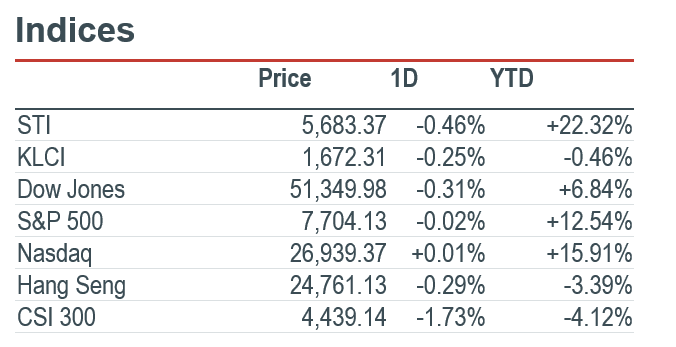
Market Movers: At Thursday’s US close, the S&P 500 edged 0.02% lower. Meta Platforms (META US) rose 4.50% to US$777.59 following Connect’s AI updates, with its Model API becoming generally available. Oracle (ORCL US) fell 3.47% to US$139.54 after a force-majeure notice raised concern over the 2.45GW Project Jupiter campus; the company said the notice itself establishes no delay. In Japan’s 24 September session, Ibiden (4062 JP) gained 14.57% as Meta’s device plans lifted component-demand expectations. (AP / Meta / Bloomberg / Reuters) Meta (META US) is our Core Recommendation.
Macro: On 24 September, Norges Bank raised its policy rate 25bps to 4.50%, citing persistent inflation and business-cost pressure. The SNB held at 0% and Sweden’s Riksbank at 1.75%. Their differing responses highlight the uneven transmission of energy inflation, with Norway prepared to tighten further if needed. (Norges Bank / SNB / Riksbank)
Geopolitical: Trump and Xi welcomed a new trade arrangement at Thursday’s summit and supported continued AI dialogue. The talks preserved engagement, but unresolved tariffs, technology restrictions and differing approaches to AI governance limit the improvement in policy certainty. (Xinhua / Reuters)
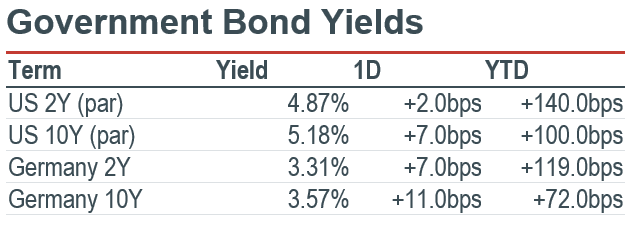
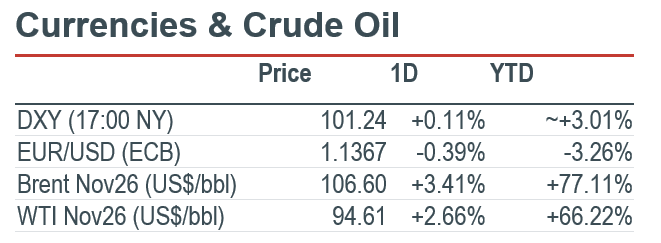
FICC: November Brent settled 3.41% higher at US$106.60/bbl on Thursday after a Houthi attack on Saudi Arabia revived supply fears; WTI rose 2.66% to US$94.61/bbl. Prices pared larger intraday gains as reported US–Iran talks revived hopes for reopening Hormuz. The US 10-year Treasury par yield rose 7bps from 5.11% to 5.18%. Higher energy and financing costs increase pressure on margins and long-duration assets. (Reuters / US Treasury)
AI
Meta broadens its AI developer platform. Meta Platforms (META US) rose 4.50% to US$777.59 at the 24 September US close. Developer-day updates made Meta Model API generally available globally and brought Muse Code out of beta on Windows. Its ecosystem includes the 30bn-parameter open-weights Muse Glimmer for local deployment. Wider distribution expands potential enterprise usage, but developer adoption and paid conversion remain the tests of commercial returns. (Meta / Yahoo Finance) Meta Platforms (META US) is our Core Recommendation.
Oracle exposes AI infrastructure execution risks. Oracle (ORCL US) fell 3.47% to US$139.54 at the 24 September US close. Bloomberg reported a force-majeure notice preserving payment rights if the 2.45GW Project Jupiter misses its 2028 opening; construction financing totals US$18bn. Oracle said the notice establishes no delay, while Blue Owl said commitments remain unchanged. Power and execution risks warrant scrutiny; no financing default or tenant exit was established. (Bloomberg)
Asian AI infrastructure draws large-scale capital. BlackRock-backed AIP and IFM Investors reportedly entered exclusive talks for Stack Infrastructure’s Asia-Pacific data-centre portfolio at a potential US$20–25bn valuation. Assets span Tokyo, Osaka, Sydney and Melbourne, with due diligence ahead. The interest indicates continued demand for capacity despite development risks elsewhere. These are negotiations, not an agreed acquisition: Reuters could not independently verify Bloomberg’s report, and talks could still fail. (Reuters / Bloomberg)
Google advances enterprise conversational video agents. Alphabet’s (GOOGL US) Google Cloud made Gemini 3.8 Live with Live Avatar generally available in Gemini Enterprise, supporting 97 languages, live audio/video and background tool calls. US/EU endpoints and provisioned throughput support production deployment, expanding potential inference demand. Custom avatars still require allowlisting and Extended Thinking remains in private preview; adoption, customer economics and any material revenue contribution remain to be established. (Google Cloud) Alphabet (GOOGL US) is our Trading Buy.
Americas
TD SYNNEX faces a cash-conversion test. TD SYNNEX (SNX US) fell 9.87% to US$259.47 at the 24 September US close despite third-quarter revenue of US$21.558bn, up about 37.7%, and adjusted EPS of US$5.68. Inventories and receivables contributed to US$916.7mn operating cash outflow; gross margin fell 61bps to 6.61%. Fourth-quarter adjusted EPS guidance of US$5.65–6.15 supports earnings momentum, but converting infrastructure demand into cash remains the key execution test. (Company)
Gen Digital’s approach revives GoDaddy deal interest. At the 24 September US close, GoDaddy (GDDY US) gained 4.60% to US$100.81 while Gen Digital (GEN US) fell 12.05% to US$23.07 after the Financial Times reported Gen’s approach. Talks are preliminary, with terms undisclosed. Combining domains, hosting and payments with consumer security offers cross-selling potential, but unresolved price, financing and integration prevent a meaningful assessment of acquisition premiums or earnings accretion. (Bloomberg / Stocktwits)
MGM’s takeover story reverses direction. MGM Resorts (MGM US) dropped 10.99% to US$33.69 at the 24 September US close after People Inc withdrew its take-private proposal the previous evening. Subsequently, Reuters relayed a Wall Street Journal report that MGM was discussing buying People itself. This unconfirmed reverse-bid discussion came after the displayed close. Strategic possibilities reopen, but there is no agreed transaction and funding, valuation and governance remain unresolved. (People Inc / Reuters)
Costco’s earnings include a one-off tariff benefit. After the 24 September US close, Costco (COST US) reported fourth-quarter EPS of US$6.75 versus US$5.87, and revenue of US$95.723bn including US$1.850bn of membership fees. EPS included US$0.15 from non-recurring tariff refunds after partial reinvestment in member value. Comparable sales excluding fuel and currency effects grew about 6.7%. Recurring memberships support earnings, but underlying growth should be assessed excluding the one-off benefit. (Company)
Merck’s trial combines efficacy success with safety questions. Merck’s (MRK US) remigromig met BRUNELLO’s primary endpoint, with both doses non-inferior to ranibizumab for visual-acuity improvement at 52 weeks in diabetic macular oedema. The pivotal trial enrolled 984 participants. Proliferative retinopathy, vitreous haemorrhage and adverse-event discontinuations were more frequent in remigromig arms. The result advances a new mechanism, but safety analysis and clinical differentiation remain critical to commercial value; regulatory approval is unestablished. (Merck / FierceBiotech)
BlackBerry upgrades guidance as QNX leads growth. BlackBerry (BB US) advanced 4.18% to US$8.73 at the 24 September US close. Second-quarter revenue rose 26% to US$163.3mn; QNX sales increased 27% to US$80.3mn. Full-year revenue guidance rose to US$616–636mn from US$594–621mn. The upgrade supports the embedded-software growth case, although Secure Communications revenue increased only 2% and adjusted EBITDA fell 18%, demonstrating uneven progress across the company’s portfolio of software businesses. (Company / MT Newswires)
Darden’s brands show uneven dining demand. Darden Restaurants (DRI US) fell 3.02% to US$207.24 at the 24 September US close. First-quarter sales rose about 5.1% to US$3.2003bn, with continuing-operations EPS of US$2.05. Comparable-calendar same-restaurant growth was about 6.8% at LongHorn but 1.0% at Olive Garden. Full-year EPS guidance remains US$11.10–11.35. The brand divergence suggests selective dining demand; execution and margin delivery remain central to the investment case. (Company)
Greater China
GigaDevice falls as Hong Kong chip shares retreat. GigaDevice (3986.HK) fell 5.12% to HK$489.60 on 24 September, from HK$516.00 in the previous session, as Hong Kong chip shares weakened. The sell-off highlights how quickly semiconductor exposure can reverse despite long-term AI demand expectations. Higher global yields increase the hurdle for growth valuations, making earnings delivery, position sizing and entry discipline more important when assessing the sector’s next move. (New TimeSpace / Market data) GigaDevice (3986.HK) is our Trading Buy.
Summit preserves engagement without resolving policy differences. Trump and Xi welcomed a new trade arrangement at their 24 September White House summit and supported continued dialogue on AI, according to China’s official account. The talks followed an earlier two-month extension of the trade truce. Reuters highlighted unresolved questions over tariffs, rare-earth supplies and technology restrictions, alongside differing approaches to AI governance. Continued engagement reduces immediate confrontation risk, while leaving companies exposed to uncertainty over implementation and future market access. (Xinhua / Reuters)
China limits the pass-through of higher oil costs. China increased retail gasoline and diesel prices from midnight on 25 September by RMB395 and RMB385 per tonne respectively. The NDRC said the pricing formula would otherwise have required increases of RMB830 and RMB800, and retained temporary controls to cushion the domestic economy. The smaller increases soften the immediate cost shock for motorists and logistics operators, while limiting refiners’ ability to pass through rising crude costs in full. (NDRC)
Tongwei clearance supports solar-sector consolidation. China’s competition regulator disclosed unconditional approval of Tongwei’s (600438.SH) acquisition of Qinghai Lihao Clean Energy in a 24 September statement. Despite the parties’ high combined share of solar-grade polysilicon, the regulator judged that ample capacity and numerous competitors would constrain the enlarged business. The decision removes a competition hurdle and supports market-led consolidation, but excess supply remains the central challenge for pricing, utilisation and the economics of integration. (SAMR)
Swap Connect expansion could broaden renminbi hedging. Chinese and Hong Kong clearing infrastructure providers are working on adding standard interest-rate swaps and standard bond forwards to Swap Connect by 2028, Bloomberg reported, citing people familiar with the plans. Clearing volume through the link reached RMB1.7tn in the second quarter, up nearly 48% year on year. More standardised contracts could improve liquidity and hedging for foreign bond investors; the reported expansion remains a plan, with implementation details still unconfirmed. (Bloomberg)
Asia ex. China
SoftBank prices a large bond package for its OpenAI investment. SoftBank Group (9984 JP) priced US$10bn of dollar notes and EUR1bn of euro notes, approximately US$11.1bn in total. Dollar coupons range from 8.625% to 9.75%. Proceeds will fund the final US$10bn tranche of its OpenAI follow-on investment and general corporate needs, while the remaining US$10bn undrawn bridge commitment is being cancelled. The financing secures longer-term funding but increases the recurring interest burden attached to SoftBank’s concentrated AI exposure. (SoftBank)
Ibiden rallies as Japan prices in AI-device demand. Ibiden (4062 JP) jumped 14.57% to JPY22,405 in Japan’s 24 September session, compared with JPY19,555 at the previous close on 18 September before the holiday break. Reuters linked the rally in CPU-related suppliers to Meta’s earlier unveiling of its Charm AI device. The reaction widens investor attention from chip designers to component suppliers, although stronger demand expectations still need to translate into orders, capacity utilisation and margins. (Reuters / Market data)
Multi-Chem’s vendor disruption triggers another sharp sell-off. Multi-Chem (AWZ SP) fell 15.44% to S$2.52 on 24 September, after its previous evening’s disclosure that a key vendor had suspended orders and commercial activities with subsidiary M.Tech. The vendor’s products represented 5–10% of first-half group revenue. Management expects a material adverse effect on full-year earnings and net tangible assets per share, without quantifying it. Replacing the lost business and preserving customer relationships are the immediate operating tests. (Multi-Chem / Market data)
IHH appeals the rejection of its Daiichi damages claim. IHH Healthcare (IHH MK) said its Northern TK subsidiary appealed a Tokyo court’s dismissal of a damages claim against Daiichi Sankyo. The claim, revised in May 2025, seeks up to INR109.3bn, or US$1.14bn, over delays to its Fortis investment. Separately, IHH intends to raise its Fortis stake from 31% to 51% over three to five years. The appeal keeps a potential recovery alive, but legal timing and acquisition execution remain distinct uncertainties. (Reuters)
EMEA and Others
Schneider agrees terms for a smart-home expansion. Schneider Electric (SU FP) plans a EUR70-per-share cash offer for Shelly Group, valuing the smart-device maker at approximately EUR1.2bn. The proposed price is 22% above Shelly’s previous close, and founders controlling about 57% have agreed conditionally to tender. The investment agreement envisages a 95% acceptance threshold and regulatory approvals. Shelly adds connected-home technology and distribution, while the demanding acceptance condition makes deal execution an important consideration. (Shelly Group / Reuters)
H&M’s profit recovery includes a sizeable temporary benefit. H&M (HM B SS) reported June–August operating profit of SEK6.04bn, up about 22.9% year on year, while local-currency sales grew 1%. Operating margin improved to 10.6% from 8.6%, including a temporary 160-basis-point benefit linked to tariffs and import-related costs. The retailer expects September sales growth of 1% in local currencies. The stronger margin is encouraging, but modest demand and the non-recurring benefit warrant separating operational progress from temporary cost relief. (H&M)
Vistry resets its operating model after a substantial loss. Vistry (VTY LN) reported a first-half pretax loss of GBP661.3mn, including GBP475mn of goodwill impairment and a GBP73.2mn building-safety provision. Adjusted pretax loss was GBP83.3mn, while net debt rose to GBP468.8mn. Its review targets a smaller business delivering about 12,000 homes annually and a further GBP50mn of annual overhead savings. The reset prioritises cash release and lower leverage; execution and weak private-market demand remain the key constraints on recovery. (Vistry)
ASOS raises profitability expectations as quarterly sales turn. ASOS (ASC LN) expects full-year adjusted gross margin above 50% and adjusted EBITDA above the midpoint of its GBP150–180mn guidance range. Fourth-quarter gross merchandise value returned to low-single-digit growth, although the full-year measure declined 5%. Net debt fell to about GBP110mn from GBP184.7mn, helped by approximately GBP116mn of property disposals. Better full-price selling supports the recovery, but slightly negative free cash flow shows that sustained organic cash generation remains the next test. (ASOS)
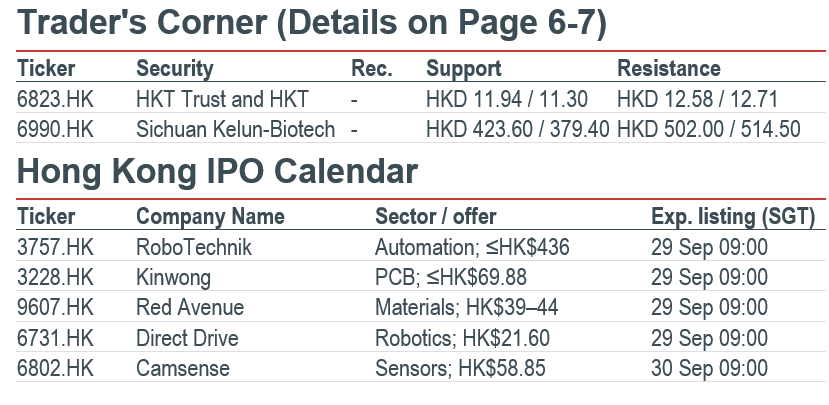
Traders’ corner
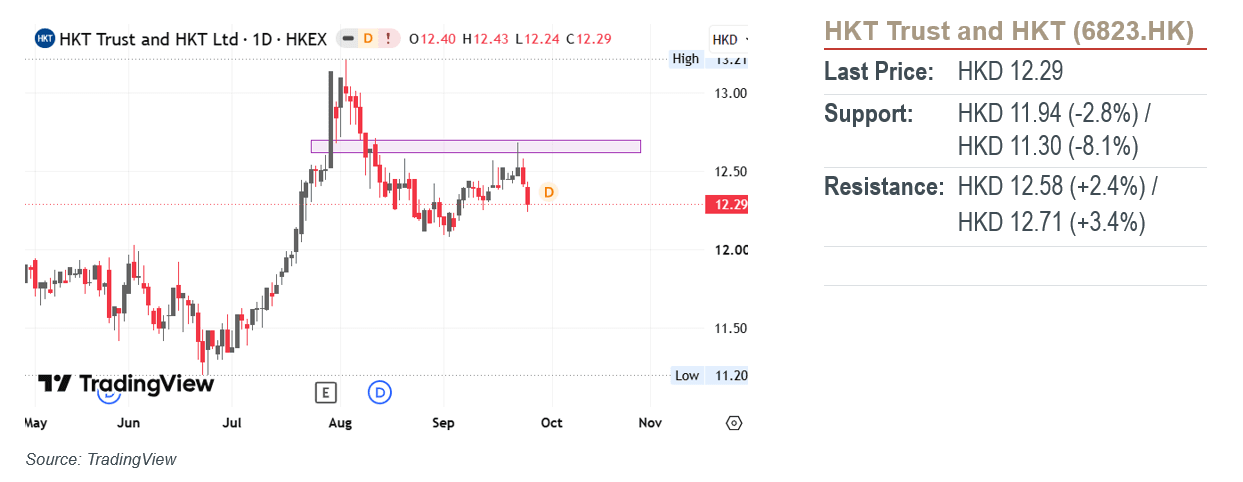
Our Technical View
Price executed a clear rejection at its previous price high resistance zone, resulting in the formation of a distinct lower high.
The RSI has fallen below its neutral 50-midline and continues to slope downward.
- As long as counter-trend rallies remain strictly capped below this overhead resistance ceiling, we could expect continued downward expansion toward lower support targets.
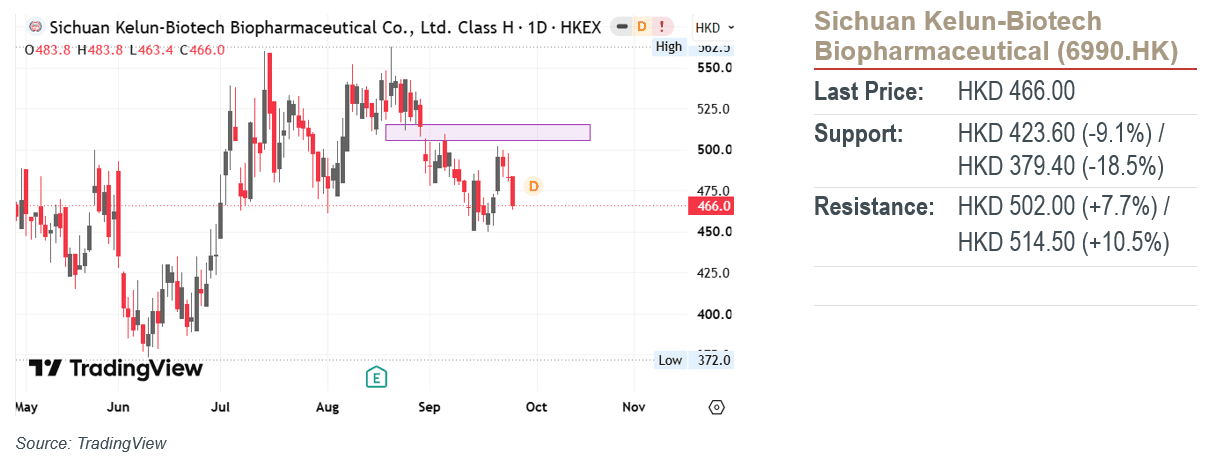
Our Technical View
Price executed a retest into its gap resistance zone, where overhead supply completely capped counter-trend advances.
The RSI remains firmly established below its neutral 50-midline and continues to slope downward.
As long as counter-trend rallies remain strictly capped below this gap resistance, we see a continued downward expansion toward lower support targets.
Market Movers: At Thursday’s US close, the S&P 500 edged 0.02% lower. Meta Platforms (META US) rose 4.50% to US$777.59 following Connect’s AI updates, with its Model API becoming generally available. Oracle (ORCL US) fell 3.47% to US$139.54 after a force-majeure notice raised concern over the 2.45GW Project Jupiter campus; the company said the notice itself establishes no delay. In Japan’s 24 September session, Ibiden (4062 JP) gained 14.57% as Meta’s device plans lifted component-demand expectations. (AP / Meta / Bloomberg / Reuters) Meta (META US) is our Core Recommendation.
Macro: On 24 September, Norges Bank raised its policy rate 25bps to 4.50%, citing persistent inflation and business-cost pressure. The SNB held at 0% and Sweden’s Riksbank at 1.75%. Their differing responses highlight the uneven transmission of energy inflation, with Norway prepared to tighten further if needed. (Norges Bank / SNB / Riksbank)
Geopolitical: Trump and Xi welcomed a new trade arrangement at Thursday’s summit and supported continued AI dialogue. The talks preserved engagement, but unresolved tariffs, technology restrictions and differing approaches to AI governance limit the improvement in policy certainty. (Xinhua / Reuters)
FICC: November Brent settled 3.41% higher at US$106.60/bbl on Thursday after a Houthi attack on Saudi Arabia revived supply fears; WTI rose 2.66% to US$94.61/bbl. Prices pared larger intraday gains as reported US–Iran talks revived hopes for reopening Hormuz. The US 10-year Treasury par yield rose 7bps from 5.11% to 5.18%. Higher energy and financing costs increase pressure on margins and long-duration assets. (Reuters / US Treasury)
AI
Meta broadens its AI developer platform. Meta Platforms (META US) rose 4.50% to US$777.59 at the 24 September US close. Developer-day updates made Meta Model API generally available globally and brought Muse Code out of beta on Windows. Its ecosystem includes the 30bn-parameter open-weights Muse Glimmer for local deployment. Wider distribution expands potential enterprise usage, but developer adoption and paid conversion remain the tests of commercial returns. (Meta / Yahoo Finance) Meta Platforms (META US) is our Core Recommendation.
Oracle exposes AI infrastructure execution risks. Oracle (ORCL US) fell 3.47% to US$139.54 at the 24 September US close. Bloomberg reported a force-majeure notice preserving payment rights if the 2.45GW Project Jupiter misses its 2028 opening; construction financing totals US$18bn. Oracle said the notice establishes no delay, while Blue Owl said commitments remain unchanged. Power and execution risks warrant scrutiny; no financing default or tenant exit was established. (Bloomberg)
Asian AI infrastructure draws large-scale capital. BlackRock-backed AIP and IFM Investors reportedly entered exclusive talks for Stack Infrastructure’s Asia-Pacific data-centre portfolio at a potential US$20–25bn valuation. Assets span Tokyo, Osaka, Sydney and Melbourne, with due diligence ahead. The interest indicates continued demand for capacity despite development risks elsewhere. These are negotiations, not an agreed acquisition: Reuters could not independently verify Bloomberg’s report, and talks could still fail. (Reuters / Bloomberg)
Google advances enterprise conversational video agents. Alphabet’s (GOOGL US) Google Cloud made Gemini 3.8 Live with Live Avatar generally available in Gemini Enterprise, supporting 97 languages, live audio/video and background tool calls. US/EU endpoints and provisioned throughput support production deployment, expanding potential inference demand. Custom avatars still require allowlisting and Extended Thinking remains in private preview; adoption, customer economics and any material revenue contribution remain to be established. (Google Cloud) Alphabet (GOOGL US) is our Trading Buy.
Americas
TD SYNNEX faces a cash-conversion test. TD SYNNEX (SNX US) fell 9.87% to US$259.47 at the 24 September US close despite third-quarter revenue of US$21.558bn, up about 37.7%, and adjusted EPS of US$5.68. Inventories and receivables contributed to US$916.7mn operating cash outflow; gross margin fell 61bps to 6.61%. Fourth-quarter adjusted EPS guidance of US$5.65–6.15 supports earnings momentum, but converting infrastructure demand into cash remains the key execution test. (Company)
Gen Digital’s approach revives GoDaddy deal interest. At the 24 September US close, GoDaddy (GDDY US) gained 4.60% to US$100.81 while Gen Digital (GEN US) fell 12.05% to US$23.07 after the Financial Times reported Gen’s approach. Talks are preliminary, with terms undisclosed. Combining domains, hosting and payments with consumer security offers cross-selling potential, but unresolved price, financing and integration prevent a meaningful assessment of acquisition premiums or earnings accretion. (Bloomberg / Stocktwits)
MGM’s takeover story reverses direction. MGM Resorts (MGM US) dropped 10.99% to US$33.69 at the 24 September US close after People Inc withdrew its take-private proposal the previous evening. Subsequently, Reuters relayed a Wall Street Journal report that MGM was discussing buying People itself. This unconfirmed reverse-bid discussion came after the displayed close. Strategic possibilities reopen, but there is no agreed transaction and funding, valuation and governance remain unresolved. (People Inc / Reuters)
Costco’s earnings include a one-off tariff benefit. After the 24 September US close, Costco (COST US) reported fourth-quarter EPS of US$6.75 versus US$5.87, and revenue of US$95.723bn including US$1.850bn of membership fees. EPS included US$0.15 from non-recurring tariff refunds after partial reinvestment in member value. Comparable sales excluding fuel and currency effects grew about 6.7%. Recurring memberships support earnings, but underlying growth should be assessed excluding the one-off benefit. (Company)
Merck’s trial combines efficacy success with safety questions. Merck’s (MRK US) remigromig met BRUNELLO’s primary endpoint, with both doses non-inferior to ranibizumab for visual-acuity improvement at 52 weeks in diabetic macular oedema. The pivotal trial enrolled 984 participants. Proliferative retinopathy, vitreous haemorrhage and adverse-event discontinuations were more frequent in remigromig arms. The result advances a new mechanism, but safety analysis and clinical differentiation remain critical to commercial value; regulatory approval is unestablished. (Merck / FierceBiotech)
BlackBerry upgrades guidance as QNX leads growth. BlackBerry (BB US) advanced 4.18% to US$8.73 at the 24 September US close. Second-quarter revenue rose 26% to US$163.3mn; QNX sales increased 27% to US$80.3mn. Full-year revenue guidance rose to US$616–636mn from US$594–621mn. The upgrade supports the embedded-software growth case, although Secure Communications revenue increased only 2% and adjusted EBITDA fell 18%, demonstrating uneven progress across the company’s portfolio of software businesses. (Company / MT Newswires)
Darden’s brands show uneven dining demand. Darden Restaurants (DRI US) fell 3.02% to US$207.24 at the 24 September US close. First-quarter sales rose about 5.1% to US$3.2003bn, with continuing-operations EPS of US$2.05. Comparable-calendar same-restaurant growth was about 6.8% at LongHorn but 1.0% at Olive Garden. Full-year EPS guidance remains US$11.10–11.35. The brand divergence suggests selective dining demand; execution and margin delivery remain central to the investment case. (Company)
Greater China
GigaDevice falls as Hong Kong chip shares retreat. GigaDevice (3986.HK) fell 5.12% to HK$489.60 on 24 September, from HK$516.00 in the previous session, as Hong Kong chip shares weakened. The sell-off highlights how quickly semiconductor exposure can reverse despite long-term AI demand expectations. Higher global yields increase the hurdle for growth valuations, making earnings delivery, position sizing and entry discipline more important when assessing the sector’s next move. (New TimeSpace / Market data) GigaDevice (3986.HK) is our Trading Buy.
Summit preserves engagement without resolving policy differences. Trump and Xi welcomed a new trade arrangement at their 24 September White House summit and supported continued dialogue on AI, according to China’s official account. The talks followed an earlier two-month extension of the trade truce. Reuters highlighted unresolved questions over tariffs, rare-earth supplies and technology restrictions, alongside differing approaches to AI governance. Continued engagement reduces immediate confrontation risk, while leaving companies exposed to uncertainty over implementation and future market access. (Xinhua / Reuters)
China limits the pass-through of higher oil costs. China increased retail gasoline and diesel prices from midnight on 25 September by RMB395 and RMB385 per tonne respectively. The NDRC said the pricing formula would otherwise have required increases of RMB830 and RMB800, and retained temporary controls to cushion the domestic economy. The smaller increases soften the immediate cost shock for motorists and logistics operators, while limiting refiners’ ability to pass through rising crude costs in full. (NDRC)
Tongwei clearance supports solar-sector consolidation. China’s competition regulator disclosed unconditional approval of Tongwei’s (600438.SH) acquisition of Qinghai Lihao Clean Energy in a 24 September statement. Despite the parties’ high combined share of solar-grade polysilicon, the regulator judged that ample capacity and numerous competitors would constrain the enlarged business. The decision removes a competition hurdle and supports market-led consolidation, but excess supply remains the central challenge for pricing, utilisation and the economics of integration. (SAMR)
Swap Connect expansion could broaden renminbi hedging. Chinese and Hong Kong clearing infrastructure providers are working on adding standard interest-rate swaps and standard bond forwards to Swap Connect by 2028, Bloomberg reported, citing people familiar with the plans. Clearing volume through the link reached RMB1.7tn in the second quarter, up nearly 48% year on year. More standardised contracts could improve liquidity and hedging for foreign bond investors; the reported expansion remains a plan, with implementation details still unconfirmed. (Bloomberg)
Asia ex. China
SoftBank prices a large bond package for its OpenAI investment. SoftBank Group (9984 JP) priced US$10bn of dollar notes and EUR1bn of euro notes, approximately US$11.1bn in total. Dollar coupons range from 8.625% to 9.75%. Proceeds will fund the final US$10bn tranche of its OpenAI follow-on investment and general corporate needs, while the remaining US$10bn undrawn bridge commitment is being cancelled. The financing secures longer-term funding but increases the recurring interest burden attached to SoftBank’s concentrated AI exposure. (SoftBank)
Ibiden rallies as Japan prices in AI-device demand. Ibiden (4062 JP) jumped 14.57% to JPY22,405 in Japan’s 24 September session, compared with JPY19,555 at the previous close on 18 September before the holiday break. Reuters linked the rally in CPU-related suppliers to Meta’s earlier unveiling of its Charm AI device. The reaction widens investor attention from chip designers to component suppliers, although stronger demand expectations still need to translate into orders, capacity utilisation and margins. (Reuters / Market data)
Multi-Chem’s vendor disruption triggers another sharp sell-off. Multi-Chem (AWZ SP) fell 15.44% to S$2.52 on 24 September, after its previous evening’s disclosure that a key vendor had suspended orders and commercial activities with subsidiary M.Tech. The vendor’s products represented 5–10% of first-half group revenue. Management expects a material adverse effect on full-year earnings and net tangible assets per share, without quantifying it. Replacing the lost business and preserving customer relationships are the immediate operating tests. (Multi-Chem / Market data)
IHH appeals the rejection of its Daiichi damages claim. IHH Healthcare (IHH MK) said its Northern TK subsidiary appealed a Tokyo court’s dismissal of a damages claim against Daiichi Sankyo. The claim, revised in May 2025, seeks up to INR109.3bn, or US$1.14bn, over delays to its Fortis investment. Separately, IHH intends to raise its Fortis stake from 31% to 51% over three to five years. The appeal keeps a potential recovery alive, but legal timing and acquisition execution remain distinct uncertainties. (Reuters)
EMEA and Others
Schneider agrees terms for a smart-home expansion. Schneider Electric (SU FP) plans a EUR70-per-share cash offer for Shelly Group, valuing the smart-device maker at approximately EUR1.2bn. The proposed price is 22% above Shelly’s previous close, and founders controlling about 57% have agreed conditionally to tender. The investment agreement envisages a 95% acceptance threshold and regulatory approvals. Shelly adds connected-home technology and distribution, while the demanding acceptance condition makes deal execution an important consideration. (Shelly Group / Reuters)
H&M’s profit recovery includes a sizeable temporary benefit. H&M (HM B SS) reported June–August operating profit of SEK6.04bn, up about 22.9% year on year, while local-currency sales grew 1%. Operating margin improved to 10.6% from 8.6%, including a temporary 160-basis-point benefit linked to tariffs and import-related costs. The retailer expects September sales growth of 1% in local currencies. The stronger margin is encouraging, but modest demand and the non-recurring benefit warrant separating operational progress from temporary cost relief. (H&M)
Vistry resets its operating model after a substantial loss. Vistry (VTY LN) reported a first-half pretax loss of GBP661.3mn, including GBP475mn of goodwill impairment and a GBP73.2mn building-safety provision. Adjusted pretax loss was GBP83.3mn, while net debt rose to GBP468.8mn. Its review targets a smaller business delivering about 12,000 homes annually and a further GBP50mn of annual overhead savings. The reset prioritises cash release and lower leverage; execution and weak private-market demand remain the key constraints on recovery. (Vistry)
ASOS raises profitability expectations as quarterly sales turn. ASOS (ASC LN) expects full-year adjusted gross margin above 50% and adjusted EBITDA above the midpoint of its GBP150–180mn guidance range. Fourth-quarter gross merchandise value returned to low-single-digit growth, although the full-year measure declined 5%. Net debt fell to about GBP110mn from GBP184.7mn, helped by approximately GBP116mn of property disposals. Better full-price selling supports the recovery, but slightly negative free cash flow shows that sustained organic cash generation remains the next test. (ASOS)
Traders’ corner
Our Technical View
Price executed a clear rejection at its previous price high resistance zone, resulting in the formation of a distinct lower high.
The RSI has fallen below its neutral 50-midline and continues to slope downward.
- As long as counter-trend rallies remain strictly capped below this overhead resistance ceiling, we could expect continued downward expansion toward lower support targets.
Our Technical View
Price executed a retest into its gap resistance zone, where overhead supply completely capped counter-trend advances.
The RSI remains firmly established below its neutral 50-midline and continues to slope downward.
As long as counter-trend rallies remain strictly capped below this gap resistance, we see a continued downward expansion toward lower support targets.
Disclosures and disclaimers
This report is provided subject to, and must be read together with, the full Disclosures / Disclaimers available at this link, which are incorporated by reference into this report. In particular, this report is intended for general circulation and informational purposes only and does not constitute personal investment advice or a recommendation to buy or sell any investment product or security. You should independently evaluate the information and, where necessary, seek advice from a qualified financial adviser regarding the suitability of any investment. Analyst certifications required under applicable regulations, including SEC Regulation AC (where relevant), are included in this report. By accessing, receiving or using this report, you acknowledge that you have read, understood and agreed to be bound by the Disclosures / Disclaimers, as may be amended, supplemented or updated from time to time.


