

Analyst
Elena Chen
elena.chen@uobkh.comAnalyst
Qi Wang, CFA
qi.wang@uobkh.comAnalyst
In collaboration with UOBKH Institutional Research
Key China Market Indices
Index | Price | Past 2-Week Return | YTD Return |
Hang Seng Index | 25,651 | -1.4% | 0.1% |
HSCEI Index | 8,555 | -0.9% | -4.0% |
Hang Seng Tech Index | 4,570 | -4.1% | -17.2% |
Shanghai Composite Index | 3,930 | 0.6% | -1.0% |
CSI 300 Index | 4,548 | -1.5% | -1.8% |
Source: UOB Kay Hian and iFinD, as of Sep 4, 2026
- Factory conditions improve, but the recovery has yet to broaden. China’s official manufacturing PMI edged up to 49.8 in Aug from 49.2 in Jul, while the new orders and production indices returned to expansion at 50.6 and 50.4, respectively. These gains signal firmer factory demand and output, although the headline PMI remained below the 50 threshold. The non-manufacturing business activity index stagnated at 49.0. The macro picture remains mixed: While industrial activity is gaining modest traction, persistent weakness in the broader services continues to drag macro rebound.
- Technology shares weaken despite selective Southbound buying. Over the past two weeks, the Hang Seng Index fell 1.4% and the Hang Seng Tech Index declined 4.1%, even as Southbound investors recorded HKD 17.1bn of net buying. Disclosed trading showed net buying in Alibaba and Tencent despite their share-price declines, alongside net selling in SMIC and Hua Hong. These flows suggest mainland investors were buying selected internet stocks on dips while reducing foundry exposure, pointing to rotation within technology.
- Bank recapitalisation strengthens the foundation for sustainable dividends. On 6 Sep, ICBC and ABC announced proposed capital raises of up to RMB100bn and RMB160bn, respectively. Once completed, these would conclude the six-bank recapitalisation programme announced on Sep 2024, following the other four banks’ capital raises in 2025. Recent profit growth and proposed interim payout increases from 30% to 31% support the income case. We see the additional capital as strengthening banks’ capacity to absorb losses and sustain distributions, while faster lending still requires stronger credit demand. Earnings growth and higher payouts could help offset dilution, although the outcome for dividends per share will depend on final issuance terms and operating performance.
- We remain cautious on China/HK, reinforcing our Barbell Strategy. We favour companies with a clearer path to shareholder returns: structural growth businesses that can convert investment into earnings and cash flow, alongside defensive companies with sustainable dividends. While favorable policy can lift overall sentiment, our bottom-up stock selection remains strictly tethered to fundamental execution and disciplined capital allocation.
- Best-performing sectors: Financials +3.7% (e.g. 0005.HK, 0939.HK, 3988.HK); Energy +1.3% (e.g. 0386.HK, 1088.HK, 1171.HK); Conglomerates +0.6% (e.g. 0267.HK, 0019.HK, 0659.HK).
- Potential movers and shakers: Details inside.
Positive | NAURA Technology (002371.CH), Foxconn Industrial Internet (601138.CH), Han’s Laser (002008.CH), ASMPT (522.HK), Meituan (3690 HK), Anta Sports (2020 HK), Midea Group (000333 CH), Inner Mongolia Yili Industrial Group (600887 CH) |
Neutral | Galaxy Entertainment (27 HK), Sands China (1928 HK), Haier Smart Home (6690 HK) |
Negative | CATL (300750 CH), Shenzhou International (2313 HK), Wuliangye Yibin (000858 CH), COLI (688 HK), CR Land (1109 HK), Longfor (960 HK) |
- Must Watch Events: China Aug trade (Sep 8), CPI/PPI (Sep 9) and activity data (Sep 15); US Aug PPI/CPI (Sep 10-11); ECB (Sep 10), FOMC (Sep 16), BoE (Sep 17) and BoJ (Sep 18) decisions. Apple Event (Sep 9); TSMC Aug sales and ORCL/ADBE earnings (Sep 10). Details below.
Date | Macro Data | Sector / Company Events |
Sep 7 | China Aug foreign exchange reserves; US Labor Day holiday |
|
Sep 8 | China Aug exports, imports and trade balance | Citi Global TMT Conference; Goldman Sachs Communacopia + Technology Conference |
Sep 9 | China Aug CPI and PPI | Apple Event (10am PT) |
Sep 10 | US Aug PPI; initial jobless claims; ECB rate decision and projections | TSMC Aug monthly sales Earnings: ORCL and ADBE |
Sep 11 | US Aug CPI |
|
Sep 15 | China Aug industrial production, retail sales, YTD fixed-asset investment and property data |
|
Sep 16 | FOMC rate decision and economic projections (meeting Sep 15-16) |
|
Sep 17 | BoE rate decision; US initial jobless claims; Aug housing starts and building permits |
|
Sep 18 | BoJ rate decision (meeting Sep 17-18); US Aug industrial production |
|
Best 3 Hang Seng Sectors (Past 2 Weeks)
Hang Seng Sector Index | Past 2-Week Return | YTD Return | Stock Drivers Past 2-Weeks |
Financials | 3.7% | 16.7% | HSBC Holdings Plc (0005.HK) +2.3%, China Construction Bank Corporation (0939.HK) +5.6%, Bank of China Limited (3988.HK) +10.2% |
Energy | 1.3% | 15.5% | China Petroleum & Chemical Corporation (0386.HK) +8.7%, China Shenhua Energy Company Limited (1088.HK) +1.6%, Yankuang Energy Group Company Limited (1171.HK) +4.2% |
Conglomerates | 0.6% | 28.3% | Citic Limited (0267.HK) +5.5%, Swire Pacific Ltd. (0019.HK) +1%, Ctf Services Limited (0659.HK) +2% |
Source: UOB Kay Hian and iFinD, as of Sep 4, 2026
- Financials led with a 3.7% two-week gain, lifting its YTD return to 16.7%. Bank of China, CCB and HSBC gained 10.2%, 5.6% and 2.3%, respectively. For mainland banks, first-half profit growth and higher proposed interim payout ratios support dividend expectations. Bank of China and CCB’s stronger gains are consistent with renewed interest in income. Sustaining dividend growth will depend on resilient earnings and stable asset quality as banks continue to face margin pressure.
- Energy rose 1.3% over two weeks, lifting its YTD gain to 15.5%. Sinopec, China Shenhua and Yankuang Energy advanced 8.7%, 1.6% and 4.2%, respectively. Sinopec’s first-half attributable net profit rose 19.3%, supported by improved refining profitability. The company proposed an interim dividend of RMB0.105 per share. Stronger refining earnings support its capacity to sustain cash distributions.
- Conglomerates gained 0.6% over two weeks, bringing its YTD gain to 28.3%. CITIC, Swire Pacific and CTF Services rose 5.5%, 1.0% and 2.0%, respectively. CITIC’s first-half profit attributable to ordinary shareholders increased 8.1% to RMB33.8bn, while its interim dividend rose 5% to RMB0.21 per share. CITIC’s profit growth is translating into a higher interim dividend, supporting the income case for the stock.
Worst 3 Hang Seng Sectors (Past 2 Weeks)
Hang Seng Sector Index | Past 2-Week Return | YTD Return | Stock Drivers Past 2-Weeks |
Real Estate | -4.5% | 2.7% | China Resources Land Ltd. (1109.HK) -13.8%, Sun Hung Kai Properties Ltd. (0016.HK) -6.8%, Henderson Land Development Co. Ltd. (0012.HK) -9.8% |
Consumer Staples | -4.7% | -13.3% | Wh Group Limited (0288.HK) -11.5%, China Resources Beer (Holdings) Company Limited (0291.HK) -8.2%, China Feihe Limited (6186.HK) -12% |
Consumer Discretionary | -6.9% | -20.4% | Alibaba Group Holding Limited (9988.HK) -10.5%, Byd Company Limited (1211.HK) -7.5%, Meituan (3690.HK) -3.8% |
Source: UOB Kay Hian and iFinD, as of Sep 4, 2026
- Real estate fell 4.5% over two weeks, reducing its YTD gain to 2.7%. CR Land, Sun Hung Kai Properties and Henderson Land declined 13.8%, 6.8% and 9.8%, respectively, with weakness spanning mainland and Hong Kong developers. CR Land’s recurring revenue grew 9.9% and core profit rose 1.6%, yet total revenue fell 28.5% as development revenue weakened. Recurring income provides a cushion, but does not resolve the pressure on development activity. A sustained recovery needs stronger property sales and cash collection.
- Consumer staples fell 4.7% over two weeks, extending its YTD decline to 13.3%. WH Group, CR Beer and Feihe lost 11.5%, 8.2% and 12.0%, respectively, showing weakness across meat, beer and infant formula. CR Beer’s first-half revenue rose just 1.2%, while reported profit fell 10.7%, partly due to a smaller headquarters-relocation gain. Excluding that gain, EBIT edged down approximately 0.9% yoy. This points to subdued underlying earnings growth, rather than an operating decline as steep as the headline profit figure suggests.
- Consumer discretionary was the weakest sector, down 6.9% over two weeks and 20.4% YTD. Alibaba, BYD and Meituan fell 10.5%, 7.5% and 3.8%, respectively. The decline spanned platforms and autos, but Meituan illustrates why stronger reported earnings may not be enough. Meituan’s adjusted second-quarter net profit rose 69% yoy. Management expected third-quarter food-delivery profit per order to remain positive and improve year on year, although seasonal marketing expenditure and higher rider costs would weigh on profitability sequentially. A durable recovery requires more consistent margins and disciplined spending.
Southbound Trading Summary (Past 2 Weeks)
(HKD millions) | Ticker | Total Buy | Total Sell | Net Buy (Sell) | % of Total Turnover | Past 2-Week Return | Data |
Southbound Total | HSHKI.HK | 488,335 | 471,204 | 17,131 | 35% | -1.4% | Full |
BABA-W | 9988.HK | 24,051 | 22,370 | 1,680 | 17% | -10.5% | Full |
TENCENT | 0700.HK | 20,981 | 19,410 | 1,571 | 23% | -3.1% | Partial |
Z.AI | 2513.HK | 19,885 | 20,396 | (511) | 36% | -4.8% | Partial |
MINIMAX-W | 0100.HK | 20,165 | 16,747 | 3,419 | 36% | 4.1% | Partial |
YOFC | 6869.HK | 19,597 | 16,898 | 2,698 | 47% | 13.9% | Partial |
SMIC | 0981.HK | 14,036 | 16,718 | (2,682) | 41% | -7.3% | Partial |
KB LAMINATES | 1888.HK | 14,008 | 14,180 | (172) | 41% | 18.6% | Partial |
HUA HONG GRACE | 1347.HK | 5,366 | 8,118 | (2,752) | 32% | -4.4% | Partial |
MEITUAN-W | 3690.HK | 4,436 | 4,900 | (465) | 23% | -3.8% | Partial |
XIAOMI-W | 1810.HK | 4,554 | 4,094 | 459 | 27% | -2.0% | Partial |
Source: UOB Kay Hian and iFinD, as of Sep 4, 2026.
Note: Based on the two-week period from Aug 24 to Sep 4, 2026. For Stock Connect Southbound trading, only the top 10 most actively traded securities are disclosed. “Full data” means the stock appeared on the top 10 list for each of the past few trading days. “Partial data” means otherwise.
- Southbound investors remain net buyers through the market decline. Gross turnover reached HKD 959.5bn, comprising HKD 488.3bn of buying and HKD 471.2bn of selling. Net purchases of HKD 17.1bn represented about 1.8% of gross turnover, while the Hang Seng Index fell 1.4%. Buying and selling were therefore closely balanced despite substantial trading activity. Disclosed stock-level flows showed buying in selected internet names alongside selling in foundries.
- Buying accompanies gains in MiniMax and YOFC and weakness in Alibaba and Tencent. MiniMax recorded HKD 3.42bn of disclosed net buying and YOFC HKD 2.70bn, alongside share-price gains of 4.1% and 13.9%, respectively. Alibaba and Tencent attracted HKD 1.68bn and HKD 1.57bn of net buying despite falling 10.5% and 3.1%. The net purchases in Alibaba and Tencent suggest mainland investors were buying on dips, although the shares continued to weaken over the period. Alibaba and Tencent remain our Core Recommendation.
- Foundry outflows suggest reduced exposure; KB Laminates selling points to profit-taking. SMIC and Hua Hong recorded disclosed net selling of HKD 2.68bn and HKD 2.75bn as their shares fell 7.3% and 4.4%, respectively, consistent with investors reducing foundry exposure. KB Laminates saw HKD 0.17bn of net selling despite an 18.6% gain, suggesting profit-taking into strength. The contrast with buying in MiniMax and YOFC points to rotation within technology.
Stocks: Potential Movers and Shakers
Stock | Sector | Type of Events | Our Take |
CATL (300750 CH) | Consumer Discretionary | Legal / Regulatory | Negative |
- CATL's stock price has come under pressure recently, with the following two events adding to negative sentiment:
- Hungary plant: On 31 Aug 26, CATL's Debrecen plant was ordered to suspend cell production after nine employees were exposed to excessive nickel levels. Remediation is partly complete, but authorities only allow equipment commissioning, not production. The 40GWh Phase 1, originally targeted for Mar/Apr 26, is now delayed until at least 1Q27. Mercedes-Benz has already shifted VLE battery supply to China, with CATL bearing extra logistics costs of Rmb0.2b-0.5b annually. As 2026 was always intended to be a ramp-up year (20-30% utilisation), the delay mainly erodes the margin premium: overseas gross margin is 30% vs 21% domestically. Expected 2026 Hungary revenue of ~Rmb7b is largely lost, though ~Rmb2.5b of Mercedes orders shift to China (revenue is retained, but at a lower margin). The net EBITDA drag for 2026 is estimated at Rmb1.5b-2.0b.
- Xiaxianwo mine: On 26 Aug, the EIA was revoked because CATL posted the public notice on a commercial website rather than the legally required platform. The mine has been idle since Aug 25. Full capacity is ~100kt of lithium carbonate, but the market had expected a Sep 26 restart, now pushed to 1Q27 at the earliest. In 2026, the mine was only expected to contribute in Q4 (2-3 months of ramp-up), worth ~Rmb0.15b-0.25b in cost savings. With those savings now eliminated, the incremental 2026 loss is Rmb0.15b-0.25b.
- Bottom line: The combined 2026 earnings drag is ~Rmb1.7b-2.3b, representing 1.8-2.5% of our Rmb93.6b 2026 net profit forecast. Assuming both projects restart by 1Q27, the 2027 impact is limited to Q1 only (~Rmb0.4-0.6b), or 0.34-0.52% of our Rmb116.4b 2027 forecast. Residual impact in 2028 is negligible (<0.1% of Rmb139.1b). We believe the 15% stock pullback is overdone, the quantified earnings drag is only ~2% of 2026 net profit, and recommend bottom fishing on share price weakness. (Zeng Sheng Di)
Stock | Sector | Type of Events | Our Take |
NAURA Technology (002371.CH) Foxconn Industrial Internet (601138.CH) Han’s Laser (002008.CH) ASMPT (522.HK) | Information Technology | Channel Check | Positive |
- Execution and earnings visibility matter. Investors are looking for names with strong execution and those that help resolve supply chain shortages. Compared with the bottleneck trade in 1H26, investors have in recent months increasingly shifted their focus to names with solid execution and high earnings visibility, and to segments that can help resolve supply shortages.
- NVIDIA partners benefit from smoother ramp-ups. Key beneficiaries include the NVIDIA supply chain, as NVIDIA’s solid execution and dominant bargaining power mean that it faces fewer supply constraints. Key supply chain partners such as Foxconn Industrial Internet (FII) are therefore likely to enjoy a smooth production ramp-up over the next few quarters.
- We also like ASMPT and NAURA, which help resolve supply shortages in advanced packaging and advanced foundry capacity respectively.
- Han’s Laser, on the other hand, is expected to expand its PCB drilling tool capacity aggressively through 2026-27, gaining share from its more conservative Japanese and Taiwanese competitors. As PCB drilling is one of the tightest-supplied areas, Han’s Laser is also one of the primary enablers in resolving supply bottlenecks. (Johnny Yum)
Stock | Sector | Type of Events | Our Take |
Meituan (3690 HK) | Consumer Discretionary | Earnings | Positive |
- Second-quarter earnings support our pre-results Trading Buy. On 28 Aug, Meituan reported adjusted second-quarter net profit of RMB2.52bn, up 69% yoy. Management expected third-quarter food-delivery profit per order to remain positive and improve yoy, despite seasonal cost pressures weighing on profitability sequentially.
- Everyday local demand offers an opportunity amid economic weakness. A weak economy encourages consumers to seek value and reduce spending per purchase, but does not necessarily eliminate demand for convenient meals and everyday services. Meituan’s exposure to frequent local transactions therefore offers a degree of resilience, although order values and margins remain under pressure. Its merchant coverage and delivery density can support competitively priced services while improving fulfilment efficiency. If subsidy competition eases, better profit per transaction could drive earnings recovery even without a broad rebound in consumer spending.
- Maintain Trading Buy as improving transaction profitability supports earnings recovery. We added Meituan ahead of its results to capture the recovery in local-services earnings. Competition remains the key risk: renewed subsidies that fail to improve customer retention or profit per order would weaken our tactical case. (Elena Chen)
Stock | Sector | Type of Events | Our Take |
Galaxy Entertainment (27 HK) Sands China (1928 HK) | Consumer Discretionary | Macro / Industry Data | Neutral |
- Aug 26’s GGR missed market consensus by 2%. Macau’s Aug 26 gross gaming revenue (GGR) reached MOP21.9b, down 1% yoy but up 8% mom, as July was impacted by the FIFA World Cup. August’s GGR figure missed market consensus by 2% and recovered to 90% of 2019’s level (vs a recovery of 83% in July 26). For 8M26, GGR rose by 4% yoy to MOP169.1b.
- Macau’s July visitation was up 2% yoy and flat vs 2019. In Jul 26, Macau’s total visitation reached 3.5m, up 2% yoy and 26% mom, broadly in line with 2019’s level. Of these 3.5m visitors, Mainland Chinese visitors accounted for 2.7m, up 5% yoy and 39% mom, while same-day visitors totalled 2.1m, up 6% yoy and 29% mom. The average length of stay for visitors remained unchanged mom at 1.7 days. For 7M26, cumulative visitation increased 8% yoy to 24.5m, up 3% vs 2019’s level, with growth driven by same-day visitor numbers, which jumped 14% yoy, while overnight visitor numbers remained flat yoy.
- Maintain OVERWEIGHT; Galaxy remains our top pick. We maintain Galaxy’s target price at HK$47.00, based on a 12.0x target 2026 EV/EBITDA ratio. (Stella Guo/Ejann Hiew)
Stock | Sector | Type of Events | Our Take |
Anta Sports (2020 HK) | Consumer Discretionary | Earnings | Positive |
- Solid 1H26 results; operating margin a beat. Anta Sports reported its 1H26 results, with revenue of Rmb43,507mn (+13% yoy, +4% hoh). By segment, the core Anta brand/FILA/all other brands recorded revenue growth of 5%/6%/44% yoy, respectively. Gross profit was Rmb27,792mn (+14% yoy, +10% hoh), with gross margin at 63.9% (+0.5ppt yoy, +3.1ppt hoh). Operating profit was Rmb11,760mn (+16% yoy, +31% hoh), with operating margin at 27.0% (+0.7ppt yoy, +5.5ppt hoh). Core net profit was Rmb7,938mn (+13% yoy, +21% hoh), with net margin at 18.2% (flat yoy, +2.5ppt hoh).
- Confident in achieving full-year targets. Despite a softer consumption trend since 2Q26, management is confident in achieving its full-year retail sales growth targets (low single-digit growth for the Anta brand, mid-single-digit growth for FILA, and over 20% for other brands), as well as operating margin targets (around 20% for the Anta brand, around 25% for FILA, and over 25% for other brands).
- Jack Wolfskin repositioned to focus on heavy-duty trekking; China store rollout in September-October. Management has repositioned Jack Wolfskin to focus on heavy-duty trekking, emphasising functionality, technique and fabric with the aim of narrowing the SKU range and concentrating on quality apparel. On the channel side, the company plans to expand the brand through direct-to-consumer (DTC) channels in China, with around five key stores targeted in September-October, mostly in northern China. In Europe, expansion will be slower, with new store concepts tested in spring next year before scaling up. The brand remained loss-making in 1H26, and management expects a slightly narrower loss in 2H26.
- Anta brand’s long-term strategy remains intact; overseas revenue expected to reach Rmb10b within five years. Regarding the recent change in the Anta brand’s leadership, management emphasised that the long-term strategy remains intact, centred on mass-market positioning and brand elevation. Looking ahead, management noted that overseas expansion remains a longer-term priority, with overseas revenue growing over 30% in 1H26 and a first-stage target of Rmb10b within around five years, starting with Southeast Asia and subsequently the Middle East, Europe and the US.
- Maintain BUY and raise target price by 4% to HK$112.20. We raise our 2026/27 earnings forecasts by 2%. We lift our DCF-based target price by 4% to HK$112.20. Our target price implies 19.2x 2026F PE and 17.7x 2027F PE. (Stella Guo/Ejann Hiew)
Stock | Sector | Type of Events | Our Take |
Haier Smart Home (6690 HK) | Consumer Discretionary | Earnings | Neutral |
- 2Q26 sales better than expected and net profit in line. In 2Q26, Haier’s revenue was Rmb78,428m, up 1% yoy, ahead of the company's previous guidance of flat yoy growth. Gross margin was 29.0%, up 0.6ppt yoy. EBIT was Rmb7,219m, down 4% yoy, with EBIT margin of 9.2%, down 0.5ppt yoy. Gross margin expansion and R&D expense savings (-0.7ppt yoy) were offset by higher SG&A expenses (+1.9ppt yoy), primarily driven by ToC channel transformation in the domestic market and overseas market expansion. Net profit was Rmb5,665m, down 13% yoy, with net margin of 7.2%, down 1.2ppt yoy.
- HVAC integration delivering benefits; targets double-digit revenue and operating profit growth in 2H26. Under the reclassified categories, in 1H26, revenue from smart home appliances (including refrigerators/freezers, kitchen appliances and laundry appliances) and other businesses declined by 6% and 5% yoy, respectively, while revenue from smart HVAC solutions (including air-conditioners and water appliances) increased by 6% yoy. Following the HVAC integration that streamlined and optimised the segment, management expects HVAC revenue and operating profit to both achieve double-digit growth in 2H26. In overseas markets in particular, it expects double-digit growth in 2026 and around 15% growth in 2027-28.
- Overseas revenue increased by 2% in 2Q26; targets low single-digit five-year CAGR in North America. By region, in 1H26, revenue from the domestic market declined by 5% yoy, while revenue from overseas markets remained largely flat (domestic revenue remained largely flat and overseas revenue increased by 2% in 2Q26). Revenue from North America declined by 3% (in US dollar terms), while revenue from Europe increased by 5%, South Asia by 17% and Southeast Asia by 13%. Looking ahead, management sets five-year growth targets of low single digits in North America, high single digits in Europe, 15-20% in Southeast Asia, and nearly 30% in South Asia & Latin America.
- Overseas gross margin improvement helped by tariff refunds. By region, in 2Q26, gross margin improved by 0.7ppt yoy to 34% in the domestic market, supported by SKU reduction and supplier platform opening, and by 0.6ppt yoy to 25% in overseas markets, helped by tariff refunds. Regarding operating margin, the domestic operating margin was nearly double-digit, down around 1ppt yoy, while the overseas operating margin remained roughly flat yoy.
- Maintain BUY and cut target price by 4% to HK$28.30. We lower our 2026/27 earnings forecasts by 9%/7%, respectively. We lower our DCF-based target price by 4% to HK$28.30. Our target price implies 12.6x 2026F PE and 11.3x 2027F PE. (Stella Guo/Ejann Hiew)
Stock | Sector | Type of Events | Our Take |
Midea Group (000333 CH) | Consumer Discretionary | Earnings | Positive |
- 2Q26 results in line. Midea’s 2Q26 revenue was Rmb129,472m (+5% yoy, -2% qoq). Gross profit was Rmb32,680m (+1% yoy, -4% qoq), with gross margin at 25.2% (-0.9ppt yoy, -0.6ppt qoq). EBIT was Rmb13,644m (+9% yoy, -4% qoq), with EBIT margin of 10.5% (+0.4ppt yoy, -0.3ppt qoq). Net profit was Rmb13,771m (+1% yoy, +9% qoq), with net margin of 10.6% (-0.3ppt yoy, +1.0ppt qoq).
- ToC segment: 2Q26 domestic sales grew by low single digits and overseas sales grew by over 10%. In 2Q26, revenue growth accelerated to over 5% yoy, led by overseas markets, which grew over 10%, while domestic sales grew by low single digits. By product, air-conditioner sales grew by low single digits (domestic: flat, overseas: over 5%), refrigerator and washing-machine sales grew by over 10% (domestic: nearly 10%, overseas: over 15%), and kitchen-appliance sales grew by around 5% (domestic: down high single digits, overseas: nearly 15%).
- ToC segment – domestic: Expect better performance in 2H26. For the domestic market, air-conditioner sales (in terms of installation cards) declined by high single digits in July while August saw high single-digit growth. Looking ahead to 2H26, although demand remains subdued and competition is fierce, an easier comparable base should help support performance, making 2H26 better than 1H26.
- ToC segment – overseas: OBM accounts for 50% of overseas ToC revenue; expect faster OBM growth in 2H26 than in 1H26. In 1H26, original brand manufacturer (OBM) revenue grew nearly 15% yoy, with 1Q26 up 10% and growth momentum further accelerating in 2Q26. OBM now accounts for over 50% of overseas ToC revenue, marking a key milestone. In July-August, overseas orders grew nearly 15% yoy, with OBM outpacing the overall overseas orderbook. Management expects OBM growth to accelerate further in 2H26 vs 1H26, and to maintain a solid growth pace in 2027-28. In terms of profitability, the original equipment manufacturer (OEM) business remains ahead of domestic sales, while OBM ranks lowest.
- ToB segment: Building technology led growth; expect ToB segment revenue growth to outpace ToC in 2H26. In 1H26, ToB revenue grew 3% yoy, with the domestic market roughly flat and overseas markets up high single digits. In 2Q26, ToB revenue grew 3%, with domestic and overseas markets expanding at a similar pace. Building technology revenue grew over 10% (both domestic and overseas markets up more than 10%), robotics & automation (KUKA) revenue grew nearly 10% yoy (domestic: over 30%, overseas: low single digits), and industrial technology revenue fell over 10% yoy (both domestic and overseas markets down over 10%), as the segment is closely tied to the pressured AC business. Management expects ToB segment revenue growth to outpace ToC in 2H26.
- Full-year guidance maintained; expect tariff refunds to be recognised in 2H26. For the full year, management maintains its guidance of mid-to-high single-digit revenue growth and a stable net margin. Tariff refunds are expected to be reflected in 2H26 (not yet reflected in 1H26).
- Maintain BUY and keep target price unchanged at Rmb112.60. We lower our 2026/27 earnings forecasts by 1%/2%, respectively. We maintain our SOTP-based target price at Rmb112.60. Our target price implies 18.4x 2026F PE and 17.3x 2027F PE. (Stella Guo/Ejann Hiew)
Stock | Sector | Type of Events | Our Take |
Shenzhou International (2313 HK) | Consumer Discretionary | Earnings | Negative |
- 1H26 earnings at the mid-point of the profit-warning range but gross margin a miss. Shenzhou reported 1H26 revenue of Rmb14,179m (-5% yoy, -12% hoh). Gross profit was Rmb3,197m (-21% yoy, -22% hoh), with gross margin at 22.6% (-4.5ppt yoy, -3.1ppt hoh). Net profit was Rmb1,905m (-40% yoy, -28% hoh), landing at roughly the mid-point of the guided range (profit warning range of a 38-43% yoy decline to Rmb1,811m-1,970m), with net margin at 13.4% (-7.8ppt yoy, -3.1ppt hoh). The sharp net profit decline can be attributed to: a) gross margin contraction, b) a forex loss of Rmb506m (vs a forex gain of Rmb126m in 1H25), c) higher SG&A ratio (+0.4ppt yoy), and d) lower government incentives of Rmb112m (vs Rmb274m in 1H25). The company declared an interim dividend of HK$0.88 per share, implying an interim dividend payout ratio of 61.5% (vs 60.0% in 1H25).
- Expect sales volume to remain largely stable and ASP to gradually recover in 2H26. In 1H26, the revenue decline was primarily driven by a decline in sales volume due to rising product complexity, while ASP in renminbi terms was flat yoy, despite a 4% yoy increase in US dollar terms. Looking ahead, management expects relatively stable order volumes in 2H26, with declines for Nike and PUMA narrowing, while Uniqlo and Adidas continue to drive growth. ASP is expected to gradually recover.
- Gross margin decline due to wage increases, rising raw material prices, forex and tariffs; expect sequential recovery in 2H26. Management attributed the 4.5ppt yoy gross margin decline to: a) increases in salary and retirement benefit expenses, which contributed 1.5ppt of the gross margin contraction; b) rising raw material prices, which contributed 1.3ppt; c) forex, which contributed 1.3ppt; and d) tariff sharing. Looking ahead, management expects sequential gross margin recovery in 2H26.
- Indonesia production capacity ramp-up expected from 2028. Regarding the Indonesia production base, management mentioned that the land handover had already been completed and construction would start the following month, with capacity only ramping up gradually from 2028. Total capex is expected to be US$160m-200m (approximately Rmb1.1b).
- Maintain BUY but cut target price by 9% to HK$55.80. We lower our 2026/27 earnings forecasts by 11%. Our DCF-based target price is lowered by 9% to HK$55.80. Our target price implies 17.4x 2026F PE and 14.0x 2027F PE. (Stella Guo/Ejann Hiew)
Stock | Sector | Type of Events | Our Take |
Wuliangye Yibin (000858 CH) | Consumer Staples | Earnings | Negative |
- 2Q26 revenue beat but net profit was at the lower end of the preliminary results range. Wuliangye’s 2Q26 revenue was Rmb5,579m (-13% yoy). Gross profit was Rmb4,219m (-12% yoy), with gross margin of 75.6% (+1.0ppt yoy). Net profit was Rmb690m, at the lower end of the range in the preliminary results announcement, up 233% yoy, with net margin of 12.4% (+9.1ppt yoy). The surge in net profit was primarily driven by a decline in sales tax (-29.5ppt yoy), higher other income (+4.1ppt yoy) and lower administrative and other operating expenses (+1.3ppt yoy), partially offset by higher selling and marketing expenses (+16.3ppt yoy) and higher income tax (+11.8ppt yoy).
- Wuliangye series to drive revenue growth. By product, in 1H26, Wuliangye series revenue grew 73% yoy to Rmb23.6b, accounting for 83% of total revenue (vs 58% in 1H25), while non-Wuliangye series revenue fell 60% yoy to Rmb3.2b.
- Cash inflow from sales of goods declined 61% yoy. At end-1H26, the company’s contract liabilities stood at Rmb10.4b, increasing 4% yoy. Cash inflow from sales of goods and services was Rmb12.2b in 2Q26, down 61% yoy and 9% qoq.
- Cut target price by 15% to Rmb78.50; maintain HOLD. We lower our 2026/27 earnings forecasts by 12%/11%, respectively. We maintain HOLD and cut our DCF-based target price by 15% to Rmb78.50. Our target price implies 20.4x 2026F PE and 19.7x 2027F PE. (Stella Guo/Ejann Hiew)
Stock | Sector | Type of Events | Our Take |
Inner Mongolia Yili Industrial Group (600887 CH) | Consumer Staples | Earnings | Positive |
- 2Q26 revenue missed; operating margin expansion better than expected; net profit decline due to one-offs. Yili’s 2Q26 revenue was Rmb29,665m, up 3% yoy. Operational gross margin was 34.2%, broadly flat yoy. EBIT totalled Rmb2,908m, up 8% yoy, with EBIT margin at 9.8%, up 0.5ppt yoy, driven by SG&A expense savings of 0.4ppt yoy. Net profit was Rmb364m, down 84% yoy, with net margin at 1.2%, down 6.8ppt yoy. Excluding the impairment losses related to Ausnutria, we estimate that core net profit decreased by 15% in 2Q26, due to an income tax adjustment payment.
- Mid-single-digit revenue growth target reiterated; aims for accelerated growth in liquid milk in the future. By product, in 2Q26, liquid milk/milk powder and dairy products/frozen dairy recorded yoy revenue changes of flat/-4%/+13% (vs +2%/+6%/+7% in 1Q26), respectively. Management has reiterated its full-year revenue growth target of mid-single digits. Looking further ahead, the company expects accelerated growth in the future (in 2027 at the earliest, per our understanding).
- Expect Ausnutria to turn profitable in 2H26. Management attributed the decline in the milk powder business to a drag from Ausnutria due to international supply chain disruptions and inventory adjustments, while Jinlingguan achieved mid-to-high single-digit growth with market share rising 1.2ppt. Looking ahead, management expects Ausnutria to turn profitable in 2H26, following active channel structure optimisation and refined inventory management in 1H26. For other products, the ToB business grew by double digits and is expected to sustain double-digit growth for the full year.
- Share buyback of Rmb1b-2b; reaffirmed dividend payout above 75%. On shareholder returns, the company announced a Rmb1b-2b buyback, and reaffirmed its 2025-27 dividend commitment to maintain a payout ratio above 75%, with the dividend amount not falling below the 2024 level.
- Maintain BUY and keep target price unchanged at Rmb32.40. We lower our 2026 earnings forecast by 1%, while raising our 2027 earnings forecast by 3%. We keep our DCF-based target price unchanged at Rmb32.40. Our target price implies 19.6x 2026F PE and 15.3x 2027F PE. (Stella Guo/Ejann Hiew)
Stock | Sector | Type of Events | Our Take |
COLI (688 HK), CR Land (1109 HK), Longfor (960 HK) | Real Estate | Legal / Regulatory | Negative |
- China moved to reform the housing presale system and rebuild the sector's funding chain over the past two weeks. On 28 Aug 26, MOHURD, the Ministry of Natural Resources and the NFRA issued the Notice on Improving the Commodity Housing Sales System, which: a) prioritises completed-home sales for newly granted land; b) lifts the presale threshold to structural topping-out of each building from 25% of total investment; and c) escrows all buyer funds until completion acceptance. The PBOC, NFRA and CSRC added six companion documents, extending development loan tenors to five/seven years and personal mortgage tenors to 40 years, and deferring mortgage disbursement on presold homes to completion filing.
- Negative for developers' financials in the near term, positive for medium-term supply and margins. Presale proceeds are the sector's largest funding source, deposits and advance receipts were 31.4% of developers' funds raised in 7M26, against 13.8% from domestic loans, so tighter presale requirements and full escrow until completion acceptance directly slow the sales-to-cash cycle. We expect new-home supply to be delayed by 12-18 months, contract liabilities to shrink, net gearing to rise and land investment to tighten. In the medium term, this mechanism will support pricing and margins, as less new supply meets lower land premiums.
- Maintain UNDERWEIGHT on China's property sector. Tighter access to presale proceeds and a longer cash conversion cycle will increase balance sheet and earnings recognition pressure in the near term. We will reassess our rating once there is greater clarity on the impact on earnings. We use contract liabilities to cash as a proxy for reliance on presale funding: COLI's 1.11x on FY25 data is the lowest among major developers, and its Tier 1 exposure should let it benefit earlier from any sales recovery and margin stabilisation. COLI remains our top pick. (Damon Shen, Liu Jieqi)
Type of Events | Explanation |
Channel Checks | Industry-wide or supply chain news with implications to a particular sector or company |
Corporate Action | Dividends, special dividends, stock splits, share buybacks, equity / bond financing, M&As, spin-offs and restructuring etc. |
Earnings | Quarterly earnings for US-listed companies. Semi-annual earnings for Hong Kong-listed companies |
Insider Dealing | Company insiders’ buying / selling of stocks and derivatives of the company |
Investor Action | Lead investor buying / selling including activist investor actions |
Investor Roadshow | Deal and non-deal roadshows, reverse roadshows (analyst days), and company meetings at investment conferences |
Legal / Regulatory | Lawsuits, legislature/regulation changes, other regulatory events |
Macro / Industry Data | Regular economic or industry data related to the sector or stock |
Sales / Products | Sales or product related news, such as monthly sales or new product launches |
Public Event | Public speeches and appearances by companies in the media or industry conferences |
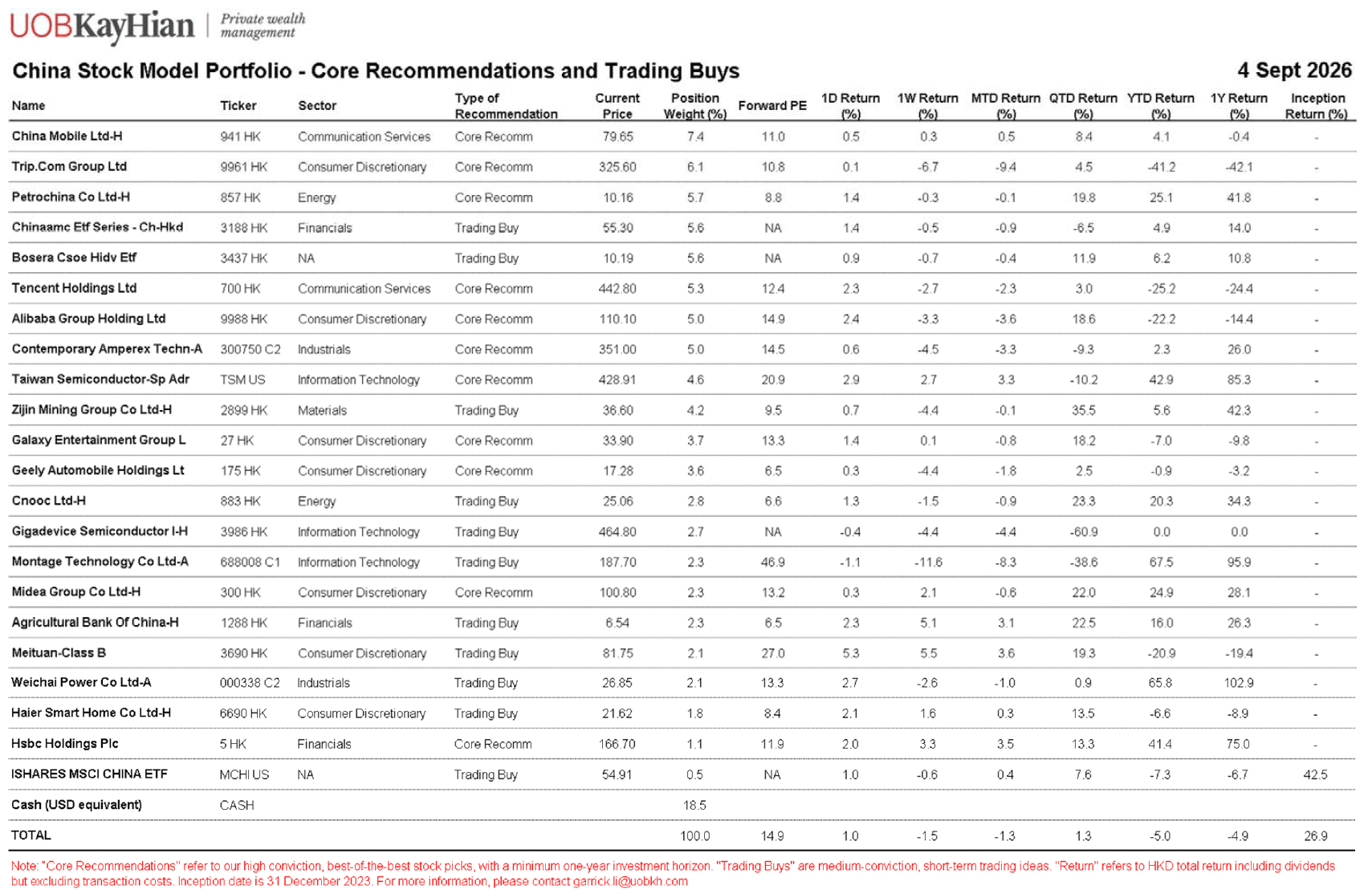
Appendix – China Stock Model Portfolio
Key China Market Indices
Index | Price | Past 2-Week Return | YTD Return |
Hang Seng Index | 25,651 | -1.4% | 0.1% |
HSCEI Index | 8,555 | -0.9% | -4.0% |
Hang Seng Tech Index | 4,570 | -4.1% | -17.2% |
Shanghai Composite Index | 3,930 | 0.6% | -1.0% |
CSI 300 Index | 4,548 | -1.5% | -1.8% |
Source: UOB Kay Hian and iFinD, as of Sep 4, 2026
- Factory conditions improve, but the recovery has yet to broaden. China’s official manufacturing PMI edged up to 49.8 in Aug from 49.2 in Jul, while the new orders and production indices returned to expansion at 50.6 and 50.4, respectively. These gains signal firmer factory demand and output, although the headline PMI remained below the 50 threshold. The non-manufacturing business activity index stagnated at 49.0. The macro picture remains mixed: While industrial activity is gaining modest traction, persistent weakness in the broader services continues to drag macro rebound.
- Technology shares weaken despite selective Southbound buying. Over the past two weeks, the Hang Seng Index fell 1.4% and the Hang Seng Tech Index declined 4.1%, even as Southbound investors recorded HKD 17.1bn of net buying. Disclosed trading showed net buying in Alibaba and Tencent despite their share-price declines, alongside net selling in SMIC and Hua Hong. These flows suggest mainland investors were buying selected internet stocks on dips while reducing foundry exposure, pointing to rotation within technology.
- Bank recapitalisation strengthens the foundation for sustainable dividends. On 6 Sep, ICBC and ABC announced proposed capital raises of up to RMB100bn and RMB160bn, respectively. Once completed, these would conclude the six-bank recapitalisation programme announced on Sep 2024, following the other four banks’ capital raises in 2025. Recent profit growth and proposed interim payout increases from 30% to 31% support the income case. We see the additional capital as strengthening banks’ capacity to absorb losses and sustain distributions, while faster lending still requires stronger credit demand. Earnings growth and higher payouts could help offset dilution, although the outcome for dividends per share will depend on final issuance terms and operating performance.
- We remain cautious on China/HK, reinforcing our Barbell Strategy. We favour companies with a clearer path to shareholder returns: structural growth businesses that can convert investment into earnings and cash flow, alongside defensive companies with sustainable dividends. While favorable policy can lift overall sentiment, our bottom-up stock selection remains strictly tethered to fundamental execution and disciplined capital allocation.
- Best-performing sectors: Financials +3.7% (e.g. 0005.HK, 0939.HK, 3988.HK); Energy +1.3% (e.g. 0386.HK, 1088.HK, 1171.HK); Conglomerates +0.6% (e.g. 0267.HK, 0019.HK, 0659.HK).
- Potential movers and shakers: Details inside.
Positive | NAURA Technology (002371.CH), Foxconn Industrial Internet (601138.CH), Han’s Laser (002008.CH), ASMPT (522.HK), Meituan (3690 HK), Anta Sports (2020 HK), Midea Group (000333 CH), Inner Mongolia Yili Industrial Group (600887 CH) |
Neutral | Galaxy Entertainment (27 HK), Sands China (1928 HK), Haier Smart Home (6690 HK) |
Negative | CATL (300750 CH), Shenzhou International (2313 HK), Wuliangye Yibin (000858 CH), COLI (688 HK), CR Land (1109 HK), Longfor (960 HK) |
- Must Watch Events: China Aug trade (Sep 8), CPI/PPI (Sep 9) and activity data (Sep 15); US Aug PPI/CPI (Sep 10-11); ECB (Sep 10), FOMC (Sep 16), BoE (Sep 17) and BoJ (Sep 18) decisions. Apple Event (Sep 9); TSMC Aug sales and ORCL/ADBE earnings (Sep 10). Details below.
Date | Macro Data | Sector / Company Events |
Sep 7 | China Aug foreign exchange reserves; US Labor Day holiday |
|
Sep 8 | China Aug exports, imports and trade balance | Citi Global TMT Conference; Goldman Sachs Communacopia + Technology Conference |
Sep 9 | China Aug CPI and PPI | Apple Event (10am PT) |
Sep 10 | US Aug PPI; initial jobless claims; ECB rate decision and projections | TSMC Aug monthly sales Earnings: ORCL and ADBE |
Sep 11 | US Aug CPI |
|
Sep 15 | China Aug industrial production, retail sales, YTD fixed-asset investment and property data |
|
Sep 16 | FOMC rate decision and economic projections (meeting Sep 15-16) |
|
Sep 17 | BoE rate decision; US initial jobless claims; Aug housing starts and building permits |
|
Sep 18 | BoJ rate decision (meeting Sep 17-18); US Aug industrial production |
|
Best 3 Hang Seng Sectors (Past 2 Weeks)
Hang Seng Sector Index | Past 2-Week Return | YTD Return | Stock Drivers Past 2-Weeks |
Financials | 3.7% | 16.7% | HSBC Holdings Plc (0005.HK) +2.3%, China Construction Bank Corporation (0939.HK) +5.6%, Bank of China Limited (3988.HK) +10.2% |
Energy | 1.3% | 15.5% | China Petroleum & Chemical Corporation (0386.HK) +8.7%, China Shenhua Energy Company Limited (1088.HK) +1.6%, Yankuang Energy Group Company Limited (1171.HK) +4.2% |
Conglomerates | 0.6% | 28.3% | Citic Limited (0267.HK) +5.5%, Swire Pacific Ltd. (0019.HK) +1%, Ctf Services Limited (0659.HK) +2% |
Source: UOB Kay Hian and iFinD, as of Sep 4, 2026
- Financials led with a 3.7% two-week gain, lifting its YTD return to 16.7%. Bank of China, CCB and HSBC gained 10.2%, 5.6% and 2.3%, respectively. For mainland banks, first-half profit growth and higher proposed interim payout ratios support dividend expectations. Bank of China and CCB’s stronger gains are consistent with renewed interest in income. Sustaining dividend growth will depend on resilient earnings and stable asset quality as banks continue to face margin pressure.
- Energy rose 1.3% over two weeks, lifting its YTD gain to 15.5%. Sinopec, China Shenhua and Yankuang Energy advanced 8.7%, 1.6% and 4.2%, respectively. Sinopec’s first-half attributable net profit rose 19.3%, supported by improved refining profitability. The company proposed an interim dividend of RMB0.105 per share. Stronger refining earnings support its capacity to sustain cash distributions.
- Conglomerates gained 0.6% over two weeks, bringing its YTD gain to 28.3%. CITIC, Swire Pacific and CTF Services rose 5.5%, 1.0% and 2.0%, respectively. CITIC’s first-half profit attributable to ordinary shareholders increased 8.1% to RMB33.8bn, while its interim dividend rose 5% to RMB0.21 per share. CITIC’s profit growth is translating into a higher interim dividend, supporting the income case for the stock.
Worst 3 Hang Seng Sectors (Past 2 Weeks)
Hang Seng Sector Index | Past 2-Week Return | YTD Return | Stock Drivers Past 2-Weeks |
Real Estate | -4.5% | 2.7% | China Resources Land Ltd. (1109.HK) -13.8%, Sun Hung Kai Properties Ltd. (0016.HK) -6.8%, Henderson Land Development Co. Ltd. (0012.HK) -9.8% |
Consumer Staples | -4.7% | -13.3% | Wh Group Limited (0288.HK) -11.5%, China Resources Beer (Holdings) Company Limited (0291.HK) -8.2%, China Feihe Limited (6186.HK) -12% |
Consumer Discretionary | -6.9% | -20.4% | Alibaba Group Holding Limited (9988.HK) -10.5%, Byd Company Limited (1211.HK) -7.5%, Meituan (3690.HK) -3.8% |
Source: UOB Kay Hian and iFinD, as of Sep 4, 2026
- Real estate fell 4.5% over two weeks, reducing its YTD gain to 2.7%. CR Land, Sun Hung Kai Properties and Henderson Land declined 13.8%, 6.8% and 9.8%, respectively, with weakness spanning mainland and Hong Kong developers. CR Land’s recurring revenue grew 9.9% and core profit rose 1.6%, yet total revenue fell 28.5% as development revenue weakened. Recurring income provides a cushion, but does not resolve the pressure on development activity. A sustained recovery needs stronger property sales and cash collection.
- Consumer staples fell 4.7% over two weeks, extending its YTD decline to 13.3%. WH Group, CR Beer and Feihe lost 11.5%, 8.2% and 12.0%, respectively, showing weakness across meat, beer and infant formula. CR Beer’s first-half revenue rose just 1.2%, while reported profit fell 10.7%, partly due to a smaller headquarters-relocation gain. Excluding that gain, EBIT edged down approximately 0.9% yoy. This points to subdued underlying earnings growth, rather than an operating decline as steep as the headline profit figure suggests.
- Consumer discretionary was the weakest sector, down 6.9% over two weeks and 20.4% YTD. Alibaba, BYD and Meituan fell 10.5%, 7.5% and 3.8%, respectively. The decline spanned platforms and autos, but Meituan illustrates why stronger reported earnings may not be enough. Meituan’s adjusted second-quarter net profit rose 69% yoy. Management expected third-quarter food-delivery profit per order to remain positive and improve year on year, although seasonal marketing expenditure and higher rider costs would weigh on profitability sequentially. A durable recovery requires more consistent margins and disciplined spending.
Southbound Trading Summary (Past 2 Weeks)
(HKD millions) | Ticker | Total Buy | Total Sell | Net Buy (Sell) | % of Total Turnover | Past 2-Week Return | Data |
Southbound Total | HSHKI.HK | 488,335 | 471,204 | 17,131 | 35% | -1.4% | Full |
BABA-W | 9988.HK | 24,051 | 22,370 | 1,680 | 17% | -10.5% | Full |
TENCENT | 0700.HK | 20,981 | 19,410 | 1,571 | 23% | -3.1% | Partial |
Z.AI | 2513.HK | 19,885 | 20,396 | (511) | 36% | -4.8% | Partial |
MINIMAX-W | 0100.HK | 20,165 | 16,747 | 3,419 | 36% | 4.1% | Partial |
YOFC | 6869.HK | 19,597 | 16,898 | 2,698 | 47% | 13.9% | Partial |
SMIC | 0981.HK | 14,036 | 16,718 | (2,682) | 41% | -7.3% | Partial |
KB LAMINATES | 1888.HK | 14,008 | 14,180 | (172) | 41% | 18.6% | Partial |
HUA HONG GRACE | 1347.HK | 5,366 | 8,118 | (2,752) | 32% | -4.4% | Partial |
MEITUAN-W | 3690.HK | 4,436 | 4,900 | (465) | 23% | -3.8% | Partial |
XIAOMI-W | 1810.HK | 4,554 | 4,094 | 459 | 27% | -2.0% | Partial |
Source: UOB Kay Hian and iFinD, as of Sep 4, 2026.
Note: Based on the two-week period from Aug 24 to Sep 4, 2026. For Stock Connect Southbound trading, only the top 10 most actively traded securities are disclosed. “Full data” means the stock appeared on the top 10 list for each of the past few trading days. “Partial data” means otherwise.
- Southbound investors remain net buyers through the market decline. Gross turnover reached HKD 959.5bn, comprising HKD 488.3bn of buying and HKD 471.2bn of selling. Net purchases of HKD 17.1bn represented about 1.8% of gross turnover, while the Hang Seng Index fell 1.4%. Buying and selling were therefore closely balanced despite substantial trading activity. Disclosed stock-level flows showed buying in selected internet names alongside selling in foundries.
- Buying accompanies gains in MiniMax and YOFC and weakness in Alibaba and Tencent. MiniMax recorded HKD 3.42bn of disclosed net buying and YOFC HKD 2.70bn, alongside share-price gains of 4.1% and 13.9%, respectively. Alibaba and Tencent attracted HKD 1.68bn and HKD 1.57bn of net buying despite falling 10.5% and 3.1%. The net purchases in Alibaba and Tencent suggest mainland investors were buying on dips, although the shares continued to weaken over the period. Alibaba and Tencent remain our Core Recommendation.
- Foundry outflows suggest reduced exposure; KB Laminates selling points to profit-taking. SMIC and Hua Hong recorded disclosed net selling of HKD 2.68bn and HKD 2.75bn as their shares fell 7.3% and 4.4%, respectively, consistent with investors reducing foundry exposure. KB Laminates saw HKD 0.17bn of net selling despite an 18.6% gain, suggesting profit-taking into strength. The contrast with buying in MiniMax and YOFC points to rotation within technology.
Stocks: Potential Movers and Shakers
Stock | Sector | Type of Events | Our Take |
CATL (300750 CH) | Consumer Discretionary | Legal / Regulatory | Negative |
- CATL's stock price has come under pressure recently, with the following two events adding to negative sentiment:
- Hungary plant: On 31 Aug 26, CATL's Debrecen plant was ordered to suspend cell production after nine employees were exposed to excessive nickel levels. Remediation is partly complete, but authorities only allow equipment commissioning, not production. The 40GWh Phase 1, originally targeted for Mar/Apr 26, is now delayed until at least 1Q27. Mercedes-Benz has already shifted VLE battery supply to China, with CATL bearing extra logistics costs of Rmb0.2b-0.5b annually. As 2026 was always intended to be a ramp-up year (20-30% utilisation), the delay mainly erodes the margin premium: overseas gross margin is 30% vs 21% domestically. Expected 2026 Hungary revenue of ~Rmb7b is largely lost, though ~Rmb2.5b of Mercedes orders shift to China (revenue is retained, but at a lower margin). The net EBITDA drag for 2026 is estimated at Rmb1.5b-2.0b.
- Xiaxianwo mine: On 26 Aug, the EIA was revoked because CATL posted the public notice on a commercial website rather than the legally required platform. The mine has been idle since Aug 25. Full capacity is ~100kt of lithium carbonate, but the market had expected a Sep 26 restart, now pushed to 1Q27 at the earliest. In 2026, the mine was only expected to contribute in Q4 (2-3 months of ramp-up), worth ~Rmb0.15b-0.25b in cost savings. With those savings now eliminated, the incremental 2026 loss is Rmb0.15b-0.25b.
- Bottom line: The combined 2026 earnings drag is ~Rmb1.7b-2.3b, representing 1.8-2.5% of our Rmb93.6b 2026 net profit forecast. Assuming both projects restart by 1Q27, the 2027 impact is limited to Q1 only (~Rmb0.4-0.6b), or 0.34-0.52% of our Rmb116.4b 2027 forecast. Residual impact in 2028 is negligible (<0.1% of Rmb139.1b). We believe the 15% stock pullback is overdone, the quantified earnings drag is only ~2% of 2026 net profit, and recommend bottom fishing on share price weakness. (Zeng Sheng Di)
Stock | Sector | Type of Events | Our Take |
NAURA Technology (002371.CH) Foxconn Industrial Internet (601138.CH) Han’s Laser (002008.CH) ASMPT (522.HK) | Information Technology | Channel Check | Positive |
- Execution and earnings visibility matter. Investors are looking for names with strong execution and those that help resolve supply chain shortages. Compared with the bottleneck trade in 1H26, investors have in recent months increasingly shifted their focus to names with solid execution and high earnings visibility, and to segments that can help resolve supply shortages.
- NVIDIA partners benefit from smoother ramp-ups. Key beneficiaries include the NVIDIA supply chain, as NVIDIA’s solid execution and dominant bargaining power mean that it faces fewer supply constraints. Key supply chain partners such as Foxconn Industrial Internet (FII) are therefore likely to enjoy a smooth production ramp-up over the next few quarters.
- We also like ASMPT and NAURA, which help resolve supply shortages in advanced packaging and advanced foundry capacity respectively.
- Han’s Laser, on the other hand, is expected to expand its PCB drilling tool capacity aggressively through 2026-27, gaining share from its more conservative Japanese and Taiwanese competitors. As PCB drilling is one of the tightest-supplied areas, Han’s Laser is also one of the primary enablers in resolving supply bottlenecks. (Johnny Yum)
Stock | Sector | Type of Events | Our Take |
Meituan (3690 HK) | Consumer Discretionary | Earnings | Positive |
- Second-quarter earnings support our pre-results Trading Buy. On 28 Aug, Meituan reported adjusted second-quarter net profit of RMB2.52bn, up 69% yoy. Management expected third-quarter food-delivery profit per order to remain positive and improve yoy, despite seasonal cost pressures weighing on profitability sequentially.
- Everyday local demand offers an opportunity amid economic weakness. A weak economy encourages consumers to seek value and reduce spending per purchase, but does not necessarily eliminate demand for convenient meals and everyday services. Meituan’s exposure to frequent local transactions therefore offers a degree of resilience, although order values and margins remain under pressure. Its merchant coverage and delivery density can support competitively priced services while improving fulfilment efficiency. If subsidy competition eases, better profit per transaction could drive earnings recovery even without a broad rebound in consumer spending.
- Maintain Trading Buy as improving transaction profitability supports earnings recovery. We added Meituan ahead of its results to capture the recovery in local-services earnings. Competition remains the key risk: renewed subsidies that fail to improve customer retention or profit per order would weaken our tactical case. (Elena Chen)
Stock | Sector | Type of Events | Our Take |
Galaxy Entertainment (27 HK) Sands China (1928 HK) | Consumer Discretionary | Macro / Industry Data | Neutral |
- Aug 26’s GGR missed market consensus by 2%. Macau’s Aug 26 gross gaming revenue (GGR) reached MOP21.9b, down 1% yoy but up 8% mom, as July was impacted by the FIFA World Cup. August’s GGR figure missed market consensus by 2% and recovered to 90% of 2019’s level (vs a recovery of 83% in July 26). For 8M26, GGR rose by 4% yoy to MOP169.1b.
- Macau’s July visitation was up 2% yoy and flat vs 2019. In Jul 26, Macau’s total visitation reached 3.5m, up 2% yoy and 26% mom, broadly in line with 2019’s level. Of these 3.5m visitors, Mainland Chinese visitors accounted for 2.7m, up 5% yoy and 39% mom, while same-day visitors totalled 2.1m, up 6% yoy and 29% mom. The average length of stay for visitors remained unchanged mom at 1.7 days. For 7M26, cumulative visitation increased 8% yoy to 24.5m, up 3% vs 2019’s level, with growth driven by same-day visitor numbers, which jumped 14% yoy, while overnight visitor numbers remained flat yoy.
- Maintain OVERWEIGHT; Galaxy remains our top pick. We maintain Galaxy’s target price at HK$47.00, based on a 12.0x target 2026 EV/EBITDA ratio. (Stella Guo/Ejann Hiew)
Stock | Sector | Type of Events | Our Take |
Anta Sports (2020 HK) | Consumer Discretionary | Earnings | Positive |
- Solid 1H26 results; operating margin a beat. Anta Sports reported its 1H26 results, with revenue of Rmb43,507mn (+13% yoy, +4% hoh). By segment, the core Anta brand/FILA/all other brands recorded revenue growth of 5%/6%/44% yoy, respectively. Gross profit was Rmb27,792mn (+14% yoy, +10% hoh), with gross margin at 63.9% (+0.5ppt yoy, +3.1ppt hoh). Operating profit was Rmb11,760mn (+16% yoy, +31% hoh), with operating margin at 27.0% (+0.7ppt yoy, +5.5ppt hoh). Core net profit was Rmb7,938mn (+13% yoy, +21% hoh), with net margin at 18.2% (flat yoy, +2.5ppt hoh).
- Confident in achieving full-year targets. Despite a softer consumption trend since 2Q26, management is confident in achieving its full-year retail sales growth targets (low single-digit growth for the Anta brand, mid-single-digit growth for FILA, and over 20% for other brands), as well as operating margin targets (around 20% for the Anta brand, around 25% for FILA, and over 25% for other brands).
- Jack Wolfskin repositioned to focus on heavy-duty trekking; China store rollout in September-October. Management has repositioned Jack Wolfskin to focus on heavy-duty trekking, emphasising functionality, technique and fabric with the aim of narrowing the SKU range and concentrating on quality apparel. On the channel side, the company plans to expand the brand through direct-to-consumer (DTC) channels in China, with around five key stores targeted in September-October, mostly in northern China. In Europe, expansion will be slower, with new store concepts tested in spring next year before scaling up. The brand remained loss-making in 1H26, and management expects a slightly narrower loss in 2H26.
- Anta brand’s long-term strategy remains intact; overseas revenue expected to reach Rmb10b within five years. Regarding the recent change in the Anta brand’s leadership, management emphasised that the long-term strategy remains intact, centred on mass-market positioning and brand elevation. Looking ahead, management noted that overseas expansion remains a longer-term priority, with overseas revenue growing over 30% in 1H26 and a first-stage target of Rmb10b within around five years, starting with Southeast Asia and subsequently the Middle East, Europe and the US.
- Maintain BUY and raise target price by 4% to HK$112.20. We raise our 2026/27 earnings forecasts by 2%. We lift our DCF-based target price by 4% to HK$112.20. Our target price implies 19.2x 2026F PE and 17.7x 2027F PE. (Stella Guo/Ejann Hiew)
Stock | Sector | Type of Events | Our Take |
Haier Smart Home (6690 HK) | Consumer Discretionary | Earnings | Neutral |
- 2Q26 sales better than expected and net profit in line. In 2Q26, Haier’s revenue was Rmb78,428m, up 1% yoy, ahead of the company's previous guidance of flat yoy growth. Gross margin was 29.0%, up 0.6ppt yoy. EBIT was Rmb7,219m, down 4% yoy, with EBIT margin of 9.2%, down 0.5ppt yoy. Gross margin expansion and R&D expense savings (-0.7ppt yoy) were offset by higher SG&A expenses (+1.9ppt yoy), primarily driven by ToC channel transformation in the domestic market and overseas market expansion. Net profit was Rmb5,665m, down 13% yoy, with net margin of 7.2%, down 1.2ppt yoy.
- HVAC integration delivering benefits; targets double-digit revenue and operating profit growth in 2H26. Under the reclassified categories, in 1H26, revenue from smart home appliances (including refrigerators/freezers, kitchen appliances and laundry appliances) and other businesses declined by 6% and 5% yoy, respectively, while revenue from smart HVAC solutions (including air-conditioners and water appliances) increased by 6% yoy. Following the HVAC integration that streamlined and optimised the segment, management expects HVAC revenue and operating profit to both achieve double-digit growth in 2H26. In overseas markets in particular, it expects double-digit growth in 2026 and around 15% growth in 2027-28.
- Overseas revenue increased by 2% in 2Q26; targets low single-digit five-year CAGR in North America. By region, in 1H26, revenue from the domestic market declined by 5% yoy, while revenue from overseas markets remained largely flat (domestic revenue remained largely flat and overseas revenue increased by 2% in 2Q26). Revenue from North America declined by 3% (in US dollar terms), while revenue from Europe increased by 5%, South Asia by 17% and Southeast Asia by 13%. Looking ahead, management sets five-year growth targets of low single digits in North America, high single digits in Europe, 15-20% in Southeast Asia, and nearly 30% in South Asia & Latin America.
- Overseas gross margin improvement helped by tariff refunds. By region, in 2Q26, gross margin improved by 0.7ppt yoy to 34% in the domestic market, supported by SKU reduction and supplier platform opening, and by 0.6ppt yoy to 25% in overseas markets, helped by tariff refunds. Regarding operating margin, the domestic operating margin was nearly double-digit, down around 1ppt yoy, while the overseas operating margin remained roughly flat yoy.
- Maintain BUY and cut target price by 4% to HK$28.30. We lower our 2026/27 earnings forecasts by 9%/7%, respectively. We lower our DCF-based target price by 4% to HK$28.30. Our target price implies 12.6x 2026F PE and 11.3x 2027F PE. (Stella Guo/Ejann Hiew)
Stock | Sector | Type of Events | Our Take |
Midea Group (000333 CH) | Consumer Discretionary | Earnings | Positive |
- 2Q26 results in line. Midea’s 2Q26 revenue was Rmb129,472m (+5% yoy, -2% qoq). Gross profit was Rmb32,680m (+1% yoy, -4% qoq), with gross margin at 25.2% (-0.9ppt yoy, -0.6ppt qoq). EBIT was Rmb13,644m (+9% yoy, -4% qoq), with EBIT margin of 10.5% (+0.4ppt yoy, -0.3ppt qoq). Net profit was Rmb13,771m (+1% yoy, +9% qoq), with net margin of 10.6% (-0.3ppt yoy, +1.0ppt qoq).
- ToC segment: 2Q26 domestic sales grew by low single digits and overseas sales grew by over 10%. In 2Q26, revenue growth accelerated to over 5% yoy, led by overseas markets, which grew over 10%, while domestic sales grew by low single digits. By product, air-conditioner sales grew by low single digits (domestic: flat, overseas: over 5%), refrigerator and washing-machine sales grew by over 10% (domestic: nearly 10%, overseas: over 15%), and kitchen-appliance sales grew by around 5% (domestic: down high single digits, overseas: nearly 15%).
- ToC segment – domestic: Expect better performance in 2H26. For the domestic market, air-conditioner sales (in terms of installation cards) declined by high single digits in July while August saw high single-digit growth. Looking ahead to 2H26, although demand remains subdued and competition is fierce, an easier comparable base should help support performance, making 2H26 better than 1H26.
- ToC segment – overseas: OBM accounts for 50% of overseas ToC revenue; expect faster OBM growth in 2H26 than in 1H26. In 1H26, original brand manufacturer (OBM) revenue grew nearly 15% yoy, with 1Q26 up 10% and growth momentum further accelerating in 2Q26. OBM now accounts for over 50% of overseas ToC revenue, marking a key milestone. In July-August, overseas orders grew nearly 15% yoy, with OBM outpacing the overall overseas orderbook. Management expects OBM growth to accelerate further in 2H26 vs 1H26, and to maintain a solid growth pace in 2027-28. In terms of profitability, the original equipment manufacturer (OEM) business remains ahead of domestic sales, while OBM ranks lowest.
- ToB segment: Building technology led growth; expect ToB segment revenue growth to outpace ToC in 2H26. In 1H26, ToB revenue grew 3% yoy, with the domestic market roughly flat and overseas markets up high single digits. In 2Q26, ToB revenue grew 3%, with domestic and overseas markets expanding at a similar pace. Building technology revenue grew over 10% (both domestic and overseas markets up more than 10%), robotics & automation (KUKA) revenue grew nearly 10% yoy (domestic: over 30%, overseas: low single digits), and industrial technology revenue fell over 10% yoy (both domestic and overseas markets down over 10%), as the segment is closely tied to the pressured AC business. Management expects ToB segment revenue growth to outpace ToC in 2H26.
- Full-year guidance maintained; expect tariff refunds to be recognised in 2H26. For the full year, management maintains its guidance of mid-to-high single-digit revenue growth and a stable net margin. Tariff refunds are expected to be reflected in 2H26 (not yet reflected in 1H26).
- Maintain BUY and keep target price unchanged at Rmb112.60. We lower our 2026/27 earnings forecasts by 1%/2%, respectively. We maintain our SOTP-based target price at Rmb112.60. Our target price implies 18.4x 2026F PE and 17.3x 2027F PE. (Stella Guo/Ejann Hiew)
Stock | Sector | Type of Events | Our Take |
Shenzhou International (2313 HK) | Consumer Discretionary | Earnings | Negative |
- 1H26 earnings at the mid-point of the profit-warning range but gross margin a miss. Shenzhou reported 1H26 revenue of Rmb14,179m (-5% yoy, -12% hoh). Gross profit was Rmb3,197m (-21% yoy, -22% hoh), with gross margin at 22.6% (-4.5ppt yoy, -3.1ppt hoh). Net profit was Rmb1,905m (-40% yoy, -28% hoh), landing at roughly the mid-point of the guided range (profit warning range of a 38-43% yoy decline to Rmb1,811m-1,970m), with net margin at 13.4% (-7.8ppt yoy, -3.1ppt hoh). The sharp net profit decline can be attributed to: a) gross margin contraction, b) a forex loss of Rmb506m (vs a forex gain of Rmb126m in 1H25), c) higher SG&A ratio (+0.4ppt yoy), and d) lower government incentives of Rmb112m (vs Rmb274m in 1H25). The company declared an interim dividend of HK$0.88 per share, implying an interim dividend payout ratio of 61.5% (vs 60.0% in 1H25).
- Expect sales volume to remain largely stable and ASP to gradually recover in 2H26. In 1H26, the revenue decline was primarily driven by a decline in sales volume due to rising product complexity, while ASP in renminbi terms was flat yoy, despite a 4% yoy increase in US dollar terms. Looking ahead, management expects relatively stable order volumes in 2H26, with declines for Nike and PUMA narrowing, while Uniqlo and Adidas continue to drive growth. ASP is expected to gradually recover.
- Gross margin decline due to wage increases, rising raw material prices, forex and tariffs; expect sequential recovery in 2H26. Management attributed the 4.5ppt yoy gross margin decline to: a) increases in salary and retirement benefit expenses, which contributed 1.5ppt of the gross margin contraction; b) rising raw material prices, which contributed 1.3ppt; c) forex, which contributed 1.3ppt; and d) tariff sharing. Looking ahead, management expects sequential gross margin recovery in 2H26.
- Indonesia production capacity ramp-up expected from 2028. Regarding the Indonesia production base, management mentioned that the land handover had already been completed and construction would start the following month, with capacity only ramping up gradually from 2028. Total capex is expected to be US$160m-200m (approximately Rmb1.1b).
- Maintain BUY but cut target price by 9% to HK$55.80. We lower our 2026/27 earnings forecasts by 11%. Our DCF-based target price is lowered by 9% to HK$55.80. Our target price implies 17.4x 2026F PE and 14.0x 2027F PE. (Stella Guo/Ejann Hiew)
Stock | Sector | Type of Events | Our Take |
Wuliangye Yibin (000858 CH) | Consumer Staples | Earnings | Negative |
- 2Q26 revenue beat but net profit was at the lower end of the preliminary results range. Wuliangye’s 2Q26 revenue was Rmb5,579m (-13% yoy). Gross profit was Rmb4,219m (-12% yoy), with gross margin of 75.6% (+1.0ppt yoy). Net profit was Rmb690m, at the lower end of the range in the preliminary results announcement, up 233% yoy, with net margin of 12.4% (+9.1ppt yoy). The surge in net profit was primarily driven by a decline in sales tax (-29.5ppt yoy), higher other income (+4.1ppt yoy) and lower administrative and other operating expenses (+1.3ppt yoy), partially offset by higher selling and marketing expenses (+16.3ppt yoy) and higher income tax (+11.8ppt yoy).
- Wuliangye series to drive revenue growth. By product, in 1H26, Wuliangye series revenue grew 73% yoy to Rmb23.6b, accounting for 83% of total revenue (vs 58% in 1H25), while non-Wuliangye series revenue fell 60% yoy to Rmb3.2b.
- Cash inflow from sales of goods declined 61% yoy. At end-1H26, the company’s contract liabilities stood at Rmb10.4b, increasing 4% yoy. Cash inflow from sales of goods and services was Rmb12.2b in 2Q26, down 61% yoy and 9% qoq.
- Cut target price by 15% to Rmb78.50; maintain HOLD. We lower our 2026/27 earnings forecasts by 12%/11%, respectively. We maintain HOLD and cut our DCF-based target price by 15% to Rmb78.50. Our target price implies 20.4x 2026F PE and 19.7x 2027F PE. (Stella Guo/Ejann Hiew)
Stock | Sector | Type of Events | Our Take |
Inner Mongolia Yili Industrial Group (600887 CH) | Consumer Staples | Earnings | Positive |
- 2Q26 revenue missed; operating margin expansion better than expected; net profit decline due to one-offs. Yili’s 2Q26 revenue was Rmb29,665m, up 3% yoy. Operational gross margin was 34.2%, broadly flat yoy. EBIT totalled Rmb2,908m, up 8% yoy, with EBIT margin at 9.8%, up 0.5ppt yoy, driven by SG&A expense savings of 0.4ppt yoy. Net profit was Rmb364m, down 84% yoy, with net margin at 1.2%, down 6.8ppt yoy. Excluding the impairment losses related to Ausnutria, we estimate that core net profit decreased by 15% in 2Q26, due to an income tax adjustment payment.
- Mid-single-digit revenue growth target reiterated; aims for accelerated growth in liquid milk in the future. By product, in 2Q26, liquid milk/milk powder and dairy products/frozen dairy recorded yoy revenue changes of flat/-4%/+13% (vs +2%/+6%/+7% in 1Q26), respectively. Management has reiterated its full-year revenue growth target of mid-single digits. Looking further ahead, the company expects accelerated growth in the future (in 2027 at the earliest, per our understanding).
- Expect Ausnutria to turn profitable in 2H26. Management attributed the decline in the milk powder business to a drag from Ausnutria due to international supply chain disruptions and inventory adjustments, while Jinlingguan achieved mid-to-high single-digit growth with market share rising 1.2ppt. Looking ahead, management expects Ausnutria to turn profitable in 2H26, following active channel structure optimisation and refined inventory management in 1H26. For other products, the ToB business grew by double digits and is expected to sustain double-digit growth for the full year.
- Share buyback of Rmb1b-2b; reaffirmed dividend payout above 75%. On shareholder returns, the company announced a Rmb1b-2b buyback, and reaffirmed its 2025-27 dividend commitment to maintain a payout ratio above 75%, with the dividend amount not falling below the 2024 level.
- Maintain BUY and keep target price unchanged at Rmb32.40. We lower our 2026 earnings forecast by 1%, while raising our 2027 earnings forecast by 3%. We keep our DCF-based target price unchanged at Rmb32.40. Our target price implies 19.6x 2026F PE and 15.3x 2027F PE. (Stella Guo/Ejann Hiew)
Stock | Sector | Type of Events | Our Take |
COLI (688 HK), CR Land (1109 HK), Longfor (960 HK) | Real Estate | Legal / Regulatory | Negative |
- China moved to reform the housing presale system and rebuild the sector's funding chain over the past two weeks. On 28 Aug 26, MOHURD, the Ministry of Natural Resources and the NFRA issued the Notice on Improving the Commodity Housing Sales System, which: a) prioritises completed-home sales for newly granted land; b) lifts the presale threshold to structural topping-out of each building from 25% of total investment; and c) escrows all buyer funds until completion acceptance. The PBOC, NFRA and CSRC added six companion documents, extending development loan tenors to five/seven years and personal mortgage tenors to 40 years, and deferring mortgage disbursement on presold homes to completion filing.
- Negative for developers' financials in the near term, positive for medium-term supply and margins. Presale proceeds are the sector's largest funding source, deposits and advance receipts were 31.4% of developers' funds raised in 7M26, against 13.8% from domestic loans, so tighter presale requirements and full escrow until completion acceptance directly slow the sales-to-cash cycle. We expect new-home supply to be delayed by 12-18 months, contract liabilities to shrink, net gearing to rise and land investment to tighten. In the medium term, this mechanism will support pricing and margins, as less new supply meets lower land premiums.
- Maintain UNDERWEIGHT on China's property sector. Tighter access to presale proceeds and a longer cash conversion cycle will increase balance sheet and earnings recognition pressure in the near term. We will reassess our rating once there is greater clarity on the impact on earnings. We use contract liabilities to cash as a proxy for reliance on presale funding: COLI's 1.11x on FY25 data is the lowest among major developers, and its Tier 1 exposure should let it benefit earlier from any sales recovery and margin stabilisation. COLI remains our top pick. (Damon Shen, Liu Jieqi)
Type of Events | Explanation |
Channel Checks | Industry-wide or supply chain news with implications to a particular sector or company |
Corporate Action | Dividends, special dividends, stock splits, share buybacks, equity / bond financing, M&As, spin-offs and restructuring etc. |
Earnings | Quarterly earnings for US-listed companies. Semi-annual earnings for Hong Kong-listed companies |
Insider Dealing | Company insiders’ buying / selling of stocks and derivatives of the company |
Investor Action | Lead investor buying / selling including activist investor actions |
Investor Roadshow | Deal and non-deal roadshows, reverse roadshows (analyst days), and company meetings at investment conferences |
Legal / Regulatory | Lawsuits, legislature/regulation changes, other regulatory events |
Macro / Industry Data | Regular economic or industry data related to the sector or stock |
Sales / Products | Sales or product related news, such as monthly sales or new product launches |
Public Event | Public speeches and appearances by companies in the media or industry conferences |
Appendix – China Stock Model Portfolio
Analyst
Elena Chen
elena.chen@uobkh.comAnalyst
Qi Wang, CFA
qi.wang@uobkh.comAnalyst
In collaboration with UOBKH Institutional Research
Disclosures and disclaimers
This report is provided subject to, and must be read together with, the full Disclosures / Disclaimers available at this link, which are incorporated by reference into this report. In particular, this report is intended for general circulation and informational purposes only and does not constitute personal investment advice or a recommendation to buy or sell any investment product or security. You should independently evaluate the information and, where necessary, seek advice from a qualified financial adviser regarding the suitability of any investment. Analyst certifications required under applicable regulations, including SEC Regulation AC (where relevant), are included in this report. By accessing, receiving or using this report, you acknowledge that you have read, understood and agreed to be bound by the Disclosures / Disclaimers, as may be amended, supplemented or updated from time to time.


