

US Bi-Weekly
Macro Takes Center Stage Ahead of Midterms and Fed Rate Decisions
Analyst
Wendy Chen
wendy.chen@uobkh.comAnalyst
Wang Qi, CFA
qi.wang@uobkh.comAnalyst
In collaboration with UOBKH Institutional Research
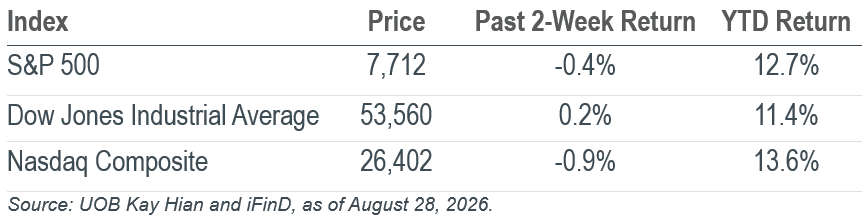
Key US Market Indices
Policy crosscurrents and de-dollarization. The current US macro landscape features a policy tug-of-war between fiscal and monetary authorities: Treasury Secretary Bessent aggressively intervenes in the bond market to cap long-term yields, while Fed Chair Warsh leans hawkish and champions market dynamics over intervention – as partly confirmed at the recent Jackson Hole. Consequently, the FedWatch probability for a September rate hike jumped from 35% to 57%. In any case, Treasury politicization and the resulting tug-of-war create dollar instability and reinforce our long-term themes of de-dollarization (more in our latest Wealth Flash).
Stock market: digestion and defensive rotation. US equities posted mild, mixed performance over the past two weeks, reflecting market digestion of recurring macro headwinds such as Fed rate path and geopolitical tensions. The Dow Jones slightly outperformed the S&P 500 (+0.2% vs. -0.4%), and the tech-heavy Nasdaq lost ground (-0.9%) amid rotation into value and defensives. While YTD returns remain remarkably robust across major indices (11.4% to 13.6%), the near-term tape is characterized by a cautious risk appetite and tactical profit-taking in high-beta, momentum names.
Robust earnings paved the fundamental floor. The 2Q2026 earnings season has conclusively proven that AI monetization is broadening, with exceptionally robust results across both hardware and software stocks. According to FactSet, the S&P 500 delivered blended earnings growth of 52% – the highest since 2021, with an impressive 86% of companies beating EPS estimates. This fundamental bedrock could provide a floor for equity valuations amid the upcoming macro turbulence.
Forward-looking: bracing for the midterm gauntlet. Historically, autumns leading into midterm elections have been notoriously tricky. This is due to a range of factors, including the dual uncertainties of the Fed’s rate path and midterm election jitters. In addition, with the bulk of earnings now behind us, macro concerns will likely take center stage. We expect more volatility ahead, with possible clearer skies towards the year-end, as the historic post-midterms rally tends to take hold and the Fed offers greater clarity on rate policy.
Must-read: Our Leading Investor Signals cover Trump’s latest trades on page 2-3.
Best performing sectors: Info Tech (XLK) +6.7%, Energy (XLE) +5.3%, Health Care (XLV) +3.2%.
Potential movers and shakers:

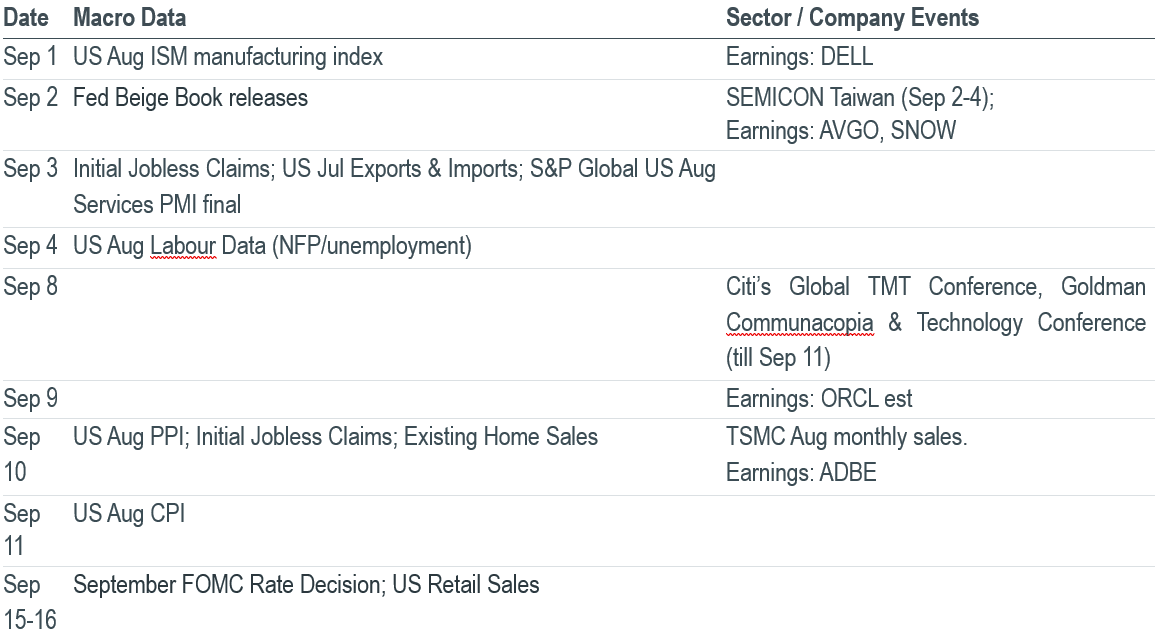
Must Watch Events: US Aug Labour Data (Sep 4), US Aug CPI/PPI data (Sep 10-11), FOMC Rate Decision (Sep 15-16). Earnings: AVGO, SNOW, ORCL (est Sep 9), DELL, ADBE. Details below.
Leading Investor Signals
One of our key messages is that Trump moves markets, and so do influential leaders such as Nvidia CEO Jensen Huang and Tesla’s Elon Musk. Their words and actions often draw attention to specific investments, shape investor sentiment and drive short-term price swings across markets. It is important to track such signals to understand where investor focus is shifting, how market narratives may evolve, and what potential risks and opportunities lie ahead. We hope you find such insights useful.
President Trump’s Trade Disclosures
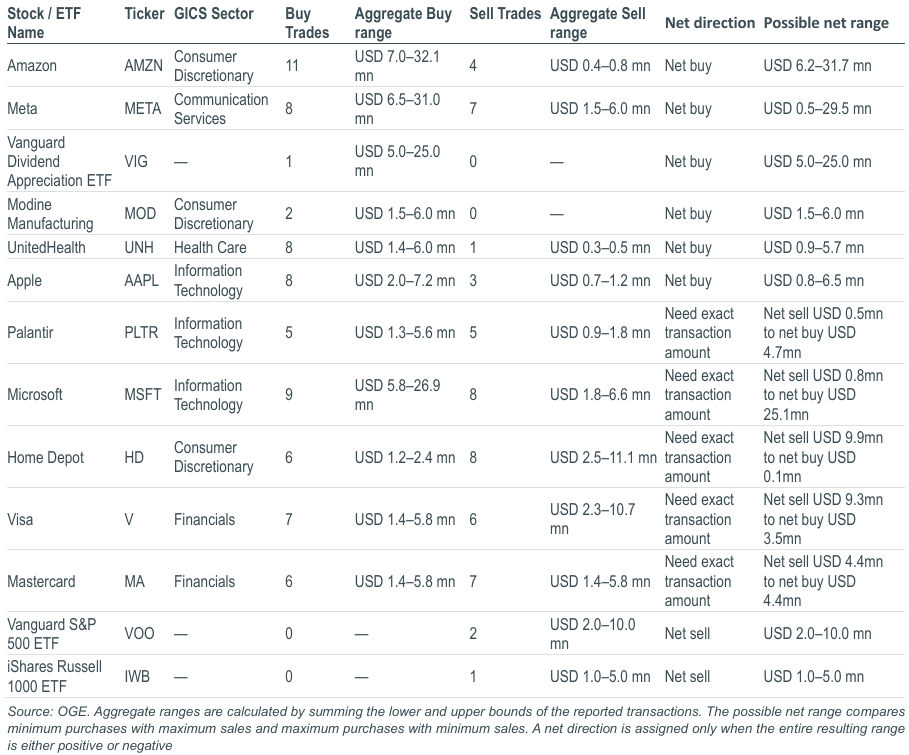
Trump disclosed >1,000 June trades worth USD 78.1-263.1mn, including purchases of Berkshire Hathaway (BRK/B +1.71%), Visa (V +3.06%), Mastercard (MA +3.31%), Cintas (CTAS +1.77%), Coinbase (COIN -3.76%) and Home Depot (HD +0.54%). Trump actively traded Palantir (PLTR -2.25%) and Meta (META +1.66%) around the Jun 14 US-Iran peace deal. He also bought USD 15,001-50,000 of SpaceX (SPCX -1.44%) on Jun 23 following its Jun 12 IPO. The White House said independent financial institutions manage Trump’s portfolio.
President Trump’s net reported trading activities for May–June 2026
Best 3 S&P Sectors (Past 2 Weeks)
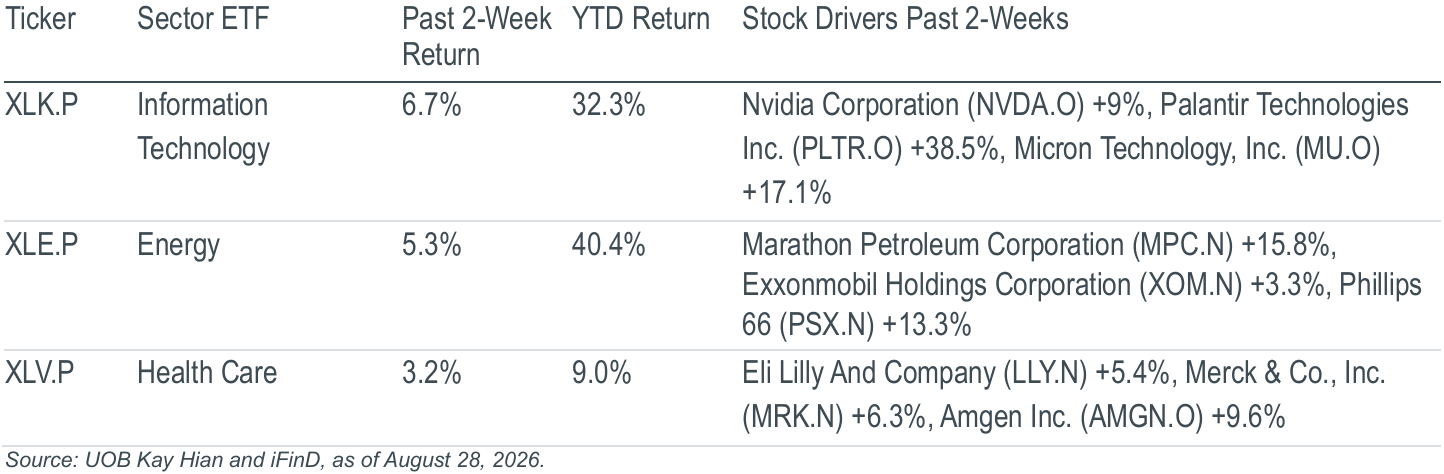
Information Technology (XLK) staged a 6.7% rally over the past two weeks, pushing its YTD return to a robust 32.3% and firmly reclaiming the market leadership. The speedy recovery validates our view that AI infrastructure spending remains strong, backed by tangible platform monetization and robust earnings across the ecosystem. Nvidia (NVDA) climbed a steady 9.0% following its strong earnings print, reinforcing its unassailable grip on AI compute chips. Palantir (PLTR) delivered a 38.5% surge post its earnings beat, as the market aggressively repriced the massive commercial and government demand for its AI platforms. Micron Technology (MU) rallied 17.1%, buoyed by its sustained pricing power amid the Memory Supercycle. We maintain NVDA as our Core Recommendation.
Energy (XLE) advanced 5.3%, extending its YTD performance to an outstanding 40.4%. The sector continues to serve as a portfolio hedge against ongoing geopolitical uncertainty and oil-driven inflation risk. Notably, the past two weeks saw exceptional strength in downstream refining: Marathon Petroleum (MPC) surged 15.8% and Phillips 66 (PSX) jumped 13.3%, driven by resilient global fuel demand and favourable crack spreads. Integrated major ExxonMobil (XOM) added a steady 3.3%. XLE remains our Core Recommendation.
Health Care (XLV) posted a steady 3.2% gain, lifting its YTD return to 9.0% and re-establishing itself as a premier defensive compounder in the current macro environment. As investors seek refuge from lingering rate and geopolitical uncertainties, capital has rotated back into cash-flow-rich, non-cyclical businesses with visible growth runways. Merck (MRK) dominated the headlines with its personalized cancer vaccine co-developed with Moderna, resulting in a 6.3% advance. Amgen (AMGN) also delivered a strong 9.6% gain, supported by increasing enthusiasm for its drug pipeline. Eli Lilly (LLY) added a solid 5.4%, continuing its relentless execution in scaling GLP-1 manufacturing and expanding its broader therapeutic footprint. LLY remains our Core Recommendation and XLV is our Trading Buy.
Worst 3 S&P Sectors (Past 2 Weeks)
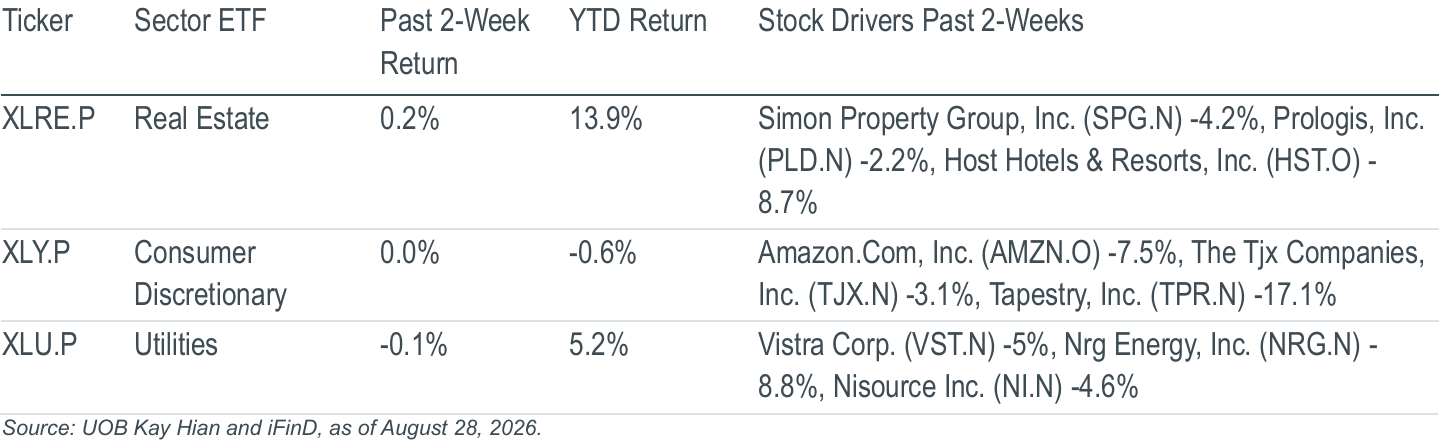
Real Estate (XLRE) managed a marginal 0.2% gain, indicating stalled momentum and significant underperformance, though the YTD return remained a respectable 13.9%. Within the sector, REITs are highly sensitive to interest rates, while certain sub-sectors face other near-term headwinds. Host Hotels & Resorts (HST) dropped 8.7% on concerns over softening corporate travel demand; Simon Property Group (SPG) and industrial logistics leader Prologis (PLD) retreated 4.2% and 2.2% respectively amid broader profit-taking. Despite share consolidation, structural demand for modern logistics facilities and experiential retail forms a long-term fundamental thesis, though near-term upside remains capped due to rate uncertainty.
Consumer Discretionary (XLY) flatlined with 0.0% return over the past two weeks, leaving the sector in negative territory at -0.6% YTD. The sector’s stagnation is tied to the lingering impact of disappointing July US retail sales and ongoing debates over 2H2026 US consumption. Tapestry (TPR) suffered a severe 17.1% decline, as its conservative guidance validated mounting concerns over US luxury spending. Amazon (AMZN) pulled back 7.5%, as the soft retail backdrop fuelled near-term concerns over e-commerce volume growth. TJX (TJX) dipped 3.1%, reflecting pressure on the lower-end of a K-shape economy. In an environment of high oil prices and low consumer confidence, the negative narratives around Consumer Discretionary are increasingly entrenched.
Utilities (XLU) edged lower by 0.1%, moderating its YTD gain to 5.2%. The sector continues to suffer as a classic "bond proxy" amid lingering "Fed Wildcard" uncertainties and fluctuating rate expectations. Independent power producers and traditional utilities faced notable selling pressures: NRG Energy (NRG) fell 8.8%, Vistra Corp. (VST) declined 5.0%, and Nisource (NI) slipped 4.6%. Near-term valuation stretches and the threat of sticky inflation have likely prompted tactical de-risking. However, structural AI-driven power demand and grid modernization remain a viable long-term thesis.
Stocks: Potential Movers and Shakers

Nvidia reported another blowout quarter, with revenue +106% YoY to USD 96.2b and forward guidance of USD108bn – both of which exceeded elevated buy-side and sell-side expectations.
Management guided 70% revenue growth in 2027 despite certain supply constraints, well above the 45% consensus. Management also expects top five hyperscaler capex to reach USD 800bn in 2026 and USD 1.3tr in 2027 (+62.5% YoY).
A further boost to reported net income from investment gains. Nvidia’s net earnings more than doubled to USD 25.7bn from USD 12.4bn a year earlier, including USD 12.7bn of investment gains from the equity portfolio. While management cautioned that quarterly net income can fluctuate due to volaille unrealized market gains and losses, underlying fundamentals of the company remains exceptionally strong. NVDA is our Core Recommendation and a top pick in the AI hardware sector. (Garrick Li)

Marvell issued stock warrants to Google, allowing Google to buy MRVL shares at USD 206.58 – a deal tied to chip purchase milestones. Full vesting requires Google to purchase USD 120bn in Marvell chips over next six years.
The announcement is a net positive for Marvell. Its networking IP and near-memory custom products are critical components in AI datacenters, as optical networking and memory scaling become central to AI clusters.
However, the market’s reaction wrongly assumed Marvell would win Google's core TPU program and displace Broadcom as part of this deal. We believe this is just a specialized TPU-attached program, not the TPU itself. We also expect Marvell’s work to target AI inference, posing a more direct threat to MediaTek’s inference ASIC pipeline than to Broadcom. (Garrick Li)

Louis Vuitton to close its only Guizhou store on 31 Aug. The Guiyang Jianghua store at Lavant Center will cease operations after around four years, according to an on-site notice. The closure is part of LV's plan to optimize its retail network as it recalibrates strategy amid soft domestic spending and shifting luxury consumption trends in China.
The Guiyang exit follows a wave of peer departures from the same mall. Since Lavant Center opened in 2022 with a full roster of luxury tenants, Gucci, Cartier, Tod's, Burberry, Qeelin, Balenciaga, Versace, Ami and Bulgari have all closed their stores there. Rolex relocated within Guiyang to a different luxury mall rather than exiting the city, and Burberry has opened at that newer location. Weak domestic demand in China suggests the reshuffle will likely continue. (Ejann Hiew)

Tesla faces a mixture of long‑term catalysts and near‑term headwinds today.
Positive catalysts: a 3 September Cybercab production‑spec launch event in Austin, the approval for 5,000 Robotaxis (exceeding Waymo and Uber) in Nevada, a USD 10.1b Texas solar cell plant filing, and resolution of the 1,021‑day Swedish strike. However, the market has reacted poorly – TSLA fell 3.83% on 24 August – as its current Robotaxi operations remain tiny (~20‑30 vehicles, <0.2% of Waymo’s mileage).
Negative headlines include a record 3 million‑vehicle recall in China (door‑handle and monitoring defects), and a separate discontinuation of solar roof tiles, signaling a strategic shift to standardized modules. The EU’s pending FSD review and unclear funding for the Texas plants add to the overhang.
We remain neutral on Tesla, balancing positive autonomous‑driving progress against immediate reputational and operational risks. Key other triggers to watch: August China retail data, EU FSD outcome, and Texas plant funding clarity. (Ken Lee)

UK Commercial Launch. Eli Lilly launched Foundayo (orforglipron) in the UK on 24 Aug, its first in Europe, following approval on 10 Aug. This is also Europe's first and only approved oral GLP-1 pill after Novo Nordisk's Wegovy pill. Initial access is via private prescriptions, with NHS coverage pending NICE review.
Competitive Positioning. Foundayo is expected to cost £100-120 per month, well below Mounjaro’s roughly £330 and broadly competitive with Novo’s Wegovy pill, supporting wider adoption of oral GLP-1 therapy.
Alzheimer’s Catalyst. The FDA cleared Roche and Lilly’s blood test (Elecsys pTau217) for patients aged 55 and above, with rollout supported by Roche’s installed analyzer base and Labcorp and Quest networks.
Constructive Long-Term Outlook. We remain constructive on LLY, as the UK launch strengthens its oral GLP-1 franchise while the pTau217 clearance adds another catalyst to its Alzheimer’s ecosystem. Together, these developments reinforce Lilly’s leadership position across two large and structurally growing healthcare markets, i.e. obesity and Alzheimer’s disease. LLY is our Core Recommendation. (Tang Kai Jie)

High-profile entertainment partnerships broaden engagement opportunities. Netflix had an exclusive premier of a 27-minute extended look at Grand Theft Auto 6 on 27 Aug, securing a six-hour lead before this was released everywhere. The partnership between Netflix and game developer Rockstar highlights Netflix’s ability to host major entertainment launches beyond TV and film, potentially broadening engagement and strengthening its positioning as a wider entertainment destination.
Strong content performance supports engagement. “Outer Banks” Season 5 debuted at No.1 on Netflix’s English TV list with 9.4m views, marking the series’ fourth consecutive season to open at the top. Meanwhile, “Don’t Say Good Luck” led the English film list with 12.8m views. Continued strong performance across both established franchises and new releases should support viewing engaging and subscriber retention.
UK content investment continues to expand. Netflix unveiled its most wide-ranging slate of new UK commissions to date at the Edinburgh TV Festival, spanning drama, comedy, entertainment and live sports. It also renewed several UK titles, including “The Gentlemen” for a third season. Continued investment in differentiated local content should strengthen Netflix’s offering in the UK while providing titles with potential to travel to its global audience.
Positive on long-term earnings growth. We remain positive on Netflix as strong content performance and an expanding global slate should support engagement and subscriber retention. Meanwhile, its push into broader streaming partnerships demonstrates further opportunities to deepen engagement and expand beyond traditional streaming, complementing advertising as an additional driver of long-term revenue growth and margin expansion. (Shaina Kamlesh Mahtani)

Major park expansion pipeline reinforces long-term Experiences growth. At D23, Disney outlined major expansion plans across Walt Disney World, Disneyland and its international parks, including new “Cars,” “Monsters Inc,” “Villains” and “Avengers” attractions. The investment pipeline should help sustain attendance and guest spending, supporting Experiences as a key earnings growth driver.
ESPN expands live-sports content on Disney+. US Disney+ subscribers will receive two ESPN/ABC college football games each week, alongside “College GameDay”, at no additional cost. They also partnered with Red Bull on “Max vs 100,” a live Max Verstappen event streaming globally on ESPN on Disney+. These events further integrate live sports and entertainment into Disney+, strengthening cross-selling across Disney’s streaming ecosystem.
ESPN price increases support further streaming monetisation. ESPN will raise prices from 17 Sept, with ESPN Unlimited increasing to USD 31.99/month from USD 29.99 and ESPN Select rising to USD 13.99 from USD 12.99. The price increase should support streaming monetization and revenue growth, although higher pricing could weigh on subscriber retention.
Positive on Disney’s earnings outlook. We remain positive on Disney as continued investment in Experiences, deeper integration of ESPN into Disney+ and higher streaming pricing should support earnings growth and monetization. While elevated sports-rights costs and potential subscriber churn remain near-term risks, Disney’s diversified growth drivers across parks, sports and streaming support a positive outlook. (Shaina Kamlesh Mahtani)

Debt redemption supports continued balance-sheet management. Verizon announced plans to fully redeem USD 1.25b of its 4.329% notes due 2028. The move follows continued efforts to manage its sizable debt burden and comes after unsecured debt declined to USD 136.5b at end 2Q2026 from USD 142.5b in 1Q2026. While leverage remains elevated, continued debt reduction should gradually improve financial flexibility.
AI adoption accelerates Verizon’s operations and enterprise offerings. Verizon is expanding AI adoption through its Google Cloud partnership, including Gemini Enterprise for customer service and data modernization, while Adaptive Network Fabric supports high-bandwidth connectivity for enterprise AI workloads. These initiatives should improve operating efficiency and strengthen Verizon’s ability to capture growing demand for AI-related connectivity.
NFL partnership strengthens Verizon’s customer-retention strategy. Verizon launched an NFL takeover of its Shine loyalty program, offering customers free game tickets, NFL Sunday Ticket, merchandise and exclusive experiences. The initiative supports Verizon’s customer-first strategy by using differentiated rewards to increase engagement and retention, potentially helping sustain the stronger subscriber momentum seen in 2Q2026.
Neutral view as high leverage and flat wireless growth offset new initiatives. Verizon’s AI initiatives and customer-retention efforts provide support to growth, while continued debt reduction should gradually improve financial flexibility. However, underlying revenue growth remains modest and wireless service revenue is still expected to be broadly flat in 2026, with leverage still elevated. (Shaina Kamlesh Mahtani)
Appendix A – US Stock Model Portfolio
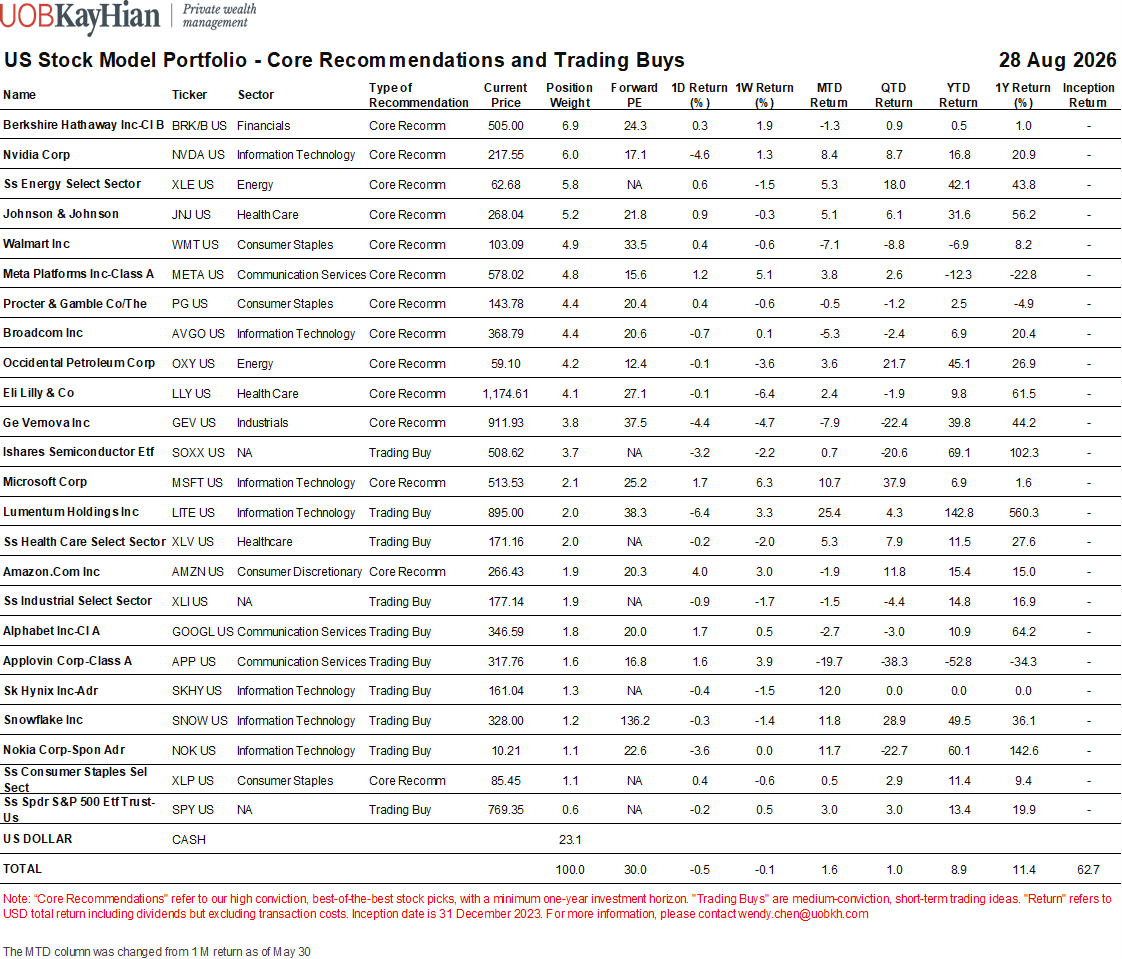
Note: "Core Recommendations" refer to our high conviction, best-of-the-best stock picks, with a minimum one-year investment horizon. "Trading Buys" are medium-conviction, short-term trading ideas. "Return" refers to USD total return including dividends but excluding transaction costs. Inception date is 31 December 2023. For more information, please contact garrick.li@uobk.com
Key US Market Indices
Policy crosscurrents and de-dollarization. The current US macro landscape features a policy tug-of-war between fiscal and monetary authorities: Treasury Secretary Bessent aggressively intervenes in the bond market to cap long-term yields, while Fed Chair Warsh leans hawkish and champions market dynamics over intervention – as partly confirmed at the recent Jackson Hole. Consequently, the FedWatch probability for a September rate hike jumped from 35% to 57%. In any case, Treasury politicization and the resulting tug-of-war create dollar instability and reinforce our long-term themes of de-dollarization (more in our latest Wealth Flash).
Stock market: digestion and defensive rotation. US equities posted mild, mixed performance over the past two weeks, reflecting market digestion of recurring macro headwinds such as Fed rate path and geopolitical tensions. The Dow Jones slightly outperformed the S&P 500 (+0.2% vs. -0.4%), and the tech-heavy Nasdaq lost ground (-0.9%) amid rotation into value and defensives. While YTD returns remain remarkably robust across major indices (11.4% to 13.6%), the near-term tape is characterized by a cautious risk appetite and tactical profit-taking in high-beta, momentum names.
Robust earnings paved the fundamental floor. The 2Q2026 earnings season has conclusively proven that AI monetization is broadening, with exceptionally robust results across both hardware and software stocks. According to FactSet, the S&P 500 delivered blended earnings growth of 52% – the highest since 2021, with an impressive 86% of companies beating EPS estimates. This fundamental bedrock could provide a floor for equity valuations amid the upcoming macro turbulence.
Forward-looking: bracing for the midterm gauntlet. Historically, autumns leading into midterm elections have been notoriously tricky. This is due to a range of factors, including the dual uncertainties of the Fed’s rate path and midterm election jitters. In addition, with the bulk of earnings now behind us, macro concerns will likely take center stage. We expect more volatility ahead, with possible clearer skies towards the year-end, as the historic post-midterms rally tends to take hold and the Fed offers greater clarity on rate policy.
Must-read: Our Leading Investor Signals cover Trump’s latest trades on page 2-3.
Best performing sectors: Info Tech (XLK) +6.7%, Energy (XLE) +5.3%, Health Care (XLV) +3.2%.
Potential movers and shakers:
Must Watch Events: US Aug Labour Data (Sep 4), US Aug CPI/PPI data (Sep 10-11), FOMC Rate Decision (Sep 15-16). Earnings: AVGO, SNOW, ORCL (est Sep 9), DELL, ADBE. Details below.
Leading Investor Signals
One of our key messages is that Trump moves markets, and so do influential leaders such as Nvidia CEO Jensen Huang and Tesla’s Elon Musk. Their words and actions often draw attention to specific investments, shape investor sentiment and drive short-term price swings across markets. It is important to track such signals to understand where investor focus is shifting, how market narratives may evolve, and what potential risks and opportunities lie ahead. We hope you find such insights useful.
President Trump’s Trade Disclosures
Trump disclosed >1,000 June trades worth USD 78.1-263.1mn, including purchases of Berkshire Hathaway (BRK/B +1.71%), Visa (V +3.06%), Mastercard (MA +3.31%), Cintas (CTAS +1.77%), Coinbase (COIN -3.76%) and Home Depot (HD +0.54%). Trump actively traded Palantir (PLTR -2.25%) and Meta (META +1.66%) around the Jun 14 US-Iran peace deal. He also bought USD 15,001-50,000 of SpaceX (SPCX -1.44%) on Jun 23 following its Jun 12 IPO. The White House said independent financial institutions manage Trump’s portfolio.
President Trump’s net reported trading activities for May–June 2026
Best 3 S&P Sectors (Past 2 Weeks)
Information Technology (XLK) staged a 6.7% rally over the past two weeks, pushing its YTD return to a robust 32.3% and firmly reclaiming the market leadership. The speedy recovery validates our view that AI infrastructure spending remains strong, backed by tangible platform monetization and robust earnings across the ecosystem. Nvidia (NVDA) climbed a steady 9.0% following its strong earnings print, reinforcing its unassailable grip on AI compute chips. Palantir (PLTR) delivered a 38.5% surge post its earnings beat, as the market aggressively repriced the massive commercial and government demand for its AI platforms. Micron Technology (MU) rallied 17.1%, buoyed by its sustained pricing power amid the Memory Supercycle. We maintain NVDA as our Core Recommendation.
Energy (XLE) advanced 5.3%, extending its YTD performance to an outstanding 40.4%. The sector continues to serve as a portfolio hedge against ongoing geopolitical uncertainty and oil-driven inflation risk. Notably, the past two weeks saw exceptional strength in downstream refining: Marathon Petroleum (MPC) surged 15.8% and Phillips 66 (PSX) jumped 13.3%, driven by resilient global fuel demand and favourable crack spreads. Integrated major ExxonMobil (XOM) added a steady 3.3%. XLE remains our Core Recommendation.
Health Care (XLV) posted a steady 3.2% gain, lifting its YTD return to 9.0% and re-establishing itself as a premier defensive compounder in the current macro environment. As investors seek refuge from lingering rate and geopolitical uncertainties, capital has rotated back into cash-flow-rich, non-cyclical businesses with visible growth runways. Merck (MRK) dominated the headlines with its personalized cancer vaccine co-developed with Moderna, resulting in a 6.3% advance. Amgen (AMGN) also delivered a strong 9.6% gain, supported by increasing enthusiasm for its drug pipeline. Eli Lilly (LLY) added a solid 5.4%, continuing its relentless execution in scaling GLP-1 manufacturing and expanding its broader therapeutic footprint. LLY remains our Core Recommendation and XLV is our Trading Buy.
Worst 3 S&P Sectors (Past 2 Weeks)
Real Estate (XLRE) managed a marginal 0.2% gain, indicating stalled momentum and significant underperformance, though the YTD return remained a respectable 13.9%. Within the sector, REITs are highly sensitive to interest rates, while certain sub-sectors face other near-term headwinds. Host Hotels & Resorts (HST) dropped 8.7% on concerns over softening corporate travel demand; Simon Property Group (SPG) and industrial logistics leader Prologis (PLD) retreated 4.2% and 2.2% respectively amid broader profit-taking. Despite share consolidation, structural demand for modern logistics facilities and experiential retail forms a long-term fundamental thesis, though near-term upside remains capped due to rate uncertainty.
Consumer Discretionary (XLY) flatlined with 0.0% return over the past two weeks, leaving the sector in negative territory at -0.6% YTD. The sector’s stagnation is tied to the lingering impact of disappointing July US retail sales and ongoing debates over 2H2026 US consumption. Tapestry (TPR) suffered a severe 17.1% decline, as its conservative guidance validated mounting concerns over US luxury spending. Amazon (AMZN) pulled back 7.5%, as the soft retail backdrop fuelled near-term concerns over e-commerce volume growth. TJX (TJX) dipped 3.1%, reflecting pressure on the lower-end of a K-shape economy. In an environment of high oil prices and low consumer confidence, the negative narratives around Consumer Discretionary are increasingly entrenched.
Utilities (XLU) edged lower by 0.1%, moderating its YTD gain to 5.2%. The sector continues to suffer as a classic "bond proxy" amid lingering "Fed Wildcard" uncertainties and fluctuating rate expectations. Independent power producers and traditional utilities faced notable selling pressures: NRG Energy (NRG) fell 8.8%, Vistra Corp. (VST) declined 5.0%, and Nisource (NI) slipped 4.6%. Near-term valuation stretches and the threat of sticky inflation have likely prompted tactical de-risking. However, structural AI-driven power demand and grid modernization remain a viable long-term thesis.
Stocks: Potential Movers and Shakers
Nvidia reported another blowout quarter, with revenue +106% YoY to USD 96.2b and forward guidance of USD108bn – both of which exceeded elevated buy-side and sell-side expectations.
Management guided 70% revenue growth in 2027 despite certain supply constraints, well above the 45% consensus. Management also expects top five hyperscaler capex to reach USD 800bn in 2026 and USD 1.3tr in 2027 (+62.5% YoY).
A further boost to reported net income from investment gains. Nvidia’s net earnings more than doubled to USD 25.7bn from USD 12.4bn a year earlier, including USD 12.7bn of investment gains from the equity portfolio. While management cautioned that quarterly net income can fluctuate due to volaille unrealized market gains and losses, underlying fundamentals of the company remains exceptionally strong. NVDA is our Core Recommendation and a top pick in the AI hardware sector. (Garrick Li)
Marvell issued stock warrants to Google, allowing Google to buy MRVL shares at USD 206.58 – a deal tied to chip purchase milestones. Full vesting requires Google to purchase USD 120bn in Marvell chips over next six years.
The announcement is a net positive for Marvell. Its networking IP and near-memory custom products are critical components in AI datacenters, as optical networking and memory scaling become central to AI clusters.
However, the market’s reaction wrongly assumed Marvell would win Google's core TPU program and displace Broadcom as part of this deal. We believe this is just a specialized TPU-attached program, not the TPU itself. We also expect Marvell’s work to target AI inference, posing a more direct threat to MediaTek’s inference ASIC pipeline than to Broadcom. (Garrick Li)
Louis Vuitton to close its only Guizhou store on 31 Aug. The Guiyang Jianghua store at Lavant Center will cease operations after around four years, according to an on-site notice. The closure is part of LV's plan to optimize its retail network as it recalibrates strategy amid soft domestic spending and shifting luxury consumption trends in China.
The Guiyang exit follows a wave of peer departures from the same mall. Since Lavant Center opened in 2022 with a full roster of luxury tenants, Gucci, Cartier, Tod's, Burberry, Qeelin, Balenciaga, Versace, Ami and Bulgari have all closed their stores there. Rolex relocated within Guiyang to a different luxury mall rather than exiting the city, and Burberry has opened at that newer location. Weak domestic demand in China suggests the reshuffle will likely continue. (Ejann Hiew)
Tesla faces a mixture of long‑term catalysts and near‑term headwinds today.
Positive catalysts: a 3 September Cybercab production‑spec launch event in Austin, the approval for 5,000 Robotaxis (exceeding Waymo and Uber) in Nevada, a USD 10.1b Texas solar cell plant filing, and resolution of the 1,021‑day Swedish strike. However, the market has reacted poorly – TSLA fell 3.83% on 24 August – as its current Robotaxi operations remain tiny (~20‑30 vehicles, <0.2% of Waymo’s mileage).
Negative headlines include a record 3 million‑vehicle recall in China (door‑handle and monitoring defects), and a separate discontinuation of solar roof tiles, signaling a strategic shift to standardized modules. The EU’s pending FSD review and unclear funding for the Texas plants add to the overhang.
We remain neutral on Tesla, balancing positive autonomous‑driving progress against immediate reputational and operational risks. Key other triggers to watch: August China retail data, EU FSD outcome, and Texas plant funding clarity. (Ken Lee)
UK Commercial Launch. Eli Lilly launched Foundayo (orforglipron) in the UK on 24 Aug, its first in Europe, following approval on 10 Aug. This is also Europe's first and only approved oral GLP-1 pill after Novo Nordisk's Wegovy pill. Initial access is via private prescriptions, with NHS coverage pending NICE review.
Competitive Positioning. Foundayo is expected to cost £100-120 per month, well below Mounjaro’s roughly £330 and broadly competitive with Novo’s Wegovy pill, supporting wider adoption of oral GLP-1 therapy.
Alzheimer’s Catalyst. The FDA cleared Roche and Lilly’s blood test (Elecsys pTau217) for patients aged 55 and above, with rollout supported by Roche’s installed analyzer base and Labcorp and Quest networks.
Constructive Long-Term Outlook. We remain constructive on LLY, as the UK launch strengthens its oral GLP-1 franchise while the pTau217 clearance adds another catalyst to its Alzheimer’s ecosystem. Together, these developments reinforce Lilly’s leadership position across two large and structurally growing healthcare markets, i.e. obesity and Alzheimer’s disease. LLY is our Core Recommendation. (Tang Kai Jie)
High-profile entertainment partnerships broaden engagement opportunities. Netflix had an exclusive premier of a 27-minute extended look at Grand Theft Auto 6 on 27 Aug, securing a six-hour lead before this was released everywhere. The partnership between Netflix and game developer Rockstar highlights Netflix’s ability to host major entertainment launches beyond TV and film, potentially broadening engagement and strengthening its positioning as a wider entertainment destination.
Strong content performance supports engagement. “Outer Banks” Season 5 debuted at No.1 on Netflix’s English TV list with 9.4m views, marking the series’ fourth consecutive season to open at the top. Meanwhile, “Don’t Say Good Luck” led the English film list with 12.8m views. Continued strong performance across both established franchises and new releases should support viewing engaging and subscriber retention.
UK content investment continues to expand. Netflix unveiled its most wide-ranging slate of new UK commissions to date at the Edinburgh TV Festival, spanning drama, comedy, entertainment and live sports. It also renewed several UK titles, including “The Gentlemen” for a third season. Continued investment in differentiated local content should strengthen Netflix’s offering in the UK while providing titles with potential to travel to its global audience.
Positive on long-term earnings growth. We remain positive on Netflix as strong content performance and an expanding global slate should support engagement and subscriber retention. Meanwhile, its push into broader streaming partnerships demonstrates further opportunities to deepen engagement and expand beyond traditional streaming, complementing advertising as an additional driver of long-term revenue growth and margin expansion. (Shaina Kamlesh Mahtani)
Major park expansion pipeline reinforces long-term Experiences growth. At D23, Disney outlined major expansion plans across Walt Disney World, Disneyland and its international parks, including new “Cars,” “Monsters Inc,” “Villains” and “Avengers” attractions. The investment pipeline should help sustain attendance and guest spending, supporting Experiences as a key earnings growth driver.
ESPN expands live-sports content on Disney+. US Disney+ subscribers will receive two ESPN/ABC college football games each week, alongside “College GameDay”, at no additional cost. They also partnered with Red Bull on “Max vs 100,” a live Max Verstappen event streaming globally on ESPN on Disney+. These events further integrate live sports and entertainment into Disney+, strengthening cross-selling across Disney’s streaming ecosystem.
ESPN price increases support further streaming monetisation. ESPN will raise prices from 17 Sept, with ESPN Unlimited increasing to USD 31.99/month from USD 29.99 and ESPN Select rising to USD 13.99 from USD 12.99. The price increase should support streaming monetization and revenue growth, although higher pricing could weigh on subscriber retention.
Positive on Disney’s earnings outlook. We remain positive on Disney as continued investment in Experiences, deeper integration of ESPN into Disney+ and higher streaming pricing should support earnings growth and monetization. While elevated sports-rights costs and potential subscriber churn remain near-term risks, Disney’s diversified growth drivers across parks, sports and streaming support a positive outlook. (Shaina Kamlesh Mahtani)
Debt redemption supports continued balance-sheet management. Verizon announced plans to fully redeem USD 1.25b of its 4.329% notes due 2028. The move follows continued efforts to manage its sizable debt burden and comes after unsecured debt declined to USD 136.5b at end 2Q2026 from USD 142.5b in 1Q2026. While leverage remains elevated, continued debt reduction should gradually improve financial flexibility.
AI adoption accelerates Verizon’s operations and enterprise offerings. Verizon is expanding AI adoption through its Google Cloud partnership, including Gemini Enterprise for customer service and data modernization, while Adaptive Network Fabric supports high-bandwidth connectivity for enterprise AI workloads. These initiatives should improve operating efficiency and strengthen Verizon’s ability to capture growing demand for AI-related connectivity.
NFL partnership strengthens Verizon’s customer-retention strategy. Verizon launched an NFL takeover of its Shine loyalty program, offering customers free game tickets, NFL Sunday Ticket, merchandise and exclusive experiences. The initiative supports Verizon’s customer-first strategy by using differentiated rewards to increase engagement and retention, potentially helping sustain the stronger subscriber momentum seen in 2Q2026.
Neutral view as high leverage and flat wireless growth offset new initiatives. Verizon’s AI initiatives and customer-retention efforts provide support to growth, while continued debt reduction should gradually improve financial flexibility. However, underlying revenue growth remains modest and wireless service revenue is still expected to be broadly flat in 2026, with leverage still elevated. (Shaina Kamlesh Mahtani)
Appendix A – US Stock Model Portfolio
Note: "Core Recommendations" refer to our high conviction, best-of-the-best stock picks, with a minimum one-year investment horizon. "Trading Buys" are medium-conviction, short-term trading ideas. "Return" refers to USD total return including dividends but excluding transaction costs. Inception date is 31 December 2023. For more information, please contact garrick.li@uobk.com
Analyst
Wendy Chen
wendy.chen@uobkh.comAnalyst
Wang Qi, CFA
qi.wang@uobkh.comAnalyst
In collaboration with UOBKH Institutional Research
Disclosures and disclaimers
This report is provided subject to, and must be read together with, the full Disclosures / Disclaimers available at this link, which are incorporated by reference into this report. In particular, this report is intended for general circulation and informational purposes only and does not constitute personal investment advice or a recommendation to buy or sell any investment product or security. You should independently evaluate the information and, where necessary, seek advice from a qualified financial adviser regarding the suitability of any investment. Analyst certifications required under applicable regulations, including SEC Regulation AC (where relevant), are included in this report. By accessing, receiving or using this report, you acknowledge that you have read, understood and agreed to be bound by the Disclosures / Disclaimers, as may be amended, supplemented or updated from time to time.


