

Wealth Daily
AI Expansion Continues As Equities Retreat
Today’s Must-Know News
Overnight Markets
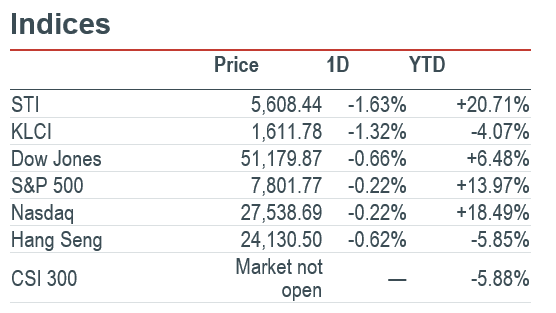
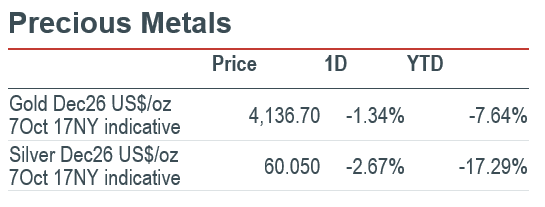
Market Movers: The S&P 500 fell 0.22% on Wednesday, 7 October, retreating from its record close. Nvidia (NVDA US) declined 0.74% while it and Microsoft (MSFT US) unveiled Windows local-AI capabilities and RTX Spark systems with up to 128GB of unified memory. The launch extends AI computing beyond cloud data centres. SpaceX (SPCX US) dropped 2.51% following reports of US$40bn in financing to buy Nvidia chips. Reuters sources confirmed the talks and PIMCO discussions; the FT reported Apollo’s expected lead role. The proposed financing remains uncompleted. BE Semiconductor Industries (BESI.AS) fell 8.49% after UBS downgraded it to Sell, citing hybrid-bonding adoption risk. Funding costs and customers’ deployment schedules remain important tests of AI investment returns. (Nvidia / Reuters / Reuters / Reuters)
Macro: Newly released Fed minutes show most participants expected another rate increase by year-end. September’s unanimous 25bp hike took the policy range to 3.75–4.00%, but officials differed over whether it mainly insured against supply shocks or restrained stronger demand. Persistent inflation leaves duration-sensitive valuations exposed, while incoming data will shape the next decision. (Federal Reserve / Reuters)
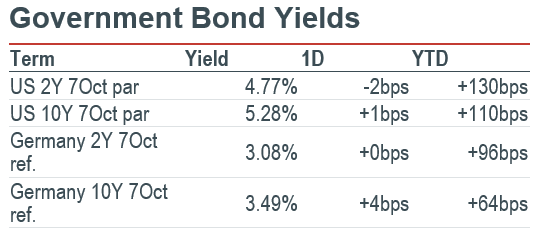
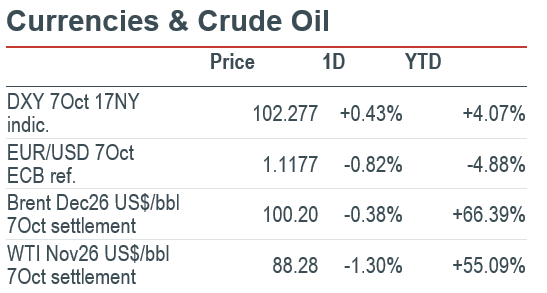
FICC: The U.S. 10-year par yield edged up 1bp to 5.28%. December Brent settled 0.38% lower at US$100.20/bbl; November WTI fell 1.30% to US$88.28/bbl. IEA members supported accelerating outstanding March stock pledges, potentially bringing about 100mn barrels to market, with diesel prioritised. These are previously pledged stocks. Faster physical delivery could ease fuel costs, although conflict-related supply risks remain. (US Treasury / IEA / Reuters) Nvidia (NVDA US) and Microsoft (MSFT US) are our Core Recommendations.
AI
Nvidia and Microsoft broaden local AI computing. Nvidia (NVDA US) and Microsoft (MSFT US) unveiled RTX Spark for Windows laptops, offering up to 128GB of unified memory and up to one petaflop of FP4 AI performance. CUDA compatibility connects local development with larger computing systems. At the 7 October U.S. close, Nvidia fell 0.74% to US$237.47 and Microsoft gained 0.09%. The launch expands on-device AI capacity, with commercial adoption still to prove. (Nvidia / Market data / Market data) Nvidia (NVDA US) & Microsoft (MSFT US) are our Core Recommendations.
SpaceX financing talks underline AI capital demands. SpaceX (SPCX US) fell 2.51% to US$167.60 at the 7 October U.S. close as investors assessed reported US$40bn financing talks for Nvidia (NVDA US) chips. Reuters' updated report cited two sources confirming the talks, including discussions with PIMCO. The proposed package comprises US$10bn of loans and US$30bn of investment-grade debt. Company confirmation remains outstanding, highlighting execution and funding risks. (Reuters / Market data)
OpenAI extends GPT-6 reach with interactive responses. OpenAI began rolling out GPT-6 with Intelligent UI to paid ChatGPT users, adding interactive diagrams, forms and other visual responses to its chat experience. The company reports more than 1.2bn weekly users and says its Instant model begins web-search answers 44% sooner than GPT-5.6 Instant. Wider distribution could strengthen engagement and software competition; the speed comparison remains a company claim. (OpenAI)
Anthropic price cuts intensify small-model competition. Anthropic launched Claude Haiku 5.5 with input and output prices of US$0.10 and US$0.50 per million tokens for prompts up to 100,000 tokens. Those rates are 90% below Haiku 4.5. Longer prompts cost US$0.50 and US$2.50 respectively. Anthropic estimates average running costs fall around 75%, allowing for changed token usage. Cheaper high-volume inference could widen adoption while increasing pricing pressure across model providers. (Anthropic)
Americas
Florida seeks tighter restrictions on Meta platforms. Meta Platforms (META US) fell 2.38% to US$721.31 at the 7 October U.S. close. Florida requested a temporary injunction covering Facebook and Instagram's teen users. The state wants under-14 accounts removed, a two-hour daily limit across apps, and autoplay and infinite scroll disabled. Court approval remains pending. Florida opted out of settlements with 48 other states. Restrictions on engagement and advertising would add operating uncertainty. (Reuters / Market data) Meta Platforms (META US) is our Core Recommendation.
Equipment shares retreat amid industry competition scrutiny. Caterpillar (CAT US) fell 5.75% to US$813.83 and Deere (DE US) lost 3.80% at the 7 October U.S. close as equipment stocks weakened. The FTC and USDA opened an agricultural-equipment competition inquiry covering distribution, pricing and barriers to service. Caterpillar was not named; its decline may reflect sector sympathy. The inquiry signals regulatory scrutiny, while any company-specific liability remains unestablished. (FTC / Benzinga / Market data / Market data)
Wells Fargo faces scrutiny of mortgage programmes. Wells Fargo (WFC US) fell 1.53% to US$80.26 at the 7 October U.S. close. HUD confirmed an investigation into its programmes promoting Black homeownership. The agency is examining possible Fair Housing Act violations. Earlier commitments included US$60bn of lending aimed at adding 250,000 Black homeowners by 2027. The investigation adds compliance uncertainty; it does not establish wrongdoing or quantify a financial penalty. (HUD / Market data)
Webull selloff reflects disputed China-link allegations. Webull (BULL US) fell 19.09% to US$5.89 at the 7 October U.S. close after reports that a congressional panel questioned its ties to China. Reuters, citing CNBC, reported concerns about the gap between public marketing and actual control. Webull called the conclusions inaccurate and unsupported, saying U.S. customer data stays in America. Any follow-on regulatory review could matter more than the immediate valuation shock. (Reuters / Market data)
Greater China
Chinese hybrid exporters face renewed European barriers. China's hybrid-car exporters face new uncertainty over European access after a 7 October Financial Times report, carried by Reuters, said Beijing rejected voluntary export curbs. The European Commission reportedly now seeks China's acceptance of unilateral import caps. Reuters could not independently verify the account. Restrictions could constrain manufacturers' overseas growth and pricing flexibility; no final agreement or quantitative cap was announced. (Reuters)
Asia ex. China
Samsung's memory partnership supports longer planning horizons. Samsung Electronics (005930.KS) remains central to AMD's (AMD US) memory supply plans, with Lisa Su describing a partnership spanning several generations during her 7 October Korea visit. She said HBM4-based MI455 and Helios systems had begun shipping and urged faster capacity expansion. Planning over three to five years supports demand visibility, although no new foundry contract or financial terms were announced. (Money Today)
OCBC's selloff exposes divergent bank earnings expectations. OCBC (O39.SI) fell about 5.9% at the 7 October Singapore close after Citi downgraded the bank to Sell with a S$27.50 target. Citi currently expects flat third-quarter earnings and pressure from deposit costs, while RHB retained OCBC as its top sector pick at S$33.70. The divergence underscores how funding costs and wealth-income normalisation can challenge elevated earnings expectations. (The Business Times / Market data)
EMEA and Others
Shell's stronger refining margins face cash-flow timing. Shell (SHEL.L) reported a third-quarter indicative refining margin of US$42 per barrel on 7 October, up from US$24 in the preceding quarter. Its update also flagged an expected US$2.5bn cash outflow for German emissions certificates, reflecting payment timing. Stronger refining economics could support earnings, while the cash movement shows why quarterly operating performance and cash generation may diverge. (Shell / Reuters)
BESI selloff exposes hybrid-bonding adoption sensitivity. BE Semiconductor Industries (BESI.AS) fell about 8.5% at the 7 October Amsterdam close after UBS cut the stock to Sell, citing risks to hybrid-bonding adoption. The reaction challenges expectations that AI demand will translate uniformly into equipment orders. Customer adoption schedules remain important for revenue visibility, while the sharp repricing highlights valuation sensitivity when a promising technology takes longer to commercialise. (Reuters / Market data)
European banks expose sovereign-bond contagion risk. European bank shares fell about 3.3% at the 7 October close, compared with a 1.0% decline in the broader STOXX 600. Reuters reported that traders feared contagion from France as sovereign spreads widened; higher yields were generating losses on government-debt holdings and renewed concern about housing exposures. The selloff shows how fiscal stress can offset the interest-income benefits of higher rates, making sovereign concentration, balance-sheet sensitivity and borrower resilience important differentiators across banks. (Reuters / Reuters)
Traders’ corner
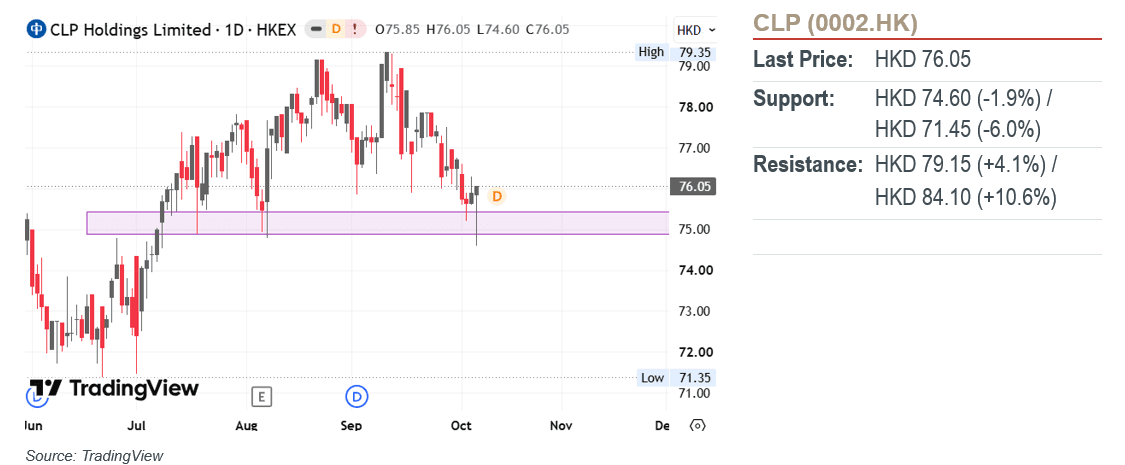
Our Technical View
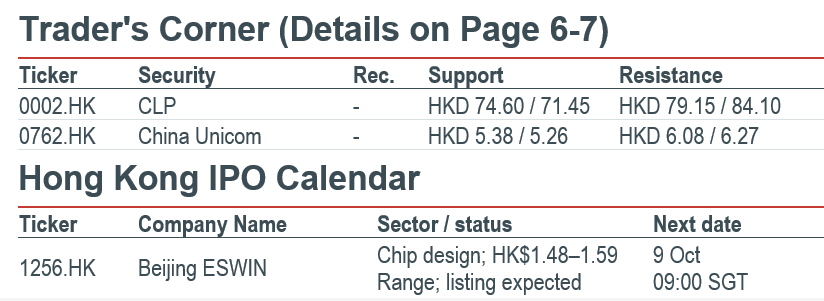
Price rebounded from its previous low support zone with a hammer candlestick pattern.
The RSI is curving upward from oversold boundaries, and while it remains below its neutral 50-midline.
As long as price defends the hammer’s low on any subsequent lower-timeframe retests, we see a continued upward rebound toward higher resistance.
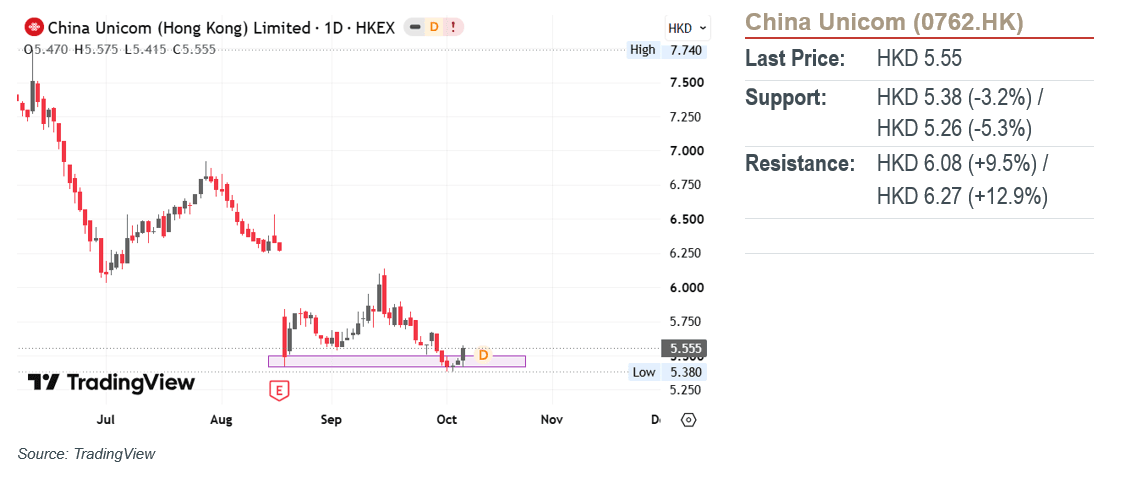
Our Technical View
Price could be bottoming at HK$5.38, signaling an initial defense of structural support.
The RSI is printing a prominent bullish divergence warning, signaling an underlying exhaustion of sell-side momentum.
As long as price defends the HK$5.38 demand floor, we see a continued upward rebound toward overhead resistance targets.
Market Movers: The S&P 500 fell 0.22% on Wednesday, 7 October, retreating from its record close. Nvidia (NVDA US) declined 0.74% while it and Microsoft (MSFT US) unveiled Windows local-AI capabilities and RTX Spark systems with up to 128GB of unified memory. The launch extends AI computing beyond cloud data centres. SpaceX (SPCX US) dropped 2.51% following reports of US$40bn in financing to buy Nvidia chips. Reuters sources confirmed the talks and PIMCO discussions; the FT reported Apollo’s expected lead role. The proposed financing remains uncompleted. BE Semiconductor Industries (BESI.AS) fell 8.49% after UBS downgraded it to Sell, citing hybrid-bonding adoption risk. Funding costs and customers’ deployment schedules remain important tests of AI investment returns. (Nvidia / Reuters / Reuters / Reuters)
Macro: Newly released Fed minutes show most participants expected another rate increase by year-end. September’s unanimous 25bp hike took the policy range to 3.75–4.00%, but officials differed over whether it mainly insured against supply shocks or restrained stronger demand. Persistent inflation leaves duration-sensitive valuations exposed, while incoming data will shape the next decision. (Federal Reserve / Reuters)
FICC: The U.S. 10-year par yield edged up 1bp to 5.28%. December Brent settled 0.38% lower at US$100.20/bbl; November WTI fell 1.30% to US$88.28/bbl. IEA members supported accelerating outstanding March stock pledges, potentially bringing about 100mn barrels to market, with diesel prioritised. These are previously pledged stocks. Faster physical delivery could ease fuel costs, although conflict-related supply risks remain. (US Treasury / IEA / Reuters) Nvidia (NVDA US) and Microsoft (MSFT US) are our Core Recommendations.
AI
Nvidia and Microsoft broaden local AI computing. Nvidia (NVDA US) and Microsoft (MSFT US) unveiled RTX Spark for Windows laptops, offering up to 128GB of unified memory and up to one petaflop of FP4 AI performance. CUDA compatibility connects local development with larger computing systems. At the 7 October U.S. close, Nvidia fell 0.74% to US$237.47 and Microsoft gained 0.09%. The launch expands on-device AI capacity, with commercial adoption still to prove. (Nvidia / Market data / Market data) Nvidia (NVDA US) & Microsoft (MSFT US) are our Core Recommendations.
SpaceX financing talks underline AI capital demands. SpaceX (SPCX US) fell 2.51% to US$167.60 at the 7 October U.S. close as investors assessed reported US$40bn financing talks for Nvidia (NVDA US) chips. Reuters' updated report cited two sources confirming the talks, including discussions with PIMCO. The proposed package comprises US$10bn of loans and US$30bn of investment-grade debt. Company confirmation remains outstanding, highlighting execution and funding risks. (Reuters / Market data)
OpenAI extends GPT-6 reach with interactive responses. OpenAI began rolling out GPT-6 with Intelligent UI to paid ChatGPT users, adding interactive diagrams, forms and other visual responses to its chat experience. The company reports more than 1.2bn weekly users and says its Instant model begins web-search answers 44% sooner than GPT-5.6 Instant. Wider distribution could strengthen engagement and software competition; the speed comparison remains a company claim. (OpenAI)
Anthropic price cuts intensify small-model competition. Anthropic launched Claude Haiku 5.5 with input and output prices of US$0.10 and US$0.50 per million tokens for prompts up to 100,000 tokens. Those rates are 90% below Haiku 4.5. Longer prompts cost US$0.50 and US$2.50 respectively. Anthropic estimates average running costs fall around 75%, allowing for changed token usage. Cheaper high-volume inference could widen adoption while increasing pricing pressure across model providers. (Anthropic)
Americas
Florida seeks tighter restrictions on Meta platforms. Meta Platforms (META US) fell 2.38% to US$721.31 at the 7 October U.S. close. Florida requested a temporary injunction covering Facebook and Instagram's teen users. The state wants under-14 accounts removed, a two-hour daily limit across apps, and autoplay and infinite scroll disabled. Court approval remains pending. Florida opted out of settlements with 48 other states. Restrictions on engagement and advertising would add operating uncertainty. (Reuters / Market data) Meta Platforms (META US) is our Core Recommendation.
Equipment shares retreat amid industry competition scrutiny. Caterpillar (CAT US) fell 5.75% to US$813.83 and Deere (DE US) lost 3.80% at the 7 October U.S. close as equipment stocks weakened. The FTC and USDA opened an agricultural-equipment competition inquiry covering distribution, pricing and barriers to service. Caterpillar was not named; its decline may reflect sector sympathy. The inquiry signals regulatory scrutiny, while any company-specific liability remains unestablished. (FTC / Benzinga / Market data / Market data)
Wells Fargo faces scrutiny of mortgage programmes. Wells Fargo (WFC US) fell 1.53% to US$80.26 at the 7 October U.S. close. HUD confirmed an investigation into its programmes promoting Black homeownership. The agency is examining possible Fair Housing Act violations. Earlier commitments included US$60bn of lending aimed at adding 250,000 Black homeowners by 2027. The investigation adds compliance uncertainty; it does not establish wrongdoing or quantify a financial penalty. (HUD / Market data)
Webull selloff reflects disputed China-link allegations. Webull (BULL US) fell 19.09% to US$5.89 at the 7 October U.S. close after reports that a congressional panel questioned its ties to China. Reuters, citing CNBC, reported concerns about the gap between public marketing and actual control. Webull called the conclusions inaccurate and unsupported, saying U.S. customer data stays in America. Any follow-on regulatory review could matter more than the immediate valuation shock. (Reuters / Market data)
Greater China
Chinese hybrid exporters face renewed European barriers. China's hybrid-car exporters face new uncertainty over European access after a 7 October Financial Times report, carried by Reuters, said Beijing rejected voluntary export curbs. The European Commission reportedly now seeks China's acceptance of unilateral import caps. Reuters could not independently verify the account. Restrictions could constrain manufacturers' overseas growth and pricing flexibility; no final agreement or quantitative cap was announced. (Reuters)
Asia ex. China
Samsung's memory partnership supports longer planning horizons. Samsung Electronics (005930.KS) remains central to AMD's (AMD US) memory supply plans, with Lisa Su describing a partnership spanning several generations during her 7 October Korea visit. She said HBM4-based MI455 and Helios systems had begun shipping and urged faster capacity expansion. Planning over three to five years supports demand visibility, although no new foundry contract or financial terms were announced. (Money Today)
OCBC's selloff exposes divergent bank earnings expectations. OCBC (O39.SI) fell about 5.9% at the 7 October Singapore close after Citi downgraded the bank to Sell with a S$27.50 target. Citi currently expects flat third-quarter earnings and pressure from deposit costs, while RHB retained OCBC as its top sector pick at S$33.70. The divergence underscores how funding costs and wealth-income normalisation can challenge elevated earnings expectations. (The Business Times / Market data)
EMEA and Others
Shell's stronger refining margins face cash-flow timing. Shell (SHEL.L) reported a third-quarter indicative refining margin of US$42 per barrel on 7 October, up from US$24 in the preceding quarter. Its update also flagged an expected US$2.5bn cash outflow for German emissions certificates, reflecting payment timing. Stronger refining economics could support earnings, while the cash movement shows why quarterly operating performance and cash generation may diverge. (Shell / Reuters)
BESI selloff exposes hybrid-bonding adoption sensitivity. BE Semiconductor Industries (BESI.AS) fell about 8.5% at the 7 October Amsterdam close after UBS cut the stock to Sell, citing risks to hybrid-bonding adoption. The reaction challenges expectations that AI demand will translate uniformly into equipment orders. Customer adoption schedules remain important for revenue visibility, while the sharp repricing highlights valuation sensitivity when a promising technology takes longer to commercialise. (Reuters / Market data)
European banks expose sovereign-bond contagion risk. European bank shares fell about 3.3% at the 7 October close, compared with a 1.0% decline in the broader STOXX 600. Reuters reported that traders feared contagion from France as sovereign spreads widened; higher yields were generating losses on government-debt holdings and renewed concern about housing exposures. The selloff shows how fiscal stress can offset the interest-income benefits of higher rates, making sovereign concentration, balance-sheet sensitivity and borrower resilience important differentiators across banks. (Reuters / Reuters)
Traders’ corner
Our Technical View
Price rebounded from its previous low support zone with a hammer candlestick pattern.
The RSI is curving upward from oversold boundaries, and while it remains below its neutral 50-midline.
As long as price defends the hammer’s low on any subsequent lower-timeframe retests, we see a continued upward rebound toward higher resistance.
Our Technical View
Price could be bottoming at HK$5.38, signaling an initial defense of structural support.
The RSI is printing a prominent bullish divergence warning, signaling an underlying exhaustion of sell-side momentum.
As long as price defends the HK$5.38 demand floor, we see a continued upward rebound toward overhead resistance targets.
Disclosures and disclaimers
This report is provided subject to, and must be read together with, the full Disclosures / Disclaimers available at this link, which are incorporated by reference into this report. In particular, this report is intended for general circulation and informational purposes only and does not constitute personal investment advice or a recommendation to buy or sell any investment product or security. You should independently evaluate the information and, where necessary, seek advice from a qualified financial adviser regarding the suitability of any investment. Analyst certifications required under applicable regulations, including SEC Regulation AC (where relevant), are included in this report. By accessing, receiving or using this report, you acknowledge that you have read, understood and agreed to be bound by the Disclosures / Disclaimers, as may be amended, supplemented or updated from time to time.


