

Wealth Flash
Call to Action
Why We Shift from Haier to Midea: A New Core Recommendation
The globalization of Chinese home appliances isn’t a new story, but it’s constantly evolving. In all of our thematic research, we aim to offer you the best of the best ideas under each theme. We like both Haier and Midea for their successful overseas expansion, yet the latter is even better positioned in our view.
CIO Summary
- We’ve replaced Haier Smart Home (600690.SH / 6690.HK) with Midea Group (000333.SZ / 0300.HK) as our Core Recommendation, reclassifying Haier as a Trading Buy.
- Midea offers faster revenue growth, structurally higher margins and more diversified growth engines beyond home appliances (e.g. KUKA robotics). It is a stronger beneficiary of Chinese brands going global under our China Export Shock 2.0 and China Maxxing themes.
- Near-term catalysts: easing high comps, moderating domestic pressure and strong overseas sales momentum, especially from the mobile A/C PortaSplit in Europe this summer.
Company Description
Midea (000333.SZ / 0300.HK) is evolving from a leading appliance manufacturer to an innovation-driven global industrial giant. Appliances remain its stable, cash-generating core, while commercial and industrial solutions are rapidly scaling and accounted for 27% of group revenue in 2025 – including KUKA robotics, building technology, industrial automation and new energy.
Investment Thesis
We like Midea for the following reasons:
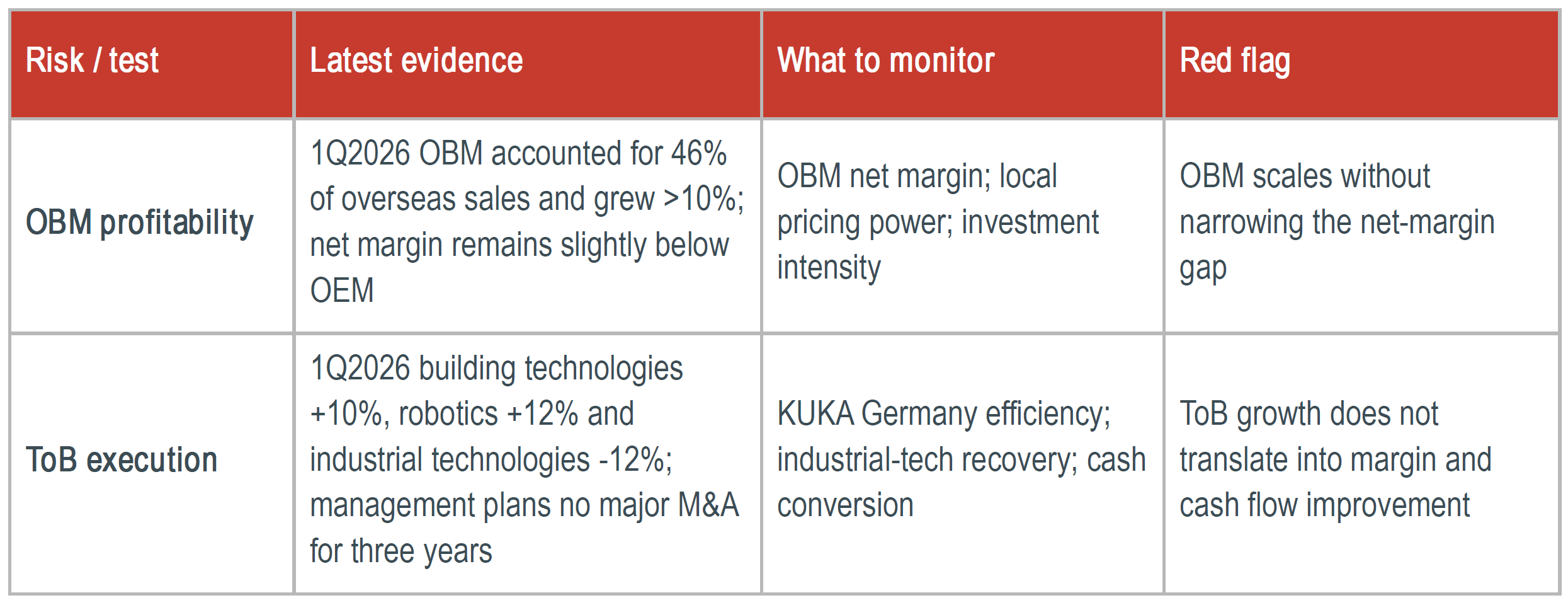
- Balanced global growth with a notable OBM upgrade. Midea generated RMB 196 bn (USD 27 bn) of overseas sales in 2025, up 15.9% and equivalent to 42.7% of group revenue. Looking ahead, management targets a 15%+ CAGR in overseas consumer sales for 2026-2028, with an original brand manufacturing (OBM) share of over 50% by 2028. A higher OBM mix should increase Midea's control over pricing, customer relationship and product positioning, allowing it to effectively upgrade the value chain. Within its international business, Midea has a more balanced exposure to Europe and Asia, plus lower concentration in the US. This is a clear advantage amid soft housing activity and consumer sentiment in America.
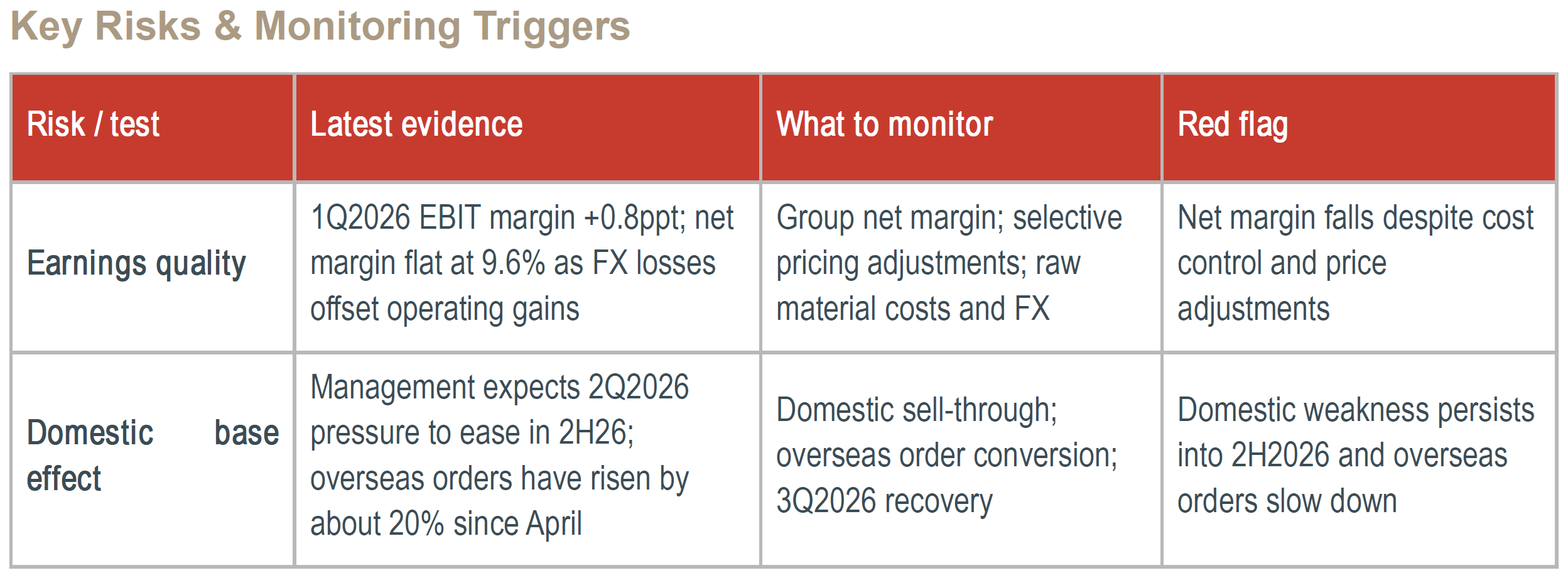
- Higher-quality earnings with stable margins. In 2025, Midea's revenue and net profit grew 12.1% and 14.0%, respectively, with a net margin of 9.6%. Consensus expects the margin to hold around 10% through 2028, while our institutional research forecasts a broadly stable mid-9%. The margin stability ensures that top-line growth can translate into robust cash generation and shareholder returns, rather than being diluted by cost inflation or pricing pressure.
- Scaling towards a technology-driven 2030. Commercial and Industrial Solutions generated RMB123 bn (USD 17 bn) of revenue in 2025, +17.5% yoy and accounting for 27% of group revenue. Consensus expects this contribution to increase to 31% by 2028. KUKA China shipped more than 32,000 robots in 2025, up more than 30% yoy, while Midea’s building technology and new energy businesses are poised to boost growth further. Midea’s diversified, growth-focused portfolio supports its ambition to become a technology-driven global player by 2030, reducing its reliance on traditional consumer appliances.
Why Midea Now
Midea’s domestic issues remain: a high comparison base, raw-material inflation and near-term foreign exchange (FX) losses. However, management expects base-effect pressure to ease in 2H2026 and raw-material pressure to moderate in 3Q-4Q2026 through lower-cost procurement. Meanwhile, overseas orders – up roughly 20% since April – should help offset softer domestic sales.
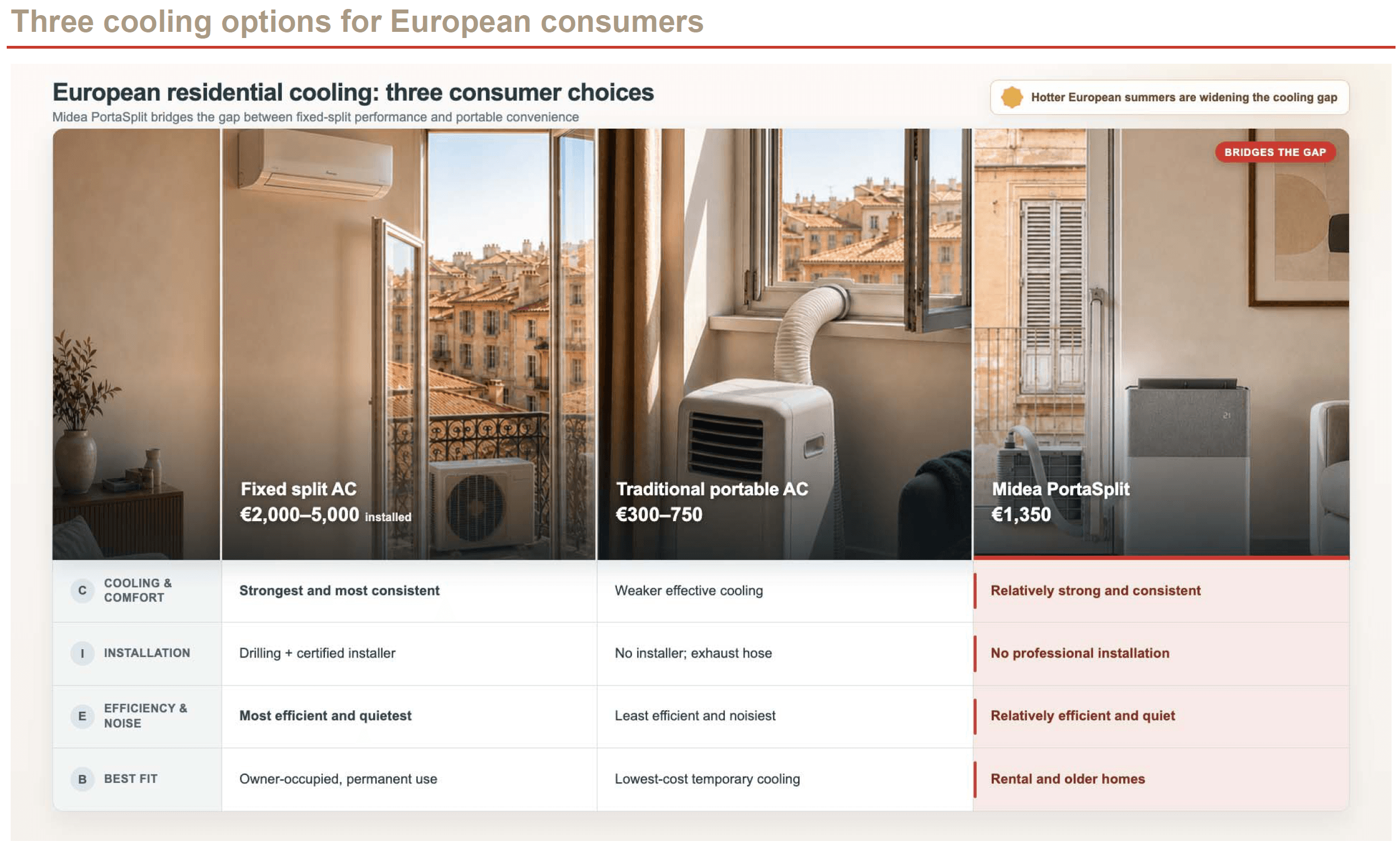
What’s happening in Europe now illustrates Midea's ability to develop locally relevant products effectively and timely. Only about 20% of European homes have air conditioning, as fixed systems are often expensive or impractical for rented and older properties. Priced at around EUR 1,350 and requiring no professional installation, Midea’s PortaSplit delivers a compelling mass market solution amid the scorching European summer. YTD European channel shipments have doubled to more than 200,000 units. While the near-term earnings impact is modest, this clearly demonstrates Midea's local R&D capability, channel reach and overseas OBM execution.
Haier also has meaningful scale in Europe (RMB 38.5 bn revenue in 2025, or 12.7% of group revenue). Within the laundry segment, Haier’s multi-brand strategy has lifted its European laundry market share to 12.5%, placing it firmly at No. 2 in the region. However, Haier’s challenge is to turn its established presence into sustainably higher margins, which is yet to be proven.
Financial Highlights
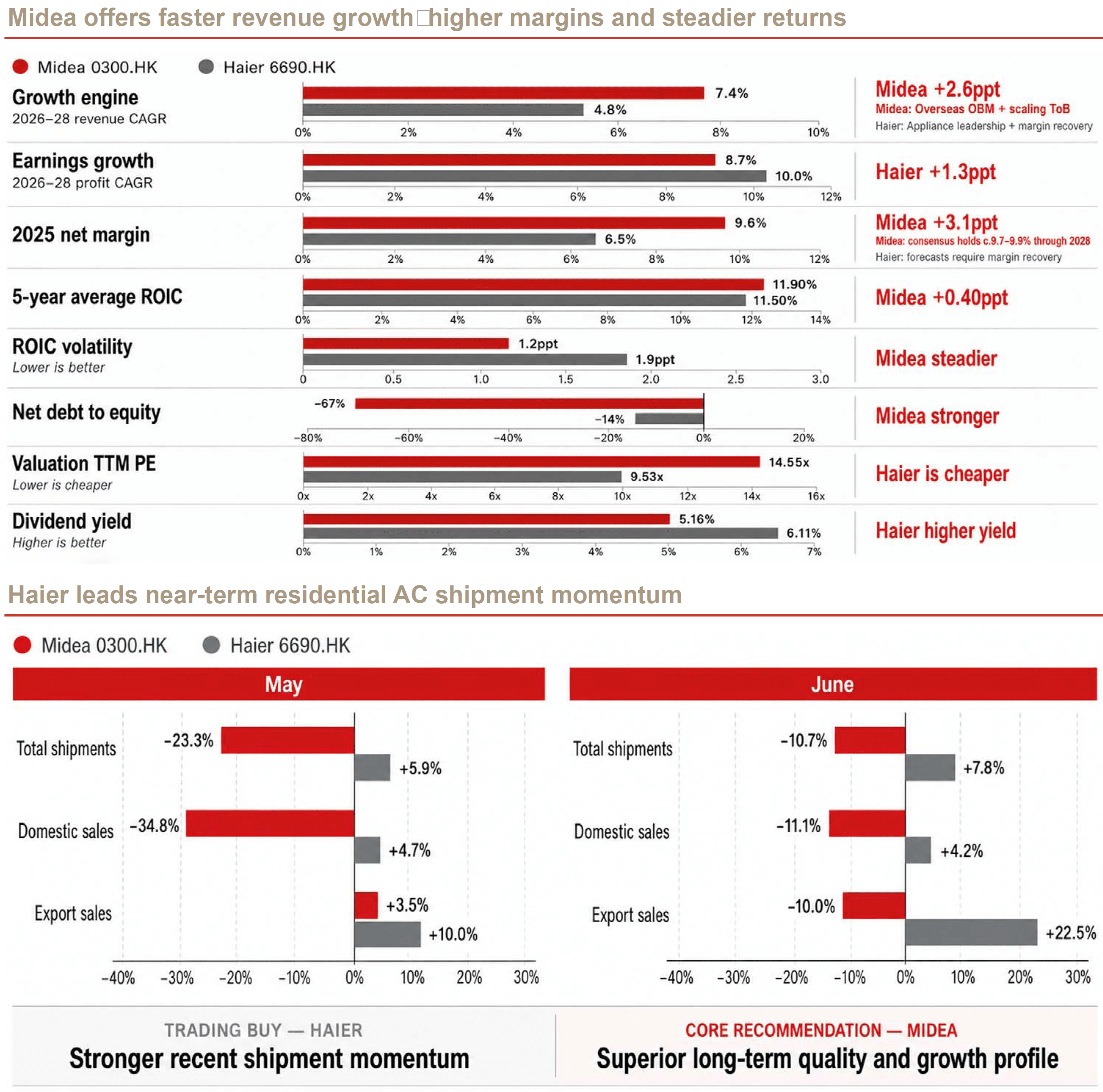
- Faster top-line growth. For Midea, consensus and UOBKH Research forecast 2026-2028 revenue CAGRs of 7.4% and 8.2%, respectively, compared with 4.8% and 6.4% for Haier.
- Structurally higher margins. Midea's net margin is expected to remain at 9.5-9.9% through 2028, while Haier's margin remains inferior, despite an expected improvement from 6.5% to 6.8-7.0%.
- Haier's higher CAGR hinges on recovery. Haier does have a higher profit CAGR thanks to its lower base, but its growth is highly dependent on the European restructuring, domestic expense discipline, and North American operating recovery. In comparison, Midea offers slightly slower but more certain and stable earnings growth.
Why the Switch
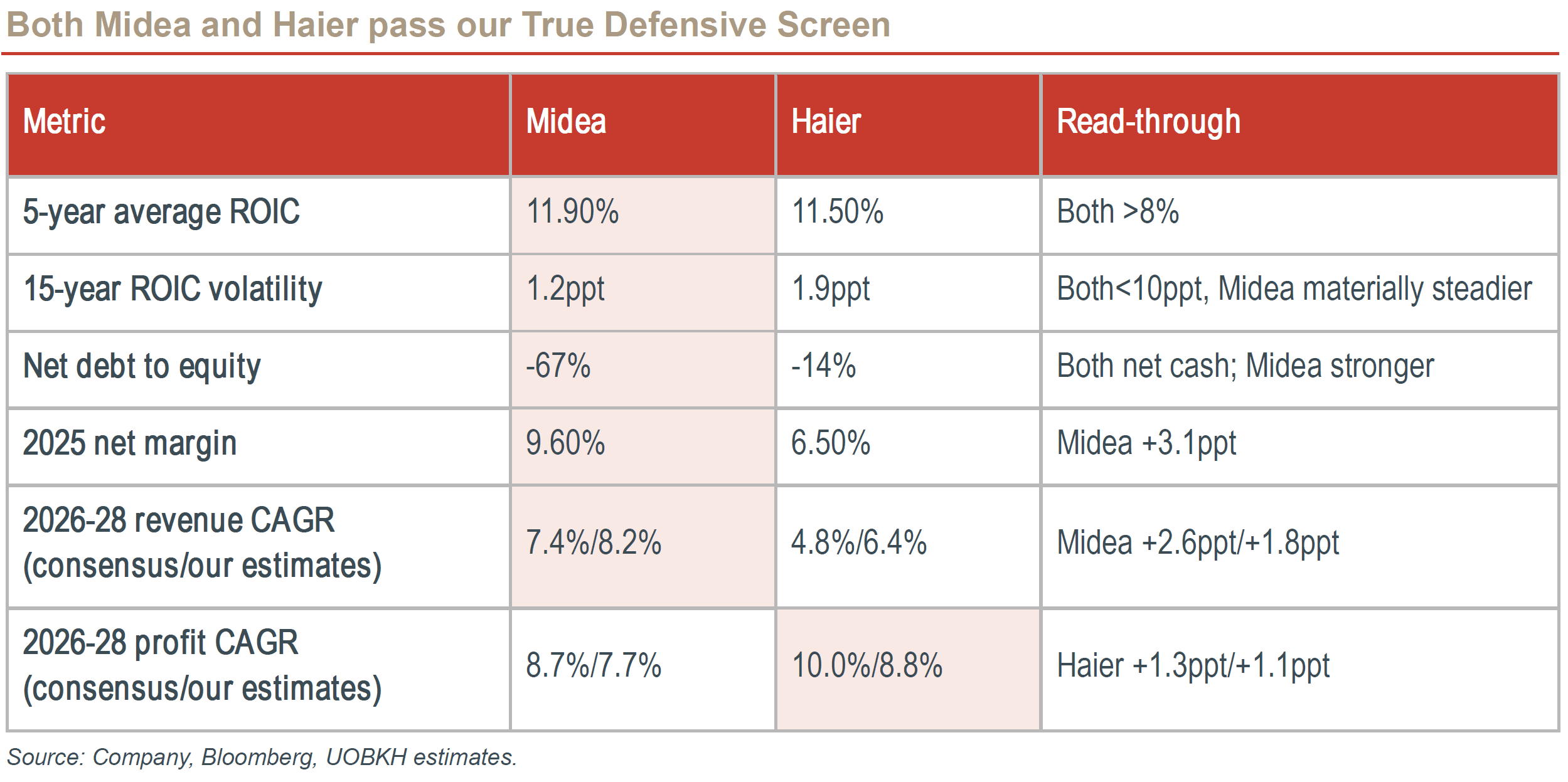
Both companies pass our ROIC-based True Defensive Screen. We prefer Midea for its higher margins, more diversified growth drivers and steadier returns on invested capital (ROICs). This means Midea offers greater stability in today’s uncertain macro environment. This is not to dismiss Haier, however, which remains a solid company given its stronger profit growth forecast, recent appliance momentum, a lower valuation and a higher dividend yield.
Valuation and Price Targets
As of 21 July close, Midea trades at about 14.6x trailing earnings and offers a 5.2% trailing yield, versus 9.5 times PE and 6.1% yield for Haier. As noted before, the premium is justified by Midea’s higher profitability, steadier ROIC and more diversified growth.
Our institutional research has a price target of RMB 112.6 for Midea A-shares (000333.SZ), implying a 29% upside from the latest close.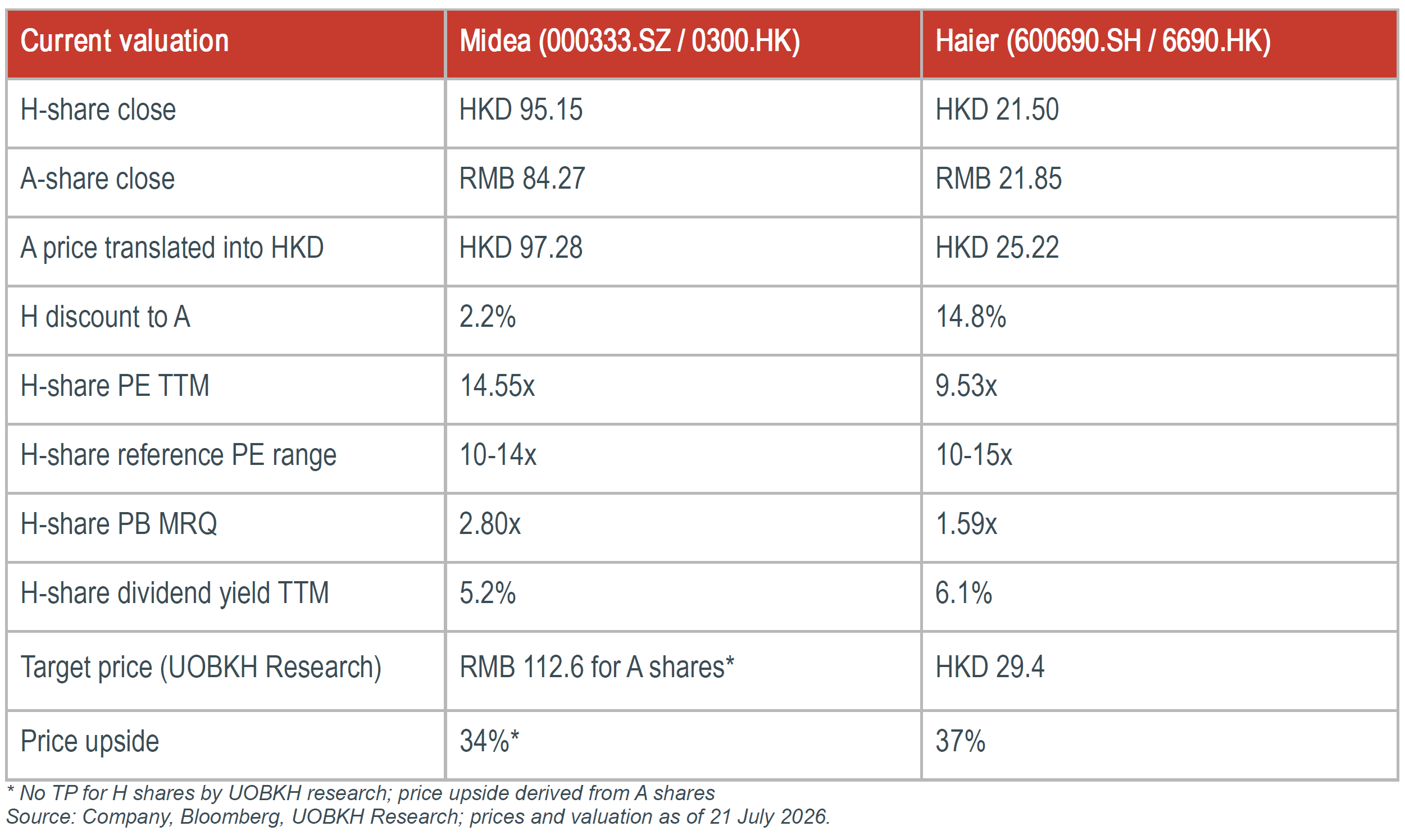
The globalization of Chinese home appliances isn’t a new story, but it’s constantly evolving. In all of our thematic research, we aim to offer you the best of the best ideas under each theme. We like both Haier and Midea for their successful overseas expansion, yet the latter is even better positioned in our view.
CIO Summary
- We’ve replaced Haier Smart Home (600690.SH / 6690.HK) with Midea Group (000333.SZ / 0300.HK) as our Core Recommendation, reclassifying Haier as a Trading Buy.
- Midea offers faster revenue growth, structurally higher margins and more diversified growth engines beyond home appliances (e.g. KUKA robotics). It is a stronger beneficiary of Chinese brands going global under our China Export Shock 2.0 and China Maxxing themes.
- Near-term catalysts: easing high comps, moderating domestic pressure and strong overseas sales momentum, especially from the mobile A/C PortaSplit in Europe this summer.
Company Description
Midea (000333.SZ / 0300.HK) is evolving from a leading appliance manufacturer to an innovation-driven global industrial giant. Appliances remain its stable, cash-generating core, while commercial and industrial solutions are rapidly scaling and accounted for 27% of group revenue in 2025 – including KUKA robotics, building technology, industrial automation and new energy.
Investment Thesis
We like Midea for the following reasons:
- Balanced global growth with a notable OBM upgrade. Midea generated RMB 196 bn (USD 27 bn) of overseas sales in 2025, up 15.9% and equivalent to 42.7% of group revenue. Looking ahead, management targets a 15%+ CAGR in overseas consumer sales for 2026-2028, with an original brand manufacturing (OBM) share of over 50% by 2028. A higher OBM mix should increase Midea's control over pricing, customer relationship and product positioning, allowing it to effectively upgrade the value chain. Within its international business, Midea has a more balanced exposure to Europe and Asia, plus lower concentration in the US. This is a clear advantage amid soft housing activity and consumer sentiment in America.
- Higher-quality earnings with stable margins. In 2025, Midea's revenue and net profit grew 12.1% and 14.0%, respectively, with a net margin of 9.6%. Consensus expects the margin to hold around 10% through 2028, while our institutional research forecasts a broadly stable mid-9%. The margin stability ensures that top-line growth can translate into robust cash generation and shareholder returns, rather than being diluted by cost inflation or pricing pressure.
- Scaling towards a technology-driven 2030. Commercial and Industrial Solutions generated RMB123 bn (USD 17 bn) of revenue in 2025, +17.5% yoy and accounting for 27% of group revenue. Consensus expects this contribution to increase to 31% by 2028. KUKA China shipped more than 32,000 robots in 2025, up more than 30% yoy, while Midea’s building technology and new energy businesses are poised to boost growth further. Midea’s diversified, growth-focused portfolio supports its ambition to become a technology-driven global player by 2030, reducing its reliance on traditional consumer appliances.
Why Midea Now
Midea’s domestic issues remain: a high comparison base, raw-material inflation and near-term foreign exchange (FX) losses. However, management expects base-effect pressure to ease in 2H2026 and raw-material pressure to moderate in 3Q-4Q2026 through lower-cost procurement. Meanwhile, overseas orders – up roughly 20% since April – should help offset softer domestic sales.
What’s happening in Europe now illustrates Midea's ability to develop locally relevant products effectively and timely. Only about 20% of European homes have air conditioning, as fixed systems are often expensive or impractical for rented and older properties. Priced at around EUR 1,350 and requiring no professional installation, Midea’s PortaSplit delivers a compelling mass market solution amid the scorching European summer. YTD European channel shipments have doubled to more than 200,000 units. While the near-term earnings impact is modest, this clearly demonstrates Midea's local R&D capability, channel reach and overseas OBM execution.
Haier also has meaningful scale in Europe (RMB 38.5 bn revenue in 2025, or 12.7% of group revenue). Within the laundry segment, Haier’s multi-brand strategy has lifted its European laundry market share to 12.5%, placing it firmly at No. 2 in the region. However, Haier’s challenge is to turn its established presence into sustainably higher margins, which is yet to be proven.
Financial Highlights
- Faster top-line growth. For Midea, consensus and UOBKH Research forecast 2026-2028 revenue CAGRs of 7.4% and 8.2%, respectively, compared with 4.8% and 6.4% for Haier.
- Structurally higher margins. Midea's net margin is expected to remain at 9.5-9.9% through 2028, while Haier's margin remains inferior, despite an expected improvement from 6.5% to 6.8-7.0%.
- Haier's higher CAGR hinges on recovery. Haier does have a higher profit CAGR thanks to its lower base, but its growth is highly dependent on the European restructuring, domestic expense discipline, and North American operating recovery. In comparison, Midea offers slightly slower but more certain and stable earnings growth.
Why the Switch
Both companies pass our ROIC-based True Defensive Screen. We prefer Midea for its higher margins, more diversified growth drivers and steadier returns on invested capital (ROICs). This means Midea offers greater stability in today’s uncertain macro environment. This is not to dismiss Haier, however, which remains a solid company given its stronger profit growth forecast, recent appliance momentum, a lower valuation and a higher dividend yield.
Valuation and Price Targets
As of 21 July close, Midea trades at about 14.6x trailing earnings and offers a 5.2% trailing yield, versus 9.5 times PE and 6.1% yield for Haier. As noted before, the premium is justified by Midea’s higher profitability, steadier ROIC and more diversified growth.
Our institutional research has a price target of RMB 112.6 for Midea A-shares (000333.SZ), implying a 29% upside from the latest close.
Disclosures and disclaimers
This report is provided subject to, and must be read together with, the full Disclosures / Disclaimers available at the following link: https://research-api.uobkayhian.com/assets/disclaimer/b2112181-0bf2-4c07-af37-3d7129735e61, which are incorporated by reference into this report. In particular, this report is intended for general circulation and informational purposes only and does not constitute personal investment advice or a recommendation to buy or sell any investment product or security. You should independently evaluate the information and, where necessary, seek advice from a qualified financial adviser regarding the suitability of any investment. Analyst certifications required under applicable regulations, including SEC Regulation AC (where relevant), are included in this report. By accessing, receiving or using this report, you acknowledge that you have read, understood and agreed to be bound by the Disclosures / Disclaimers, as may be amended, supplemented or updated from time to time.


