Gain timely investment insights on:
By subscribing, you agree to receive research insights and marketing communications from us, and to the terms of our Privacy Policy . You also consent to the collection, use, processing, disclosure and transfer of your personal data for the purposes described in our Privacy Policy . You may unsubscribe at any time.
A stop order can either be a stop limit order or a stop market order, which will determine the nature of the actual order created once the trigger condition is met. Once activated, the stop market order will be treated the same as a regular market order and the stop limit order will be treated as a regular limit order.
For example
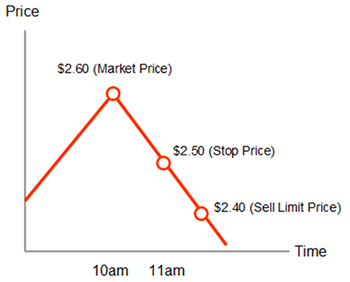
A stop limit order is an order which will be traded at a specified price or better after a given stop price has been reached. That is, once the stop price is reached, the stop limit order becomes a limit order to sell at the limit price or better.
An investor enters a stop limit order to sell ABC shares with a stop price of $2.50 and a limit price of $2.40. The price of ABC shares starts declining from current market price of $2.60 and reaches $2.50 intraday. Upon the price of ABC shares reaching $2.50, the stop limit sell order is triggered, and is converted into a sell limit order. As long as the order can be filled at or above $2.40, it will be executed.